
AI
Shaalan Beg’s Oncology AI Hits an Enrollment Wall
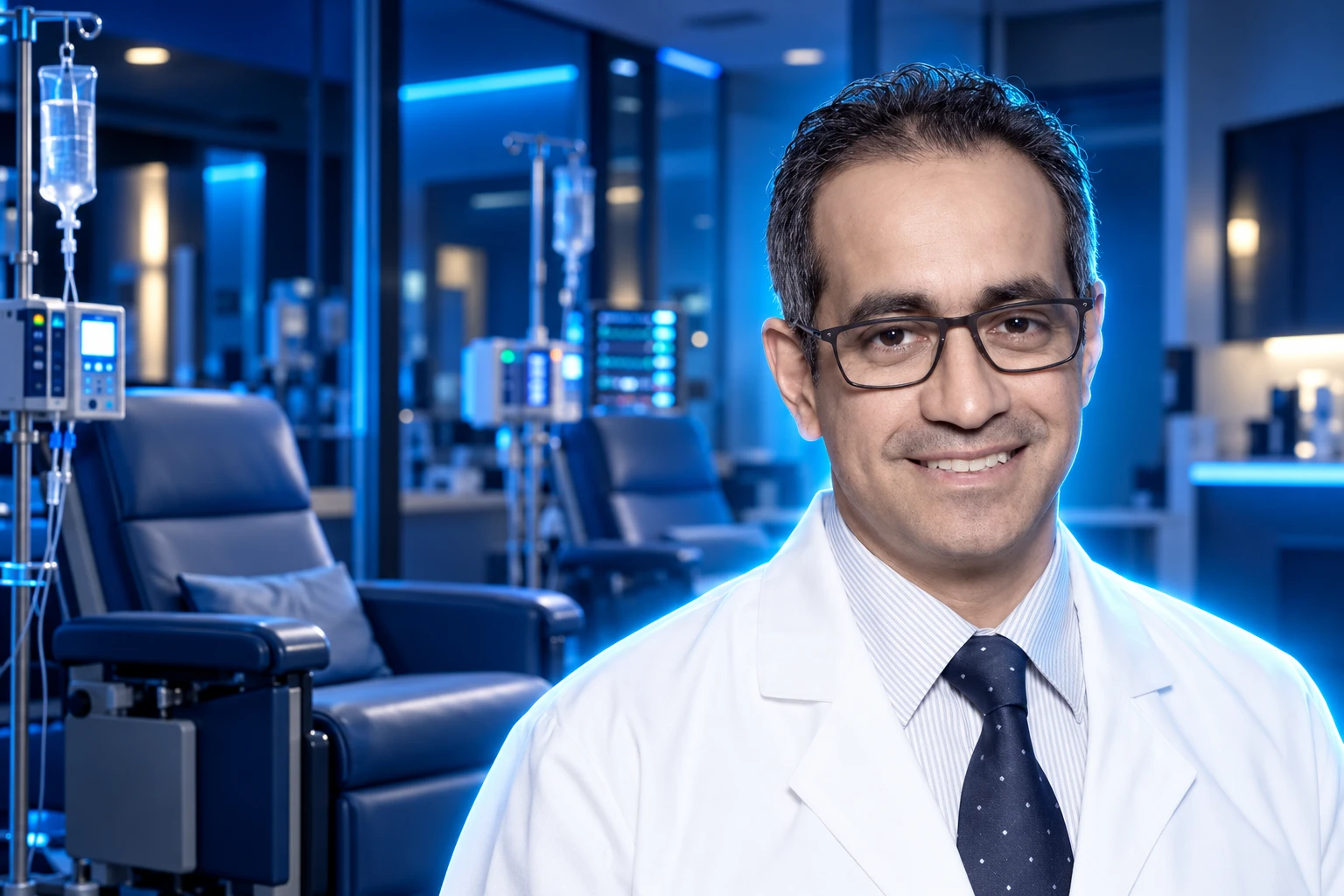
Shaalan Beg wants narrow oncology agents and lane-assist AI, but a 20,707-patient matching trial did not raise enrollment and still leaves doctors liable.

Shaalan Beg wants AI in oncology to work like lane assist, and a 20,707-patient trial already tested the matching half of that bet.
Enrollment did not rise. Beg, a gastrointestinal medical oncologist named ConcertAI’s chief medical officer for oncology on October 22, 2025, still argues that narrow agents, locked clinical data, and a doctor who stays legally on the hook will decide whether these tools help anyone.
Narrow Agents With One Job Each
Beg does not describe an all-knowing machine. He describes a worker hired for one job. “I view agentic AI solutions as doers of specific tasks,” he said. “They have been trained based on the knowledge that we have around a specific use case, around a specific problem.”
In a hospital, a new kidney problem brings a nephrologist. A suspected cancer brings an oncologist. Each specialist arrives with a bounded body of knowledge, answers a defined question, and leaves. Beg wants software agents built the same way, with guardrails baked in, rather than one giant medical brain that tries to do every job at once.
We pull in agents that are trained with specific expertise for the problem that we’re looking to solve. There are guardrails in place and expertise that’s built into those agents, similar to how, when we call in a consultant or a specialist, we pull in that specific expertise.
Shaalan Beg, chief medical officer for oncology, ConcertAI
Anyone can now spin up a helper that files a calendar or summarizes a folder. Cancer care is a different test. Beg said a clinical tool needs a team obsessed with one use case, plus proof of when the tool works, when it fails, and when it breaks. Public papers are not enough. The split, in his view, is not chatbot versus chatbot. It is general text versus data that still sits in records, claims, trial databases, and the habits of people who have practiced for decades.
“What they don’t have access to is proprietary data,” he said. Medicine has always celebrated the clinician who notices one extra pattern. AI, he argued, now forces the field to write down that chain of thought and put it in software, which is harder than licensing another language model.
An Algorithm Does Not Travel Like Acetaminophen
Beg’s simplest warning is about place. Acetaminophen for a headache should act much the same in the mountains of Nepal as it does in a Boston teaching hospital. An AI tool does not travel that way. A model tuned in one health system can stumble in another country, another clinic, or even another physician’s workflow, because language, infrastructure, local practice, and the shape of the record all change how it behaves.
That is why he treats hallucinations as a use-case problem as much as a model problem. In oncology, respected experts already disagree about the same evidence. If humans do not share one answer, a fluent agent can still sound sure. Beg’s reply is to pick smaller jobs and to put testing underneath the tool before it touches a decision. “We really have to pick the use cases carefully,” he said. “For us to think this solution, or AI, is going to solve all of these problems is very unfounded.”
WHERE A TOOL BREAKS IN A REAL CLINIC
- The record: Notes, pathology, and scans stay trapped in systems that were never built to answer trial questions.
- The workflow: A flag that appears at the wrong minute is ignored, even when the match is real.
- The people: Staff may not trust the output, may not be trained, or may quit the tool after a couple of weeks.
- The site: Data quality, language, and local practice can make a “working” model fail after it moves.
Hospitals already know this pattern from electronic records. Beg said physicians were told 15 years ago that digital charts would cut their work. Many now see fewer patients in a clinic day and feel more exhausted. He calls the next wave a change-management problem, not a plug-and-play install, which is why a pretty demo is a weak predictor of a Tuesday afternoon in clinic.
Dana-Farber’s Matching Alerts Did Not Raise Enrollment
Beg has spent much of his career in the gap between clinic and research. Oncology is unusual because the best option for a patient may live inside a study, and the science, in his words, is moving faster than the clinics that have to keep up. “We’re in, in my opinion, the most exciting time for drug development in oncology,” he said. Labs are crowding in, including Anthropic’s own drug-development work, while coordinators still hunt through charts by hand.
The matching half of that story already has a hard test. Tali Mazor, PhD, Kenneth L. Kehl, MD, MPH, and colleagues at Dana-Farber Cancer Institute ran a randomized trial of 20,707 patients with genomically characterized solid tumors, from January 30, 2023 to June 30, 2024. An AI model read imaging reports, looked for progression and a likely treatment change, then emailed treating oncologists about genomically matched therapeutic trials. The paper was published April 21, 2025. Its own background figure is the one this piece keeps: fewer than 10% of adults with cancer have historically enrolled, and about 20% of trials close early, often because too few patients join.
DANA-FARBER MATCHING ALERTS, PRIMARY RESULTS
| Measure | AI emails | No emails | Gap |
|---|---|---|---|
| Patients randomized | 13,802 | 6,905 | 2:1 split |
| Therapeutic trial enrollment | 2.20% | 2.03% | 0.18 points, P=0.41 |
| Enrollment if ever “trial ready” (n=2,127) | 18.05% | 18.50% | -0.45 points, P=0.80 |
| Enrollment if new systemic therapy started (n=2,036) | 22.67% | 20.14% | 2.53 points, P=0.19 |
The emails did not move the primary outcome. Among patients the model ever called trial ready, the control arm was slightly higher. The progression model had posted an AUROC of 0.95 in earlier testing, and the treatment-change model an AUROC of 0.77, so this was not a toy classifier. It was a timed ping, at a center that already had MatchMiner, sent to academic oncologists. The ping was not enough.
That is the second constraint behind Beg’s interview. Finding the patient is not the same as seating the patient. Eligibility still depends on line of therapy, progression, biomarkers, and a calendar window that can close while a coordinator is in another chart. ConcertAI has said some oncology protocols stack 40 to 70 inclusion and exclusion rules, and that a manual review can take one to four hours per patient. Faster screening still leaves consent, travel, slot limits, and a physician who has to believe the flag.
What ConcertAI Says TriaLinQ Changes at the Point of Care
ConcertAI, based in Cambridge, Massachusetts, sells generative and agentic AI software plus multi-modal data for oncology and life sciences. It says it works with more than 46 biomedical innovators and 2,000 healthcare providers. It bought CancerLinQ from the American Society of Clinical Oncology in December 2023, when the product was still best known for automating quality reporting. Beg’s job, in the company’s own language, is to sit between practicing oncologists and the people who build the tools.
The CancerLinQ Suite now bundles SmartLinQ for quality dashboards, PatientLinQ for treatment comparisons against NCCN guidelines, and TriaLinQ for trial matching, all on ConcertAI’s Cara agentic platform. The company says the network draws on more than 13 million patient records and more than 200 data variables. On May 28, 2026, ahead of that year’s ASCO meeting, it said TriaLinQ can match eligible patients 3.3 times faster than manual screening and that putting those hits in the workflow can support up to 50% higher enrollment.
CANCERLINQ PRODUCT DATES
- December 2023: ConcertAI acquires CancerLinQ from ASCO, inheriting quality-measure reporting more than trial matching.
- October 22, 2025: Beg joins as chief medical officer, oncology, to feed clinic needs back into the product line.
- May 28, 2026: ConcertAI unveils TriaLinQ matching upgrades and claims a 3.3x screen-time cut plus a 50% enrollment lift.
Those enrollment figures are ConcertAI’s. They are not the Dana-Farber result. A vendor can compress chart review and still watch accrual stay flat if the bottleneck is a conversation, a slot, or a patient who is too sick by the time the flag appears. Beg himself keeps saying the hard part is rollout. “The major challenges around healthcare AI are around implementation,” he said, after watching strong development models fail once they hit a live clinic.
Free matching toys run into the same wall from the other side. An oncologist can ship an open tool that pastes a de-identified case and returns trial hits, then watch inference bills spike until the keys get pulled. Accuracy was not the thing that died. The cost of running AI at scale and the last mile into a named patient’s chart were. Locked records remain the moat Beg is pointing at, which is another way of saying the winning agent may be the one that is already inside the hospital, not the one with the cleverest demo.
Ambient Scribes Cut Seconds, Not Pajama Time
The burnout pitch is the other promise physicians have heard before. Ambient listening sits in the room, drafts the note, and, in theory, gives back the hours once spent at the kitchen table. Beg has watched the results split. “In some cases, we’re seeing hours per week being returned to clinicians. In others, we’re seeing no difference,” he said. “In some instances, we’re seeing the acceptance rate being high. In others, we’re seeing that after a couple of weeks people are stopping using these tools.”
A UCLA Health randomized trial described on September 8, 2026, put two commercial scribes, Microsoft DAX and Nabla, against usual care among 238 physicians across 14 specialties and 72,000 patient encounters, from November 2024 to January 2025. Paul Lukac, MD, MBA, MS, chief AI officer at UCLA Health, said doctors often spend two hours on paperwork for every hour of patient care. Nabla users cut time per note by an estimated 41 seconds, from 4 minutes 30 seconds to 3 minutes 49 seconds, a 9.5% larger drop than the control arm, which fell 18 seconds. DAX’s smaller drop did not beat control. Burnout scores in both scribe arms improved by about 7% versus control. Fewer than 10% of patients declined the tools. Physicians still reported notes that “occasionally” held clinically important errors, mostly omissions or pronoun mistakes, and the study logged one mild safety event.
UCLA SCRIBE TRIAL, TIME ON THE NOTE
- Nabla: 4 minutes 30 seconds down to 3 minutes 49 seconds, a 41-second cut that beat usual care.
- Usual care: 4 minutes 22 seconds down to 4 minutes 4 seconds, an 18-second cut.
- DAX: a smaller drop that did not reach a clear gap versus control.
- Safety: occasional clinically important inaccuracies, plus one mild patient safety event.
John N. Mafi, MD, MPH, a UCLA Health internist and senior author, said the tools need active oversight, not a shrug. A separate crossover study of 160 outpatient clinicians, with 136 surveys analyzed, found no meaningful change in pajama time after ambient scribes went in, even as burnout scores on some scales improved. Forty-one seconds off a note is not the same as getting dinner back. Beg’s mixed field report still fits the measurements: the draft can help, the after-hours pile can stay, and a tool that needs constant correction becomes another chore.
Who Pays When a Clinic Agent Gets It Wrong?
When people say “physician in the loop,” Beg hears a liability sentence. The doctor still signs, so the doctor still carries the miss. Medicine has not settled whether the developer, the hospital, the physician, or all three own the failure. Until that is written down, lane assist is also a way of parking legal risk on the person with the NPI number.
When we talk about the physician being in the loop, we’re actually saying that we want the physician on the hook for anything that’s going to go wrong.
Shaalan Beg, chief medical officer for oncology, ConcertAI
The U.S. Food and Drug Administration’s January 2026 clinical decision support guidance, issued January 6 and reissued January 29, still draws a line between software that stays a non-device because a clinician can review the basis of a recommendation, and software that behaves like a device. Ambient scribes, in current practice, have often sat outside device regulation, which leaves safety and accuracy to hospitals, vendors, and the person who clicks sign. A cancer note is a bad place for a missed line of therapy. One published vignette described an ambient draft that recorded a patient with metastatic lung cancer as having failed two lines of treatment when the second line was only under discussion.
WHO STILL HOLDS THE PEN
- The physician: Signs the note, places the order, and remains the easiest defendant if the output is wrong.
- The hospital: Chooses the vendor, sets the workflow, and owns privacy, security, and reputational risk.
- The developer: Trains the agent, sets the guardrails, and may or may not face device-style duties depending on the function.
Beg’s advice to cancer centers starts with a smaller question than “Where can we use AI?” He wants a defined clinical problem, a named champion, and a hybrid governance group that can retire a tool, not only buy one. A committee of technologists can approve software no oncologist opens. A committee of clinicians can pick a useful product that never clears security. Neither failure shows up in a model card.
Beg’s Morning Advice Starts With a Reading List
Asked for one thing an oncologist could do the next morning, Beg did not name a treatment engine. He named a reading habit. He uses Google’s NotebookLM to collect papers and turn sources into Audio Overviews, a custom podcast built from the stack that otherwise dies in a “read later” folder. “Being able to design what I want my podcasters to talk about has been great,” he said. “It’s really changed how I interact with articles and topics.”
He also sees a path that does not wait for a hospital to open its data warehouse: patients downloading their own records and asking questions of them. That still leaves the clinic’s harder jobs, trial seats, and signatures where he put them, on a human who can be nudged but not replaced. The modest starting point is the point. The 20,707-patient matching study already showed what happens when the ping is clever and the enrollment math does not move.
Disclaimer: This article is news reporting and analysis of public comments, company materials, and published studies on AI tools used in cancer care. It is informational only and is not medical advice, a treatment recommendation, or an assessment of any specific patient’s options. It is not legal advice on malpractice or product liability, and it is not investment advice about ConcertAI or any other firm. Readers should consult a licensed oncologist for care decisions and a qualified health-law attorney or compliance officer before buying or deploying clinical software. Figures, product claims, and study results reflect the cited sources as of the article’s date and may change as trials, guidance, and vendor tools are updated.

Instagram Plus Tests a Read-Only Mode That Cuts Stories

Altman Asks the Public to Accept Some AI Harm

Google Freezes OSS VRP Product Reports After AI Flood

AI Agents Make Payment Rails the Scarce Prize

Turkey’s Crypto Boom Now Runs Through Three Banks

Fable 5 Came Back Under a Commerce On-Off Switch

Google’s SpaceX GPU Lease Has a Sept. 30 Deadline

Plasma One’s XPL Locks Face a 1.81 Billion Cliff

DGO’s Rs 549 World Cup Pass Cost Fans Sleep and Data

Moonshot AI’s $30 Billion Ask Became a $35 Billion Close
-
 AI4 months ago
Fable 5 Came Back Under a Commerce On-Off Switch
-
 AI5 months ago
Google’s SpaceX GPU Lease Has a Sept. 30 Deadline
-
 CRYPTO4 months ago
Plasma One’s XPL Locks Face a 1.81 Billion Cliff
-
 APPS5 months ago
DGO’s Rs 549 World Cup Pass Cost Fans Sleep and Data
-
 AI5 months ago
Moonshot AI’s $30 Billion Ask Became a $35 Billion Close
-
 NEWS5 months ago
ColorOS 17 Device List Spans Oppo, OnePlus and Realme
-

 GAMING4 months ago
The RTX 4050 Under Rs 70,000 Hides a Wattage Gap
-
 AI4 months ago
Boris Cherny’s Loops Still Demand a Higher Production Bar