
AI
Samsung Leads Mistral’s €3 Billion Factory-Floor AI Bet
Samsung led Mistral’s €3 billion Series D to run open-weight models inside its chip plants, joined by an EU fund and ASML.

Mistral AI raised €3 billion (about $3.5 billion) on September 8, lifting its value to more than €21 billion, in a Series D led by Samsung Electronics. The Paris lab said that was the largest equity fundraising round ever completed by a European technology company, three years after launch.
Samsung did not arrive only as a financial lead. On September 9 the chipmaker said it would put Mistral Large into its own semiconductor operations and build customized on-premises AI models that keep fab data inside Samsung’s walls.
The €3 Billion Check Nearly Doubles Last Year’s Price
Co-leads were the EQT-managed €5 billion Scaleup Europe Fund and existing backer PSG Equity. New names on the round were Advent, funds and accounts managed by BlackRock, and the Grand Duchy of Luxembourg. Returning holders included a16z, ASML, Belfius, BNP Paribas CIB, Bpifrance, DST Global, General Catalyst, Index Ventures, Lightspeed, NVIDIA and Salesforce Ventures.
PitchBook data treats the deal as Europe’s largest venture round. Chief financial officer Johan Bergqvist made the same equity-record claim. A year earlier, in September 2025, ASML led a €1.7 billion Series C that set the price at €11.7 billion. The new post-money figure is nearly double that mark.
SERIES C VERSUS SERIES D
| Term | Series C (September 2025) | Series D (September 8, 2026) |
|---|---|---|
| Equity raised | €1.7 billion | €3 billion |
| Post-money valuation | €11.7 billion | more than €21 billion |
| Lead | ASML | Samsung Electronics |
| Headline industrial cheque | ASML, €1.3 billion, about 11% | Samsung, size not disclosed |
Mistral now operates in 20 countries and says it supports 125+ enterprises, naming Airbus, ASML and HSBC. Arthur Mensch, co-founder and chief executive, wrote that the money is for training and inference compute, “to scale our training and inference compute, and make open and sovereign AI the technology frontier.”
Today marks a major step for Mistral: we’re announcing a €3B Series D, the largest equity round ever raised by a European tech company, just three years after launch. pic.twitter.com/5AexUxyrZM
— Mistral AI (@MistralAI) September 8, 2026
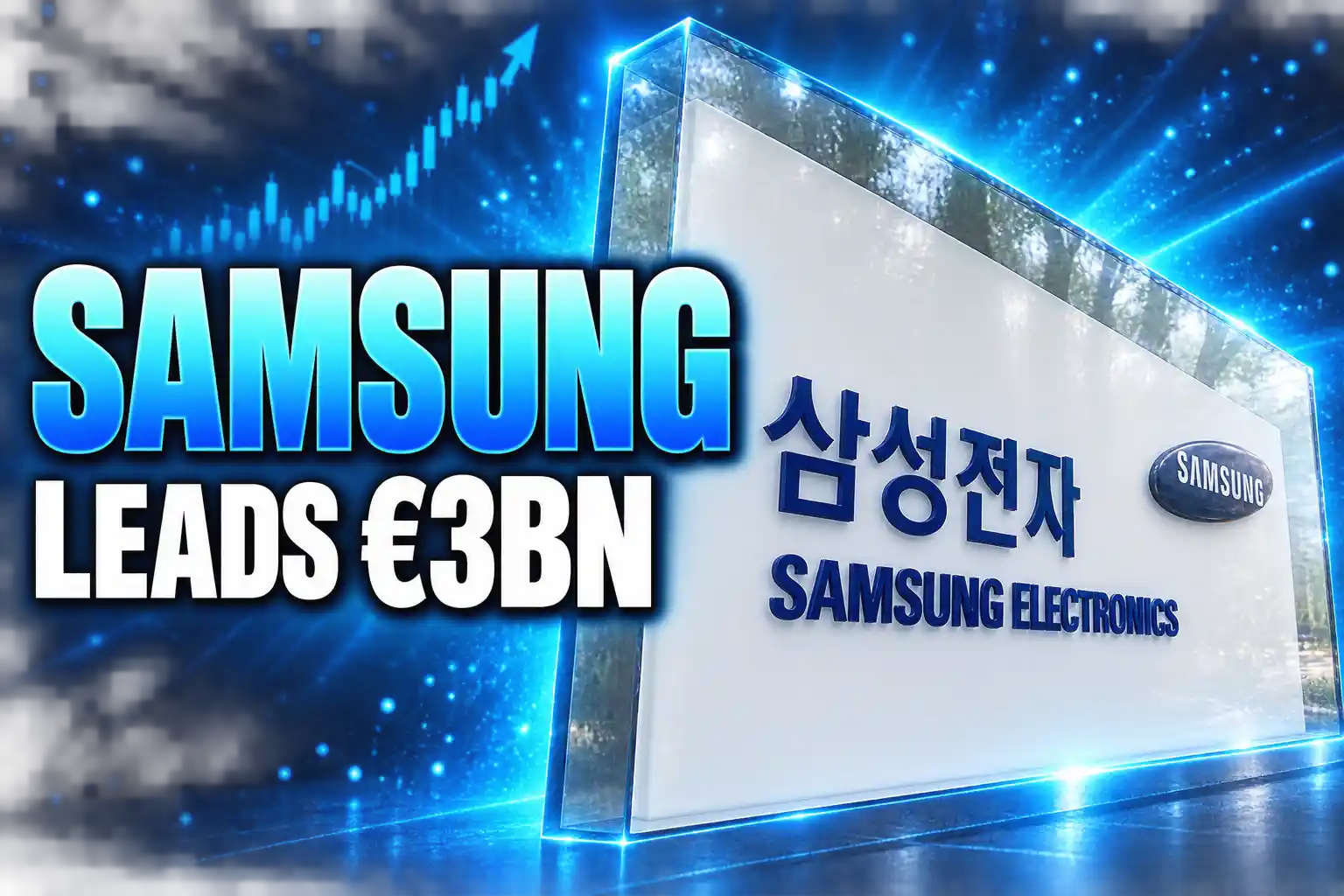
Samsung Wants Mistral Large on the Fab Floor
The partnership was unveiled during a Paris summit between French president Emmanuel Macron and South Korean president Lee Jae Myung. Samsung will fold Mistral’s tools, including Mistral Large, into design and manufacturing work across memory, logic and foundry, and apply the models to defect detection, equipment optimization and yield.
Young Hyun Jun, vice chairman and chief executive of Samsung’s Device Solutions division, tied the deal to the rising mess of AI chip making, not to a consumer chatbot race.
Increasing complexities involved in AI chip design and manufacturing requires continuous innovation in semiconductor technologies.
Young Hyun Jun, Vice Chairman and CEO, Device Solutions Division, Samsung Electronics
Mensch, speaking in the same note, said AI is “reshaping how we build complex technologies, from silicon to software,” and that Mistral would help Samsung improve how chips are designed and manufactured. Macron wrote that ASML a year ago and Samsung now showed Mistral’s knack for industrial partners, and that France and South Korea meant to “construire ensemble une troisième voie dans l’IA,” a third way in AI.
Samsung had already sat on an earlier round through Samsung Ventures. This time it led the equity raise and took a strategic stake whose euro size the companies did not publish. For a memory maker fighting for high-bandwidth supply into AI clusters, an open-weight lab that wants to own European compute is a customer as much as a portfolio company.
ASML Bought the Same Control a Year Earlier
The Dutch lithography group did not wander into Mistral as a tourist. In the September 2025 Series C it put in €1.3 billion and became the largest shareholder, at about 11%, while remaining a named customer. ASML’s machines sit at the tightest point in advanced chipmaking. Process data from those tools is exactly the kind of material a closed American model API is built to swallow, and exactly the kind a fab will not ship out.
Mistral’s own round note now pairs that ASML Series C with the Samsung Series D and calls both a bet that its stack can run “inside complex real-world environments” while the buyer keeps data, infrastructure and knowledge. The pattern is industrial, not media. Airbus is on the customer list for the same reason HSBC is: the work is regulated, the workflows are proprietary, and a vendor that can be switched off from California is a problem.
Mensch, Guillaume Lample and Timothée Lacroix started the company in 2023 after stints at Google DeepMind and Meta. They have spent three years selling open-weight models as the way to keep that switch in the customer’s hands. The Series D is the first time a Korean chip champion and a Dutch equipment champion sit together at the front of that pitch, each with a plant to protect.
An EU Growth Fund Sat at the Front of the Table
The other co-lead is a political object as much as a financial one. The Scaleup Europe Fund is the European Commission’s late-stage vehicle for companies it does not want to watch raise, and then relocate, in the United States. EQT runs it as an independent manager. The Commission is a founding investor and has committed €1 billion toward a target of approximately €5 billion, alongside names such as Novo Holdings, Allianz and APG.
Brussels built the fund so that a round of this size would not have to be assembled entirely abroad. Mistral still brought in a16z, BlackRock, Advent, NVIDIA and Salesforce Ventures. The European cheque sits at the front; it does not empty the American and Asian seats.
WHO WROTE NEW CHECKS, WHO CAME BACK
- New in Series D: Advent, BlackRock-managed funds and accounts, and the Grand Duchy of Luxembourg, which is now a shareholder as well as a government customer of the stack.
- Industrial leads across two rounds: ASML in Series C, Samsung Electronics in Series D, with NVIDIA remaining a holder and a supplier of the GPUs Mistral is installing.
- Public European capital: the EQT-managed Scaleup Europe Fund as co-lead, plus existing French public money through Bpifrance and Belfius.
Luxembourg’s cash is small beside Samsung’s undisclosed lead, and it is the clearest state signature on the cap table. A ministry that already wants models it can audit has now bought a slice of the vendor. That is a different kind of lock-in from an API contract, and it is the one Mistral has been selling since the Series C.
What Sovereignty Looks Like With a Global Cap Table
Mistral now calls itself the only AI company building the full stack that answers a post-chatbot question: how to use frontier models without handing over the infrastructure and the intelligence loop. It defines that stack as open-weight models, the compute they run on, and the products that put them into production. In its language, the sovereign layer has four controls.
THE FOUR CONTROLS MISTRAL IS SELLING
- Data: stays inside the organisation’s own boundary.
- Models: can be steered and customised, rather than taken as a black box.
- Compute: private and predictable, not rationed by a single cloud roadmap.
- Production systems: controllable and auditable once they are live.
That is a procurement argument, and it is landing with plants, banks and ministries. It is also a label that enterprise buyers still cannot define sovereign AI around with any shared precision, which is why Mistral keeps repeating the four-part version.
The independence on offer is legal and operational. It is not a European transistor supply chain. Mistral’s French training halls still fill with Nvidia GPUs. The new lead investor is the memory company those GPUs drink from. BlackRock and a16z remain on the register. Microsoft, which did not join this equity round, already buys European capacity from the same halls under a multibillion-dollar European infrastructure agreement signed on July 21.
So the “third way” Macron described is real at the data-residency layer and rented at the silicon layer. Customers who want weights they can inspect, and logs they can show a regulator, will pay for that. Customers who think the round made Europe self-sufficient in AI hardware will be reading a press release that Mistral did not actually write.
The Cash Is Going Into Machines Mistral Hopes to Own
Mensch has been blunt about where the money goes. Long term, he said, the plan is to rely fully on capacity Mistral builds itself, which means the compute it owns should grow around 100% over five years. In the meantime it will keep renting. Bergqvist said the staff has already grown to more than 1,000, nearly doubling in a year, and that the three founders still set the company’s direction even as the register fills with manufacturers and funds.
The physical map was already in motion before Samsung’s cheque cleared. In March Mistral raised $830 million of debt to buy 13,800 Nvidia GB300 GPUs for a site at Bruyères-le-Châtel, south of Paris, in a hall run by French operator Eclairion. A €1.2 billion project at EcoDataCenter in Borlänge, Sweden, is in the pipeline. The company has talked of putting €4 billion into European data centers, with a near-term target of 200 megawatts of capacity by the end of 2027 and 1 gigawatt by 2030.
THE COMPUTE CALENDAR BESIDE THE ROUND
- March 2026: Raises $830 million in debt for 13,800 Nvidia GB300 GPUs at Bruyères-le-Châtel.
- July 21, 2026: Microsoft agrees to take European GPU capacity from Mistral under a multibillion-dollar deal, and to put Mistral models into Foundry, Copilot Studio and Azure Local.
- September 8, 2026: Closes the €3 billion Series D at a valuation of more than €21 billion.
- September 9, 2026: Samsung says it will run Mistral Large on premises across its semiconductor operations.
The July Microsoft pact is the awkward twin of the sovereignty pitch. Mistral is selling independence from hyperscaler model APIs while renting halls to one of those hyperscalers so the halls stay full. Co-founder Timothée Lacroix has described that as a neocloud move: Microsoft as anchor tenant, European ministries as the other book of business. The companies already had a widened Microsoft compute partnership before Samsung led the equity round; Bergqvist said Microsoft sat out Series D itself.
Mensch also said Mistral is on track to surpass $1 billion in annual recurring revenue before the year is out. That figure is a target, not a booked total, and it is the commercial test sitting under the industrial romance. Samsung can wire Mistral Large into a Korean fab only if the models, the cluster and the support organisation keep pace with closed US labs that still raise in much larger units.
The factory buyers have now paid up for a stack they can lock in a plant. Mensch has the cash to keep filling rooms with GPUs he wants to own. Whether those rooms stay busy, and whether open weights remain a sufficient substitute for the largest closed models, is the part of the round that the term sheet cannot settle.
Frequently Asked Questions
Did Samsung Disclose How Much It Invested in Mistral’s Series D?
No. Samsung said it led the round and took a strategic equity stake to support a long-term technology collaboration, and Korean coverage of talks in July had put a possible cheque around €1 billion, but neither company published the final amount. Samsung Ventures had already backed Mistral in an earlier round, so the Series D lead is an increase in commitment, not a first look.
Do Arthur Mensch and the Other Founders Still Control Mistral?
Yes, according to chief financial officer Johan Bergqvist, who said after the round that co-founders Arthur Mensch, Guillaume Lample and Timothée Lacroix still control the company. The Series D adds Samsung, the Scaleup Europe Fund, BlackRock-managed vehicles, Advent and Luxembourg to a register that already included ASML and NVIDIA, without a disclosed change in founder voting control.
Did Microsoft Take Part in This Equity Round?
Microsoft did not participate in the Series D, Bergqvist said. The US firm’s live tie is the July 21 compute pact, under which it buys capacity in Mistral’s European GPU halls and distributes Mistral models in Foundry, Copilot Studio and Azure Local, rather than a new shareholding in this raise.
How Large Are Cheques From the Scaleup Europe Fund Meant to Be?
The fund is designed to write growth-stage equity tickets in the range of EUR 100 million and above, including follow-ons, into companies in EU member states or Horizon Europe associated countries. EQT selects those companies on commercial terms; the Commission sits in governance as a founding investor and does not pick individual deals.
How Does Mistral’s €3 Billion Round Compare With Other European Tech Raises?
PitchBook recorded Revolut’s €2.6 billion venture-growth deal in November 2025 as the largest European VC transaction of that year, and Northvolt’s €5 billion 2024 facility financing was a green loan, not equity. Mistral’s Series D is larger than those equity marks and is the figure the company and PitchBook now treat as the European equity record, while remaining far smaller than the late-stage rounds closed by the largest US model labs.

Instagram Plus Tests a Read-Only Mode That Cuts Stories

Altman Asks the Public to Accept Some AI Harm

Google Freezes OSS VRP Product Reports After AI Flood

AI Agents Make Payment Rails the Scarce Prize

Turkey’s Crypto Boom Now Runs Through Three Banks

Fable 5 Came Back Under a Commerce On-Off Switch

Google’s SpaceX GPU Lease Has a Sept. 30 Deadline

Plasma One’s XPL Locks Face a 1.81 Billion Cliff

DGO’s Rs 549 World Cup Pass Cost Fans Sleep and Data

Moonshot AI’s $30 Billion Ask Became a $35 Billion Close
-
 AI4 months ago
Fable 5 Came Back Under a Commerce On-Off Switch
-
 AI4 months ago
Google’s SpaceX GPU Lease Has a Sept. 30 Deadline
-
 CRYPTO4 months ago
Plasma One’s XPL Locks Face a 1.81 Billion Cliff
-
 APPS4 months ago
DGO’s Rs 549 World Cup Pass Cost Fans Sleep and Data
-
 AI4 months ago
Moonshot AI’s $30 Billion Ask Became a $35 Billion Close
-

 NEWS4 months ago
ColorOS 17 Device List Spans Oppo, OnePlus and Realme
-

 GAMING4 months ago
Xbox Cuts 3,200 Jobs After Five Years of Thin Returns
-
 GAMING4 months ago
The RTX 4050 Under Rs 70,000 Hides a Wattage Gap