
AI
Philips Splits Innovation and Hands AI to Partovi
Philips made Shez Partovi its first chief AI officer while hiring Laura Matz from Merck KGaA to industrialize technology, leaving AI with the informatics business.

Philips named Shez Partovi its first chief AI officer and hired Laura Matz from Merck KGaA as chief technology and innovation officer, effective Sept. 15, 2026. He keeps Enterprise Informatics, the software business he has run since it was set up in 2023.
Chief executive Roy Jakobs posted the moves as a way to sharpen innovation and AI inside a plan for profitable growth. The titles are new. The operating logic is older: AI stays with the person who already sells hospital software, while a chip-materials operator is being brought in to scale the rest of the technology shop.
Philips Hands AI to the Executive Who Already Sells Software
This is not a raid on a foundation-model lab. Partovi has been on the executive committee since he joined on July 1, 2021, first as chief innovation officer. Jakobs said he remains on that committee and continues as business leader of Enterprise Informatics. The new title sits on top of a P&L, not beside it.
Matz is the outsider. She has been chief science and technology officer at Merck KGaA, Darmstadt, Germany, since 2021, the first person in that job. Jakobs said she will lead the enterprise innovation and technology agenda and help businesses scale through design, engineering, technology capabilities and platforms.
That split is the appointment. One executive owns how AI shows up in products and inside the company. The other owns the platforms that have to carry everything else, from imaging hardware to consumer devices. Hospitals that buy Philips software will feel Partovi’s brief first. Labs and engineering groups will feel Matz.
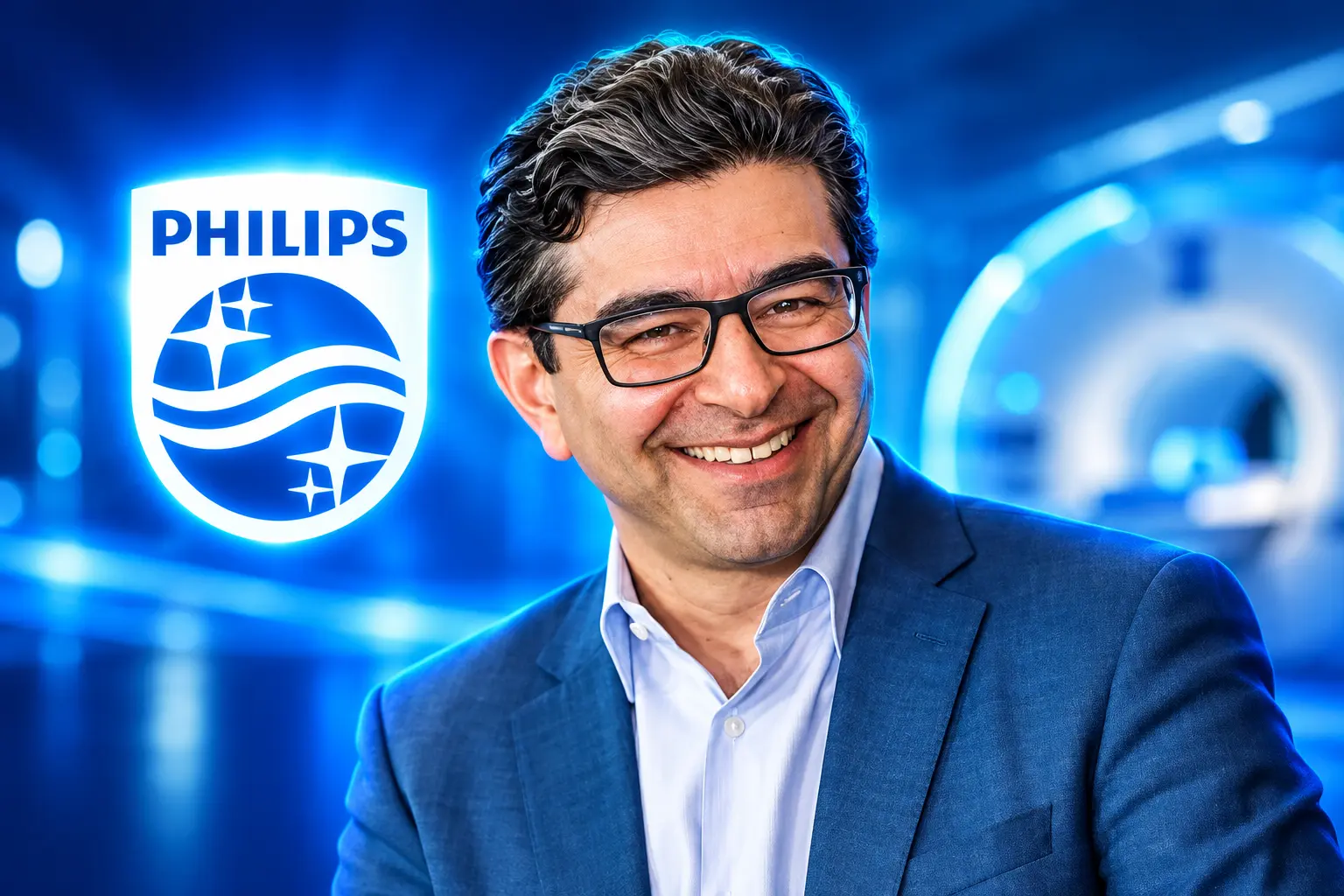
Partovi’s Dual Brief Covers Products and Internal Work
Philips’ own executive biography still describes a neuroradiologist who already runs Enterprise Informatics. He is Canadian, trained at McGill University in Montreal, and began in 1998 at the Barrow Neurological Institute. He stayed in clinical practice until 2013. He spent 20 years at Dignity Health, then joined Amazon Web Services in 2018 as worldwide head of business development for healthcare, life sciences and medical devices.
Enterprise Informatics, set up in 2023, bundles Philips software and hardware so hospital leaders can see workflows and diagnostics in one place. Partovi has said in Philips forums that innovation scales better when it lives where the financial accountability lives. The CAIO job is written that way on purpose.
On LinkedIn he described the mandate as enterprise-wide: how AI shows up in what Philips builds for clinicians and patients, and how it remakes work inside the company. Jakobs used a shorter line for the same idea.
As Chief AI Officer, he will guide our transformation into a people-led, AI-powered company.
Roy Jakobs, CEO, on LinkedIn
The dual seat matters in a regulated device company. A staff AI chief can publish principles. A business leader can put models into scanners, ultrasound carts and reporting software that already have customers, service contracts and notified-body files. Partovi has been the public face of that work, including Philips comments on the EU AI Act, which he has called a Herculean compliance task for a European manufacturer that still wants to ship as fast in Europe as in North America.
Why Philips Hired a Semiconductor Operator
Matz is often tagged as a pharma hire. Her record is closer to a fab. She holds a PhD in analytical chemistry from Washington State University and an undergraduate degree from Indiana University of Pennsylvania. She started as a back-end-of-line process engineer at Texas Instruments, then ran materials businesses at Air Products, Versum Materials and EMD Electronics after Merck KGaA bought Versum.
HER PATH INTO THE PHILIPS JOB
- The shop floor: She spent 20 years in semiconductor manufacturing and a decade running materials P&Ls, including planarization, the step that flattens chips between layers.
- The Merck office: As the first chief science and technology officer she owned corporate innovation, the digital office and new digital business models across life science, healthcare and electronics.
- The data venture: She was CEO of Athinia, a Merck-Palantir data collaboration platform launched on Dec. 7, 2021, so chipmakers and materials suppliers could share anonymized process data without mixing intellectual property.
Athinia runs on Palantir Foundry. Micron’s global quality lead, Raj Narasimhan, said a earlier Merck collaboration used AI on chemical mechanical polishing data to improve process and quality, and that extending the model to a wider supply chain could speed predictive manufacturing. That is the muscle Philips is buying: taking siloed factory and lab data, putting access controls around it, and turning it into something a business can run every week.
Jakobs’s note on Matz stressed science, technology, business and digital work across life sciences, healthcare and electronics. Philips still lives in all three. Imaging systems are electronics. Consumables and patient monitoring sit next to clinical software. Personal health products need the same platform discipline. A chief who has already tried to make three Merck sectors share tools is a different hire from a generative-AI researcher.
Profitable Growth Now Depends on Platforms
Jakobs told shareholders Philips is making a shift from stabilizing to accelerating profitable growth. The 2023 to 2025 stretch was rebuild work: quality systems, a simpler organization, and a consent-decree overhang in Sleep & Respiratory Care. 2025 results show how unfinished that still is. Sales were EUR 17.8 billion, comparable growth was 2%, and adjusted EBITA was 12.3%. Free cash flow of EUR 512 million included a EUR 1,025 million payment for Respironics recall-related medical monitoring and personal injury settlements in the United States. About 65,000 people were on the payroll. The 2026 outlook still excludes the Department of Justice inquiry and state attorneys general cases.
The next three-year plan is where the new titles have to earn their keep.
THE 2026 TO 2028 SCOREBOARD JAKOBS SET
| Goal | Number | When |
|---|---|---|
| Average comparable sales growth | 4% to 6% | By the end of 2028 |
| Adjusted EBITA margin | Mid-teens | 2028 |
| Lives improved per year | 2.5 billion | 2030 ambition |
| Proposed dividend | 85 euro cents a share | 2025 payout |
In 2025 Philips said it improved 2 billion lives. Engagement inside the company rose from 70% in the first half of 2023 to 79% in the second half of 2025. Jakobs also pointed to more than $150 million of U.S. manufacturing investment in Reedsville, Pennsylvania, for AI-powered health technology. Platforms, he said, are how hardware, software and AI get packaged so they can be sold more than once.
That is Matz’s job description in all but name. Partovi’s job is to make sure the AI layer on those platforms is a product, not a slide. Second-quarter 2026 comparable sales grew 4%, so the commercial machine is no longer shrinking. The titles land in a company that can fund the work if the work actually ships.
Sixteen Working Days and a Training Gap
Partovi does not inherit a blank page. Philips released the 11th Future Health Index on June 9, 2026, from more than 2,000 healthcare professionals and 20,000 patients in 10 countries. The survey is the company’s own, and it is the dataset he has been carrying into customer meetings.
WHAT THE 2026 INDEX SAYS CLINICIANS ALREADY SEE
- Time back: Philips says AI is saving clinicians the equivalent of over 16 working days a year; 46% reported at least 132 hours saved.
- More patients: 50% said they have capacity for more visits, on average eight extra patients a week.
- Fewer misses: 39% said AI identified or helped prevent potential medical errors at least three times in the prior three months.
- Thin training: 70% called AI training inadequate, inconsistent or unavailable, even as 65% said they had increased use of workplace AI tools.
Forty-nine percent reported less work-related stress. Partovi’s comment on the release was that AI is already changing daily practice and that infrastructure and training are the unfinished work. If he is going to be measured as chief AI officer, those two gaps are the scorecard hospitals will use, not the org chart in Amsterdam.
The same survey is also a warning. A company can ship models faster than a health system can teach people to check them. Liability, accuracy checks and basic navigation were the top training needs. A CAIO who still runs the informatics catalog can put education into the license. A CAIO who only owns a center of excellence cannot.
Philips Broke the Usual CAIO Hiring Pattern
Research firm Avasant, in a March 2026 note on the role, found nearly one in four Fortune 500 firms now have a dedicated chief AI officer, with average tenure about 2.2 years. Forty-seven percent of those appointments were external hires. Philips went the other way for AI and spent its outside hire on technology and innovation.
That is a bet on domain depth over a celebrity model resume. Partovi has already sat with radiology customers, AWS account teams and Philips engineers. Matz has already sat between materials suppliers and fabs that refuse to share raw data. Neither is a pure research appointment. The CAIO title is spreading through regulated industries that need a named owner; Liberty Insurance’s first chief AI officer landed in a similar C-suite shuffle, next to a new president rather than inside a quiet IT reorg.
The trade press barely treated the Philips move as a spectacle, and that silence fits the design. There was no foundation-model founder on a stage. There was a LinkedIn post, two biographies, and a start date a week out. For a company still answering to a consent decree and a U.S. settlement, a quiet split may be the point.
What Hospitals Will Notice First
On the floor, the next months are about which products get the AI budget and which engineering backlogs Matz is told to kill. Jakobs used the 2026 meeting to name the current wave: helium-free MRI with AI reconstruction, Verida as a detector-based spectral CT, the SpectraWAVE deal in coronary imaging, and a next-generation telemetry monitor. Those are already in the catalog. The question is whether they behave like one platform or like a pile of projects.
WHERE THE NEW BRIEFS MEET THE CATALOG
- Informatics: Partovi’s teams still own the software layer that sits on scanners and in reading rooms, including cloud imaging moves such as HealthSuite.
- Modalities: Precision Diagnosis and Image-Guided Therapy keep the iron; they now have a CAIO who can either fund shared models or let each unit train its own.
- The factory of tools: Matz inherits design, engineering and technology platforms that Jakobs wants reused, which is how a Merck-style science office actually pays off.
If the split works, a hospital CIO sees faster software drops on machines already in the basement, and Philips sees the same model sold across CT, MR and ultrasound. If it fails, Philips will have two executive owners for work that used to live in one innovation office, and customers will still wait on training that 70% of clinicians say they do not get.
Matz starts on Tuesday, Sept. 15. Until the Philips executive-committee page changes, Partovi remains listed under his old title. The work does not. AI at Philips now has a named owner who already holds the software P&L, and the rest of technology has a new boss whose last company built a data room for chip plants.
Disclaimer: This article is news reporting and analysis of a leadership change at Koninklijke Philips N.V. and is for information only. It is not investment advice, a recommendation to buy or sell PHG or any other security, and it is not medical or legal advice about AI tools used in clinical care. Readers who may act on company outlooks, margin targets or product claims should consult a licensed financial adviser, and clinicians should consult their own medical-device and compliance teams, before making decisions. Figures, titles and legal statuses are those published by Philips and the other named organizations as of the dates cited and may change as filings, consent-decree work and the Sept. 15 start date play out.

Instagram Plus Tests a Read-Only Mode That Cuts Stories

Altman Asks the Public to Accept Some AI Harm

Google Freezes OSS VRP Product Reports After AI Flood

AI Agents Make Payment Rails the Scarce Prize

Turkey’s Crypto Boom Now Runs Through Three Banks

Fable 5 Came Back Under a Commerce On-Off Switch

Google’s SpaceX GPU Lease Has a Sept. 30 Deadline

Plasma One’s XPL Locks Face a 1.81 Billion Cliff

DGO’s Rs 549 World Cup Pass Cost Fans Sleep and Data

Moonshot AI’s $30 Billion Ask Became a $35 Billion Close
-
 AI4 months ago
Fable 5 Came Back Under a Commerce On-Off Switch
-
 AI5 months ago
Google’s SpaceX GPU Lease Has a Sept. 30 Deadline
-
 CRYPTO4 months ago
Plasma One’s XPL Locks Face a 1.81 Billion Cliff
-
 APPS4 months ago
DGO’s Rs 549 World Cup Pass Cost Fans Sleep and Data
-
 AI5 months ago
Moonshot AI’s $30 Billion Ask Became a $35 Billion Close
-

 NEWS5 months ago
ColorOS 17 Device List Spans Oppo, OnePlus and Realme
-

 GAMING4 months ago
The RTX 4050 Under Rs 70,000 Hides a Wattage Gap
-
 AI4 months ago
Boris Cherny’s Loops Still Demand a Higher Production Bar