
AI
Exowatt Warns Gas-Fired AI Campuses May Not Last a Decade
Exowatt CEO Hannan Happi says a year of grid delay costs a hyperscaler $12 billion, as gas-fired AI campuses stall on turbines, permits, and neighbors.

Hannan Happi, co-founder and CEO of Exowatt, puts a one-year grid delay at $12 billion in missed revenue for a hyperscaler racing new models. He said that on August 23, 2026, while arguing that AI infrastructure is now a power-plant problem, and that many gas-backed campuses may not still be running a decade from now.
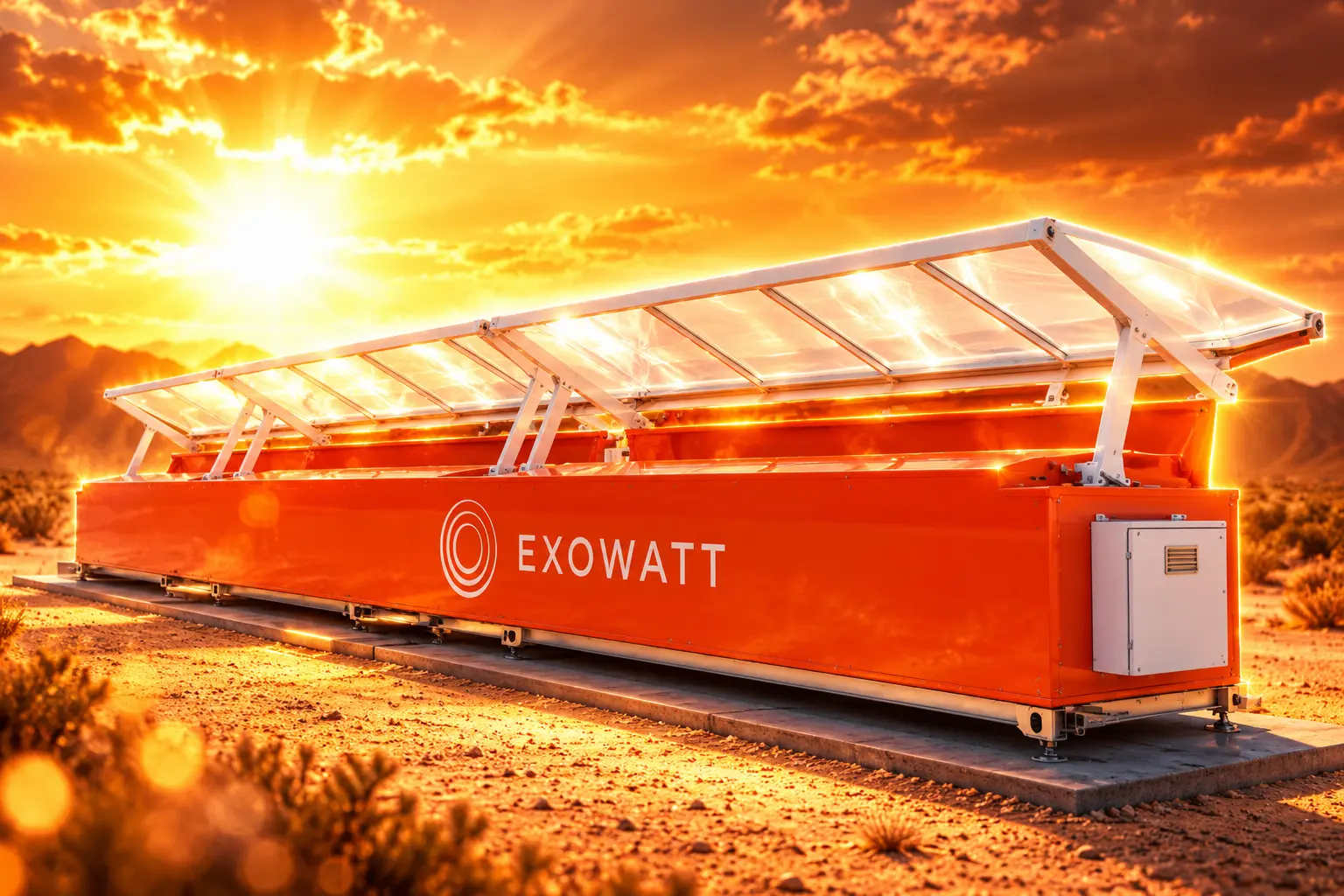
Exowatt, the Miami firm backed by Sam Altman and Andreessen Horowitz, sells modular solar-heat units meant to sit beside the load and skip a long wait for a utility hookup. The company was named a finalist on September 1, 2026, in two Platts Global Energy Awards categories, Rising Star Company and Emerging Technology of the Year, as that wait moved from a talking point into cancelled sites, frozen permits, and a turbine line that stretches years.
A $12 Billion Price on One Year of Grid Delay
Happi’s $12 billion figure is simple arithmetic from a rich contract. He pointed to recent cloud deals, including work tied to SpaceX, Anthropic, and Google, that he put at about $1 billion a month, then multiplied by twelve. A year on the interconnection list, in that math, is a year of models you did not serve.
A few years ago the largest data center in the United States was about 100 megawatts, he said, and a building block was 10 to 20 megawatts. The block is now 300 to 700 megawatts. Campuses average about a gigawatt, and a few are talked about at about 10 gigawatts. He equated one gigawatt with the draw of about 1 million U.S. homes, which is why a site that size no longer “just plugs in.”
Chips still matter. They also draw more watts in total even as each generation gets more efficient, which is why the constraint moved from silicon lead times to steel, permits, crews, and fuel. Happi put the near-term U.S. hole at 70 to 100 gigawatts. Hyperscalers, he said, will now take 10 megawatts if that is what is on offer, because even a small block of power turns into hundreds of millions of dollars of product.
China’s Power Build Still Runs About 10 Times America’s
China’s National Energy Administration put total installed generating capacity at 3.89 terawatts at the end of 2025, up 16.1% from a year earlier, a rise of about 540 gigawatts. The U.S. Energy Information Administration recorded 53 GW of new capacity in 2025, the most in a single year since 2002. That is about 10 times the U.S. add on a raw gigawatt count.
Lawrence Berkeley National Laboratory’s 2025 update, posted in 2026, estimated U.S. data centers used 192 terawatt-hours in 2024, or 4.7% of total U.S. electricity. Its reference case reaches 649 terawatt-hours in 2030, or 11.8% of forecast U.S. use, with a band from 9.5% to 15.3%. Happi has talked about data centers taking 9% to 10% of U.S. grid capacity; the lab’s 2030 band is the independent range that holds.
The EIA’s 2026 interconnect list, if projects hit their dates, is a record 86 gigawatts. It is not a gas list.
U.S. UTILITY-SCALE ADDITIONS PLANNED FOR 2026
| Source | Planned capacity | Share of the 86 GW list |
|---|---|---|
| Solar | 43.4 GW | 51% |
| Battery storage | 24 GW | 28% |
| Wind | 11.8 GW | 14% |
| Natural gas | 6.3 GW | about 7% |
Those four rows sum to 85.5 gigawatts of the 86 gigawatt plan. Gas is the fuel most AI campus announcements still name, and it is a thin slice of what the federal inventory says will actually switch on this year.
Why the Gas Pipeline Is Mostly Paper
Global Energy Monitor’s August 2026 update counted 378 gigawatts of U.S. gas-fired capacity in development, up from 252 gigawatts in January, a 50% rise. Of that pile, it counted 189 gigawatts of gas-fired capacity meant to serve data centers. Texas alone held 122 gigawatts of gas projects in development, including 77 gigawatts aimed at campuses.
Happi put heavy-duty turbine waits at 5 to 7 years. GEM did not publish a single lead time, but it said the three large turbine makers are reporting rising backlogs and multi-year waits, and that more than three-quarters of the global gas pipeline is still in early stages. In the first half of 2026, about 45 gigawatts of announced and pre-construction capacity had its planned start year pushed back. More than half of data-center-tied projects had no named turbine or engine maker.
This frenzy of gas proposals is running headlong into the hurdles of an already tight gas market. It is nearly impossible nowadays to guess what is a pie in the sky proposal, and what has a real chance of getting built.
Jenny Martos, project manager, Global Oil and Gas Plant Tracker at Global Energy Monitor
Developers are already swapping the big machines for reciprocating engines and smaller aero-derivative units that can be built faster. GEM put engine capacity tied to data centers at 45 gigawatts after a tripling in six months. Those units are quicker. They also burn dirtier per kilowatt-hour than a combined-cycle plant, which is the trade a campus makes when the turbine slot is in the next decade and the model release is this quarter.
46 AI Campuses Frozen by Local Fights
Carbon Direct, in a June 2026 study with Data Center Watch, counted 46 AI data center projects stalled, blocked, or withdrawn between January 2024 and May 2026 across 20 states. Announced investment on those sites sat between $137 billion and $172 billion. Cancellations quadrupled in 2025, and the first months of 2026 added more than 20 more, the fastest quarterly pace in that set. Fifteen of the projects that disclosed load added up to about 8.2 gigawatts.
New York halted large new data center proposals in July 2026. Happi called the backlash bipartisan and said it is showing up in gas-rich states, including Texas. Some pipeline analysts argue that a freeze often lands on an early-stage site that was never going to make its press-release date. That can be true in a given county and still leave 46 named projects and 189 gigawatts of DC-tied gas looking for a path that neighbors, turbines, and fuel contracts will actually clear.
WHAT NEIGHBORS SAY THEY ARE PAYING
- The bills: Ratepayers get asked to fund transmission and substation upgrades for a load they do not own.
- The water: Cooling at gigawatt scale competes with wells, rivers, and municipal systems.
- The air: Behind-the-meter gas and diesel stacks put NOx and other exhaust next to houses.
- The jobs: Construction is intense, then the finished hall runs with a thin permanent crew.
- The land: A campus locks a large parcel into one use and pushes other housing and industry out of the way.
Happi said hyperscalers and the federal government are now being pushed to pay for those upgrades themselves so the cost does not land on local bills. He also said the industry’s first answer, more gas in the same suburban counties that hosted the old 100-megawatt halls, is the thing communities are voting down.
Happi Wants Those Campuses Off the Map
His fix has a name he uses on purpose: frontier land. Build the next wave on empty ground with sun, wind, or gas, far from the neighborhoods that now treat a data hall as a power plant with a bad neighbor record. Fiber used to set the map. Real estate used to set it. Power was assumed. That assumption is dead, which is why he keeps asking why so much capacity still sits in Northern Virginia, where land and power are both expensive.
The factory pitch sits on top of that map. Exowatt wants to assemble modules in a plant, ship them, and bolt them down with a smaller field crew, the same modular turn the hall builders are trying on the compute side. Skilled electricians and technicians are already scarce; moving the skilled hours into a factory is how he says you avoid sending a full craft army into the desert.
On August 24, 2026, the company’s account put the political point in public: a freeze on halls, in its telling, is a freeze on the country’s shot at staying in the AI race.
Moratoriums aren't the answer.
A blanket freeze on data center construction would not protect American workers, communities, or the environment.
It would surrender American leadership in the most consequential technology to competitors who will not pause alongside us.
— Exowatt (@ExowattEnergy) August 24, 2026
That is the company line. The harder operational point is the one GEM’s pipeline makes: if the campus still needs a multi-year turbine, a new gas lateral, and a county board, empty land does not by itself clear the clock.
How Exowatt’s P3 Tries to Make Solar Run at Night
The Exowatt P3 is a modular solar-heat box. Lenses take sunlight, a long-duration thermal battery holds it as heat, and a heat engine turns that heat into electricity when the hall needs it, including after dark. The company says a unit can deliver up to 24 hours of power daily and can sit at or near the load so the project does not wait on a transmission queue. Happi has said the design target is one cent per kilowatt-hour, and that the stack is built around common materials rather than a lithium supply chain.
In November 2025 the company said it had a demand backlog exceeding 90 GWh from U.S. data centers, energy developers, and others. It has not, in its public funding notes, named the hyperscalers in that queue. Andre de Baubigny, managing director of MVP Ventures, said AI demand will not wait for new transmission hookups, which is the sales case in one line.
EXOWATT’S FUNDING CLOCK
- 2023: Hannan Happi and Atomic CEO Jack Abraham found the company in Miami.
- April 2024: Seed round of $20 million, with Andreessen Horowitz, Atomic, Sam Altman, and Leonardo DiCaprio among the backers.
- September 2024: P3 launches at the RE+ conference in Anaheim, California.
- April 22, 2025: Series A of $70 million led by Felicis, split $35 million equity and $35 million of debt from HSBC Innovation Banking and other lenders, taking the total to $90 million. The company said commercial deployments would go live in 2025.
- November 13, 2025: A $50 million Series A extension led by MVP Ventures and 8090 Industries takes capital raised to $140 million in under two years.
- September 1, 2026: Exowatt is named a Platts Global Energy Awards finalist in two categories.
Happi is due in New York on September 24, 2026, during Climate Week, and the company has set its Power Summit for September 30, 2026, in Las Vegas. A backlog of 90 gigawatt-hours is still a backlog until named sites switch on. Factory control can cut cost and crew time. It does not, by itself, invent customers who will take solar-heat modules instead of a gas turbine they have already reserved.
The 10-Year Test for Every New AI Campus
Happi’s investor screen is the second bill, after the delay. Short term, can the campus beat communities, fuel, labor, and the interconnect list. Long term, is the power source still legal, cheap, and running in 10 or 20 years, or does a later administration, a lawsuit, or a fuel spike strand it.
I would want to say and look at how sustainable is that revenue stream? Can we bank on it for another five, 10, 15, 20 years, and look at the long-term components of the infrastructure build-out as well.
Hannan Happi, co-founder and CEO, Exowatt
He argues gas halls are exposed to fuel swings, supply-chain bottlenecks, and future penalties on emissions, and that communities will keep suing. Solar-plus-storage on empty land is his way around that stack: no turbine slot, no neighborhood, no imported fuel. Hyperscalers, he said, are already buying dispatchable renewables in several flavors, and they will buy power from almost anything that can be turned on this year. There is no single fuel that clears the 70 to 100 gigawatt hole he described.
The 2026 U.S. list is still mostly solar and batteries. The announcement pile is still mostly gas. China’s 540-gigawatt year is the capacity race Happi wants Washington to feel. The quieter test is the one he put on the books: if a campus only works while the turbine wait, the county vote, and the fuel contract all hold, it is a short trade dressed up as AI infrastructure, and that is the part of the build-out that can go dark before the models it was meant to train are old.

Instagram Plus Tests a Read-Only Mode That Cuts Stories

Altman Asks the Public to Accept Some AI Harm

Google Freezes OSS VRP Product Reports After AI Flood

AI Agents Make Payment Rails the Scarce Prize

Turkey’s Crypto Boom Now Runs Through Three Banks

Fable 5 Came Back Under a Commerce On-Off Switch

Google’s SpaceX GPU Lease Has a Sept. 30 Deadline

Plasma One’s XPL Locks Face a 1.81 Billion Cliff

DGO’s Rs 549 World Cup Pass Cost Fans Sleep and Data

Moonshot AI’s $30 Billion Ask Became a $35 Billion Close
-
 AI4 months ago
Fable 5 Came Back Under a Commerce On-Off Switch
-
 AI5 months ago
Google’s SpaceX GPU Lease Has a Sept. 30 Deadline
-
 CRYPTO4 months ago
Plasma One’s XPL Locks Face a 1.81 Billion Cliff
-
 APPS4 months ago
DGO’s Rs 549 World Cup Pass Cost Fans Sleep and Data
-
 AI5 months ago
Moonshot AI’s $30 Billion Ask Became a $35 Billion Close
-

 NEWS5 months ago
ColorOS 17 Device List Spans Oppo, OnePlus and Realme
-

 GAMING4 months ago
The RTX 4050 Under Rs 70,000 Hides a Wattage Gap
-

 AI4 months ago
Boris Cherny’s Loops Still Demand a Higher Production Bar