
CRYPTO
Bitcoin Miners Split Between AI Data Centers and Pure-Play Mining
TeraWulf’s $19B Anthropic lease and Cipher’s $5.5B AWS deal show Bitcoin miners splitting between AI winners and pure-play holdouts under post-halving pressure.

Two anchor deals landed within nine months, and they are reshaping what “Bitcoin miner” means. TeraWulf signed a 20-year, $19 billion lease with Anthropic for a 401-megawatt Kentucky campus, and Cipher Mining locked a 15-year, $5.5 billion agreement with Amazon Web Services for 300 megawatts in Texas. The contracts are the clearest evidence yet that Bitcoin miners are splitting into two tracks: AI infrastructure landlords on one side, pure-play crypto operators absorbing the post-halving squeeze on the other.
The split is already visible in share prices and in the cost of producing a single bitcoin. Public miners with secured AI hosting contracts trade at 12.3 times next-twelve-month sales, more than double the 5.9 times fetched by pure-play peers. The gap is the market’s verdict on which side of the line a miner wants to be standing when 2027 arrives.
The $19 Billion Anchor at Hawesville
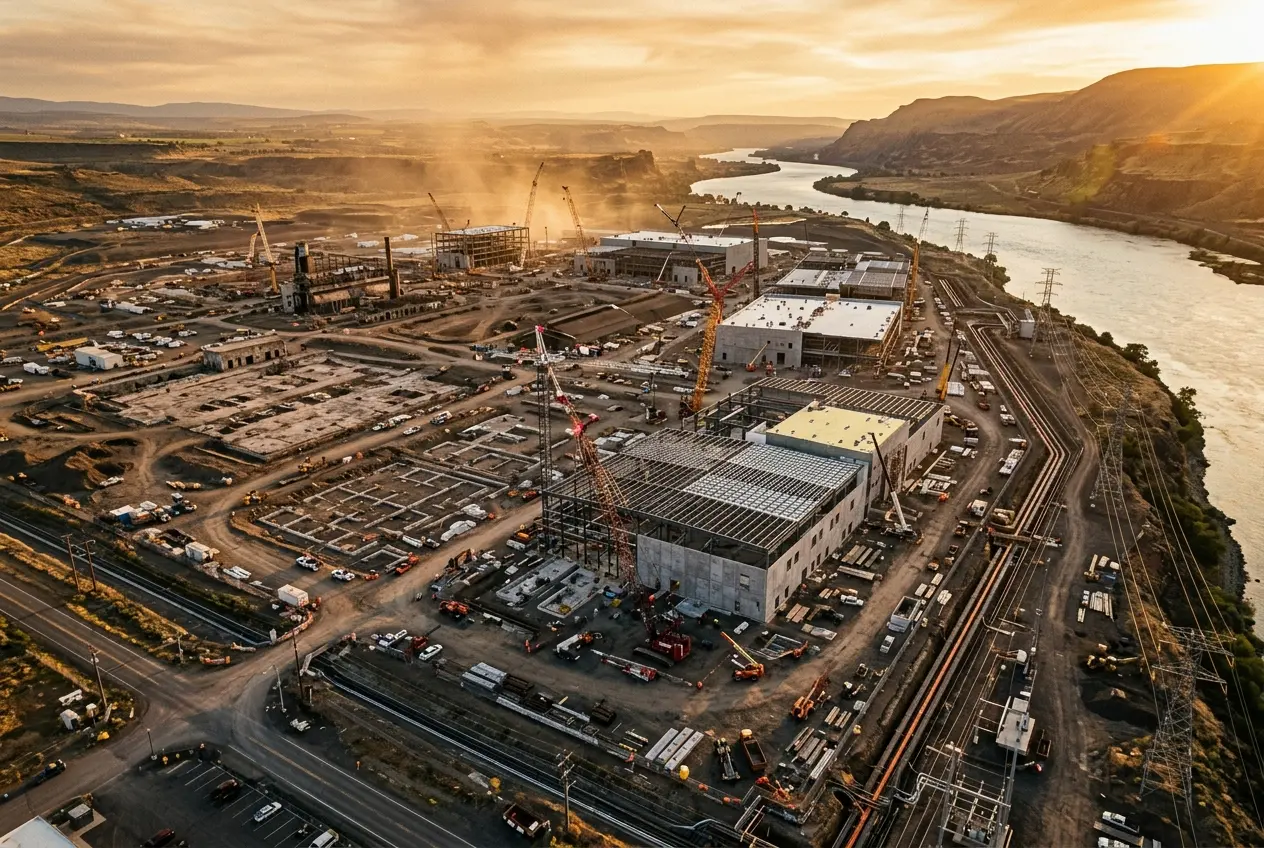
TeraWulf announced the Anthropic lease Monday. The agreement covers a 790-acre campus in Hawesville, Kentucky, built on the site of a former aluminum smelting facility, and runs 20 years with first power delivery expected in the second half of 2027. The facility reaches 401 megawatts of operational capacity the following year.
The economics stand out on both sides of the table. TeraWulf plans to invest between $3 billion and $4 billion in the site, less than one-fifth of the lease’s value. The company posted $34 million in revenue the prior quarter. Anthropic will use a closed-loop cooling system that recirculates a propylene-glycol mix rather than drawing from local water reservoirs.
The Anthropic lease validates our strategy and establishes a long-duration revenue stream with one of the world’s leading AI companies.
TeraWulf CEO Paul Prager said that as the deal closed. TeraWulf shares rose 4.8% on the news in midday trading, having earlier jumped more than 16% in premarket action. The stock is up more than 80% year to date, and the company also disclosed it sold its 50.1% stake in a 168-megawatt Abernathy, Texas AI facility to Fluidstack for $450 million.
Cipher’s $5.5 Billion Counterweight
Cipher Mining’s deal predates TeraWulf’s by eight months but carries similar weight. On November 3, 2025, Cipher announced an approximately $5.5 billion, 15-year lease with Amazon Web Services for 300 megawatts of capacity at its Texas sites, including both air and liquid cooling. Delivery begins in July 2026 and completes in the fourth quarter, with rent commencing in August 2026.
Last quarter, we discussed our aggressive aim to position Cipher ahead of the curve, anticipating where the industry is heading and aligning our strategy accordingly. Since then, we’ve delivered on that vision, executing two milestone HPC transactions, as well as our most significant pipeline addition to date.
Cipher CEO Tyler Page said the AWS agreement followed a separate deal with Fluidstack in September 2025, a 10-year, $3 billion contract for 168 megawatts at Cipher’s Barber Lake facility in Colorado City, Texas, backed by Google. The full set of terms is in Cipher’s November 2025 SEC earnings filing.
| Deal | TeraWulf / Anthropic | Cipher Mining / AWS |
|---|---|---|
| Lease value | $19 billion | $5.5 billion |
| Term | 20 years | 15 years |
| Capacity | 401 MW | 300 MW |
| Site | Hawesville, Kentucky | Texas (Barber Lake and other sites) |
| First delivery | Second half of 2027 | July 2026 |
The Pure-Play Miners Taking the Other Side
Not every miner is converting. The economics of running SHA-256 rigs at today’s bitcoin price have collapsed. CoinShares’ Q1 2026 mining report puts the weighted average cash cost to produce one bitcoin among publicly listed miners at $79,995 in Q4 2025.
Bitcoin traded in a $68,000 to $70,000 band over the period, generating losses of about $19,000 per coin mined. Hash price, the per-petahash revenue metric, hit an all-time post-halving low of roughly $28 to $30 per day in early March 2026. Miners running mid-generation hardware need electricity below $0.05 per kilowatt-hour to stay cash-profitable at those levels. The CoinShares report put the infrastructure cost differential at $700,000 to $1 million per megawatt for bitcoin mining versus $8 million to $15 million per megawatt for AI.
The market is paying for AI exposure. Miners with secured HPC contracts trade at 12.3 times next-twelve-month sales. Pure-play miners trade at 5.9 times, more than a 2x gap that doubles as a valuation split.
That valuation gap is the clearest signal yet that capital has already chosen a side. Bitfarms and other pure-play operators continue to mine bitcoin without AI hosting agreements, riding the price. CoinShares expects further miner exits if bitcoin stays below $80,000, a threshold the network already tested in March.
Hashrate Falls as Miners Reroute Capital
The flip side is the bitcoin network itself. Miners reallocating capital and megawatts toward AI are the same operators whose rigs secure the blockchain. The network hashrate peaked at approximately 1,160 exahashes per second in early October 2025 and has since declined to roughly 920 EH/s. Three consecutive negative difficulty adjustments followed, the first such streak since July 2022.
To fund the pivot, public miners have collectively reduced their BTC treasuries by more than 15,000 BTC from peak. Marathon, the largest public holder at 53,822 BTC, expanded its March 10-K policy to authorize sales from its entire balance sheet reserve. A separate read on the same sell pressure sits in Strategy’s $216M Bitcoin sale didn’t tank BTC, which traces a parallel forced-sale dynamic at the largest corporate holder.
- Core Scientific sold 1,992 BTC worth $175 million in March 2026 and plans to liquidate substantially all remaining holdings in Q1 2026.
- Bitdeer reduced its treasury to zero in February.
- Riot Platforms sold 1,818 BTC worth $162 million in December.
The Calculus That Split the Industry
Industry analysts estimate AI-related services could account for about 70% of public Bitcoin miners’ revenue by the end of 2026, compared with about 30% earlier in 2025. At the company level the rotation is already visible. Core Scientific’s AI colocation revenue already accounts for 39% of its total.
TeraWulf is at 27% of revenue from HPC leasing, with management intent on exiting bitcoin mining entirely. IREN sits at 9% and is scaling rapidly, with up to 200 megawatts of liquid-cooled GPU capacity under construction and a separate five-year Microsoft partnership projected to generate $1.94 billion in annualized revenue at an 85% project-level EBITDA margin. CoreWeave’s expanded agreement with Core Scientific is worth $10.2 billion over 12 years. Hut 8 signed a $7 billion, 15-year lease for AI infrastructure at its River Bend campus.
- Bitcoin mining infrastructure cost: $700,000 to $1 million per MW
- AI infrastructure cost: $8 million to $15 million per MW
- AI contract margins: above 85%
- Hash price post-halving low: $28 to $30 per petahash per day
The math favors the AI side. AI hosting contracts deliver multi-year revenue visibility that bitcoin mining, with its halving cycles and energy costs, cannot match. The contracts fund the next round of buildouts, and the buildouts pull more megawatts off the bitcoin network.
What the Two Tracks Look Like Next
CoinShares forecasts the network hashrate will reach 1.8 zetahashes by the end of 2026 and 2 zetahashes by the end of March 2027. That projection depends on bitcoin recovering to $100,000 by year-end. If prices stay below $80,000, the firm expects hash price to keep falling and hashrate to decline further as more miners exit. A sustained move below $70,000 could trigger larger capitulation that would paradoxically benefit survivors through lower difficulty.
The bitcoin mining industry entered this cycle as a group of companies that secured the network and accumulated bitcoin. It is exiting as a group of companies that build AI data centers and sell bitcoin to fund them. The market has already priced that transition. Network security, so far, has not caught up, and the price call behind the gap is in Bitcoin’s $64K structural stabilization call.
Frequently Asked Questions
Which Bitcoin miners have signed the largest AI data center deals?
TeraWulf’s $19 billion, 20-year lease with Anthropic covers 401 megawatts at a Kentucky campus. Cipher Mining’s $5.5 billion, 15-year lease with Amazon Web Services covers 300 megawatts in Texas. CoreWeave’s expanded agreement with Core Scientific is worth $10.2 billion over 12 years. Hut 8 signed a $7 billion, 15-year lease at its River Bend campus. IREN’s five-year Microsoft partnership is projected to generate $1.94 billion in annualized revenue.
How much revenue could AI deals generate for Bitcoin miners?
Publicly listed miners could derive as much as 70% of their revenue from AI by the end of 2026, up from roughly 30% earlier in 2025, per CoinShares’ Q1 2026 mining report. Over $70 billion in cumulative AI and high-performance computing contracts have been announced across the public mining sector.
Why are Bitcoin miners pivoting to AI data centers?
The weighted average cash cost to produce one bitcoin among publicly listed miners rose to $79,995 in Q4 2025, while bitcoin traded between $68,000 and $70,000, generating losses of about $19,000 per coin mined. AI hosting contracts deliver margins above 85% with multi-year revenue visibility, against mining margins tied directly to bitcoin’s price.
What happens to the Bitcoin network if miners keep leaving?
Network hashrate peaked at approximately 1,160 exahashes per second in early October 2025 and has declined to roughly 920 EH/s, with three consecutive negative difficulty adjustments, the first streak since July 2022. CoinShares forecasts hashrate will reach 1.8 zetahashes by end of 2026 if bitcoin recovers to $100,000.


South Korea Retail Investors Face Reckoning After KOSPI AI Rally Collapses

Surrey AI Maps Three Heart Attack Paths and Their Molecular Roots

Germany Locks Neutral Apple ATT Prompts Across Most of Europe

Apple’s 5% EU Fee Quietly Rewrites Alternative App Store Math

Apple’s EU Fee Truce Cuts Complexity but Leaves Rivals Fuming

Pixel 11 Pro Fold Trades Thinness for Durability and Seven-Year Stay

Mayo AI Flags HCM Obstruction From Everyday Ultrasound Videos

Indian Brands Quietly Scale Landmark Screens and Home Tech

Navin Vatsa Turns Grief Into a Lifetime of Quiet Seeing

Google Bets Pixel 11 Agentic AI Will Redefine Phones

Oracle Cuts 21,000 Jobs in a Year, Cites AI in 10-K Filing

Fable 5 and Mythos 5 Return as US Lifts Anthropic Export Controls

SpaceX’s Google Deal Turns a Rocket Company Into a Cloud Landlord

CD Projekt Red Co-CEO: Redemption Arc Isn’t Done, Witcher 4 in 2027

XPL Rallies 30% Ahead of Plasma One Card Tier Launch

Google Search Profiles Build a Follow Graph Inside Discover

DGO App Brings Rs 549 Mobile Pass for FIFA World Cup 2026 in Nepal

Moonshot AI Targets $30 Billion in China’s Fastest AI Funding Sprint

Oppo’s ColorOS 17 Eligibility List Leaves A-Series Buyers Behind

Microsoft Xbox Layoffs Start in July as Sharma Slams 3% Margin
-
 AI2 months ago
Oracle Cuts 21,000 Jobs in a Year, Cites AI in 10-K Filing
-
 AI2 months ago
Fable 5 and Mythos 5 Return as US Lifts Anthropic Export Controls
-
 AI2 months ago
SpaceX’s Google Deal Turns a Rocket Company Into a Cloud Landlord
-
 GAMING2 months ago
CD Projekt Red Co-CEO: Redemption Arc Isn’t Done, Witcher 4 in 2027
-
 CRYPTO2 months ago
XPL Rallies 30% Ahead of Plasma One Card Tier Launch
-
 NEWS2 months ago
Google Search Profiles Build a Follow Graph Inside Discover
-
 APPS2 months ago
DGO App Brings Rs 549 Mobile Pass for FIFA World Cup 2026 in Nepal
-
 AI2 months ago
Moonshot AI Targets $30 Billion in China’s Fastest AI Funding Sprint