
NEWS
Tilr TetraOP Lands as Free 4-Operator Wavetable FM Synth
Tilr TetraOP is a free 4-operator wavetable FM synthesizer with FM and RM routing, phase distortion, and a dual filter, shipping for KVR Developer Challenge 2026.

Tilr TetraOP landed on July 8, 2026 as a free, open-source wavetable and FM synthesizer plugin for the KVR Developer Challenge 2026, and it is built around four oscillators that can each behave as either a wavetable voice or an FM operator. The release runs as VST3 and AU on macOS in both Apple Silicon and Intel builds, plus Linux and Windows, and it is the third free synth shipped under the Tilr name, following Rippler X and Rippler.
The bigger signal sits one layer below the spec sheet. Tilr, also known as Tiagolr, has spent two years publishing free physical-modeling and wavetable code, and that pipeline is already feeding a paid release: reFX began teasing a commercial synth on July 6, 2026 that mirrors the layout of Tilr’s earlier free Rippler plugin. TetraOP is the third open-source release from the same hands, and the question hovering over it is the same one that has hung over the previous two.
What Tilr Shipped Into the 2026 Challenge
TetraOP is Tilr’s third synthesizer, and the design language carries over from the Rippler X alpha build that circulated as a free download before Rippler itself shipped in February 2026. The plugin was submitted to the tenth KVR Developer Challenge, an event that opened to entries on April 27, 2026 and runs through the summer.
It is distributed as a free download with the source code released alongside it, and the developer note at the top of the announcement frames it as a “highlight of this year’s challenge.” The package ships as VST3 and AU, supports macOS in both Apple Silicon and Intel builds, and also runs on Linux and Windows. A small set of factory presets is included in the download, with more expected as the challenge gathers feedback, a pattern that mirrors past KVR Developer Challenge entries that expanded their preset libraries over the competition window. The challenge keeps a running roster of submissions on the KVR Audio 2026 entry list at the running list of 2026 KVR Developer Challenge entries, where TetraOP appears with a one-line feature summary that calls out the four-oscillator core.
The Four-Operator Architecture at Its Core
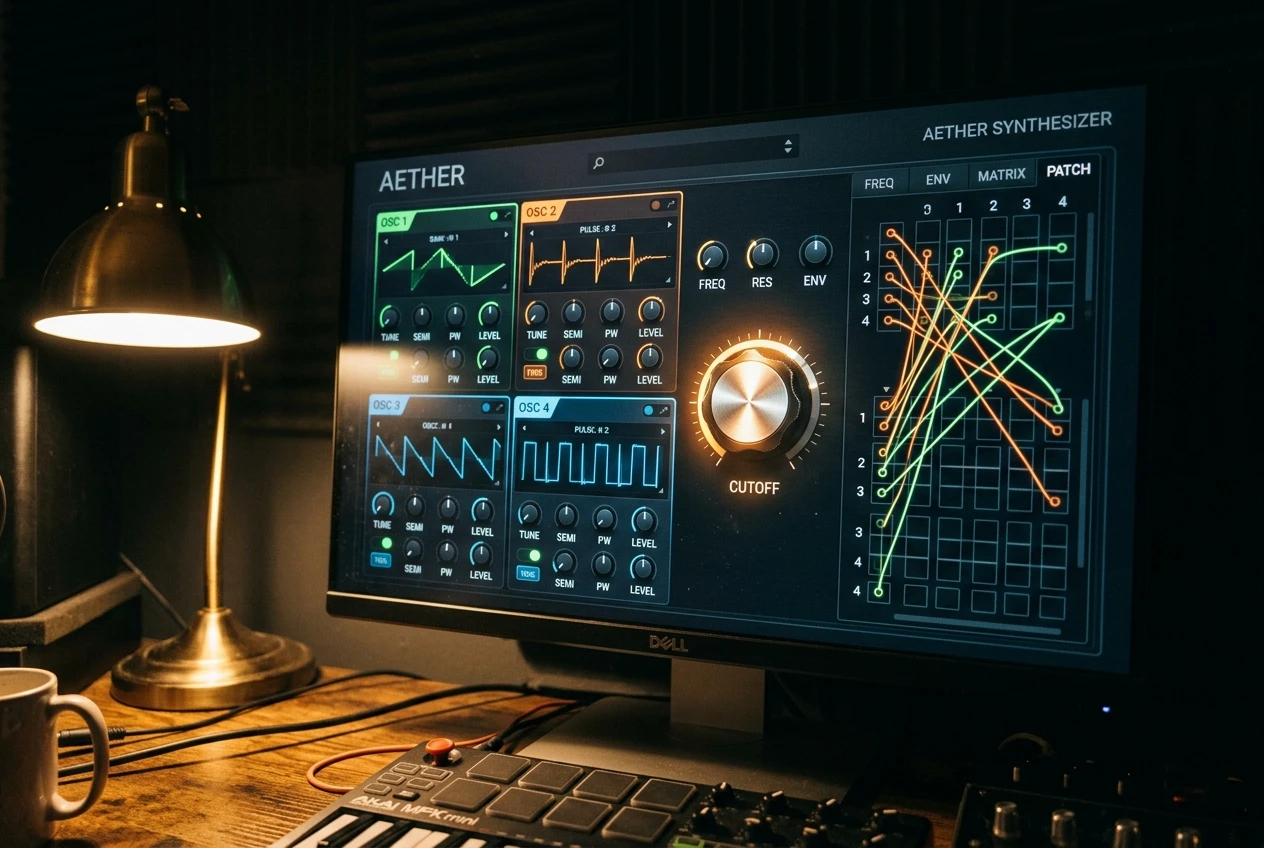
At the heart of TetraOP sit four oscillators, and each one can act as a classic wavetable oscillator or as one of four FM operators. That dual role is the headline feature: the same block behaves as a wavetable voice when the user wants subtractive shaping and as an FM carrier or modulator when the user routes it through the FM matrix. Every oscillator supports up to 16 unison voices per operator with five available unison modes, and the wavetable side ships with familiar controls: level, fine-tune, phase, plus modifiers named bend, skew, and formant. Factory wavetables are bundled, and the plugin accepts imported user wavetables, a choice that opens the door to third-party content packs. The SYNTH ANATOMY walkthrough of TetraOP’s oscillator panel at the SYNTH ANATOMY walkthrough of TetraOP’s oscillator panel steps through each parameter and confirms that oscillators can also modulate themselves, a configuration that pushes the engine well past standard two-operator FM.
The FM and ring modulation side is exposed as a routing matrix with ten pre-defined layouts on the bottom-right of the interface, and users can build their own FM or RM algorithms for the same four operators. Eight phase distortion modes sit alongside the FM and RM routings, giving the synth a Casio CZ-style range that sits in a different corner of the digital synthesis family. Each oscillator also carries the option to self-modulate, an unusual choice that turns a single wavetable voice into its own modulation source.
Four oscillators, sixteen unison voices per operator, ten FM and RM layouts, and eight phase distortion modes: the numbers reflect a free plugin built to a commercial brief rather than a weekend project.
- 16 unison voices per operator
- 5 unison modes
- 10 FM and RM routing layouts
- 8 phase distortion modes
Modulation, Filters, and the Effects Rack
TetraOP feeds its oscillators into a dual multimode filter, and each filter offers five types and four modes. The published list includes digital, analog, 303, and phase flavors, alongside a built-in drive that can push the filter output into heavier harmonic territory. Routing is set inside each filter, which also lets users bypass the filter cleanly or build custom signal paths when they want one oscillator running dry while the rest pass through the filter stage.
Modulation runs through four ADSR envelopes, four function generators that double as LFOs, and a random generator, plus four macros alongside velocity, aftertouch, and mod-wheel sources. Modulators attach to parameters via drag-and-drop, and the assignments show up on a separate modulation matrix page with additional depth and shaping options. The drag-and-drop approach is the same workflow the earlier Rippler releases used, and the consistency matters: a user moving from Rippler X or Rippler into TetraOP finds the same modulation logic in a new skin.
A multi-FX engine on the second interface page ships eight effects: compressor, multimode distortion, chorus, phaser, delay, reverb, and EQ. The slots are reorderable through drag-and-drop, and every effect parameter is modulatable, which lets the FX chain sit inside the same modulation matrix as the oscillators. 10 FM/RM layouts and a modulatable FX chain put TetraOP’s feature count above most free instruments in the same weight class.
The Developer’s Arc: Rippler X, Rippler, TetraOP
Tilr, who publishes under the GitHub handle Tiagolr, has built a long tail of open-source audio tools, and his GitHub profile lists 89 repositories covering synths, effects, and utility code. The synth side of that catalog runs through three releases: Rippler X, Rippler, and now TetraOP. Rippler X arrived roughly a year before TetraOP as a free, open-source physical modeling synth built with the JUCE framework, designed as an open-source alternative to AAS Chromaphone. The open-source RipplerX codebase on GitHub at the open-source RipplerX codebase on GitHub confirms VST3 and LV2 builds for Windows, Linux, and macOS, plus AU for macOS, and nine acoustic resonator models ranging from string and beam to drumhead and closed tube.
Rippler followed in February 2026 as a substantial rewrite of that engine. The February 2026 Rippler release coverage at the February 2026 Rippler release coverage walks through the new feature set: 32 voices, two independent layers with their own gain and pan controls, and twelve resonator models including string, beam, squared, bell, membrane, plate, drumhead, djembe, vibraphone, marimba, open tube, closed tube, and a manual model the user can shape themselves. The modulation engine carried four ADSR envelopes, four multi-wave LFOs, plus velocity, keytrack, aftertouch with MPE, and randomization, and the FX rack offered nine algorithms per layer plus a master FX chain. Rippler was released as freeware even though, per the developer’s own note, it had been designed as a commercial product.
| Synth | Year | Synthesis | Platform support |
|---|---|---|---|
| Rippler X | 2025 | Physical modeling, AAS Chromaphone-inspired | VST3, LV2, AU; macOS, Linux, Windows |
| Rippler | Feb 2026 | Physical modeling, 32 voices, 12 resonators | macOS, Linux, Windows |
| TetraOP | July 2026 | Wavetable and 4-operator FM and RM and CZ phase distortion | VST3, AU; macOS, Linux, Windows |
TetraOP borrows the Rippler X alpha design language and runs on the same drag-and-drop modulation logic, but it swaps physical modeling for wavetable and FM as the synthesis core. The result is three free plugins from the same developer, each tackling a different corner of digital synthesis, and all sharing a consistent workflow.
The Trend Hiding in Plain Sight
On July 6, 2026, reFX posted a teaser for a new synthesizer plugin, and the layout in the video clip lines up closely with the free Rippler that Tilr had published earlier in the year. reFX’s July 6 teaser that walks through the Rippler resemblance at reFX’s July 6 teaser that walks through the Rippler resemblance identifies the same two resonators in the middle of the interface with controls for decay, release, material, and tone, the same exciter sections on the left side covering impulse and noise generators, and the same resonator strength slider position.
The reFX version adds two wave-folding oscillators and two multimode filters that the original free Rippler did not have, plus built-in cutoff, resonance, and drive on those filters, and a routing option for connecting the new oscillators and the resonators through different filter paths. The modulation engine in the commercial version is, per the report, “almost identical to the original layout,” carrying four envelopes, four LFOs, and random generators that can be assigned via drag-and-drop, alongside velocity, key tracking, and aftertouch.
The free Rippler plugin itself is no longer available as a public download. The plugin disappeared after Tiagolr reached an agreement with a development company to release it as a commercial product, and the original developer note captured on the plugin coverage reads:
This synth was designed as a commercial product, last few days decided to release as freeware but there is the possibility of an agreement with a plugin company. Thanks for your time, Tilr.
That note is the through-line. Tilr’s pattern is to build a free, open-source plugin at feature-parity with paid tools, get it into the hands of users, and then license the codebase to a commercial developer for a paid release. 20 years of KVR Developer Challenge history has produced a long list of free plugins that later turned into commercial products, and Tilr’s catalog is now part of that pipeline twice over.
KVR Developer Challenge 2026: a 20-Year Talent Pipeline
The KVR Developer Challenge 2026 opened on April 27, 2026 and is the tenth edition of a competition that first ran in 2006, putting the program at 20 years and counting. The challenge is open to anyone who develops audio plugins, applications, or soundware, and entries must be new and free at launch. The April 27 launch post for the tenth KVR Developer Challenge at the April 27 launch post for the tenth KVR Developer Challenge confirms that cash prizes for the top entries and a wildcard pick are funded by a community donation pool, and that KVR members vote on the entries with whatever criteria they choose.
Past winners show how often the challenge has launched projects that turn into commercial products or long-running free tools:
- Triple Cheese by u-he, 2006
- Multiply by Acon Digital, 2014
- Youlean Loudness Meter, 2016
- ProF.E.T. by Ignite Amps, 2018
- WhispAir by Full Bucket Music, 2021
- Solaris by Adam Szabo, 2023 winner
- Roundels by XiiixxiQ, 2023 wildcard
Other named winners across the same run include Nova-67P by vladg/sound and Emissary by Ignite Amps in 2014, Lagrange by Ursa DSP and Spaceship Delay by Musical Entropy in 2016, Deducktion by Dead Duck Software and MPS by Full Bucket Music in 2018, GR-8 by Phuturetone, Virtuosity Drums by Versilian Studios, and FKFX Influx by FKFX in 2021, plus MONSTER OctaChord v1 by Monster DAW, Wave Breaker by Press Play, and Northern Trumpets by VG Trumpet in 2023.
Where TetraOP Sits Next to Paid FM Synths
TetraOP’s first-impression review positions it as a free instrument that folds wavetable fans and classic FM fans into the same patch, with an open door for hybrid sounds that move between the two worlds. Compared with commercial wavetable and FM synths, the free plugin lacks a built-in wavetable editor and the extra oscillator modifiers that paid tools typically ship, but the feature count already lands at a higher level than most free synths of the same weight class. The release is described as a highlight of this year’s challenge, and the developer note predicts that the factory preset bank will grow as the competition window produces more user feedback.
Frequently Asked Questions
What is Tilr TetraOP?
Tilr TetraOP is a free, open-source synthesizer plugin that combines wavetable synthesis with four-operator FM and ring modulation, plus eight phase distortion modes for Casio CZ-style sounds. It was released on July 8, 2026 as an entry into the KVR Developer Challenge 2026.
Is TetraOP really free, and is the source code open?
Yes. TetraOP is distributed as a free download, and the source code is open, in line with the developer’s previous open-source releases Rippler X and Rippler.
What plugin formats and platforms does TetraOP support?
TetraOP runs as VST3 and AU on macOS in native Apple Silicon and Intel builds, and on Linux and Windows.
Who is the developer behind Tilr TetraOP?
Tilr is the release name for developer TiagoLr, who publishes open-source audio code under the GitHub handle Tiagolr and lists 89 repositories covering synths, effects, and utilities. He previously shipped the Rippler X physical modeling synth in 2025 and the Rippler physical modeling synth in February 2026.
Is reFX’s new commercial synth related to Tilr’s earlier work?
reFX’s July 6, 2026 teaser shows a layout that matches the free Rippler plugin’s resonators, exciters, and modulation section, and the free Rippler disappeared from public release after Tilr reached an agreement with a development company to ship it as a paid product. That makes TetraOP the second time a Tilr release has shifted from free to paid, and the same question will shadow TetraOP until its commercial fate is settled.


OpenAI Ultrafast Puts GPT-5.6 Sol on Live Workloads

Apple’s 15% External Fee Bid Admits Its Own Zero Floor

JBL Beats Bose and Sony on Value for 2026 Soundbars

iPhone Users Pull 40 Percent More From Microdrama Apps

Nebius Q2 Turns AI Cloud Demand Into Prepaid Growth Machine

One UI 9.5 App Lock Ends Years of Samsung Delays

Shiprocket IPO Premium Hides ESOP Costs and Flat Merchant Base

Google Halves Gemini 3.7 Flash Price to Fuel Agent Swarms

Dawnwalker Time Clock Cracks Open-World RPG Habits

Gemini 3.7 Flash Cuts Agent Costs While Pro Stays Delayed

Fable 5 and Mythos 5 Return as US Lifts Anthropic Export Controls

Oracle Cuts 21,000 Jobs in a Year, Cites AI in 10-K Filing

SpaceX’s Google Deal Turns a Rocket Company Into a Cloud Landlord

CD Projekt Red Co-CEO: Redemption Arc Isn’t Done, Witcher 4 in 2027

XPL Rallies 30% Ahead of Plasma One Card Tier Launch

Google Search Profiles Build a Follow Graph Inside Discover

DGO App Brings Rs 549 Mobile Pass for FIFA World Cup 2026 in Nepal

Moonshot AI Targets $30 Billion in China’s Fastest AI Funding Sprint

Microsoft Xbox Layoffs Start in July as Sharma Slams 3% Margin

Oppo’s ColorOS 17 Eligibility List Leaves A-Series Buyers Behind
-
 AI2 months ago
Fable 5 and Mythos 5 Return as US Lifts Anthropic Export Controls
-
 AI2 months ago
Oracle Cuts 21,000 Jobs in a Year, Cites AI in 10-K Filing
-
 AI2 months ago
SpaceX’s Google Deal Turns a Rocket Company Into a Cloud Landlord
-
 GAMING2 months ago
CD Projekt Red Co-CEO: Redemption Arc Isn’t Done, Witcher 4 in 2027
-
 CRYPTO2 months ago
XPL Rallies 30% Ahead of Plasma One Card Tier Launch
-
 NEWS2 months ago
Google Search Profiles Build a Follow Graph Inside Discover
-
 APPS2 months ago
DGO App Brings Rs 549 Mobile Pass for FIFA World Cup 2026 in Nepal
-
 AI2 months ago
Moonshot AI Targets $30 Billion in China’s Fastest AI Funding Sprint