
COMPUTERS
IQM Buys Quantistry Assets to Build Industrial Quantum Software Stack
IQM Quantum Computers bought Quantistry’s software assets the same week it listed on Nasdaq, betting industrial quantum revenue runs through owning the whole software stack.

IQM Quantum Computers acquired selected assets of Quantistry GmbH on July 6, 2026, the same week the Espoo, Finland-based hardware vendor closed its business combination with Real Asset Acquisition Corp. (RAAQ), a Nasdaq-listed special purpose acquisition company (SPAC), and began trading on Nasdaq under the ticker IQMX. The acquisition folds a Berlin-based simulation-software vendor into IQM’s hardware business.
The acquired assets include Quantistry’s proprietary software applications, algorithms, and intellectual property, according to IQM’s July 6 announcement of the Quantistry deal. Quantistry’s core technical, quantum chemistry, and software engineering staff will join IQM. The transaction completed concurrently with the SPAC merger that made IQM the first publicly listed quantum computer company from Europe.
A Hardware Vendor That Just Went Vertical
IQM built its name selling superconducting quantum hardware and on-premises systems to research labs, HPC centers, and enterprises. Quantistry is something different: a Berlin-based cloud platform that lets chemists and materials scientists run simulations without writing quantum code. Combining the two turns IQM into a vendor that sells hardware, software, and an enterprise customer pipeline together. The CEO of the company framed the deal as ‘a bridge between hardware, software, and real industrial applications.’
In the IQM press release, Jan Goetz, the CEO and Co-Founder of IQM Quantum Computers, framed the deal as a bridge between hardware, software, and real industrial applications. The acquisition positions IQM to inherit Quantistry’s existing industrial relationships and ‘transition and expand these enterprise relationships under the IQM brand,’ the release said, with the company offering a continuum that runs from classical simulation through AI-driven optimization into quantum acceleration. IQM was founded in 2018, is headquartered in Finland, runs major operations in Munich, and employs over 400 people across Europe, Asia, and North America.
| IQM Quantum Computers | Quantistry GmbH | |
|---|---|---|
| Headquarters | Espoo, Finland; major operations in Munich | Berlin, Germany |
| Core product | Full-stack superconducting quantum computers | Cloud-native chemical and materials simulation software |
| Listing status | Public; Nasdaq: IQMX since July 2, 2026 | Private; assets now part of IQM |
| Industries served | Enterprises, research, universities, HPC centers, national labs | Automotive, aerospace, chemical, materials, pharmaceutical |
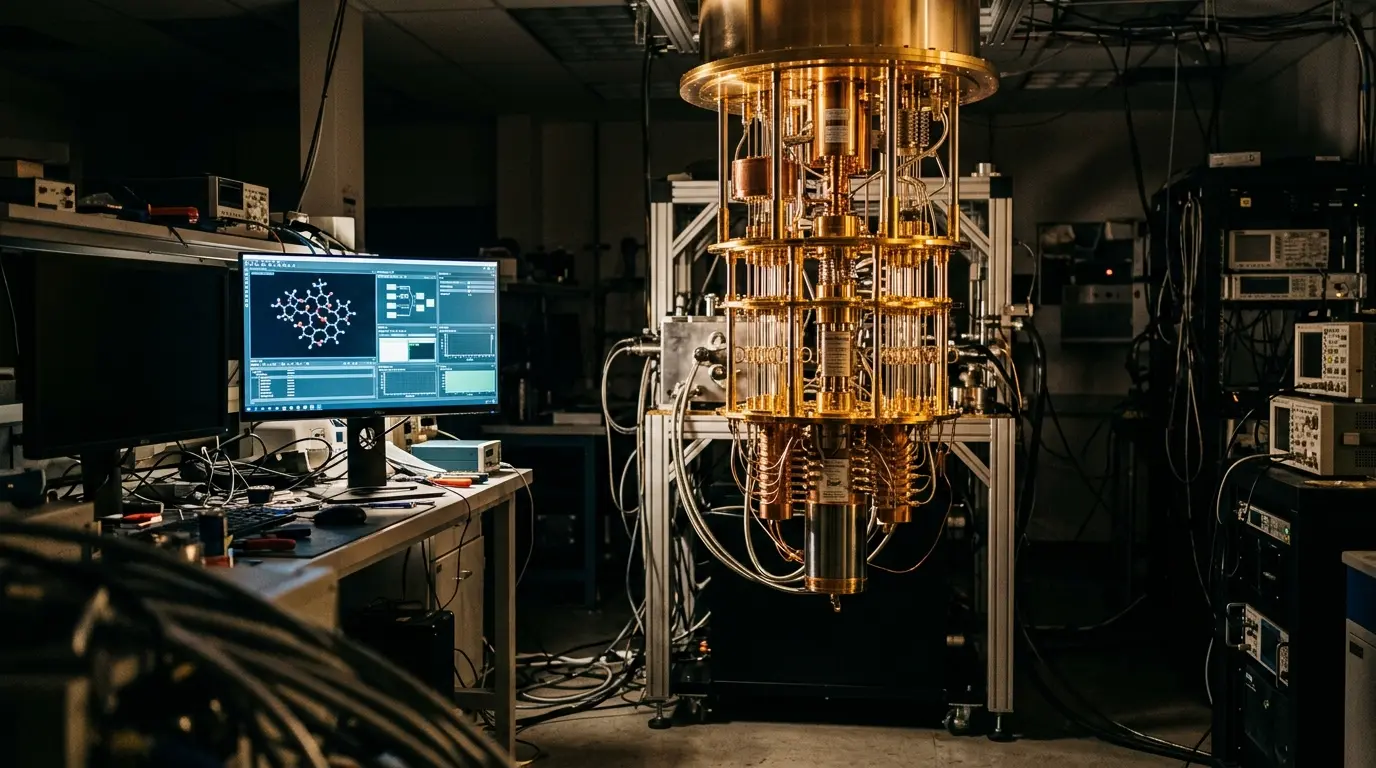
The Software Stack That Now Sits on Top of the Qubits
Quantistry’s selling point is its proprietary machine-learning layer, which the company says lets a user without deep expertise in quantum computing or chemical simulation create and simulate chemical compounds ‘with accuracy on demand.’ That same layer picks the backend for each job, routing work across classical HPC, native AI environments, and quantum machines based on what the workflow needs. A chemist runs a problem on classical hardware today and reruns the same input on a quantum machine once one is ready, without rewriting the workflow. The framework decides which backend is the cheapest path to a given answer, with the user kept out of that decision.
- Classical high-performance computing (HPC) for the bulk of routine chemical and materials calculations.
- Native AI computing environments for the model’s machine-learning-driven routing and surrogate modeling.
- Quantum backends for the small subset of problems where quantum acceleration is expected to matter most.
Under the deal, Quantistry’s platform connects directly to IQM’s quantum hardware. ‘Industrial clients can build a proof of concept inside the IQM ecosystem, then scale it as the hardware improves, without switching platforms or starting over,’ the press release said. For a customer that has spent a year training chemists on one tool, that continuity is what they get to keep.
For a research team that has spent a year training on classical simulation tools, that workflow portability is what the deal buys. The release frames the continuity as the customer-facing benefit, and the joint statement from Goetz and Quennet lands on the same point.
The First Week of Public-Market Life
The asset purchase did not land in a vacuum. On July 2, 2026, IQM completed its business combination with Real Asset Acquisition Corp. and listed on Nasdaq. The transaction was priced at a pre-money equity valuation of approximately USD 1.8 billion, with a PIPE financing that was upsized to over USD 146 million, and disclosed expected cash of up to EUR 406 million (USD 477 million) and 2025 revenue of EUR 31 million (USD 36 million) in the June 2 PIPE upsizing. New and existing investors, including pension insurance company Ilmarinen, added commitments on top of the previously announced USD 134 million PIPE.
The two moves are not separate stories. Going public at a $1.8 billion pre-money valuation put IQM in a position where it can do small, software-led acquisitions without straining the balance sheet, and the expected cash position of up to EUR 406 million sits behind the Quantistry purchase. The release frames the asset purchase as a planned opening act for a public-company growth story.
IQM operates a vertically integrated business model the company calls ‘Production Quantum,’ in which customers own the system, operate it, and grow with it. In the press release, Goetz and Quantistry CEO Dr. Marcel Quennet framed the deal as a step toward that one-stop model, with Quennet calling IQM’s hardware infrastructure ‘the ultimate launchpad to scale our simulation platform.’
The previously announced PIPE of USD 134 million was upsized on June 2, 2026, with Ilmarinen’s $12M commitment. The cash position of up to EUR 406 million is one of the larger balance sheets in the European quantum hardware sector. The PIPE money is the financial firepower the Quantistry deal is being made against.
What the Deal Buys for Industrial R&D
Five industrial verticals sit at the center of the deal: automotive, aerospace, chemical, materials science, and pharmaceuticals. Materials R&D and molecular simulation are the workloads where the case for quantum is most concrete. Modelling catalysts, battery chemistries, lightweight alloys, and drug candidates is expensive and slow on classical hardware, and the problems map to the kind of linear-algebra-heavy computations that quantum machines are expected to accelerate. The same verticals are the ones Quantistry built its software pipeline around.
What Quantistry brings to that pitch is the software layer an R&D manager can actually use. A research chemist is not going to learn Qiskit. Quantistry’s ML layer sits between the chemist and the underlying compute, decides which problems run on classical HPC, which on AI accelerators, and which on a quantum backend, and ships the result back as a usable property prediction. That workflow is the customer-facing layer that IQM lacked, and acquiring it compresses a multi-year software roadmap into a single transaction that lands with enterprise relationships already attached.
Joining forces with IQM Quantum Computers represents a monumental next chapter for our technology and the industry. IQM’s world-class quantum, hardware infrastructure and deep institutional trust provide the ultimate launchpad to scale our simulation platform. Together, we will enable R&D teams to model complex molecular and physical properties with unprecedented speed, moving from theoretical simulation to market-ready material innovation faster than ever before.
In the same press release, Quennet framed the deal as a ‘monumental next chapter’ for the simulation platform and called IQM’s hardware infrastructure ‘the ultimate launchpad to scale’ it. IQM is now selling a single industrial stack that combines Berlin-based chemistry and software talent with Espoo-based superconducting hardware. Industrial R&D budgets favor tooling that survives a hardware refresh, and the deal is structured around that logic. The combined platform’s product pitch is that a customer’s classical compute work today becomes quantum compute work tomorrow, on the same workflow.
Where the Deal Could Crack
IQM is now integrating a Berlin-based software team it did not build, on a public-company timeline, in a market where most quantum-hardware customers are still buying systems, not enterprise software. Three pressure points run through the deal: integration, hardware maturity, and the customer base.
Integration is the first pressure point. The press release promises ‘seamless continuity and rapid platform integration,’ and the same release is long on synergies and short on specifics. Acquired software teams regularly lose the speed that made them attractive, and post-acquisition attrition is the metric investors usually watch first. Quennet said IQM’s hardware infrastructure and ‘deep institutional trust’ provide ‘the ultimate launchpad to scale our simulation platform,’ and the question of how much autonomy the Berlin unit keeps will show up first in the product roadmaps and hiring decisions that follow.
Underneath the software layer sits the second pressure point: the hardware. The release’s own forward-looking statement acknowledges that IQM is ‘pursuing an emerging technology, which faces significant technical challenges and may not achieve commercialization or market acceptance.’ Other European quantum hardware players are scaling on similar timelines, with Quobly’s €115M silicon qubit raise now targeting cloud access in 2026 and HPC deployments in 2027.
The customer base is the third pressure point. The press release describes Quantistry’s enterprise relationships as ‘an exceptional roster of industrial leaders’ but does not list them. IQM is taking on enterprise software revenue risk against a backdrop where most quantum-hardware customers are still national labs, HPC centers, and university groups, not industrial R&D buyers. Quantistry had raised roughly EUR 3 million in disclosed venture funding before the deal, led by Ananda Impact Ventures with contributions from Chemovator, BASF, and IBB.
Goetz says the integration will accelerate IQM’s software development ‘in a capital-efficient way.’ The PIPE money funds the integration, and the next step is connecting Quantistry’s software to IQM’s quantum computers, with industrial clients building proofs of concept inside the IQM ecosystem.
Frequently Asked Questions
What did IQM actually buy from Quantistry?
IQM acquired selected assets, specifically Quantistry’s proprietary software applications, algorithms, and intellectual property, and retained the company’s core technical, quantum chemistry, and software engineering staff. The transaction was structured as an asset purchase rather than a full company acquisition, and the release did not disclose a transaction price.
When did the Quantistry deal close?
IQM announced the acquisition on July 6, 2026, with the press release stating that the transaction ‘completed recently, concurrently with’ the IQM-RAAQ business combination that closed on July 2, 2026.
Why is the deal happening the same week as the SPAC merger?
IQM completed its business combination with Real Asset Acquisition Corp. and began trading on Nasdaq under the ticker IQMX on July 2, 2026. The Quantistry asset purchase, announced later in the same week, follows a PIPE financing that was upsized to over USD 146 million on June 2, 2026, at a pre-money equity valuation of approximately USD 1.8 billion, and the PIPE was supported by new and existing investors, including pension insurance company Ilmarinen.
What is Production Quantum, and how does Quantistry fit?
Production Quantum is IQM’s term for its customer-owned model, in which buyers operate the system themselves and grow with it as the hardware improves. The Quantistry acquisition extends that model to the software layer: industrial customers get a single workflow that can run on classical HPC, AI compute, or quantum hardware, all inside the IQM environment.
Disclaimer: This article is for informational purposes only and does not constitute financial or investment advice. The information presented reflects publicly available company announcements and is accurate as of publication. Readers should consult a qualified financial professional before making any investment decisions.


Workers Still Trust Judgment Over the AI Tools They Use

DigitalOcean’s $894 Million Backlog Rewrites the Old Cloud

Companies Froze Job Design and Called AI a People Problem

AI Capex Looks Unique Because the Chips Wear Out

Samsung Medison’s HERA Z10 Aims at the Sonographer Shortage

GPT-6 Astra Ships as OpenAI’s First Critical Cyber Model

Palms Sells Clean Air Without Ending Casino Smoking

OnlyFans Promo Bots on X Now Pass the Humanity Tests

Datamaran Drops the ESG Label After Winning the Argument

Xiaomi’s Own Chip Lands While Apple Argues Over Color

Oracle Cuts 21,000 Jobs in a Year, Cites AI in 10-K Filing

Fable 5 and Mythos 5 Return as US Lifts Anthropic Export Controls

SpaceX’s Google Deal Turns a Rocket Company Into a Cloud Landlord

CD Projekt Red Co-CEO: Redemption Arc Isn’t Done, Witcher 4 in 2027

XPL Rallies 30% Ahead of Plasma One Card Tier Launch

Google Search Profiles Build a Follow Graph Inside Discover

DGO App Brings Rs 549 Mobile Pass for FIFA World Cup 2026 in Nepal

Moonshot AI Targets $30 Billion in China’s Fastest AI Funding Sprint

Oppo’s ColorOS 17 Eligibility List Leaves A-Series Buyers Behind

Microsoft Xbox Layoffs Start in July as Sharma Slams 3% Margin
-
 AI3 months ago
Oracle Cuts 21,000 Jobs in a Year, Cites AI in 10-K Filing
-
 AI2 months ago
Fable 5 and Mythos 5 Return as US Lifts Anthropic Export Controls
-
 AI3 months ago
SpaceX’s Google Deal Turns a Rocket Company Into a Cloud Landlord
-
 GAMING3 months ago
CD Projekt Red Co-CEO: Redemption Arc Isn’t Done, Witcher 4 in 2027
-
 CRYPTO3 months ago
XPL Rallies 30% Ahead of Plasma One Card Tier Launch
-
 NEWS3 months ago
Google Search Profiles Build a Follow Graph Inside Discover
-
 APPS3 months ago
DGO App Brings Rs 549 Mobile Pass for FIFA World Cup 2026 in Nepal
-
 AI3 months ago
Moonshot AI Targets $30 Billion in China’s Fastest AI Funding Sprint