
CRYPTO
EU’s New Crypto Ban Power Hits Russia’s Evasion Rails Hardest
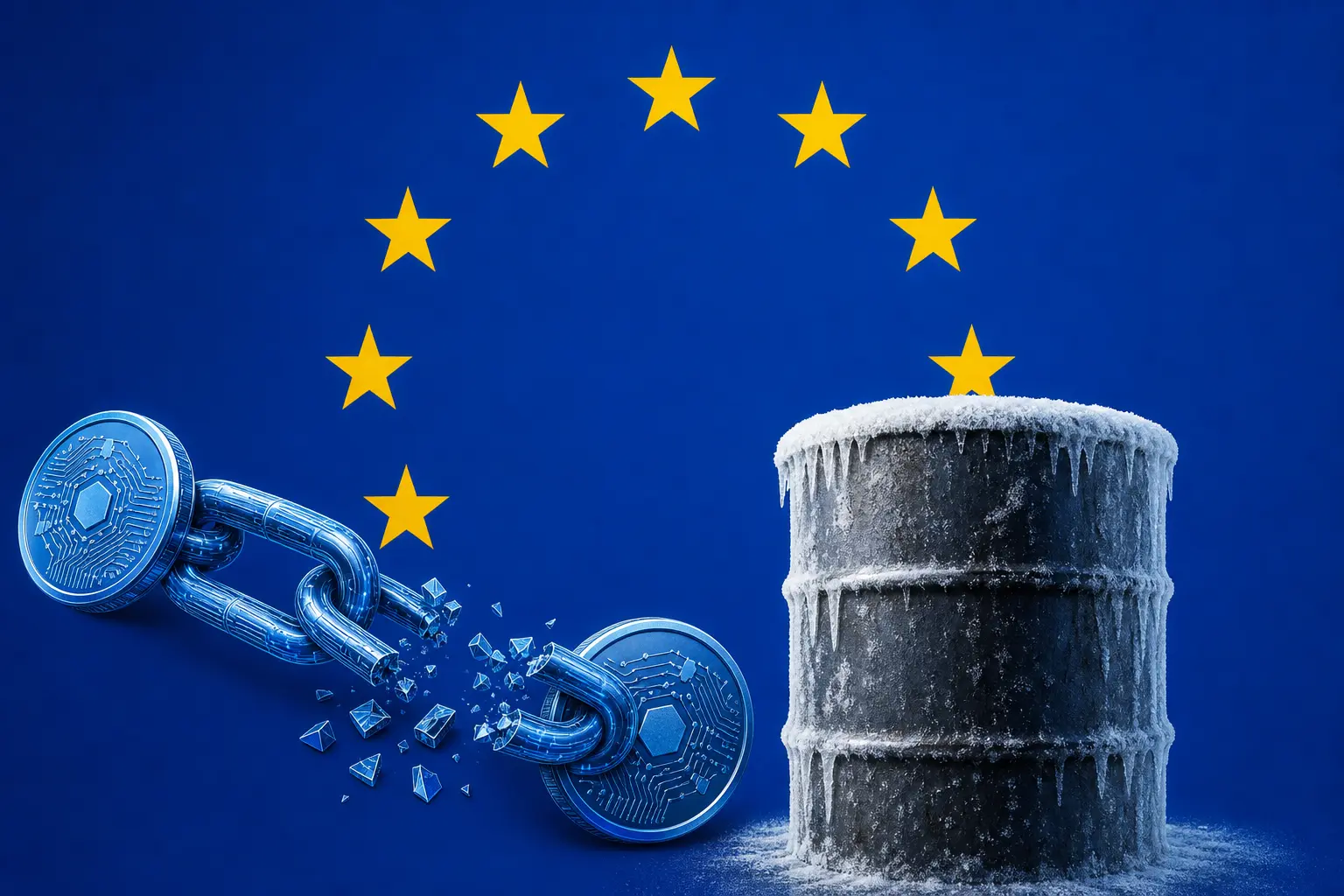
The EU’s 21st Russia package freezes the oil price cap and creates first-ever third-country crypto service bans, targeting 14 platforms and a $120B network.

The European Union adopted its 21st package of restrictive measures against Russia on 23 July 2026, freezing the oil price cap at $44.10 per barrel until 15 July 2027 and creating the first legal power to ban entire third countries from providing crypto-asset services to EU operators. The package adds 218 listings, the largest batch in four years, and places transaction bans on 14 crypto platforms across six jurisdictions plus asset freezes on 94 banks.
High Representative Kaja Kallas framed the round as cutting financial lifelines. The deeper shift sits in the new crypto instrument, which turns every offshore hub hosting Russia-linked platforms into a potential systemic risk for EU firms.
The Crypto Power That Goes Beyond Named Platforms
For the first time the EU can impose a full third-country ban on crypto-asset services. Any EU operator could be barred from dealing with any provider in a designated host country that Russia uses for evasion. Officials cast it as a deterrent aimed at jurisdictions that shelter platforms.
The package already extends a transaction ban to 14 crypto-related service platforms based in Georgia, Panama, the UAE, the Marshall Islands, Kyrgyzstan and Belarus. Four further designations hit the cross-border A7 network, including fresh Africa links. Chainalysis data shows the associated A7A5 ruble-backed stablecoin has processed volumes approaching $120 billion, built expressly as a sanctions-evasion rail on Ethereum and Tron.
We’re hitting over a hundred banks and crypto operators, 40+ vessels in Russia’s shadow fleet, and several oil refineries in Russia and Belarus.
Kaja Kallas said that in her statement accompanying the package. Days earlier Russia’s State Duma had passed its first comprehensive crypto market law, with most rules due 1 September. The timing puts the new EU tool directly against Moscow’s attempt to formalise digital rails.
EU crypto-asset service providers (CASPs) now face expanded screening duties. Transaction bans mean no funds to or from the listed platforms. The third-country option raises the ceiling: a host state that becomes a known haven could see all its providers cut off from the EU market at once.
- Georgia, Panama, UAE, Marshall Islands, Kyrgyzstan, Belarus: jurisdictions of the 14 platforms under immediate transaction ban
- A7 network: four new designations covering Africa expansion
- Third-country ban instrument: first-time authority for blanket crypto-service cut-offs
- Compliance trigger: CASPs must refresh Russia-risk and third-country exposure models immediately
On X, crypto accounts quickly labelled the third-country power the most material move yet against Russian-linked networks. Skeptics replied that evasion simply migrates; the structural tool is designed to raise the cost of that migration for host governments as well as operators.
Ninety-Four Banks and the Parallel Financial System
Asset freezes and a prohibition on making funds available now cover 94 banks and major financial institutions, plus one prominent figure in Russia’s banking establishment. A transaction ban extends to 33 additional Russian credit and financial institutions. One Kyrgyz bank linked to the SPFS messaging system and three other non-Russian banks face the same ban for circumvention.
These steps target the remaining channels that still move money for the war economy after earlier SWIFT exclusions and listings. The A7 designations close another loop that mixed traditional finance with crypto settlement.
The numbers sit inside a wider pattern. Earlier packages already banned A7A5 itself and related entities. This round goes after the distribution and African extension, then adds the country-level deterrent. For EU banks and payment firms the practical effect is denser due-diligence files and higher residual risk on any Central Asian or Gulf counterpart with Russian exposure.
Oil Price Cap Frozen While Shadow Fleet Expands the Net
The package pauses automatic adjustment of the oil price cap until 15 July 2027. The freeze keeps the cap at its current $44.10 per barrel level even as the Strait of Hormuz closure has driven Urals and global prices sharply higher. An interim review will check whether the suspension remains necessary and proportionate.
Without the freeze the dynamic mechanism (15 percent below average market price) would have lifted the cap toward $58, handing Moscow a revenue windfall. Greece’s objections to broader LNG service bans shaped the final compromise; a full ban on transporting Russian LNG to third countries was dropped, while the oil-cap pause was extended from an initial six-month idea to a full year-plus.
Shadow-fleet measures tighten in parallel. Forty-one more vessels join the 632 already listed. For the first time the rules also cover vessels that support the fleet through bunkering and other services. Eight entities and one individual in the shadow-fleet ecosystem are designated, including companies acting for Russian oil majors and, newly, a crewing agency.
| Measure | Scale | Detail |
|---|---|---|
| Oil price cap | Frozen at $44.10 | Until 15 July 2027, interim review |
| Shadow fleet vessels | +41 | On top of 632; support vessels now in scope |
| Shadow ecosystem | 8 entities + 1 individual | Includes first crewing agency |
| Oil-sector designations | 18 entities + 1 individual | 3 Russian refineries, 1 major Belarusian refinery |
| Georgian refinery | Transaction ban | Kulevi plant, force in six months |
Eighteen oil-sector entities and one individual are listed, among them three Russian refineries and a major Belarusian one. A company set up to sell Belarusian petroleum products inside Russia is also hit. The package creates authority to ban transactions with listed refineries that process Russian crude, and applies that immediately (with six-month delay) to the Georgian facility in Kulevi. Five oil traders join the transaction-ban list for frustrating the Russian oil purchase prohibition.
Critical-infrastructure pressure adds a key cross-border energy supplier, a Russian Railways figure, two ports and four airports under transaction bans. LNG tanker sales now carry notification duties and the option of further restrictions on sales to Russian persons, plus contractual clauses against resale for Russian use.
Long-Range Drones and the Dual-Use Supply Chain
Fifty-six listings target the military-industrial complex. Thirty-seven of them link directly to long-range drone production and supply chains. Fifty-one new entities face tighter dual-use export restrictions; some sit in China (including Hong Kong), India, Kazakhstan, Kyrgyzstan, Türkiye and the UAE and have helped circumvent controls on microelectronics, CNC tools and semiconductor equipment.
Export bans expand to nickel powders, corrosion-resistant metal alloys for jet engines, beryllium powders for propellants, self-adhesive films used in aerospace, and a suite of UAV-specific aviation items: ground support, jamming systems, launch systems, servomotors and flight-termination gear.
Import restrictions hit goods that generate significant Russian revenue (over €60 million category), including copper, nickel and lead ores, precious-metal ores, unwrought zinc, alkaline-earth metals, zinc and chromium oxides, glassware, imitation pearls and car parts. Belarus measures largely mirror the Russian trade and legal-protection steps.
Combatants, Propaganda and War Crimes Listings
The package lays the legal basis for a comprehensive visa ban on Russian combatants and ex-combatants, including proxy groups. Member states retain the decision on when it enters into force; France and Italy had earlier objected to an immediate blanket ban.
Eight individuals are designated for spreading war propaganda. A Major General is listed for torture, executions and desecration of Ukrainian military bodies, including prisoners of war. That sits alongside the 13 July human-rights designations.
Gold-sector actors (seven major), one leading diamond company, and mining and metallurgy entities lose access. EU operators gain stronger legal shields: courts and member states may refuse to recognise or enforce Russian court decisions obtained in litigation over EU restrictive measures.
What Changes for Markets and Compliance Teams
Oil traders face a lower effective price ceiling for Russian barrels for another year, plus expanded vessel and refinery exposure. Crypto firms and banks must treat the 14 platforms and A7 network as immediately off-limits and model the possibility of country-wide cut-offs. Dual-use exporters tighten end-use checks on the newly listed third-country entities.
The full background on EU Russia sanctions shows the cumulative architecture: earlier energy embargos, financial exclusions and crypto asset bans now reinforced by structural tools. The Council Regulation amending Ukraine integrity rules and companion decisions publish the legal texts.
On the ground the shadow fleet still sails and new stablecoin variants can appear. The second-order bet is that raising the price for host jurisdictions and forcing EU operators into automatic cut-off readiness will shrink the viable space faster than pure entity lists alone.
Kallas’s Kallas post announcing the package stressed that this is not the end of the road and that the EU is already preparing further steps. The third-country crypto authority gives those steps a new lever.
Frequently Asked Questions
What is the third-country crypto ban and when can the EU use it?
It is a new legal instrument allowing the Council to prohibit any EU operator from transacting with any crypto-asset service provider in a designated third country if that country hosts platforms used by Russia for sanctions evasion. No specific country has been designated yet; the power itself is the deterrent and can be activated by further decision.
Which crypto platforms are under the immediate transaction ban?
Fourteen unnamed platforms headquartered or operating in Georgia, Panama, the UAE, the Marshall Islands, Kyrgyzstan and Belarus. EU persons and entities may not send or receive funds involving them. Separate A7 network designations add four more related parties with Africa links.
How does the oil price cap freeze work after the Hormuz disruption?
The automatic 15-percent-below-market adjustment is paused until 15 July 2027, locking the cap at the existing $44.10 per barrel. An interim review will test whether the freeze stays necessary. The step prevents a market-driven rise that would have increased Russian oil revenue while Hormuz closure elevated global prices.
Does the package ban Russian soldiers from entering the EU right away?
No. It only creates the legal basis for a comprehensive visa ban on combatants and ex-combatants of the Russian armed forces and proxy groups. The Council still has to decide the entry-into-force date; earlier proposals for an immediate ban met resistance from some member states.
What happens to the A7A5 stablecoin under these measures?
A7A5 was already restricted in prior packages. The 21st package adds designations around the broader A7 network that issues and distributes it, including African expansion nodes. Chainalysis research on A7A5 stablecoin volume and ties documents its role as a purpose-built ruble settlement rail that has moved tens of billions.
Are Belarus measures identical to the Russia ones?
They largely mirror the Russian package on trade (import bans on high-revenue goods and military-related export restrictions) plus legal protection for EU operators. Specific Belarus listings and implementing acts were adopted in parallel on the same day.


Menlo’s keyboard-kill bet hits $2 billion with Wispr

OnePlus and Oppo hikes hand AI memory costs to Indian buyers

Bit Reactor bets studio future on Star Wars Zero Company

AI Price Cuts Tighten Power Demand and Rewrite Capacity Deals

Honor Robot Phone sale starts with a gimbal that cuts both ways

Ethereum’s price lag hides its growing role as finance infrastructure

Designkit turns product photos into e-commerce videos at scale

Germany Forces Neutral Apple ATT Prompts Across Most of Europe

Korea AI Job Shift Erases Youth Roles While Seniors Gain

Meta Faces States Over Child Safety Claims in Oakland Trial

Fable 5 and Mythos 5 Return as US Lifts Anthropic Export Controls

Oracle Cuts 21,000 Jobs in a Year, Cites AI in 10-K Filing

SpaceX’s Google Deal Turns a Rocket Company Into a Cloud Landlord

CD Projekt Red Co-CEO: Redemption Arc Isn’t Done, Witcher 4 in 2027

XPL Rallies 30% Ahead of Plasma One Card Tier Launch

Google Search Profiles Build a Follow Graph Inside Discover

DGO App Brings Rs 549 Mobile Pass for FIFA World Cup 2026 in Nepal

Moonshot AI Targets $30 Billion in China’s Fastest AI Funding Sprint

Oppo’s ColorOS 17 Eligibility List Leaves A-Series Buyers Behind

Microsoft Xbox Layoffs Start in July as Sharma Slams 3% Margin
-
 AI2 months ago
Fable 5 and Mythos 5 Return as US Lifts Anthropic Export Controls
-
 AI2 months ago
Oracle Cuts 21,000 Jobs in a Year, Cites AI in 10-K Filing
-
 AI2 months ago
SpaceX’s Google Deal Turns a Rocket Company Into a Cloud Landlord
-
 GAMING2 months ago
CD Projekt Red Co-CEO: Redemption Arc Isn’t Done, Witcher 4 in 2027
-
 CRYPTO2 months ago
XPL Rallies 30% Ahead of Plasma One Card Tier Launch
-
 NEWS2 months ago
Google Search Profiles Build a Follow Graph Inside Discover
-
 APPS2 months ago
DGO App Brings Rs 549 Mobile Pass for FIFA World Cup 2026 in Nepal
-
 AI2 months ago
Moonshot AI Targets $30 Billion in China’s Fastest AI Funding Sprint