
NEWS
Honor Robot Phone Sale Tests a Costly Gimbal Bet
Honor opened China sales of the Robot Phone, a 9,999 yuan gimbal flagship that cannot shoot 4K with its arm deployed.

Honor opened China sales of the Honor Robot Phone on August 18, a compact flagship whose rear camera sits on a motorized titanium arm. The 12GB and 512GB model is 9,999 yuan (about $1,480), and the 16GB and 1TB model is 12,999 yuan. Both colors, Silver and Grey, ship with a lifetime YOYO AI SVIP plan and a box that includes a magnetic stand, a lanyard, and a 120W charger.
Honor spent more than 100 patents getting that arm into a 9.59 mm body. Reviewer Connor Jewiss, walking a pre-production unit through London rain on September 13, found the mode you buy the arm for cannot record 4K.
A Titanium Arm Rises From a 9.59 mm Slab
The gimbal lives in the rear camera plateau behind a dust cover you slide open by hand. Tap the gimbal control and a titanium arm lifts the main camera on four degrees of freedom. Docked, that same 200MP sensor shoots like a normal flagship lens. It is one camera with two lives, not a bonus shooter bolted on the side.
Honor’s 200MP Agile Gimbal Main Camera uses a 1/1.28-inch sensor and an f/1.6 aperture. Beside it sit a 200MP periscope telephoto with a 1/1.4-inch sensor, f/2.6, 2.7x optical zoom and 200x digital zoom, plus a 50MP ultrawide with a 122° field of view and f/2.0. The front camera is 50MP. Honor puts the motor at 2.6 g and 360° per second, and says the 4-DoF stack is 65% smaller and 200% stronger than mainstream gimbals after 60 manufacturing steps and more than 100 precision parts.
THE THREE REAR CAMERAS
| Camera | Sensor and lens | What it does |
|---|---|---|
| Gimbal main | 200MP, 1/1.28-inch, f/1.6 | Rises on the 4-DoF titanium arm |
| Periscope telephoto | 200MP, 1/1.4-inch, f/2.6, 2.7x | Stays fixed in the body |
| Ultrawide | 50MP, 122°, f/2.0 | Stays fixed in the body |
The phone is 248 g on a 6.31-inch LTPO OLED that Honor rates at 1 to 120Hz, 6,800 nits peak, 4320Hz PWM dimming, and a NanoCrystal Shield. Power comes from a 7,060mAh silicon-carbon pack with 120W wired and 50W wireless charging, and from Qualcomm’s Snapdragon 8 Elite Gen 5 platform under MagicOS 10 on Android 16. Honor sells that package as a pocket camera crew. The company’s own post puts the pitch in one line.
Your phone now has its own cameraman. 🤖🎥
Meet the HONOR Robot Phone—featuring a built-in titanium gimbal and ARRI image science.#HONORRobotPhone pic.twitter.com/SkKDtglDqW— HONOR (@Honorglobal) August 10, 2026
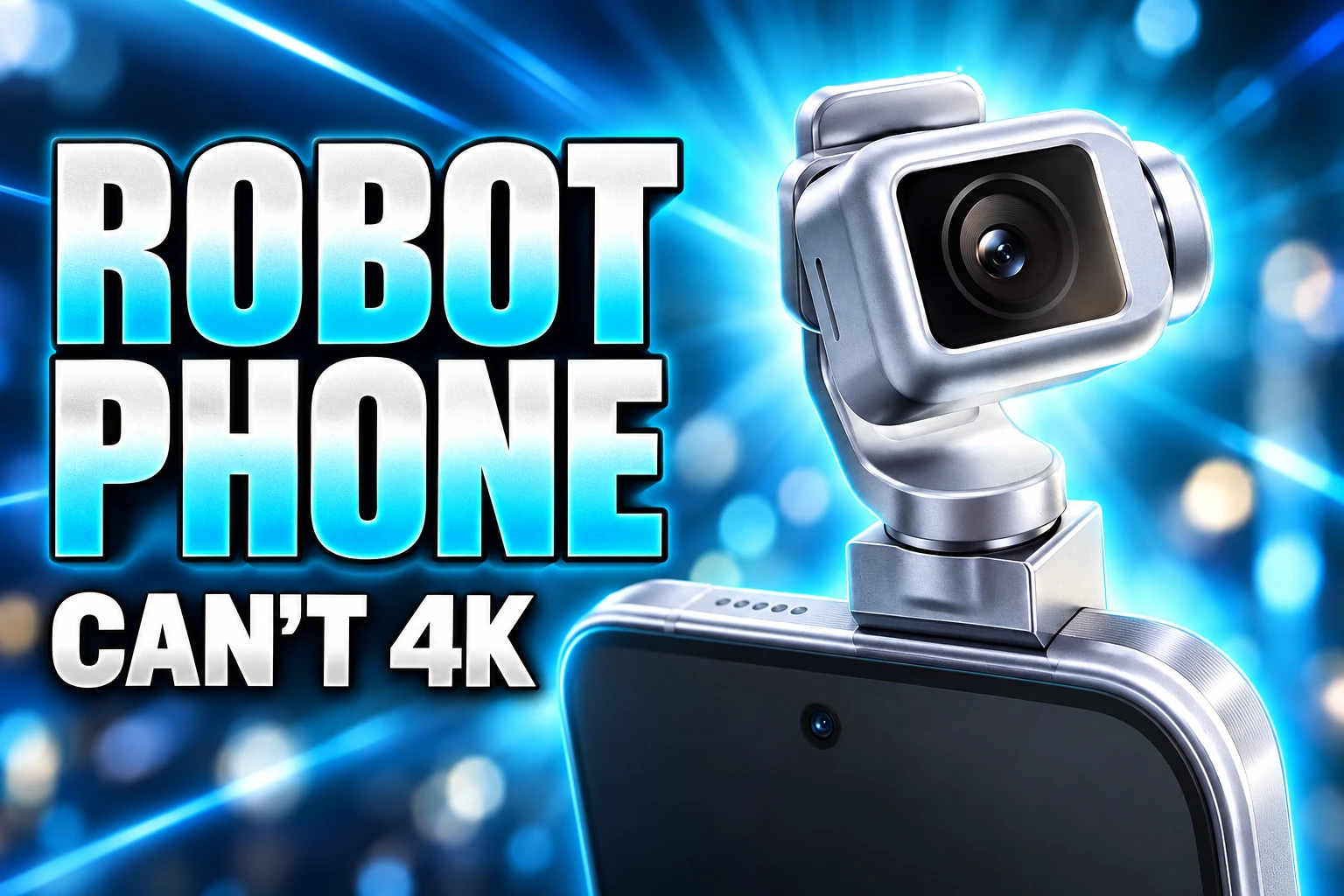
The Gimbal You Want Cannot Shoot 4K
Jewiss wanted to know if a motor in the phone beats the software stabilization every other 2026 flagship already ships. For shake, the Honor arm won his outdoor walk test against a Pixel 11 Pro XL, a bare iPhone 17 Pro Max, and that same iPhone in an Insta360 Flow 2 Pro. Tracking held through a 180° turn of the body until he drifted off the edge of the sensor’s view, and the motor stayed quiet on a city street.
Then the recording settings collapse. With the arm out, video is capped at 2.8K. 4K remains only when the gimbal is tucked away, so the shooting mode that justifies the weight is the softest one. Jewiss said “the camera mode you’d actually want to film with is the one with the lowest resolution,” and Honor did not say whether that is a crop or a hard limit. In his rain walk the Honor footage was also noisier than the Pixel’s, the mics turned a fountain into a storm, and the pack dropped around 10% in under an hour of gimbal filming.
The cover is part of that bargain. If you leave it shut, the phone blocks the deploy and warns you on screen, which is the right fail-safe. Leave it open in a pocket and you are trusting a sliding pane over a motor people already drop.
James Li Overruled Engineers Who Said No
Honor CEO James Li told staff and guests in Guangzhou on August 12 that this is not another software filter. He said the company’s AI agent should read a shooting request and then drive the camera and the gimbal, an “intermediary layer connecting AI models with sensors and physical actuators.” When Shenzhen-based Honor started the project, Li said, “there were many objections,” because motors force a new split among weight, thickness, power, reliability, and cost. “We are confident in this,” he added.
Looking back at a century of imaging, every major leap has come from the evolution of both light capture and intelligent processing. Hardware sets the foundation for image quality, while algorithms deliver the leap.
James Li, CEO of Honor, Honor Robot Phone launch, Guangzhou
That is the wager in plain language. Honor is asking buyers to carry 248 g and a moving joint so YOYO can pan, tilt, and follow, while every rival still bets that computation can fake a gimbal. Li also said the industry question in two or three years will be whether phone hardware can still host agents that act, not whether every slab grows an arm.
How Much Does the Honor Robot Phone Cost?
The Honor Robot Phone has two China retail prices and no other official ones. The 12GB and 512GB model is 9,999 yuan, the 16GB and 1TB model is 12,999 yuan, and Honor set official sales starting August 18 at 10:08 AM after pre-orders opened at 8:30 PM on August 12. Li said at that launch that pre-orders had already passed more than 400,000. Honor has not published a later sell-through figure.
THE TWO CHINA MODELS
| Memory | Price | What is in the box |
|---|---|---|
| 12GB RAM, 512GB storage | 9,999 yuan | Magnetic stand, lanyard, 120W charger, lifetime YOYO SVIP |
| 16GB RAM, 1TB storage | 12,999 yuan | Same gift pack and YOYO SVIP |
Those prices sit in true flagship air, and they are still lower than the 15,000 yuan-plus guesses that circulated before Honor printed the list. You are paying for a motor, an ARRI color path, and a spare-part problem the slab phones next to it do not have. You are not paying for a published IP rating. Honor told Jewiss the IP numbers going around were not its own, then let him keep filming in steady rain with the arm out.
ARRI Looks and a Neck for YOYO
The Robot Phone is the first shipping product under Honor’s cinematic imaging partnership with ARRI. In ARRI CINEMA mode the gimbal main camera records 10-bit ARRI LogC3 with ARRI Wide Gamut 3 and ARRI Looks, processed through Honor’s H1 image chip. Honor says AI noise reduction lifts video SNR by 8 dB and that dynamic-range work supports up to 14 stops, with the pipeline cleaning noise in RAW, running 14-bit 4:4:4, and writing 10-bit LogC3 4:2:2 that can go into DaVinci Resolve with ARRI LUTs. That is the same family of Log C cinema encoding ARRI uses to hold highlight and shadow data instead of a finished Rec.709 picture.
ARRI chief product officer David Bermbach said the two companies “come from different industries, but we share one ambition: to expand what creators can achieve with the tools they carry every day.” Honor has already said the same imaging work will keep moving onto the Magic9 series, which is a hint that the color science may outlive this particular arm.
WHAT THE ARM IS FOR
- Cinematic moves: Tilt Lock, FPV, FPV Vertical, and AI SpinShot, plus 90° and 180° rotations on a tap.
- Tracking: Subject lock, double-tap to switch targets, voice pointing, and live follow on apps such as Douyin and WeChat.
- YOYO Robot Mode: The gimbal dances to music, answers waves and thumbs-up, and matches on-screen faces with small head turns.
- Agent jobs: YOYO Auto Execution runs multi-step tasks, and Agent Skills lets outside developers hook the gimbal.
YOYO Robot Mode is the shop-floor demo. It gives the assistant a neck, which is a clearer pitch than another chat bubble. Jewiss could not test that layer in London, because Honor has not turned Robot Mode on outside China, and the dancing clip is a weak reason to spend 9,999 yuan if the video file is 2.8K.
Replacing the Gimbal Costs 3,079 Yuan
Honor told Jewiss the arm is durable enough for regular use, then declined to share a cycle count. Foldables publish lab folds in the hundreds of thousands. This phone does not. Honor also prices the spare: swapping the gimbal camera module costs 3,079 yuan, almost a third of the 9,999 yuan model. Teardown clips already treat that module as something you unscrew and unplug, which is honest engineering and a running cost.
THE COST OF THE MOVING PART
- Spare module: Honor quoted 3,079 yuan to replace the gimbal camera.
- Cover: A manual slide has to open before the arm will rise, and a flimsy pane is an easy pocket snag.
- Heat and drain: Long gimbal recording warms the body, and Jewiss saw around 10% fall off in under an hour.
- Abuse clips: A viral “it died by itself” video shows the arm being shoved off path, blocked on a table, and loaded with a charger.
The mechanism can be bullied into a stall, which is true of any small motor. It is also true that a phone lives in bags, sinks, and back pockets in a way a DJI Osmo Pocket does not. Honor’s machining claims, 0.005 mm precision and a 0.4 mm rotation gap, do not answer what a two-meter drop does to that gap.
Does the Honor Robot Phone Leave China?
The first Honor Robot Phone is a China retail product with no second-market date. Honor staged a global launch in Guangzhou, showed the arm at Mobile World Congress in March 2026, then at Cannes Film Festival’s China Night and the 28th Shanghai International Film Festival, and still opened buying only on Honor’s China store and local partners. Jewiss’s London unit ran the Play Store, which is how Honor’s European press loaners usually arrive, and that is not a shelf date for London or Berlin.
FROM MWC TO THE CHINA STORE
- March 2026: Honor shows the Robot Phone at Mobile World Congress.
- Festival circuit, 2026: Stabilized tracking shots run at Cannes China Night and the 28th Shanghai International Film Festival.
- August 12, 2026: Guangzhou launch; China pre-orders open at 8:30 PM; Li says pre-orders are more than 400,000.
- August 18, 2026: Open sales begin at 10:08 AM in China at 9,999 yuan and 12,999 yuan.
- September 13, 2026: Jewiss’s rain test records the 2.8K gimbal cap and a 3,079 yuan module price.
Honor has not ruled out a later global SKU and has not committed to one. A second unit would need a larger slice of the sensor so the arm can keep 4K, a published durability figure, and a cover that does not ask you to remember a slide before every vlog. Until that phone exists, the bet is the one on sale in China: a titanium neck for YOYO, cinema color from ARRI, and a spare part that already has a price.

Instagram Plus Tests a Read-Only Mode That Cuts Stories

Altman Asks the Public to Accept Some AI Harm

Google Freezes OSS VRP Product Reports After AI Flood

AI Agents Make Payment Rails the Scarce Prize

Turkey’s Crypto Boom Now Runs Through Three Banks

Fable 5 Came Back Under a Commerce On-Off Switch

Google’s SpaceX GPU Lease Has a Sept. 30 Deadline

Plasma One’s XPL Locks Face a 1.81 Billion Cliff

DGO’s Rs 549 World Cup Pass Cost Fans Sleep and Data

Moonshot AI’s $30 Billion Ask Became a $35 Billion Close
-
 AI4 months ago
Fable 5 Came Back Under a Commerce On-Off Switch
-
 AI4 months ago
Google’s SpaceX GPU Lease Has a Sept. 30 Deadline
-
 CRYPTO4 months ago
Plasma One’s XPL Locks Face a 1.81 Billion Cliff
-
 APPS4 months ago
DGO’s Rs 549 World Cup Pass Cost Fans Sleep and Data
-
 AI4 months ago
Moonshot AI’s $30 Billion Ask Became a $35 Billion Close
-
 NEWS4 months ago
ColorOS 17 Device List Spans Oppo, OnePlus and Realme
-

 GAMING4 months ago
Xbox Cuts 3,200 Jobs After Five Years of Thin Returns
-

 GAMING4 months ago
The RTX 4050 Under Rs 70,000 Hides a Wattage Gap