
AI
ONR Bets on AI to Run Research and Multiply Program Officers
The Office of Naval Research will use AI to conduct basic research itself, aiming to outpace adversaries while building validation guardrails and AI aides for.

The Office of Naval Research will use artificial intelligence to conduct basic and applied research itself, not only study AI for ships and Marines, under its new science-and-technology strategy released this week. The goal is machine-driven acceleration that outpaces adversaries in discovery, invention and fielding.
Chief of Naval Research Dr. Rachel Riley framed the document as a break from “peanut butter spreading” across too many small bets. The second-order effects land on validation methods, program-officer capacity and governance rules that must keep pace with the very speed the office now seeks.
Riley’s Bet Against Spreading Thin
ONR marks its 80th anniversary in 2026. Public law created the office in 1946 to foster scientific research for naval power. The new strategy, titled the 2026 Office of Naval Research S&T strategy, retools that mission around disciplined choice.
Riley’s introductory letter states that strategy in innovation organizations “requires placing informed bets, and sometimes big ones.” Resource allocation is core work. The office must put portfolios on the highest and best uses and adjust as data arrives.
The portfolio already runs unusually wide: Technology Readiness Levels 1 through 6 or 7. That span takes ideas from basic principles through demonstration in relevant or operational environments and across the so-called Valley of Death. Eleven enduring S&T focus areas and 63 subordinate research areas structure the bets. AI and autonomy sit at the top of the list.
- AI and Autonomy sub-areas: machine learning; adversarial AI and autonomy; intelligent and collaborative agents; perception and understanding; autonomous systems control; modeling, simulation, testing, verification and validation.
- Other focus areas: C5ISR and naval space; directed energy and kinetic systems; materials and electronics; human and biological systems; manufacturing; naval engineering; naval aerospace; ocean, atmosphere and space; power and energy; undersea systems.
The operating framework is now called “FEED at Speed”: Focus, Engage, Explain, Deploy, plus Speed. Speed means organizational fixes and tools such as AI so the rate-limiting factor becomes the physical science itself, not bureaucracy.
What Research by AI Means
The strategy draws a bright line between research on AI and research by AI. ONR will keep funding naval use cases. It will also begin a strategic initiative to let AI systems perform the research.
ONR will begin a strategic initiative to not only research AI for naval use cases but also use AI to conduct basic and applied research. The goal is to achieve machine-driven acceleration in research to outpace adversaries in the discovery, invention and fielding of new technology. ONR will use AI to compress combinatorial search problems to accelerate scientific research and will search for new forms of accelerated research, such as AI hypothesis-driven research or other methods, yet to be discovered.
Officials wrote those lines in the Speed section of the document. Combinatorial search compression is the near-term lever. Hypothesis-driven research by AI is the farther one. Both aim at the same outcome: shorter cycles from question to fieldable result for Sailors and Marines.
This sits inside a wider 2026 push. Acting Secretary of the Navy Hung Cao signed the Department of the Navy’s Strategy to Weaponize Data and Artificial Intelligence earlier in the summer. Cao said the roadmap builds an “AI-first” Fleet that can “out-learn and out-fight any adversary.” Secretary of Defense Pete Hegseth’s January Artificial Intelligence Strategy for the Department of War directed the department to become an AI-first warfighting force from front to back. ONR’s move is the research arm matching that tempo.
Program Officers Become Force Multipliers
The most immediate workplace change hits program officers. POs already manage complex portfolios under tight administrative load. ONR will invest in specialized AI assistant tools so each officer can stay current with fast-changing technology, spot new research and non-traditional performers, synthesize results, and automate routine tasks.
Education is part of the package. Officers will learn how researchers themselves now apply AI inside scientific workflows. Data-informed portfolio analysis is the payoff. The strategy states a single PO will dramatically enhance scientific productivity. The explicit goal is not replacement. It is exponential increase through large-scale networks of coordinated performers and agents that produce asymmetric effects in problem-solving and time.
| AI support for POs | Intended effect |
|---|---|
| Stay current with technology | Faster awareness of emerging work |
| Identify non-traditional performers | Broader performer base beyond usual labs |
| Synthesize researcher results | Quicker portfolio insight |
| Automate administrative tasks | More hours on high-value decisions |
| Data-informed portfolio analysis | One PO covers more ground with higher quality |
That shift changes the human bottleneck. A smaller number of well-tooled officers can oversee wider networks. Non-traditional performers gain a clearer path in if the AI tools surface them. Traditional academic and lab performers face a new expectation that their own AI use will be visible and comparable.
The Validation Collision Arrives First
Faster generation of hypotheses, results and designs solves only half the problem. The strategy immediately asks how those outputs will be checked: human review, experimental confirmation, or independent AI critique.
Human review and physical experiment reintroduce the old bottleneck and can erase the speed gain. Independent AI critique is the novel path. AI systems would validate, red-team and quality-check work from both AI performers and human ones. ONR will develop governance and human oversight frameworks with defined ethical and security guardrails.
Crowd reaction around the parallel Navy AI-first documents already flags the practical brake: data readiness and trustworthy evaluation. Prototypes that answer strategy language in days still carry notional sensor numbers and explicit human command loops. The same pattern will apply inside ONR. Machine-generated science that cannot be independently red-teamed or experimentally confirmed will not reach the fleet faster; it will stall in review. Guardrails are therefore not a side policy. They are the second system that must be invented at the same pace as the research system.
- July 2026: ONR releases S&T strategy with research-by-AI initiative and PO AI tools.
- June-July 2026: Acting SECNAV Cao signs Navy data-and-AI weaponization strategy for an AI-first Fleet.
- January 2026: Secretary Hegseth issues Department of War AI strategy directing AI-first force posture.
- Ongoing: ONR continues long-range BAAs and focus-area investments while adding AI workflow tools.
Bureaucracy busting runs in parallel. ONR is cutting redundant approvals inside its own echelon, seeking Science and Technology Reinvention Laboratory waivers, ending budgeting pauses, and automating internal operations. Every team member is asked to name bottlenecks. The physical science should be the only rate limit left.
Only ONR Problems and the Transition Path
Focus remains non-negotiable. ONR will apply an “Only ONR” filter: challenges at the intersection of high transformational potential and unique naval applicability where the commercial market is unlikely to invest. Basic research rarely offers the returns private capital wants. Applied work narrows further. If ONR does not pursue these problems, no one else will deliver them in time.
Transition remains the historic weak point. Mismatches between S&T cycles and acquisition timelines, weak demand signals from the Fleet, and scarce partners through engineering and manufacturing have stranded inventions. The strategy recalibrates Future Naval Capabilities and Innovative Naval Prototypes toward transformational outcomes and redesigns technology maturation for specific warfighter solutions. Warfare Area Leads match operational demand with S&T supply and push feasible tech outward.
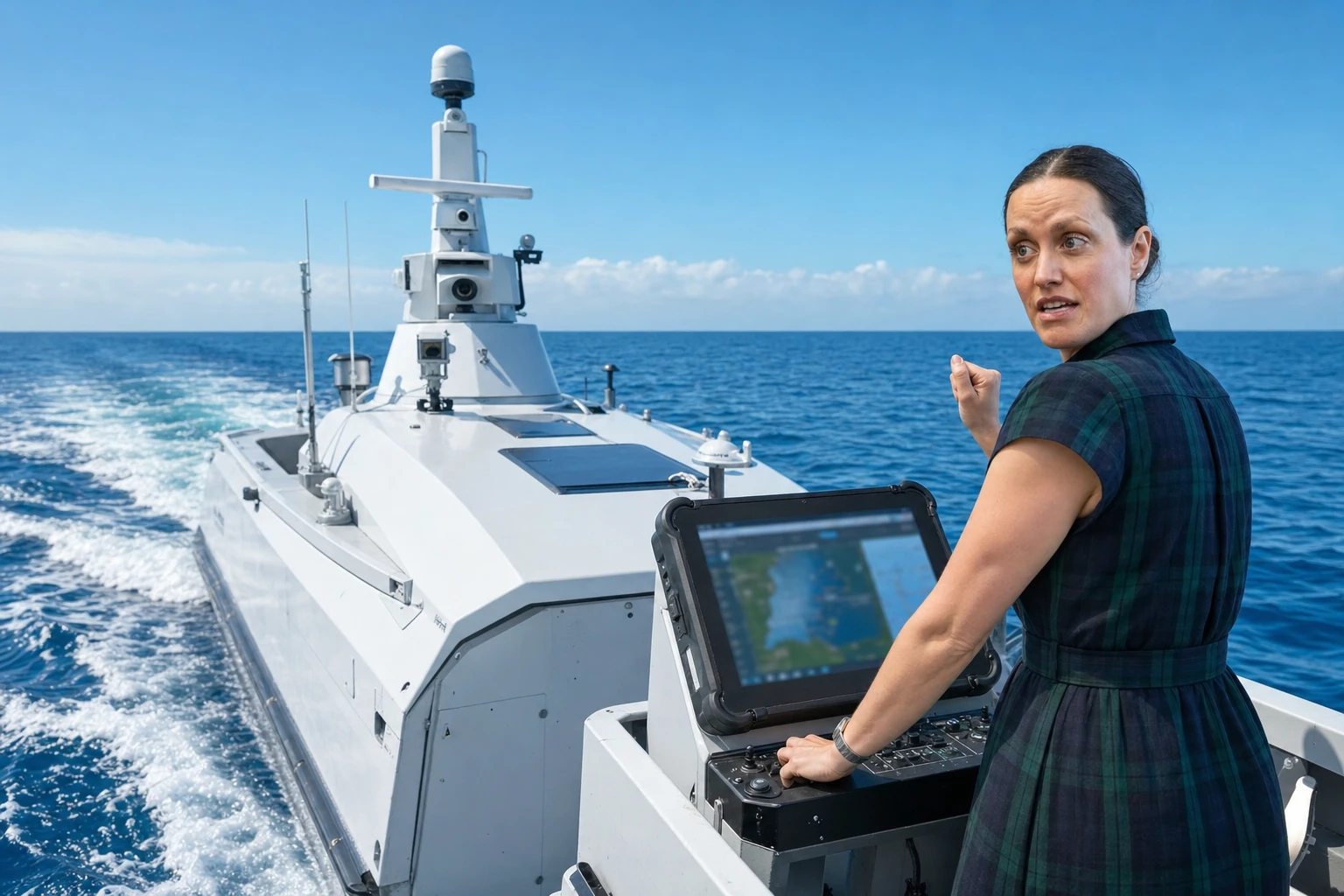
Recent delivery examples already appear in the document. The Medium Displacement Unmanned Surface Vessel Seahawk reached the Fleet in 2026 alongside its predecessor Sea Hunter. All-analog processors smaller than a penny, hexapod mobility demos, and the DSEND atmospheric dive suit illustrate the span from micro-electronics to human systems.
Performers, Budgets and the Next Year
Performers should watch the ONR funding opportunities and BAAs. The long-range BAA remains open on a rolling basis. AI and autonomy topics sit high. Young Investigator and MURI programs continue to seed early-career and multi-university work. A single PO equipped with AI assistants can now evaluate more proposals and non-traditional teams, which raises the bar for clarity and AI-native workflows in submissions.
DoD-wide AI and autonomy funding requested for FY2026 has been reported near $13.4 billion across offices. ONR is one accessible channel for maritime autonomy, human-machine teaming and sensor fusion. The research-by-AI initiative does not replace that portfolio; it changes how the office generates and vets work inside it.
Over the next year the open questions are concrete. Which combinatorial search problems get compressed first? How fast can independent AI critique tools reach production use with real security guardrails? Does a single PO’s measured output actually rise by the “dramatic” margin claimed? And does the Valley of Death shrink when both generation and validation move at machine speed? The strategy supplies the intent. Execution will show whether the second-order systems keep up with the first.
Frequently Asked Questions
What is the difference between research on AI and research by AI at ONR?
Research on AI funds naval use cases such as machine learning for sensors, adversarial robustness, collaborative agents and autonomous control. Research by AI means ONR will also deploy AI systems to perform the scientific work itself, including compressing combinatorial searches and testing AI hypothesis-driven methods that have not yet been invented.
Will AI replace ONR program officers?
No. The strategy states the goal is not replacement. Specialized AI assistants will handle currency tracking, performer discovery, result synthesis and routine administration so one officer can oversee larger coordinated networks of human and machine performers and produce asymmetric problem-solving capacity.
How will ONR validate results generated by AI?
Three paths are listed: human review, experimental confirmation, and independent AI critique that red-teams both AI and human outputs. Because the first two can reintroduce human bottlenecks, independent AI critique plus new governance frameworks with ethical and security guardrails form a core part of the initiative.
How does the ONR strategy connect to Secretary Cao’s and Secretary Hegseth’s AI pushes?
Cao’s Navy strategy calls for an AI-first Fleet that out-learns and out-fights adversaries by turning data into decisions faster. Hegseth’s January Department of War AI strategy directs an AI-first force across the entire department. ONR’s research-by-AI and PO-tool moves are the S&T arm executing that same tempo and measurement culture inside naval discovery.
What are ONR’s 11 science and technology focus areas?
They are AI and autonomy; C5ISR and naval space; directed energy and kinetic systems; materials and electronics; human and biological systems; manufacturing; naval engineering; naval aerospace; ocean, atmosphere and space; power and energy; and undersea systems. Sixty-three research areas sit underneath them and guide investments from basic science through advanced technology development.
What does “FEED at Speed” stand for?
Focus on high-impact Only ONR problems, Engage stakeholders more transparently, Explain naval relevance and transition paths for every program, Deploy technology fastest in partnership with acquisition and the Warfighter while measuring results, and Speed invention with organizational fixes and AI so bureaucracy is no longer the limiter.


South Korea Retail Investors Face Reckoning After KOSPI AI Rally Collapses

Surrey AI Maps Three Heart Attack Paths and Their Molecular Roots

Germany Locks Neutral Apple ATT Prompts Across Most of Europe

Apple’s 5% EU Fee Quietly Rewrites Alternative App Store Math

Apple’s EU Fee Truce Cuts Complexity but Leaves Rivals Fuming

Pixel 11 Pro Fold Trades Thinness for Durability and Seven-Year Stay

Mayo AI Flags HCM Obstruction From Everyday Ultrasound Videos

Indian Brands Quietly Scale Landmark Screens and Home Tech

Navin Vatsa Turns Grief Into a Lifetime of Quiet Seeing

Google Bets Pixel 11 Agentic AI Will Redefine Phones

Oracle Cuts 21,000 Jobs in a Year, Cites AI in 10-K Filing

Fable 5 and Mythos 5 Return as US Lifts Anthropic Export Controls

SpaceX’s Google Deal Turns a Rocket Company Into a Cloud Landlord

CD Projekt Red Co-CEO: Redemption Arc Isn’t Done, Witcher 4 in 2027

XPL Rallies 30% Ahead of Plasma One Card Tier Launch

Google Search Profiles Build a Follow Graph Inside Discover

DGO App Brings Rs 549 Mobile Pass for FIFA World Cup 2026 in Nepal

Moonshot AI Targets $30 Billion in China’s Fastest AI Funding Sprint

Oppo’s ColorOS 17 Eligibility List Leaves A-Series Buyers Behind

Microsoft Xbox Layoffs Start in July as Sharma Slams 3% Margin
-
 AI2 months ago
Oracle Cuts 21,000 Jobs in a Year, Cites AI in 10-K Filing
-
 AI2 months ago
Fable 5 and Mythos 5 Return as US Lifts Anthropic Export Controls
-
 AI3 months ago
SpaceX’s Google Deal Turns a Rocket Company Into a Cloud Landlord
-
 GAMING2 months ago
CD Projekt Red Co-CEO: Redemption Arc Isn’t Done, Witcher 4 in 2027
-
 CRYPTO2 months ago
XPL Rallies 30% Ahead of Plasma One Card Tier Launch
-
 NEWS3 months ago
Google Search Profiles Build a Follow Graph Inside Discover
-
 APPS2 months ago
DGO App Brings Rs 549 Mobile Pass for FIFA World Cup 2026 in Nepal
-
 AI3 months ago
Moonshot AI Targets $30 Billion in China’s Fastest AI Funding Sprint