
AI
Starbucks Builds AI Apps to Replace Microsoft and IBM
Starbucks is coding its own inventory and maintenance tools with AI while still running a Microsoft barista assistant, after a failed counting app.

Starbucks is coding its own inventory and maintenance software with AI tools, aiming at a $400 million yearly license bill. An internal presentation put a Microsoft stock-tracking system and an IBM maintenance platform first in line, with a possible rollout by the end of 2027 if tests hold.
The same chain already runs a barista assistant on Microsoft Azure OpenAI. In May 2026 it retired an AI shelf scanner that miscounted milk and syrups across North American stores.
Homegrown Code for Inventory and Store Maintenance
Chief Technology Officer Anand Varadarajan told staff earlier in 2026 that the company spends about $400 million a year on software. “There’s clear opportunities to reduce the spend in software,” he said in an internal forum, according to a recording of the meeting. The presentation reviewed in July 2026 said engineers are using AI-assisted coding to build replacements rather than keep paying for generic suites.
Follow-on accounts of that presentation named the Microsoft side as Dynamics 365-class inventory software and the IBM side as TRIRIGA. Starbucks has also spent years on an internal point-of-sale build meant to succeed Oracle Simphony. None of those swaps is live. The presentation said some homegrown tools could reach stores by the end of 2027, pending tests.
THE STORE SOFTWARE UNDER REVIEW
| System | Job | Who supplies it | Status |
|---|---|---|---|
| Microsoft inventory stack | Track stock | Microsoft | In-house AI-coded replacement in testing toward 2027 |
| IBM maintenance platform | Equipment upkeep | IBM | In-house AI-coded replacement in testing toward 2027 |
| Automated Counting | Scan milk and syrups | NomadGo | Retired May 2026 |
| Green Dot Assist | Recipes and equipment help | Microsoft Azure OpenAI | 35-store pilot in June 2025; U.S. and Canada rollout set for fiscal 2026 |
| Oracle Simphony POS | Checkout | Oracle, with an internal rebuild underway | Multi-year project, still in progress |
The presentation said the technology group was reviewing every contract and service. In-house code can drop recurring license and support fees, which matters inside a companywide push for $2 billion in gross savings through fiscal 2028. It also moves the risk. Starbucks has to write, secure, and run the tools in thousands of cafes if the vendors step back.
Microsoft Sells the App and the AI That Would Replace It
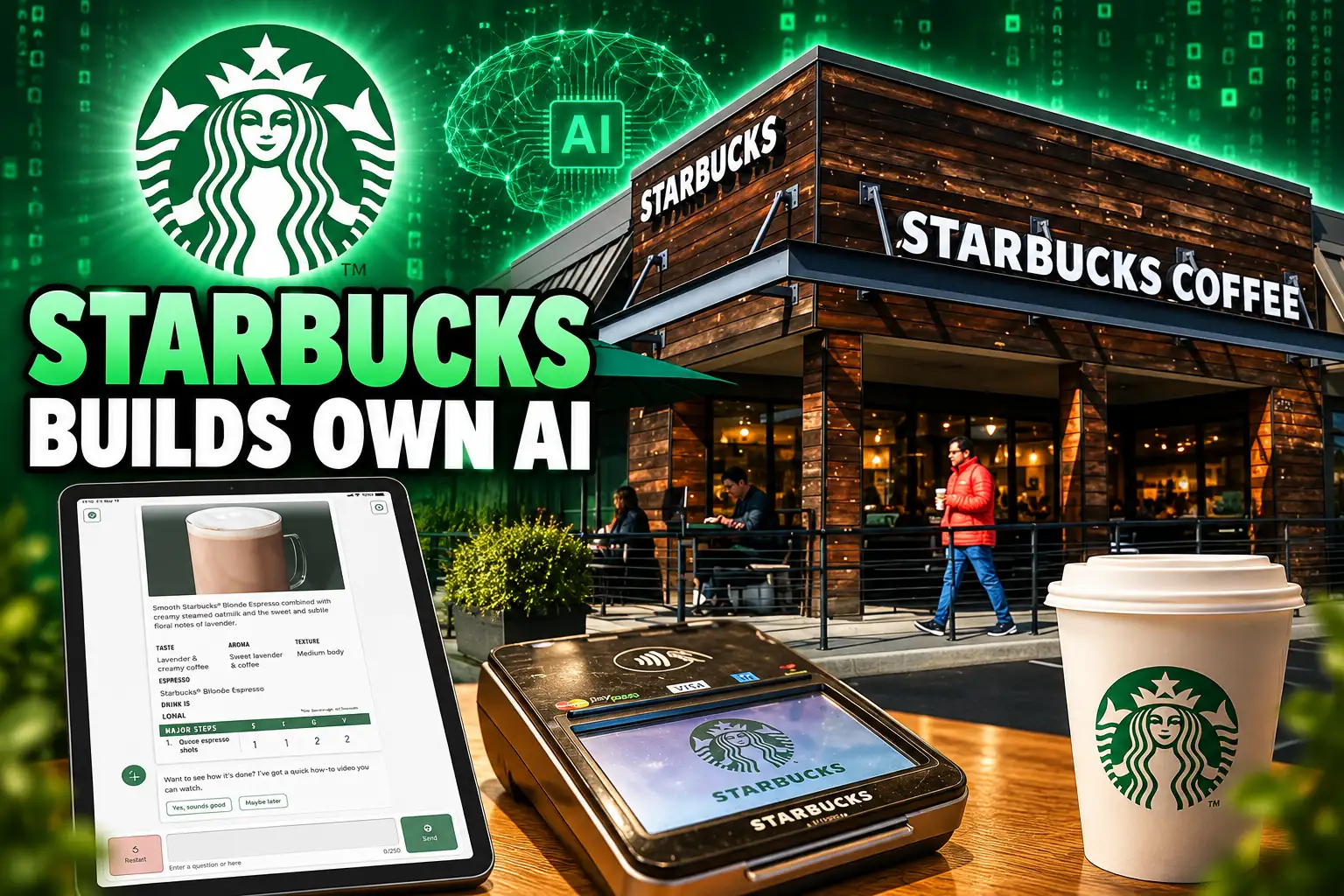
Microsoft still collects on both sides of this plan. It sells the inventory application Starbucks wants to leave, and it sells the Azure OpenAI stack behind the barista assistant the chain is rolling toward stores. On June 10, 2025, Starbucks introduced Green Dot Assist on in-store iPads, built with Microsoft Azure’s OpenAI platform, and put it in 35 coffeehouses with a wider U.S. and Canada launch set for fiscal 2026.
Then-CTO Deb Hall Lefevre told store leaders the assistant would let baristas type or speak questions instead of flipping through manuals. Starbucks said partners could get drink recipes, short how-to videos, food pairings, and help when a machine threw an error. Later ideas included opening an IT ticket when equipment failed and suggesting coverage when someone called out.
WHAT GREEN DOT ASSIST WAS BUILT TO ANSWER
- Recipes: Instant guidance on seasonal drinks so a barista does not hunt through cards mid-rush.
- Equipment: Troubleshooting steps when an espresso machine or oven flags an error.
- Pairings: Food suggestions tied to a drink, such as a lemon loaf with a lavender oatmilk latte in the launch demo.
- Coverage: Help for managers filling a shift when a barista calls out, listed as a later step.
That assistant keeps Microsoft in the store even if Dynamics-class inventory licenses shrink. Microsoft documents a real-time inventory visibility service that posts on-hand, ordered, in-transit, returned, and quarantined stock across warehouses, order systems, and point-of-sale feeds. A cafe still has to know whether the carton on a steel fridge shelf is real stock. Those are different jobs, and Starbucks is trying to own the second one.
IBM has less of that cloud cushion. The TRIRIGA facilities maintenance suite automates corrective and preventive work, asset lifecycle, and service orders. IBM has since folded TRIRIGA into Maximo Real Estate and Facilities and is selling AI features on that stack, including lease abstraction and workflow automation. Starbucks is writing a private replacement anyway. License revenue is what moves on a leak like this. Azure consumption can rise in the same quarter a Dynamics line shrinks.
Oat Milk, Peppermint Syrup and a Retired Scanner
The coding bet is not the first time this company put AI on inventory. In September 2025 it spread Automated Counting, an app from Seattle firm NomadGo, across North American stores as part of CEO Brian Niccol’s push to fix shortages he had blamed for lost sales. Cafe workers held a tablet up to shelves of milks, syrups, and other beverage components. The app used camera and LiDAR data and was supposed to finish in minutes a job that had taken more than an hour by hand.
NomadGo has said on its site that the product is 99% accurate. Store reality was messier. Workers and managers told interviewers the app mixed up similar milk types, skipped bottles, and sometimes missed stock sitting in plain view. A promotional video Starbucks itself posted showed the scanner passing over a peppermint syrup bottle while it counted the bottles on either side.
In February 2026 the company still said adoption had improved product availability. In May 2026 it killed the program, nine months after the North American rollout. An internal newsletter that week told stores: “Starting today, Automated Counting will be retired.” Beverage components and milk, it said, would be counted the same way as every other inventory category in the coffeehouse. In a statement, Starbucks said it wanted to standardize how inventory is counted as it focused on consistency and execution at scale. Hand counts came back.
That failure sits next to the new project, and it is easy to mash them together. They are not the same AI. Automated Counting was computer vision in a fridge. The Microsoft and IBM work is AI-assisted coding of back-office systems. One broke on oat milk. The other still has to survive store tests in 2027. Token bills and a larger internal payroll can also chew through money that looks, on a slide, like license savings.
An Amazon Grocery Veteran Owns the Build
Varadarajan joined on January 19, 2026 as executive vice president and CTO, reporting to Niccol. Starbucks hired him after Hall Lefevre retired in September 2025 and Ningyu Chen served as interim CTO. Niccol told partners Varadarajan spent nearly 19 years at Amazon, most recently leading technology and supply chain for Worldwide Grocery Stores, including work tied to Whole Foods Market and Amazon Fresh. He had earlier software jobs at Oracle and at startups. He holds an undergraduate degree from the Indian Institute of Technology, a master’s in civil engineering from Purdue, and a master’s in computer science from the University of Washington.
He knows how to create systems that are reliable and secure, drive operational excellence and scale solutions that keep customers at the center.
Brian Niccol, chairman and chief executive officer, partner memo announcing the hire
That grocery-systems background is the point of the hire. Starbucks wants store software that matches how a cafe actually runs, not a suite tuned for a thousand other industries. The July presentation said AI-assisted coding was central to the IBM maintenance replacement, and that the company had been pushing technology staff to use AI tools, including by folding usage into bonuses. Speed is the pitch. Running the result in peak-hour stores is the test Amazon grocery ops would recognize.
$400 Million in Licenses and a $30 Million Cut
The $400 million figure is the annual software bill Varadarajan put in front of staff, not a savings target. The near-term cut is smaller and already dated. The internal presentation said the enterprise technology team was on track to reduce its budget by about $30 million in the fiscal year ending in late September 2026. About $10 million of that was lower software spend. Another $13 million was expected mostly from fewer contractors at professional-services firms, with some roles filled by Starbucks staff. Those two slices add to $23 million. The presentation did not spell out the rest of the $30 million in the extracts that circulated.
Ten million dollars is 2.5% of a $400 million software bill. It is a trim, not an exit. The $2 billion program is wider still. On the fiscal 2026 third-quarter call, management said the company remained on track for $2 billion in gross savings through fiscal 2028, spread across product and distribution costs, operating expenses, and G&A. Consolidated G&A fell by about 20% in that quarter, helped by cost work, the deconsolidation of the China business, and a comparison against a year that included a large leadership event. Cathy Smith, the chief financial officer, has said G&A was the fastest lever while other savings take longer to show up.
THE COST CUT ALREADY ON THE BOOKS
- Annual software bill: About $400 million, per Varadarajan’s internal forum.
- FY2026 tech budget: About $30 million lower, per the internal presentation.
- Software slice: About $10 million of that $30 million.
- Contractor slice: About $13 million, mostly from less outside professional-services labor.
Other large software buyers will try a version of this if the 2027 tools actually run. That copycat risk, not one coffee chain’s invoice, is why a leaked cafe-ops presentation can hit enterprise software names. IBM, Salesforce, and ServiceNow all sold off on the July 9, 2026 session in various prints of the story. The percentages did not agree across those prints, so the useful fact is the direction: investors treated a build-vs-buy flip as a sector problem, not a Starbucks footnote.
Chennai Adds 800 Engineers to the In-House Roster
On September 21, 2026, Varadarajan told the technology team that Starbucks had chosen Chennai for a new technology hub in Chennai, after saying earlier in the year that an India hub was planned for fiscal 2027. He called it a step toward a more flexible, globally connected technology group. The company said Chennai was picked for a deep talent pool, retention, long-term business needs, and fit with how teams already work in Seattle, Nashville, London, and Hong Kong.
The Tamil Nadu government said the same day that Starbucks had signed a memorandum of understanding to put a global capability center in Chennai and hire about 800 technology professionals. The hub will run apart from the Tata Consumer Products joint venture that operates Starbucks cafes in India. Starbucks said it is still in early planning for local hiring, office readiness, and working rhythms, with recruiting expected to begin in the first quarter.
The July presentation had already flagged new technology offices in Nashville and India. Chennai is that India line turning into a city, a headcount, and a hiring calendar. Bringing contractor work in-house was part of the $13 million slice. An 800-person hub is how a company tries to make that shift stick. It is also a new fixed cost that has to be earned back if the Microsoft and IBM replacements slip past 2027.
What Has to Work Before a 2027 Switch?
The presentation did not promise that Dynamics-class inventory or TRIRIGA-class maintenance would be dark on January 1, 2028. It promised tests. A homegrown inventory system has to feed stores without repeating Automated Counting’s misreads, and a homegrown maintenance tool has to dispatch work on espresso machines and ovens without a silent miss during peak hours. Green Dot Assist can still sit on Azure while those back-office builds proceed. Oracle’s checkout stack is a separate, slower rebuild.
WHAT 2027 TESTING HAS TO PROVE
- Counts: Store-level inventory that matches the fridge, not a camera’s guess at a reflection.
- Tickets: Maintenance work orders that reach the right technician before a bar goes down.
- Cost: License savings that still show up after model usage, internal payroll, and the Chennai hub.
- Cutover: A path off Microsoft and IBM that does not freeze thousands of cafes on a bad build.
WHAT WE KNOW
- The targets: A Microsoft inventory system and an IBM maintenance platform are on an internal replacement list, with AI-assisted coding as the method.
- The money: About $400 million a year in software spend, a $30 million FY2026 tech-budget cut, and a $2 billion gross-savings plan through fiscal 2028.
- The people: Varadarajan has run the technology group since January 19, 2026, and Chennai is the India hub city, with about 800 tech jobs per the state government.
WHAT IS UNCONFIRMED
- Go-live: No public test score, store-count, or contract-termination date for the Microsoft or IBM replacements.
- Green Dot scale: The fiscal 2026 U.S. and Canada rollout was planned in June 2025; Starbucks has not issued a later completion notice in the materials reviewed here.
- Net save: No figure that nets license cuts against token spend, hub payroll, and the cost of owning the code.
Recruiting for Chennai is due in the first quarter of the fiscal 2027 hub plan. The inventory and maintenance replacements still have to pass store tests before a Microsoft or IBM contract actually ends.

Instagram Plus Tests a Read-Only Mode That Cuts Stories

Altman Asks the Public to Accept Some AI Harm

Google Freezes OSS VRP Product Reports After AI Flood

AI Agents Make Payment Rails the Scarce Prize

Turkey’s Crypto Boom Now Runs Through Three Banks

Fable 5 Came Back Under a Commerce On-Off Switch

Google’s SpaceX GPU Lease Has a Sept. 30 Deadline

Plasma One’s XPL Locks Face a 1.81 Billion Cliff

DGO’s Rs 549 World Cup Pass Cost Fans Sleep and Data

Moonshot AI’s $30 Billion Ask Became a $35 Billion Close
-
 AI4 months ago
Fable 5 Came Back Under a Commerce On-Off Switch
-
 AI5 months ago
Google’s SpaceX GPU Lease Has a Sept. 30 Deadline
-
 CRYPTO5 months ago
Plasma One’s XPL Locks Face a 1.81 Billion Cliff
-
 APPS5 months ago
DGO’s Rs 549 World Cup Pass Cost Fans Sleep and Data
-
 AI5 months ago
Moonshot AI’s $30 Billion Ask Became a $35 Billion Close
-

 NEWS5 months ago
ColorOS 17 Device List Spans Oppo, OnePlus and Realme
-
 GAMING4 months ago
The RTX 4050 Under Rs 70,000 Hides a Wattage Gap
-
 AI4 months ago
Boris Cherny’s Loops Still Demand a Higher Production Bar