
NEWS
Memory Crunch Splits iPhone 18 Launch Under New CEO
AI-driven RAM costs push iPhone 18 Pro toward $1299 and delay base models to 2027, giving John Ternus a premium-only debut with foldable Ultra.

Apple is bracing for its first major iPhone price jump in years as memory costs soar from AI demand, with the iPhone 18 Pro expected to start near $1,299 and the base model delayed until spring 2027. Outgoing CEO Tim Cook already warned that increases are unavoidable. New CEO John Ternus, who takes over September 1, will step onstage weeks later to unveil only the premium tier plus Apple’s first foldable.
That split is the second-order effect of the chip crunch: Apple protects margins on its highest-ASP devices while mainstream buyers wait six extra months. The calendar shift is not a soft delay. It is a deliberate reorder of which customers get new silicon first when every gigabyte of memory carries a heavier invoice.
The Fall Lineup Stays Premium Only
Expect the iPhone 18 Pro, iPhone 18 Pro Max, and the foldable (called Ultra or Fold in leaks) in early September. The regular iPhone 18, cheaper 18e, and next iPhone Air arrive around March 2027.
MacRumors tracking shows Pro models and Fold in September as the firm plan. Display sizes stay familiar: 6.3 inches for Pro and base, 6.9 inches for Pro Max. The foldable is tipped for a 5.5-inch cover and 7.8-inch inner screen in a wider 4:3 ratio, thin enough that Touch ID may replace Face ID on the side button.
Keeping the fall event to three high-end devices shrinks the stage clutter. It also lets Apple concentrate scarce high-spec memory and display capacity on the models that can absorb the higher bill of materials. The spring wave then becomes the volume play once component pricing and yields have had another half-year to settle.
| Model | Expected Window | Key Notes |
|---|---|---|
| iPhone 18 Pro | September 2026 | 6.3-inch, A20 Pro, variable aperture |
| iPhone 18 Pro Max | September 2026 | 6.9-inch, larger battery near 5,500 mAh |
| iPhone Ultra / Fold | September 2026 (sale possibly later) | Book-style foldable, ~$2,000+ |
| iPhone 18 / 18e / Air | March 2027 | Standard specs, possible cost cuts |
Forbes analysis of 15 years of Apple calendars points to a keynote likely on September 9, with pre-orders that Friday and sales on September 18.
Why the Chip Squeeze Forces the Split
AI data centers have driven a global memory shortage nicknamed RAMageddon. Tim Cook told the Wall Street Journal price increases are unavoidable after the company tried to absorb the hit.
Unfortunately, price increases are unavoidable. We’re doing our best to mitigate the huge increases that are being passed to us.
Cook said that in a June interview as he prepared to hand the CEO role to Ternus. The Journal’s math showed memory components alone adding roughly $150 to the bill of materials versus the iPhone 17 Pro. Their estimate put the iPhone 18 Pro could cost $1,299, a $200 jump from last year’s starting point.
That $150 memory hit lands differently across the range. On a Pro that already commands a high average selling price, the company can pass most of the increase through and still protect gross margin. On a base or 18e model, the same dollar increase would crush the percentage margin or force a retail price that undercuts the value story those devices are meant to tell. Delaying those SKUs is the cleaner lever.
Apple already raised MacBook prices earlier in 2026 for the same reason. The global chip squeeze already hitting MacBooks made the iPhone decision clearer: protect the Pro margin and delay lower-priced volume models that would face even tighter cost pressure. The Mac precedent showed customers would accept higher tickets on premium hardware when the alternative was thinner configurations or missing features. The iPhone split simply applies that lesson to the highest-volume product line.
Camera Hardware Takes the Biggest Leap
Bloomberg’s Mark Gurman called the iPhone 18 Pro camera package some of the biggest hardware upgrades in the lineup’s history. The standout is a variable aperture on the main 48MP sensor.
Leakers including Digital Chat Station first flagged it. Users could dial light intake for natural bokeh without heavy software processing, better low-light shots, and more flexible portraits. A larger-aperture telephoto is also in the mix. The camera plateau may grow slightly to house the new glass.
- Variable aperture main camera for real optical depth control
- Improved telephoto with wider aperture
- Possible 24MP front camera across the lineup
- Simplified Camera Control button that drops capacitive sensing
On X, camera-focused accounts treat the variable aperture as the clearest reason to upgrade from an iPhone 16 or 17 Pro. Battery life still draws equal attention in replies. The optical control matters because recent Pro generations leaned hard on computational photography to fake depth and lift shadows. Giving shooters a mechanical way to shape light reduces reliance on those pipelines and gives the hardware a tangible demo moment on stage and in stores.
A simplified Camera Control button that drops capacitive sensing also trims a failure point and a cost line. Together with the aperture hardware, the package gives Ternus a concrete story that is easier to show than another incremental chip speed claim.
Bigger Cells and a Cleaner Back
Pro models should clear 5,000 mAh for the first time in a meaningful way. Chinese regulatory filings spotted by Digital Chat Station point to roughly 4,288 mAh for the U.S. iPhone 18 Pro (eSIM) and as high as 5,567 mAh for the Pro Max eSIM version. Physical-SIM variants run a bit lower because the tray steals space.
Battery snapshot from leaks:
- iPhone 18 Pro (U.S. eSIM): ~4,288 mAh
- iPhone 18 Pro Max (U.S. eSIM): ~5,567 mAh
- Pro Max physical SIM: ~5,235-5,391 mAh range across reports
The Pro Max may gain a quarter-millimeter of thickness and about 7 grams. Rear glass moves to a unified frosted Ceramic Shield look instead of the two-tone finish on the 17 Pro. Displays stay LTPO but with higher brightness targets that have already stressed suppliers.
Higher brightness and a larger cell pull in opposite directions on thermal and power budgets. Clearing 5,000 mAh on the Max in a body only slightly thicker suggests Apple is using the extra volume carefully rather than simply packing a bigger pouch into the same shell. The unified frosted back also removes a cosmetic split that complicated finishing and scrap rates. Small industrial-design cleanups like that matter when every other cost line is moving the wrong way.
Colors, Island, Chips and Connectivity
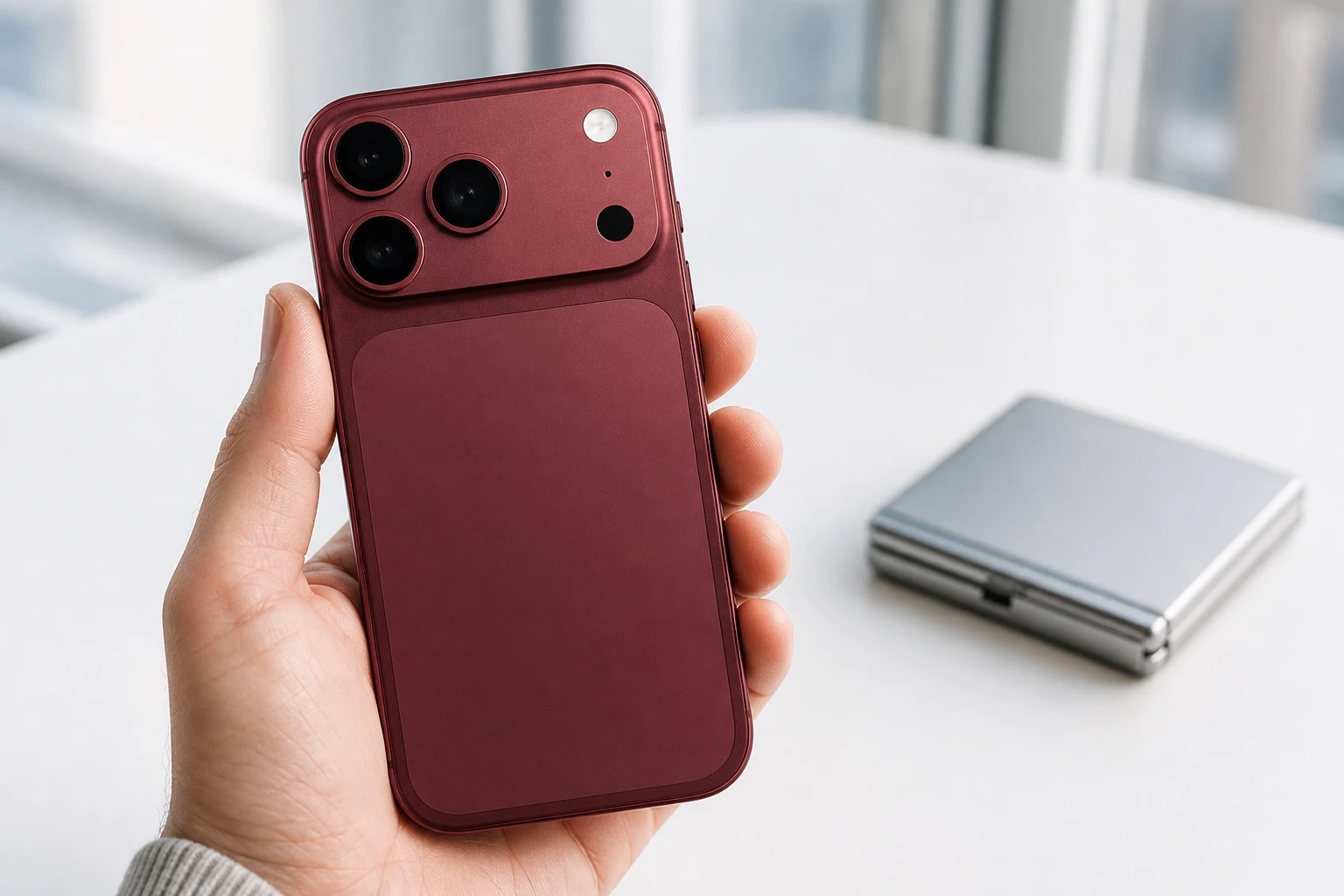
Macworld supply-chain reporting lists four Pro colors: silver, dark gray, light blue, and dark cherry (the deep red fans have wanted). Black is out again.
The Dynamic Island shrinks, possibly by moving the flood illuminator under the display. Exact cuts vary by leaker, but mockups show a noticeably narrower pill.
Under the hood sit the A20 and A20 Pro chips on TSMC’s 2 nm node, Apple’s C2 modem (with potential 5G satellite support), and the N2 wireless chip for better hotspot and AirDrop. Most leaks put 12 GB of RAM across Pro models. Base iPhone 18 rumors conflict between 9 GB and 12 GB; 9 GB would block two on-device Apple Intelligence features that need the higher count.
iOS 27 arrives with the phones. Its chatbot-style Siri, on-screen awareness, and writing tools are already in public beta. Early builds show new Siri voices limited in iOS 27 beta to a short list of devices, a reminder that hardware RAM still gates the AI experience.
That RAM gate is why the base-model memory decision will shape the spring story as much as camera or battery specs. If the cheaper phones land at 9 GB, Apple will have to market a two-tier Intelligence experience inside the same iOS 27 release. Pro buyers already pay for the higher count. Mainstream buyers who waited six months may discover the wait did not unlock the full software pitch.
Who Feels the Price and the Wait
Pro buyers face the sticker shock first. A $200 lift tests how much loyalty remains when Android flagships and midrange phones undercut on specs. Value-focused shoppers who normally refresh every two years now face a half-year gap with no new standard iPhone.
Apple gains a cleaner high-margin event. Ternus, a longtime hardware executive, gets to open his tenure with the foldable and the camera story instead of a four-model spread. Suppliers of high-end DRAM and the foldable’s display stack win volume. Samsung building screens for the Apple foldable keeps that rivalry complicated: Samsung sells panels to its biggest competitor while defending its own Fold franchise.
Crowd chatter on X already mixes excitement over dark cherry and the aperture with resignation about the price. Some users say they will skip to the base model in 2027 or hunt refurbished 17 Pros. Others treat the Ultra as a once-a-decade flex purchase regardless of cost.
The six-month gap also stretches trade-in and carrier upgrade rhythms. Shoppers who timed previous cycles around a September launch now have to decide whether to stretch an aging handset, buy last year’s Pro at a discount, or jump to another brand for a season. That friction is the hidden cost of protecting the fall margin story.
The Foldable Tightens the Early Sales Window
If the foldable ships in volume only later, the Pro and Pro Max must carry September and October revenue almost alone. That is a narrower bet than a classic four-model launch. Strong reviews on the variable aperture and the larger cells would still pull the usual upgrade cohort. Weak first impressions on price or early crease behavior would leave a longer gap before the March volume models arrive to reset the conversation.
At a cluster of $2,000 to $2,500, the Ultra or Fold is priced as a statement device, not a volume driver. Limited early supply reinforces that role. Ternus can treat it as proof that Apple’s hardware group can still open a new category, while the Pro pair handles the real unit volume and the margin defense against the memory spike.
Samsung’s dual position as panel supplier and Fold rival adds another layer. Every high-end display that ships into an Apple foldable is a sale Samsung makes and a competitive product it must out-feature. The arrangement keeps both companies tethered even as they market against each other in the same premium pocket.
March Models Carry the Volume Question
The regular iPhone 18, 18e, and Air are slated for March 2027 with standard specs and possible cost cuts. By then the memory market may have eased, or Apple may have locked longer-term supply that lets those devices hold a lower retail price without surrendering every AI feature. The open risk is the RAM split. A 9 GB base configuration would wall off two on-device Intelligence features that 12 GB Pro models already clear.
That creates a messaging problem six months after the premium launch. Shoppers who waited patiently for a more affordable phone could find the software story incomplete. Apple would then be selling continuity of design language more than parity of experience. Cost cuts on other components might offset the memory line, but they cannot invent RAM that is not in the board.
For carriers and retail partners, the staggered calendar means two distinct sell-in seasons instead of one. Training, inventory, and promo calendars have to flex. The upside for Apple is a cleaner read on pure Pro demand in the fall and a second bite at mainstream volume once component costs and yields are better known.
Ternus Inherits a Different September Script
Every recent September has been Cook’s show. This one belongs to Ternus from day one of his CEO term. The historical pattern of Labor Day-aware Tuesday or Wednesday keynotes still holds, but the product mix is new: three premium devices, two watches, and no volume iPhone.
If the foldable ships in volume only in December, the Pro models carry the entire early sales window. That concentrates risk and reward. Strong camera reviews and real battery gains could lock in the usual upgrade wave. A soft reception to the price or early foldable creases would give Android a longer opening than usual.
The memory shortage did not invent Apple’s premium focus. It simply forced the calendar and the pricing to match that focus more tightly than any prior cycle. Ternus steps into that tighter frame with a hardware resume and a stage already cleared of the lower-priced SKUs. How he frames the $1,299 starting point and the foldable’s premium ask will set the tone for the first year of his tenure as much as any feature checklist.
Frequently Asked Questions
When will the iPhone 18 Pro go on sale?
Historical patterns and recent calendars point to a keynote around September 9 2026, pre-orders on September 11, and store availability on September 18. A one-week slip remains possible if Apple needs extra production time for the foldable.
Will the base iPhone 18 support all iOS 27 AI features?
If it ships with 9 GB of RAM as one set of analyst notes claims, two on-device features (custom Siri voice expressivity and improved speech-to-text) will stay locked to 12 GB models. The Pro lineup is expected to clear that bar.
How much could the foldable iPhone cost?
Leaks and analyst notes cluster around $2,000 to $2,500, roughly double a Pro Max. Early supply is expected to be limited, so some buyers may wait until a later production ramp.
Does the Pro Max battery differ by region?
Yes. eSIM-only U.S. models appear to gain extra capacity (filings near 5,567 mAh) because they omit the physical SIM tray. China dual-SIM versions run lower, around 5,391 mAh in the same leaks.
Why is there no black option for the iPhone 18 Pro?
Supply-chain color lists circulating since spring consistently name silver, dark gray, light blue, and dark cherry. Black titanium has been absent from every major Pro color rumor this cycle.


Nintendo Already Tested These NES Remakes, With Mixed Results

South Korea’s Crypto Framework Bill Hinges on a Bank Standoff

Court of Appeal Restores Imo APP Ahead of 2027 Polls

Vivo’s X300 Costs $647, but No US Carrier Sells It

Super Micro’s Bargain Stock Price Rests on One Hidden Customer

Resident Evil’s Remake Profits Just Vindicated Capcom’s Pragmata Bet

XRP Stalls Near $1 While Ripple’s Own Stablecoin Surges

WhatsApp Web’s Free Calling Update Takes Aim at Zoom

Hiya Toys’ Fox Figure Ships the Same Year as Persona 6

ARRI Hands Honor Its First-Ever Smartphone Camera Deal

Fable 5 and Mythos 5 Return as US Lifts Anthropic Export Controls

SpaceX’s Google Deal Turns a Rocket Company Into a Cloud Landlord

CD Projekt Red Co-CEO: Redemption Arc Isn’t Done, Witcher 4 in 2027

Oracle Cuts 21,000 Jobs in a Year, Cites AI in 10-K Filing

XPL Rallies 30% Ahead of Plasma One Card Tier Launch

DGO App Brings Rs 549 Mobile Pass for FIFA World Cup 2026 in Nepal

Moonshot AI Targets $30 Billion in China’s Fastest AI Funding Sprint

Google Search Profiles Build a Follow Graph Inside Discover

Microsoft Xbox Layoffs Start in July as Sharma Slams 3% Margin

Oppo’s ColorOS 17 Eligibility List Leaves A-Series Buyers Behind
-
 AI4 weeks ago
Fable 5 and Mythos 5 Return as US Lifts Anthropic Export Controls
-
 AI2 months ago
SpaceX’s Google Deal Turns a Rocket Company Into a Cloud Landlord
-
 GAMING1 month ago
CD Projekt Red Co-CEO: Redemption Arc Isn’t Done, Witcher 4 in 2027
-
 AI1 month ago
Oracle Cuts 21,000 Jobs in a Year, Cites AI in 10-K Filing
-
 CRYPTO2 months ago
XPL Rallies 30% Ahead of Plasma One Card Tier Launch
-
 APPS2 months ago
DGO App Brings Rs 549 Mobile Pass for FIFA World Cup 2026 in Nepal
-
 AI2 months ago
Moonshot AI Targets $30 Billion in China’s Fastest AI Funding Sprint
-
 NEWS2 months ago
Google Search Profiles Build a Follow Graph Inside Discover