
AI
Citadel’s Hawkish Fed Bet Deepens Asia’s AI Stock Rout
Citadel Securities is betting on a Fed rate hike this week as an Iran-driven oil shock and AI earnings anxiety collide across Asian markets.

Asian stocks extended a brutal selloff Wednesday, with South Korea’s KOSPI down 5% and the region’s benchmark index on pace for an 8% loss this month. Oil jumped 3% after Iran fired missiles that U.S. forces intercepted overnight. Citadel Securities is now betting the Federal Reserve raises interest rates Wednesday, against a market that mostly still expects a hold.
The AI trade already looked shaky before oil or the Fed entered the picture. SK Hynix posted a record quarter and its stock still fell 9%. Microsoft and Meta report results later Wednesday, the first full test of AI spending since Alphabet and Tesla unsettled investors with negative cash flow last week.
Three Shocks Collide Across Asian Markets
South Korea’s KOSPI opened higher Wednesday before reversing to close down 5%, a whipsaw session that followed Tuesday’s plunge of more than 10% to a three month low. The reversal came hours after SK Hynix reported blowout earnings.
Gary Tan, portfolio manager at Allspring Global Investments, said the crowded calendar was forcing investors to de-risk. “With the FOMC meeting sandwiched between major U.S. tech earnings this week, and expectations for AI capex already elevated, investors appear to be taking some risk off the table ahead of a critical test for both AI spending expectations and market liquidity,” he said.
Nick Twidale, chief market strategist at ATFX Global in Sydney, expects another tough day for Asian equities, with the Middle East news adding to the pressure. “I think the risk of a Fed hike will also concern investors, so rather than a more usual pre-Fed quieter market, I’ve got a feeling it could be a volatile day ahead,” he said.
| Market or Asset | Wednesday Move | Wider Context |
|---|---|---|
| Nikkei 225 (Japan) | Down 1% | On pace for a monthly drop of more than 10% |
| MSCI Asia-Pacific ex-Japan | Down 1% | Down 3.6% Tuesday; heading for an 8% loss in July |
| Hang Seng (Hong Kong) | Up 1.5% | One of the few gainers in the region |
| China blue-chip index | Flat | Little changed on the day |
| Nasdaq futures | Up 0.5% | Choppy through the Asian session |
| Brent crude | Up 3% to $86.80/barrel | Jumped after intercepted Iranian missile strike |
Three separate forces were pulling in the same direction Wednesday: AI valuation nerves, a Fed meeting nobody can call with confidence, and a fresh jolt out of the Middle East. SK Hynix reported its earnings hours before the region’s markets opened.
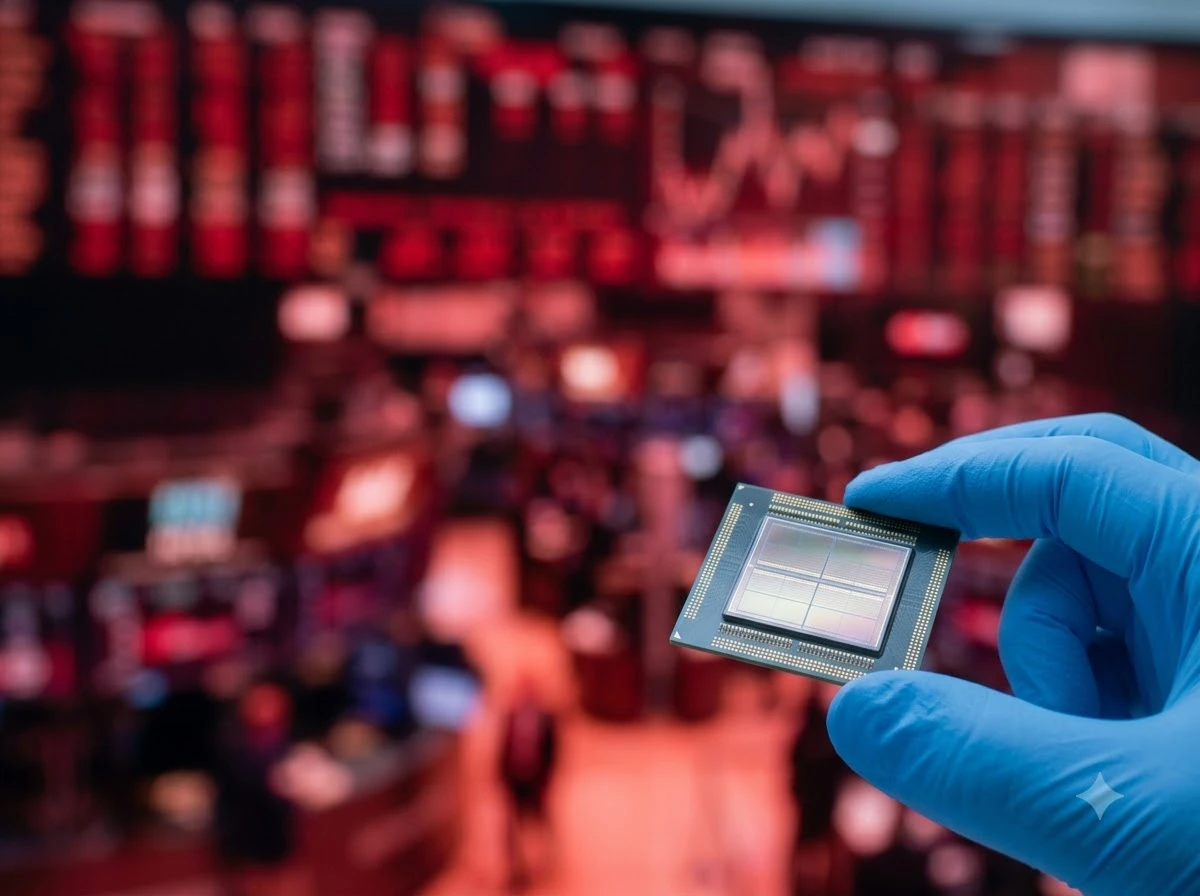
SK Hynix’s Record Quarter Still Wasn’t Enough
SK Hynix, the South Korean memory chipmaker that supplies the high bandwidth memory stacked inside AI accelerators, reported quarterly operating profit of 60.5 trillion won (about $43.7 billion), up 557% from a year earlier, an all time high with a 76% operating margin, according to its second quarter earnings release. Revenue jumped 257% to 79.3 trillion won. The company began mass production of its next generation HBM4 memory during the quarter and locked in supply agreements with roughly ten customers.
The stock fell 9% anyway. Investors focused less on the record and more on the gap between that number and even loftier expectations built into the shares during this year’s AI memory rally. Asian chipmakers have driven much of that rally, and now absorb the sharpest swings whenever confidence in it wobbles.
The scrutiny now reaches beyond memory makers. NVIDIA, the dominant designer of AI accelerator chips, recently trimmed its Asian chip buyer list by more than half, tightening the circle of firms it will sell into just as demand questions mount across the supply chain.
Iran’s Intercepted Missiles Send Oil Above $86
Brent crude jumped 3% to $86.80 a barrel and U.S. benchmark WTI rose more than 3% to $81.95 after U.S. Central Command said Iran had launched multiple ballistic missiles at American forces, all of them intercepted. The attack shattered the relative calm of recent days in the U.S.-Iran conflict.
The dispute centers on passage through the Strait of Hormuz. The waterway runs between Iran and Oman and carries a large share of the Gulf’s seaborne oil exports, according to a Congressional Research Service analysis of Iran’s leverage over the strait. Iran effectively shut the route to non-Iranian vessels after the U.S. and Israel struck the country on February 28. A deal between Washington and Tehran partially reopened it last month, then collapsed in early July after Iran fired on ships using an unapproved channel.
“The latest attack highlights that the two sides remain a long way from resolving the core dispute of passage through the Strait of Hormuz that caused the earlier MOU to collapse,” said Tony Sycamore, market analyst at IG.
Brent has whipsawed for weeks, trading below $77 a barrel in early July, above $90 at the height of mid month fighting, then back near $84 on Tuesday before Wednesday’s jump. Each new flashpoint moves both the price of oil and the inflation math facing the Fed.
Citadel’s Contrarian Case for a Rate Hike
The Fed has held its benchmark rate at 3.5% to 3.75% for four straight meetings, and economists polled by FactSet expected a fifth hold Wednesday. Traders had priced roughly a one in three chance of a hike, though estimates varied: some trading desks put the odds as high as 38%, while prediction markets sat closer to 28%, a spread that shows how unsettled the call is.
Kevin Warsh, the Fed’s chairman since earlier this year, has ended the practice of signaling policy moves in advance. That no guidance regime is what makes Wednesday harder to call than a typical meeting. It is only his second meeting at the helm; his first, in June, ended with rates unchanged and a nod toward possible hikes ahead.
We think the market may once again be underestimating the extent of the hawkish shift at the Fed, and that the (for now) moderate increase in energy prices may tip an already finely balanced meeting in favour of a hike this week.
Frank Flight, head of macro strategy at Citadel Securities, wrote that in a note to clients. It is a close call, he said, but Citadel now expects “a rate hike at the July meeting,” a move Flight argued would reinforce Warsh’s inflation fighting credibility and prove the no guidance regime is more than rhetoric.
Views inside the Fed itself are split heading into Wednesday’s vote.
- Citadel Securities (Frank Flight, head of macro strategy): expects a quarter point hike, arguing traders still underprice Warsh’s hawkish turn.
- Lorie Logan, president of the Federal Reserve Bank of Dallas: has said publicly that a July hike would be prudent.
- Economists polled by FactSet: still expect a fifth consecutive hold at the current range.
Beth Hammack, president of the Federal Reserve Bank of Cleveland, has separately said inflation remains too high for comfort, even as other officials grow more open minded about AI’s longer run potential to hold down prices.
How Much Are Microsoft and Meta Spending on AI?
Microsoft and Meta both report results Wednesday, the first full readout on AI spending since Alphabet and Tesla unsettled investors with negative free cash flow last week. Together with Amazon, the four hyperscalers are projected to spend about $724 billion on capital expenditure this year and nearly $950 billion in 2027, almost all of it chasing AI capacity.
- Microsoft spent roughly $97.2 billion on capex over the past twelve months; analysts expect that to climb to about $118.9 billion in the coming fiscal year, a 22% increase, then toward $178.9 billion the year after.
- Meta spent about $75.8 billion over the past year; consensus estimates put next year’s figure near $135 billion, up roughly 79%.
- Alphabet, Microsoft, Amazon and Meta combined are projected to spend about $724 billion this year and nearly $950 billion in 2027.
That is the backdrop Wednesday’s earnings land against, a preview of the hyperscalers’ results from S&P Global Market Intelligence flagged as the sector’s show me the money moment. A hawkish Fed surprise would raise the cost of capital right as these companies ask investors to keep funding that spending run on faith in future AI returns.
The Hidden Cost of a Stronger Dollar
The dollar was perched near a one month high ahead of the Fed decision. A hike would likely push it higher still, raising costs for Asian economies that import oil in dollars and now face a pricier barrel and a pricier currency at the same time.
South Korea and Japan, the two markets hit hardest Wednesday, are also large net oil importers. A surprise hike would tighten financial conditions for their exporters just as AI capex doubts already weigh on the chip firms that anchor both economies.
Fed officials have grown more open minded about AI’s longer run potential to hold down prices, even as Warsh insists inflation right now is still too high to look past. Wednesday’s vote falls between those two timelines.
Citadel’s contrarian rate call and Big Tech’s AI spending both get their verdicts within hours of each other, right after Asian trading closes for the day.


Nintendo Already Tested These NES Remakes, With Mixed Results

South Korea’s Crypto Framework Bill Hinges on a Bank Standoff

Court of Appeal Restores Imo APP Ahead of 2027 Polls

Vivo’s X300 Costs $647, but No US Carrier Sells It

Super Micro’s Bargain Stock Price Rests on One Hidden Customer

Resident Evil’s Remake Profits Just Vindicated Capcom’s Pragmata Bet

XRP Stalls Near $1 While Ripple’s Own Stablecoin Surges

WhatsApp Web’s Free Calling Update Takes Aim at Zoom

Hiya Toys’ Fox Figure Ships the Same Year as Persona 6

ARRI Hands Honor Its First-Ever Smartphone Camera Deal

Fable 5 and Mythos 5 Return as US Lifts Anthropic Export Controls

SpaceX’s Google Deal Turns a Rocket Company Into a Cloud Landlord

CD Projekt Red Co-CEO: Redemption Arc Isn’t Done, Witcher 4 in 2027

Oracle Cuts 21,000 Jobs in a Year, Cites AI in 10-K Filing

XPL Rallies 30% Ahead of Plasma One Card Tier Launch

DGO App Brings Rs 549 Mobile Pass for FIFA World Cup 2026 in Nepal

Moonshot AI Targets $30 Billion in China’s Fastest AI Funding Sprint

Google Search Profiles Build a Follow Graph Inside Discover

Microsoft Xbox Layoffs Start in July as Sharma Slams 3% Margin

Oppo’s ColorOS 17 Eligibility List Leaves A-Series Buyers Behind
-
 AI4 weeks ago
Fable 5 and Mythos 5 Return as US Lifts Anthropic Export Controls
-
 AI2 months ago
SpaceX’s Google Deal Turns a Rocket Company Into a Cloud Landlord
-
 GAMING1 month ago
CD Projekt Red Co-CEO: Redemption Arc Isn’t Done, Witcher 4 in 2027
-
 AI1 month ago
Oracle Cuts 21,000 Jobs in a Year, Cites AI in 10-K Filing
-
 CRYPTO2 months ago
XPL Rallies 30% Ahead of Plasma One Card Tier Launch
-
 APPS2 months ago
DGO App Brings Rs 549 Mobile Pass for FIFA World Cup 2026 in Nepal
-
 AI2 months ago
Moonshot AI Targets $30 Billion in China’s Fastest AI Funding Sprint
-
 NEWS2 months ago
Google Search Profiles Build a Follow Graph Inside Discover