
AI
Google Says Its India Apprenticeship Won’t Guarantee a Job
Google’s APAC apprenticeship lead says the India 2027 program builds skills, not job guarantees, as entry-level tech hiring falls sharply amid AI adoption.

Google will not promise its apprentices a job. Shanu Ahluwalia Vij, the company’s Asia-Pacific (APAC) lead for apprenticeship and traineeship programs, said so herself this month in a LinkedIn post timed to the opening of applications for the India Apprenticeship Program 2027. The clarification lands the same season that independent labor data show the entry-level tech jobs those apprentices would eventually chase are shrinking fast.
Vij called the apprenticeship a launchpad, not a hiring pipeline. Staffing data out of India this year describe a runway that is getting shorter for everyone trying to land on the other side of it, apprentice or not.
Vij Draws a Line Between Training and a Permanent Job
Vij used her post to address what she called one of the most common assumptions about the program: that finishing it leads straight to a Google badge.
While the apprenticeship isn’t a direct pipeline to a permanent role at Google, it is an incredible launchpad.
She wrote that the program is built to hand participants industry-relevant, transferable skills learned alongside Google’s own staff, skills meant to travel with them across the wider tech sector. Many former apprentices, she said, have gone on to jobs at other major companies or back into higher education.
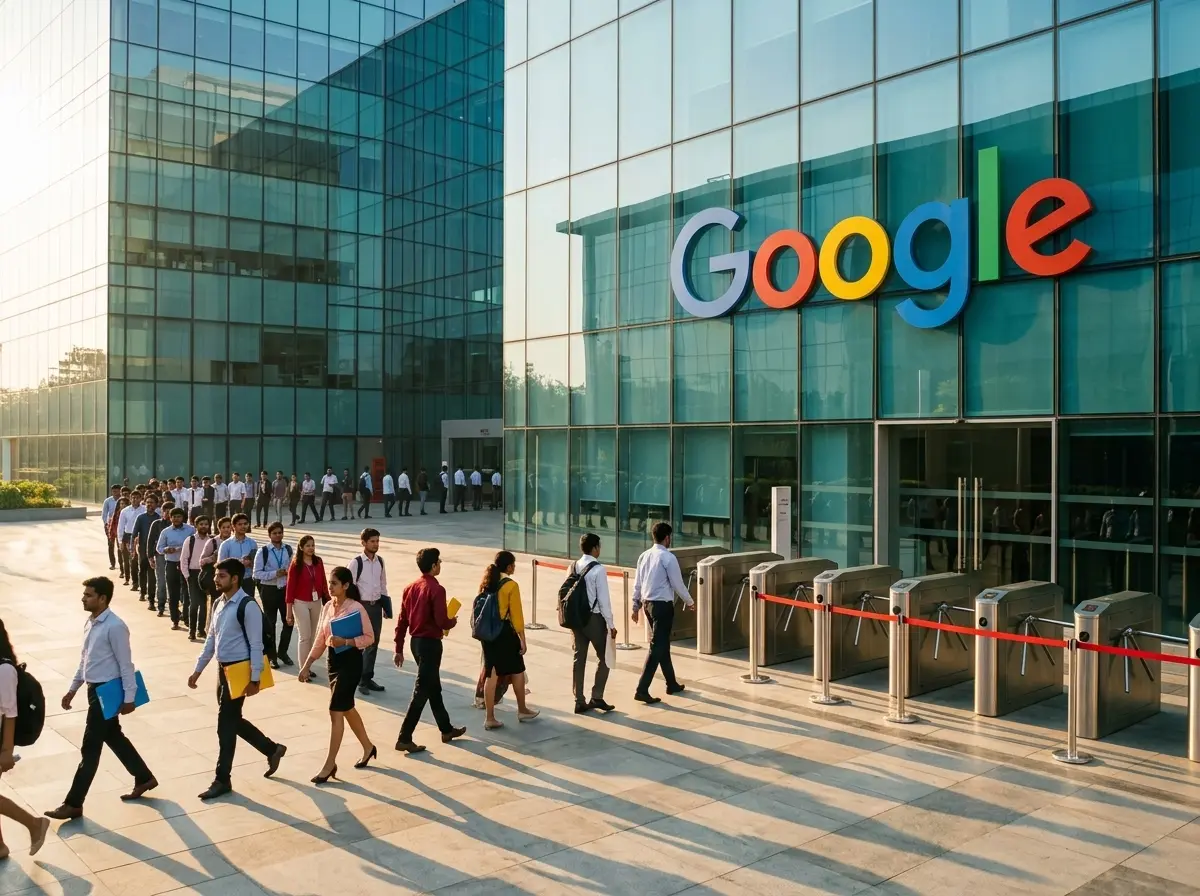
Four Tracks, One Application Deadline
The 2027 cohort covers four disciplines: software application development, project management, data analytics and digital business marketing. Applications close on August 3, 2026, and the tracks differ in how long they run.
| Track | Duration | 2027 Start | Cities |
|---|---|---|---|
| Software Application Development | 12 months | March 2027 | Bengaluru, Gurugram, Hyderabad, Mumbai |
| Project Management | 24 months | March or June 2027 | Bengaluru, Gurugram, Hyderabad, Mumbai |
| Data Analytics | 24 months | March 2027 | Bengaluru, Gurugram, Hyderabad, Mumbai |
| Digital Business Marketing | 24 months | March 2027 | Bengaluru, Gurugram, Hyderabad, Mumbai |
Software application development is the only 12-month track among the four; the rest run two years. Apprentices work in person from their assigned office, roughly 40 hours a week, splitting time between a structured training curriculum and live projects with a Google team.
The Fine Print on Turning an Apprenticeship Into a Job
Google’s own software apprenticeship job listing spells out the timing. Apprentices are only eligible to apply for any other full-time role at Google in the last three months of their apprenticeship tenure, and even then it runs through the standard external hiring process rather than an internal handoff.
Vij made the same point in her post. She said Google’s apprentices are always welcome to apply once suitable full-time roles open up, but through that same external channel everyone else uses.
India’s Entry-Level Tech Funnel Is Shrinking
The timing gives the clarification more weight than a routine HR post might otherwise carry. India’s entry-level tech hiring has been contracting through 2026.
- 44% decline: demand for tech professionals with up to two years of experience fell to about 10,000 openings in a recent month, down from 13,000 in May 2026, a slide staffing firm Xpheno pegged at 44% lower than a year earlier.
- 37% automated: a 2026 study by Cognizant and Pearson found entry-level tasks in India are already being handled by AI at that rate, versus 33% globally.
- 12,000 roles cut: Tata Consultancy Services trimmed about that many positions in mid-2025, a move described at the time as a skills realignment rather than a demand collapse.
Industry group NASSCOM (National Association of Software and Service Companies), in a workforce survey run with Unearth Insights, points to hiring freshers and building structured training around them as the strategy most tech employers are now leaning on to manage skills gaps and attrition. That is effectively a description of what an apprenticeship program does. It builds a talent pipeline without committing to expand permanent headcount.
Hong Kong graduates are running into a similar wall, where entry-level roles are shrinking as AI absorbs junior work once handled by new hires. The pattern is not confined to one country or one company.
Infosys, Wipro and Rivals Are Hiring Differently Too
Google is not the only large tech employer recalibrating how freshers enter the workforce. Infosys is targeting more than 20,000 new graduate hires for 2026, and Wipro is aiming for 10,000 to 12,000, according to figures reported by Business Today and cited in NASSCOM’s Tech Workforce Outlook for 2026. Collectively, top Indian IT firms are expected to onboard around 82,000 graduates in the 2026 fiscal year.
That is still a large number on paper. But it comes with a shift from bulk campus recruitment toward selective, skills-first hiring, prioritizing demonstrated project work and AI-adjacent capability over volume intake of generalist coders.
The squeeze is not evenly spread across every AI-adjacent job either. The data centers running the models behind this shift are struggling with the opposite problem, a shortage of electricians and other skilled trades needed to build them. Entry-level software and analytics seats are getting harder to find while entry-level construction and technical trade roles tied to AI infrastructure are going unfilled.
Who Can Apply for a Seat Now?
Google widened its eligibility language well beyond fresh graduates. Vij said the program welcomes candidates from different age groups and life stages, career changers, and people from varied educational backgrounds who do not hold a specific degree or prior technical experience.
- Career switchers moving in from unrelated industries
- Candidates across different age groups and life stages, not only recent graduates
- Applicants without a specific degree or prior technical experience, depending on the track
- People with nontraditional or varied educational backgrounds
Broadening the applicant pool while the number of full-time seats on the other side gets tighter means more people are competing for a launchpad that Google itself says will not guarantee where they land.
Frequently Asked Questions
How long does Google’s apprenticeship selection process take?
Recruitment listings tracking the 2027 cycle put the selection process at roughly 18 to 24 weeks from application to offer, longer than a typical single-round graduate hiring process elsewhere in the industry.
What stipend does a Google apprenticeship pay in India?
Google has not published an official stipend figure for the 2027 cycle. Third-party recruitment listings tracking past cohorts put monthly pay at roughly 41,600 to 66,600 rupees (about $480 to $770), alongside a possible relocation bonus for eligible candidates.
Do all four apprenticeship tracks require an engineering degree?
No. The software application development track needs a bachelor’s or master’s degree in engineering or a related field, while the data analytics track accepts a bachelor’s degree in any discipline, making it one of the more open entry points among the four.
Can current students apply for the Google Apprenticeship 2027?
No. Applicants must hold a completed degree and cannot be currently enrolled in an academic program at the time they apply, according to the eligibility criteria listed for the 2027 tracks.
Do Google apprentices get a recognized certificate after finishing?
Yes, at least on some tracks. Google’s data analytics apprenticeship in India runs 24 months and ends with a nationally recognized credential certified by the Government of India, on top of whatever role the apprentice lands next.


Workers Still Trust Judgment Over the AI Tools They Use

DigitalOcean’s $894 Million Backlog Rewrites the Old Cloud

Companies Froze Job Design and Called AI a People Problem

AI Capex Looks Unique Because the Chips Wear Out

Samsung Medison’s HERA Z10 Aims at the Sonographer Shortage

GPT-6 Astra Ships as OpenAI’s First Critical Cyber Model

Palms Sells Clean Air Without Ending Casino Smoking

OnlyFans Promo Bots on X Now Pass the Humanity Tests

Datamaran Drops the ESG Label After Winning the Argument

Xiaomi’s Own Chip Lands While Apple Argues Over Color

Oracle Cuts 21,000 Jobs in a Year, Cites AI in 10-K Filing

Fable 5 and Mythos 5 Return as US Lifts Anthropic Export Controls

SpaceX’s Google Deal Turns a Rocket Company Into a Cloud Landlord

CD Projekt Red Co-CEO: Redemption Arc Isn’t Done, Witcher 4 in 2027

XPL Rallies 30% Ahead of Plasma One Card Tier Launch

Google Search Profiles Build a Follow Graph Inside Discover

DGO App Brings Rs 549 Mobile Pass for FIFA World Cup 2026 in Nepal

Moonshot AI Targets $30 Billion in China’s Fastest AI Funding Sprint

Oppo’s ColorOS 17 Eligibility List Leaves A-Series Buyers Behind

Microsoft Xbox Layoffs Start in July as Sharma Slams 3% Margin
-
 AI3 months ago
Oracle Cuts 21,000 Jobs in a Year, Cites AI in 10-K Filing
-
 AI2 months ago
Fable 5 and Mythos 5 Return as US Lifts Anthropic Export Controls
-
 AI3 months ago
SpaceX’s Google Deal Turns a Rocket Company Into a Cloud Landlord
-
 GAMING3 months ago
CD Projekt Red Co-CEO: Redemption Arc Isn’t Done, Witcher 4 in 2027
-
 CRYPTO3 months ago
XPL Rallies 30% Ahead of Plasma One Card Tier Launch
-
 NEWS3 months ago
Google Search Profiles Build a Follow Graph Inside Discover
-
 APPS3 months ago
DGO App Brings Rs 549 Mobile Pass for FIFA World Cup 2026 in Nepal
-
 AI3 months ago
Moonshot AI Targets $30 Billion in China’s Fastest AI Funding Sprint