
CRYPTO
Coreum Bridge Multisig Signed Off on Its Own 200k XRP Drain
A missing destination check let an attacker turn self-payments into real XRP payouts while 17 of 28 relayers signed every transfer; XRPL itself stayed intact.

An attacker emptied nearly all of the Coreum cross-chain bridge’s XRP in 97 minutes on August 9, 2026, walking away with 199,916.3 XRP while 17 of the bridge’s 28 relayer keys signed every payment. The XRP Ledger itself never failed. The multi-signature process worked exactly as written.
That is the irony. The security layer did its job on evidence that should never have been accepted.
The Drain Clock Ran for 97 Minutes
The official Coreum bridge account on the XRP Ledger, rxXXXeMX8Gy5YvibvGLnQJ1XKKD7UswM1, held roughly 200,410 XRP on the afternoon of August 9. At 19:16 UTC it began a steady series of outbound payments. By 20:53 UTC only 493.5 XRP remained.
- 94 native XRP payments plus nine earlier wrapped-token probes
- Two brand-new destination wallets created less than two hours before the first send
- 17-of-28 relayer signatures on every release
- ~1,694.7 XRP alternating rhythm once the main phase began
The two fresh addresses, rfXSfH2q4zhGWdw45nYcWfjvFN5ZfwE1U6 and rwt8PJhyXWgW8uwmTjmQ7Rw89tJHELFgb5, received about 107,397.5 XRP and 92,518.8 XRP. Both later forwarded nearly everything onward and now hold only residual balances near 3 XRP each. The on-chain reconstruction of the 97-minute drain from XRPL.to maps every ledger entry between validated ledgers 106,183,346 and 106,184,842.
| Metric | Value |
|---|---|
| Start balance | ~200,410 XRP |
| XRP released | 199,916.3 |
| End balance | 493.5 XRP |
| Duration | 97 minutes (19:16-20:53 UTC) |
| Payments | 94 XRP + 9 wrapped-token |
| Quorum used | 17 of 28 relayer keys |
No private keys were stolen. Native XRP cannot ripple. Every outbound transaction carried the bridge account as sender and a full multi-sig array.
The split across the two destinations was uneven but deliberate. One wallet took a larger share near 107,000 XRP. The other took the balance near 92,500 XRP. Residual balances near 3 XRP on each address show the outbound hop was almost complete once the bridge side finished signing.
Ninety-seven minutes is a long window for automated monitoring. It is a short window for human response when the traffic looks like ordinary bridge releases. The alternating rhythm near 1,694.7 XRP per payment kept each send inside a familiar size band, which reduced the chance that any single transfer would stand out on its own.
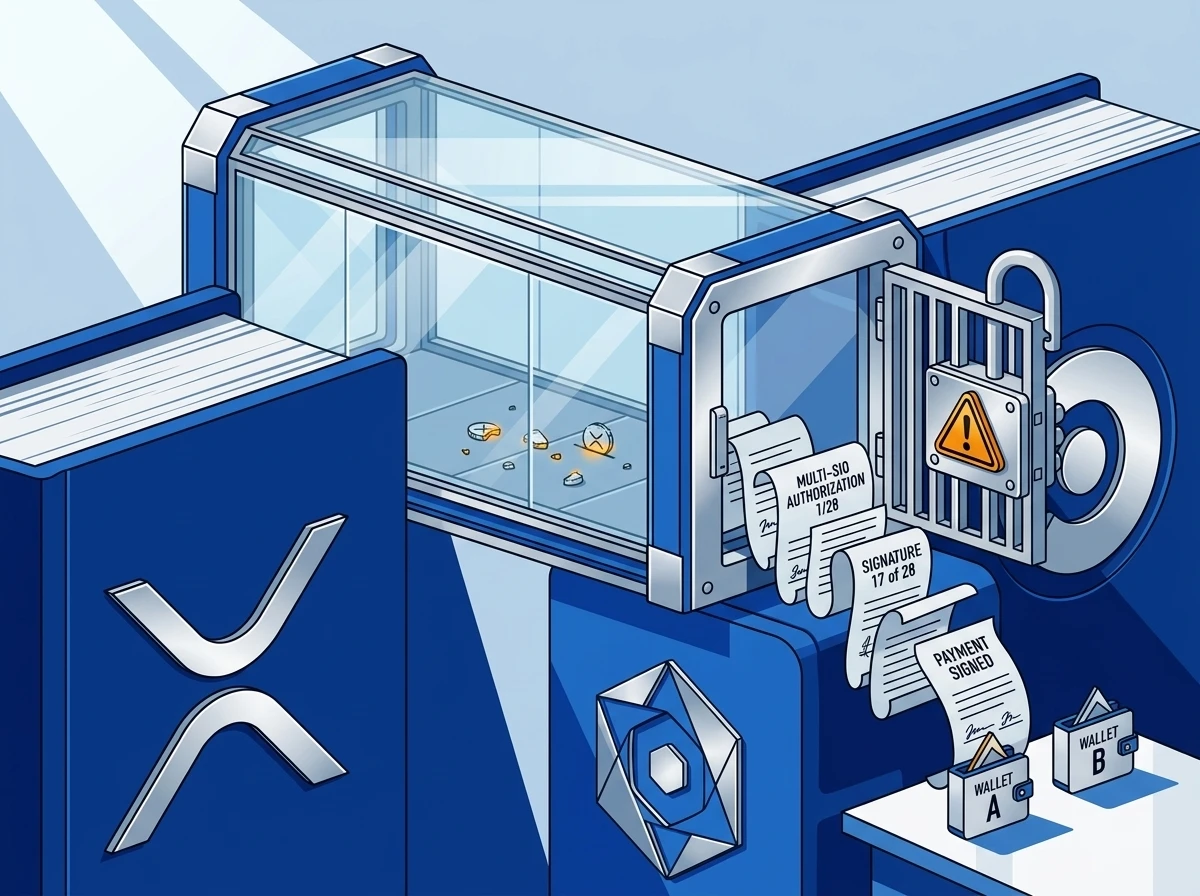
How Phantom Deposits Became Real Payouts
A cross-chain bridge locks assets on one ledger and mints equivalents on another. Relayers watch both sides, submit attestations, and co-sign releases when a quorum agrees. Coreum’s contract never reads the XRP Ledger directly. It trusts the evidence the relayers feed it.
The attacker never sent XRP to the bridge. They moved the bridge’s own wrapped Coreum token between wallets they controlled, attaching a memo formatted like a legitimate deposit note. Because the bridge itself issues that token, the transfers appeared in its history. The relayer code treated any successful payment carrying the right memo as a deposit. It never verified the destination address.
- Create two fresh XRPL wallets the same afternoon.
- Issue a 92-unit probe of the bridge’s wrapped token with a deposit-style memo.
- Double the size in a ladder (roughly 20k, 40k, 80k… up to 1.82 million units) while 21 relayers attest the first fake transfer.
- Once the Coreum contract books the phantom deposits, request withdrawals.
- Collect real native XRP as the 17-of-28 quorum signs each payment.
The first nine transactions were the probe-and-ladder phase. Only after the books were poisoned did the account switch to metronomic XRP releases. The signatures were genuine. The input was fabricated.
The ladder mattered because it tested tolerance before size. A small 92-unit probe established that the memo format and the attestation path would clear. Doubling through roughly 20k, 40k, and 80k units, then on toward 1.82 million, stretched the same false deposit pattern until the Coreum books showed large credits that had never arrived as native XRP.
From the contract’s point of view those credits were already settled inventory. Withdrawal requests against them therefore looked routine. The XRPL side had no independent view of whether a true lock had occurred. It only saw a quorum of relayer signatures on payment instructions that the poisoned books had already approved.
The Multi-Sig That Authorized Everything
The bridge account’s master key is disabled. Control rests entirely with 28 relayer keys; 17 must co-sign. That design is meant to prevent any single operator from moving funds. In this case the quorum simply ratified what the poisoned contract said was owed.
The signatures were real and the procedure was followed. What was corrupted is the deposit the procedure trusts, a self-payment dressed up, on Coreum’s public record, as money arriving.
That assessment comes from the same XRPL.to analysis that first dismantled the early “rippling” theory circulating while the drain was still live. The DefaultRipple flag was on, yet native XRP has no trust line and cannot ripple. Zero XRP left the account by any path other than bridge-signed Payments.
The open-source Coreumbridge XRPL repository and its bridge specification for multi-signing and evidence describe an evidence queue, pending-operations queue, and kill-switch. The missing destination check sits in the relayer’s deposit-attestation path. Once enough matching evidence arrives, the contract mints and the XRPL side pays.
Multi-sig here enforced threshold consent, not semantic truth. Seventeen keys agreeing on a false deposit still produce a valid Payment on the ledger. Disabling the master key removed a single point of unilateral control. It did not add a second source of truth about whether native XRP had ever locked on the bridge account.
| Layer | What held | What failed |
|---|---|---|
| XRPL multi-sig | 17-of-28 quorum on every release | No view into deposit authenticity |
| Relayer attestations | Matching evidence reached the queue | Destination address never checked |
| Coreum books | Mint and withdraw path executed | Phantom credits treated as real locks |
| Kill-switch | Available to relayers and owners | Engaged only after the 97-minute window |
Who Lost Skin
At roughly one dollar per XRP the haul is only about $200,000. That figure understates the exposure. The drained XRP was the backing for wrapped representations already circulating. Holders of those wrapped assets now face a collateral hole. Whether they are made whole depends on what the Coreum side does next. As of August 12 the bridge remains fully suspended and no official post-mortem has appeared.
Early social warnings blamed an XRP Ledger flag. On-chain data killed that theory within hours. The ledger executed every multi-sig instruction correctly. The failure lived entirely in third-party infrastructure that sits beside the ledger, not inside it.
Crowd reaction on X zeroed in on the same point: the multi-sig theater looked robust until the input layer was examined. One widely shared breakdown noted the project’s earlier rebrand path from Sologenic into the TX ecosystem and treated the missing check as a quality-control failure for a team pitching institutional rails.
Suspension stops further releases. It does not refill the backing pool. Anyone still holding the wrapped side of the pair is waiting on a policy decision, a recapitalization, or a write-down. Until one of those arrives, the gap between tokens in circulation and native XRP left in the bridge account remains an open balance-sheet problem for that market.
The Same Class of Failure as 2022’s Bridge Season
Cross-chain bridges have been crypto’s most expensive recurring surface. Ronin lost more than $600 million in 2022 after validator-key compromise. Wormhole lost roughly $325 million to a signature verification bug that let an attacker mint unbacked wrapped ETH. Nomad collapsed after an upgrade zeroed critical checks. Together those incidents and others topped $1.2 billion that year.
| Incident | Approx. loss | Core failure type |
|---|---|---|
| Ronin (2022) | ~$624M | Compromised validator keys |
| Wormhole (2022) | ~$325M | Signature / mint verification |
| Nomad (2022) | hundreds of millions | Upgrade disabled checks |
| Coreum XRPL (2026) | ~200k XRP (~$200k) | Deposit destination never verified |
The dollar size is smaller. The pattern is not. Attestation or verification logic accepts something that is not a real deposit or a real signature, then the downstream multi-sig or minting machinery dutifully executes. Later 2025 crypto theft totals and laundering patterns show overall stolen value fluctuating while bridges and mixers remain preferred movement tools after a hit.
Coreum’s kill-switch exists precisely so any relayer or owner can halt the contract on unexpected behavior. It was used after the fact. It did not prevent the 97-minute window.
Ronin was a key-control failure. Wormhole was a verification-bug failure. Nomad was an upgrade that stripped checks. Coreum joins the list through a quieter route: the deposit path accepted self-payments of the bridge’s own wrapped token when the memo looked right. Different entry points, same downstream obedience once bad evidence clears the gate.
XRPL Stayed Clean While Sentiment Did Not
XRP slipped below $1 on August 11, touching roughly $0.99 before recovering near $1.01. Multiple outlets tied the print to the bridge news on top of already soft sentiment. The ledger’s consensus and payment engines were never implicated. Analysts repeated that distinction because early panic posts had blurred it.
That separation matters for the rest of the ecosystem. XRP hovering near the one-dollar level has coincided with quieter institutional work on the ledger itself. Tokenized liquidity rails already live on XRPL show the direction larger players are testing. A third-party bridge failure does not rewrite those rails, yet it refreshes the oldest objection: any asset that must leave the native ledger to become useful elsewhere inherits the bridge’s risk budget.
Funds have already begun classic cover-track movement, including reports of paths toward Tornado Cash. Recovery odds for the specific XRP remain low without a coordinated freeze that has not materialized.
Price action and protocol integrity moved on different clocks. The ledger cleared every signed Payment in order. The market priced headline risk and an old category fear about bridges. Those are related stories only through perception. They are not the same technical event.
The Kill Switch Closed the Gate Late
The specification already listed a kill-switch beside the evidence queue and the pending-operations queue. Any relayer or owner could halt the contract when behavior looked wrong. That tool is a circuit breaker, not a filter. It stops new work after someone pulls it. It does not inspect memos or destinations on the way in.
In this incident the breaker came down after the 97-minute window. By then the bridge account had already moved from roughly 200,410 XRP to 493.5 XRP under repeated 17-of-28 signatures. Suspension on August 12 confirmed the halt in public. It could not unwind payments the ledger had already validated.
- Evidence queue: accepted deposit-style memos on wrapped-token transfers
- Pending-operations queue: turned booked credits into withdrawal work
- Multi-sig array: signed native XRP releases once the queues agreed
- Kill-switch: available throughout, engaged only after the drain completed
Designers treat a kill-switch as last-resort insurance. Insurance that triggers after the vault is empty still has value for what remains, and for reputation repair. It does not substitute for the destination check that was missing in the deposit-attestation path. The open-source repository and bridge specification made the queues and the switch visible. They also made the gap visible once investigators traced where verification stopped.
Why Destination Checks Decide Bridge Safety
Bridges live or die on a short list of predicates. Was value locked on the source ledger. Was the lock addressed to the bridge. Does the attestation match that lock. Coreum’s relayers answered a weaker question: did a successful payment carry a deposit-style memo in the bridge token’s own history.
That weaker question is cheap to evaluate and easy to fake when the attacker can move the bridge-issued token between wallets they control. The nine probe and ladder transfers built a trail that looked like inbound value. Twenty-one relayers attested the first fake transfer. Seventeen later signed each native release. None of those steps required proving that the bridge account on the XRP Ledger had received XRP.
Compare that path to what the multi-sig actually guaranteed:
- Sender was the bridge account
- Enough relayer keys co-signed
- Payment format met ledger rules
- No requirement that a matching native lock existed
Quorum size changes collusion cost. It does not repair a missing predicate. A 17-of-28 threshold can still march in lockstep when every relayer reads the same poisoned evidence queue. The Coreum case is a clean illustration because no keys were stolen, native XRP never rippled, and the ledger never mis-executed a signed instruction. The only broken link was the one that should have asked where the supposed deposit actually went.
What the Signatures Proved
Seventeen independent keys can still be wrong together when they all read the same bad memo. The Coreum incident is small in dollars and large in clarity. The multi-signature process performed flawlessly. The deposit check that should have fed it never existed. Until that class of verification is treated as non-negotiable rather than optional polish, every bridge that copies the same attestation pattern carries the same quiet failure mode, regardless of how many keys sit in the quorum.
Coreum has suspended the bridge and promised further detail. The ledgers already published the full story.


Coreum Bridge Multisig Signed Off on Its Own 200k XRP Drain

AI Shrinks Solar Inspection Crews While Paying Hybrid Skills Far More

Intel Graphics Driver Fixes Still Fight Windows and OEMs

Codex Now Runs Your Mac Apps and Remembers Across Days

Mercado Takes DOH as Dual Leadership Faces Health Funding Test

Gmail Keeps Breaking in iPhone Mail for a Deeper Reason

Golaman Ties Tourist Tee Times to Filipino Junior Golf Funding

Gemini App Hits 1 Billion Users on Google’s Distribution Edge

Binge with AI Turns Noida Food Hub into Free Family Tech Lab

Claude’s Invisible Marks Now Tag Light AI Help Worldwide

Fable 5 and Mythos 5 Return as US Lifts Anthropic Export Controls

Oracle Cuts 21,000 Jobs in a Year, Cites AI in 10-K Filing

SpaceX’s Google Deal Turns a Rocket Company Into a Cloud Landlord

CD Projekt Red Co-CEO: Redemption Arc Isn’t Done, Witcher 4 in 2027

XPL Rallies 30% Ahead of Plasma One Card Tier Launch

Google Search Profiles Build a Follow Graph Inside Discover

DGO App Brings Rs 549 Mobile Pass for FIFA World Cup 2026 in Nepal

Moonshot AI Targets $30 Billion in China’s Fastest AI Funding Sprint

Microsoft Xbox Layoffs Start in July as Sharma Slams 3% Margin

Oppo’s ColorOS 17 Eligibility List Leaves A-Series Buyers Behind
-
 AI1 month ago
Fable 5 and Mythos 5 Return as US Lifts Anthropic Export Controls
-
 AI2 months ago
Oracle Cuts 21,000 Jobs in a Year, Cites AI in 10-K Filing
-
 AI2 months ago
SpaceX’s Google Deal Turns a Rocket Company Into a Cloud Landlord
-
 GAMING2 months ago
CD Projekt Red Co-CEO: Redemption Arc Isn’t Done, Witcher 4 in 2027
-
 CRYPTO2 months ago
XPL Rallies 30% Ahead of Plasma One Card Tier Launch
-
 NEWS2 months ago
Google Search Profiles Build a Follow Graph Inside Discover
-
 APPS2 months ago
DGO App Brings Rs 549 Mobile Pass for FIFA World Cup 2026 in Nepal
-
 AI2 months ago
Moonshot AI Targets $30 Billion in China’s Fastest AI Funding Sprint