
CRYPTO
Jeff Booth’s 15,000-Hour Bitcoin Test Never Left His Node
Jeff Booth told Scott Melker on August 16, 2026 that he spent about 15,000 hours trying to kill Bitcoin. He ran a node. The leftover risk he still names is mining-pool concentration, and he sits on the board of Core Scientific.

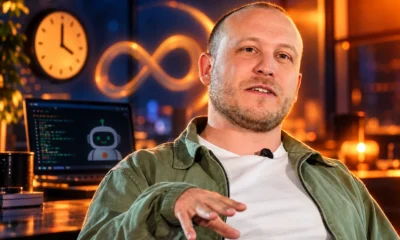
About 15,000 hours into trying to kill Bitcoin, Jeff Booth still watched a new block arrive every 10 minutes. He said so on August 16, 2026, to host Scott Melker, after running a node and walking through attacks a government, a rival, or a large miner might use.
The clip now travels as proof the network cannot be broken. Booth is an independent director at Core Scientific and a founding partner at Ego Death Capital. The hours were his. They never bought hashrate.
He Spent 15,000 Hours Asking How to Kill It
The person in the story is not a nameless tester. Booth is a Canadian entrepreneur, the author of The Price of Tomorrow, and he put the hours on himself. Speaking with Melker, he went back seven years, to a time when the book had given Bitcoin a single paragraph and he still did not believe the chain could stay spread out and safe against concentrated power.
I spent about 15,000 hours trying to say, how do I kill Bitcoin? What does that look like
Jeff Booth, independent director, Core Scientific, on The Wolf of All Streets
Fifteen thousand hours at a 40-hour week is 375 weeks, or about 7.2 years of full-time work. That matches the span from the book to the interview. It does not match a 24-hour red team locked in a lab. He had already used the same figure in a June 24, 2026 conversation, so the line was in his pocket before the Melker episode turned it into a headline.
What he describes doing is specific and limited. He ran a node. He asked whether his vote counted. He modeled how a state, a competitor, or a large miner would try to stop the chain. Every version, he said, still produced a block on schedule, “bounded by energy, decentralized and secure.”
That is a conversion study with a stopwatch on it. It is not a published method, not a peer review, and not an attempt to outrun the live chain with machines. Fifteen thousand hours of one entrepreneur thinking at a node tells you he changed his mind. It tells you much less about what a well-financed attacker would do with actual hashpower.

A Laptop Node Cannot Stage a Majority Attack
Bitcoin’s live security bet is not whether a thoughtful reader can imagine a kill. It is whether anyone can rewrite recent blocks with majority hashrate and make the rest of the network accept the new history. Nodes follow the longest valid chain. If you can outwork honest miners for long enough, you can deactivate recent blocks and spend the same coins twice. You cannot mint extra coins, steal other people’s funds, or change the rules, because every node still checks those.
Greg Walker’s explainer, using the bits field in block 972,375, puts current network work at 1,006,309,585,683,276,759,040 hashes per second, or about 1,006 EH/s. Booth’s node did not add a meaningful slice of that. Satoshi Nakamoto’s paper put the same limit in one sentence: as long as a majority of the work is held by nodes that are not cooperating to attack, they generate the longest chain and outpace attackers.
CHANCES TO REPLACE RECENT BLOCKS
| Attacker share of hashrate | Chance to replace 1 block | Chance to replace 6 blocks |
|---|---|---|
| 50% or more | 100% | 100% |
| 40% | 73.6% | 46.2% |
| 30% | 44.6% | 9.9% |
| 10% | 5.1% | 0.006% |
Those odds come from the same page, built on the white paper’s math. Six blocks is the confirmation depth most services still treat as settled. At 10% of hashrate the chance of undoing that depth is 0.006%. At 40% it is still 46.2%. The table is why “I ran a node and the blocks kept coming” is the wrong instrument. The stress test that matters is industrial.
No one has pulled that attack off on Bitcoin since the chain started in 2009. The closest public scare was GHash.io, which came close to 50% of mining power in 2014 and did not reverse the chain. A node study cannot recreate that concentration, and it cannot disprove it either.
Three Pools Still Cut Most of the Blocks
Booth did not leave the interview claiming a perfect network. After saying yes, he thinks Bitcoin is decentralized and secure right now, he pointed at the place a government or a cartel would actually lean: the people who assemble blocks.
Hashrate Index’s live pool table puts Foundry USA, AntPool and F2Pool at 25.32%, 21.27%, and 16.76% of recent hashrate. Added together that is 63.35%. Pools choose which transactions go into a template under today’s Stratum setup, so the majority question on any given day is less “can a man with a node break the math” and more “who is building the next block.”
SHARE OF RECENT HASHRATE
| Pool | Share |
|---|---|
| Foundry USA | 25.32% |
| AntPool | 21.27% |
| F2Pool | 16.76% |
| Top three combined | 63.35% |
Booth’s own answer is that mining lives in a free market, and that operators who overpay for power go broke. He told Melker he sits on the board of Core Scientific, “which was one of the largest Bitcoin miners,” and he treated the shift of big sites toward AI halls as a solvent. If expensive fleets power down, he said, the fear that four or five large pools had captured the work starts to fade. That is a bet on attrition, not a measurement that 63.35% has already dispersed.
Core Scientific Is Wiring Halls for AI Tenants
The company under that board seat is not standing still as a pure miner. Core Scientific’s 2026 proxy, filed March 31, 2026, is a build log for high-density colocation. Early in 2025 the firm expanded its CoreWeave deal by 70 megawatts, taking contracted capacity to about 590 megawatts across five sites and lifting projected revenue over the 12-year term to more than $10 billion.
CORE SCIENTIFIC’S CONTRACTED BUILD
- Contracted load: About 590 megawatts across five data center sites for CoreWeave.
- Projected take: More than $10 billion of revenue over the 12-year term.
- Power on: About 350 megawatts energized, with more than 180 megawatts online and billing.
- Sites named: Denton, Texas; Marble, North Carolina; Muskogee, Oklahoma; and Dalton, Georgia.
Adam Sullivan, the chief executive, told stockholders the year was about turning that contract into buildings, power, and labor, including more than 1 million square feet of shell and nearly $2 billion of infrastructure assets already installed. Shareholders had already refused to sell the company. On October 30, 2025 they rejected an all-stock takeover by CoreWeave, and the board terminated the merger.
So the man whose 15,000-hour story is being used as a Bitcoin-security proof sits on the board of a listed miner that is spending its decade wiring halls for an AI tenant, after investors chose to stay independent rather than fold into that tenant. He said the conversion of miners into AI data centers would further spread mining if those machines go dark. The proxy is the other half of that sentence: the darkness is a business plan.
What Booth Still Flags After the Conversion
The hours convinced him the code was not the weak point. He still named the chokepoints a serious attacker would use, and he did it in the same conversation that produced the viral line.
THE RISKS HE LEFT ON THE TABLE
- Mining pools: “Mining pools are a risk. Centralization mining is a risk,” he said, after affirming the network is secure right now.
- One main client: He listed “one implementation like Core” beside pools as a place a government could try to infiltrate if those concentrations never moved.
- Human time: He argued Bitcoin fails if people keep pouring time and money into the credit system he says extracts from them, a social failure rather than a broken hash.
- Leverage around the coin: He separated a working chain from the liquidations that arrive when people treat Bitcoin like a leveraged asset in the old system.
He expects competition to grind the pool and client numbers down without a protocol change. Expensive miners bust, new machines show up where power is cheap, and the market does the rest. That is a forecast. The 63.35% share is a present fact. Holding both in one interview is honest. Circulating only the 15,000-hour failure is the part that turned a board director’s conversion into a security certificate.
Wallet thefts do not close that gap. Melker brought up the Coldcard exploit and a BTCPay drain. Booth’s distinction, which is correct as far as it goes, is that those hits did not touch consensus. They also did not test majority hashrate. Users can lose coins on bad devices while the 10-minute block keeps printing. That is the same split the clip erases when it treats a node study as an attack on the network.
From One Paragraph to a Board Seat
The Core Scientific proxy fills in the rest of the résumé that the clip compresses into “20-year tech veteran.” Booth is 56 in that filing. He co-founded BuildDirect.com in 1999, ran it as chief executive until 2017, then wrote the 2020 book. He is a founding partner of Ego Death Capital, which his site calls a Bitcoin-only fund for software built on the protocol, and he sits on the boards of Fedi and Breez as well.
BOOTH’S PATH TO THE CLIP
- 1999: Co-founds BuildDirect, a building-materials marketplace, and leads it through 2017.
- January 2020: Publishes The Price of Tomorrow with one paragraph on Bitcoin and, by his later account, no conviction it could stay secure against state power.
- 2022: Helps found Ego Death Capital to put his working time into Bitcoin companies.
- January 23, 2024: Joins Core Scientific’s board under the Chapter 11 plan, as an independent director since January 2024 on audit, compensation, and nominating committees.
- August 16, 2026: Tells Melker he spent about 15,000 hours asking how to kill Bitcoin, and that he now thinks it is decentralized and secure.
The filing lists him as beneficial owner of 68,241 Core Scientific shares. That is not a controlling stake. It is enough to say the conversion and the board seat share a ticker. Ego Death backs software on Bitcoin rather than miners, which is the other half of his money. The public story prefers the hours. The proxy prefers the colocation build. Both are him.
The Next Block Does Not Settle the Pool Question
Do I think Bitcoin is decentralized and secure right now. Booth answered yes. He also said mining pools are a risk, that one client implementation is a risk, and that he sits on the board of a company that was one of the largest miners and is now pouring concrete for AI. The 10-minute block will keep arriving on that schedule. Foundry USA, AntPool, and F2Pool will still be the names most likely to find it, with 63.35% of recent hashrate between them, until that share actually moves.
Disclaimer: This article is news reporting and analysis of a public interview, a company proxy statement, and published network data. It is informational only and is not investment advice, a recommendation to buy or sell bitcoin or Core Scientific shares, or a formal security audit of any blockchain. Readers should consult a qualified financial adviser before making any digital-asset decision, and an independent security specialist before relying on any claim about network attacks. Figures for hashrate, pool share, contracted megawatts, and director holdings reflect the filings and data pages named above and can change as machines are pointed, contracts are revised, and new blocks are found.

Instagram Plus Tests a Read-Only Mode That Cuts Stories

Altman Asks the Public to Accept Some AI Harm

Google Freezes OSS VRP Product Reports After AI Flood

AI Agents Make Payment Rails the Scarce Prize

Turkey’s Crypto Boom Now Runs Through Three Banks

Fable 5 Came Back Under a Commerce On-Off Switch

Google’s SpaceX GPU Lease Has a Sept. 30 Deadline

Plasma One’s XPL Locks Face a 1.81 Billion Cliff

DGO’s Rs 549 World Cup Pass Cost Fans Sleep and Data

Moonshot AI’s $30 Billion Ask Became a $35 Billion Close
-
 AI4 months ago
Fable 5 Came Back Under a Commerce On-Off Switch
-
 AI5 months ago
Google’s SpaceX GPU Lease Has a Sept. 30 Deadline
-
 CRYPTO4 months ago
Plasma One’s XPL Locks Face a 1.81 Billion Cliff
-
 APPS4 months ago
DGO’s Rs 549 World Cup Pass Cost Fans Sleep and Data
-
 AI5 months ago
Moonshot AI’s $30 Billion Ask Became a $35 Billion Close
-

 NEWS5 months ago
ColorOS 17 Device List Spans Oppo, OnePlus and Realme
-

 GAMING4 months ago
The RTX 4050 Under Rs 70,000 Hides a Wattage Gap
-
 AI4 months ago
Boris Cherny’s Loops Still Demand a Higher Production Bar