
AI
Samsung Medison’s HERA Z10 Aims at the Sonographer Shortage
Samsung Medison’s HERA Z10 inherits the Z20’s AI scan cuts and lands in London, where empty sonographer posts, not just older pregnancies, set the demand.

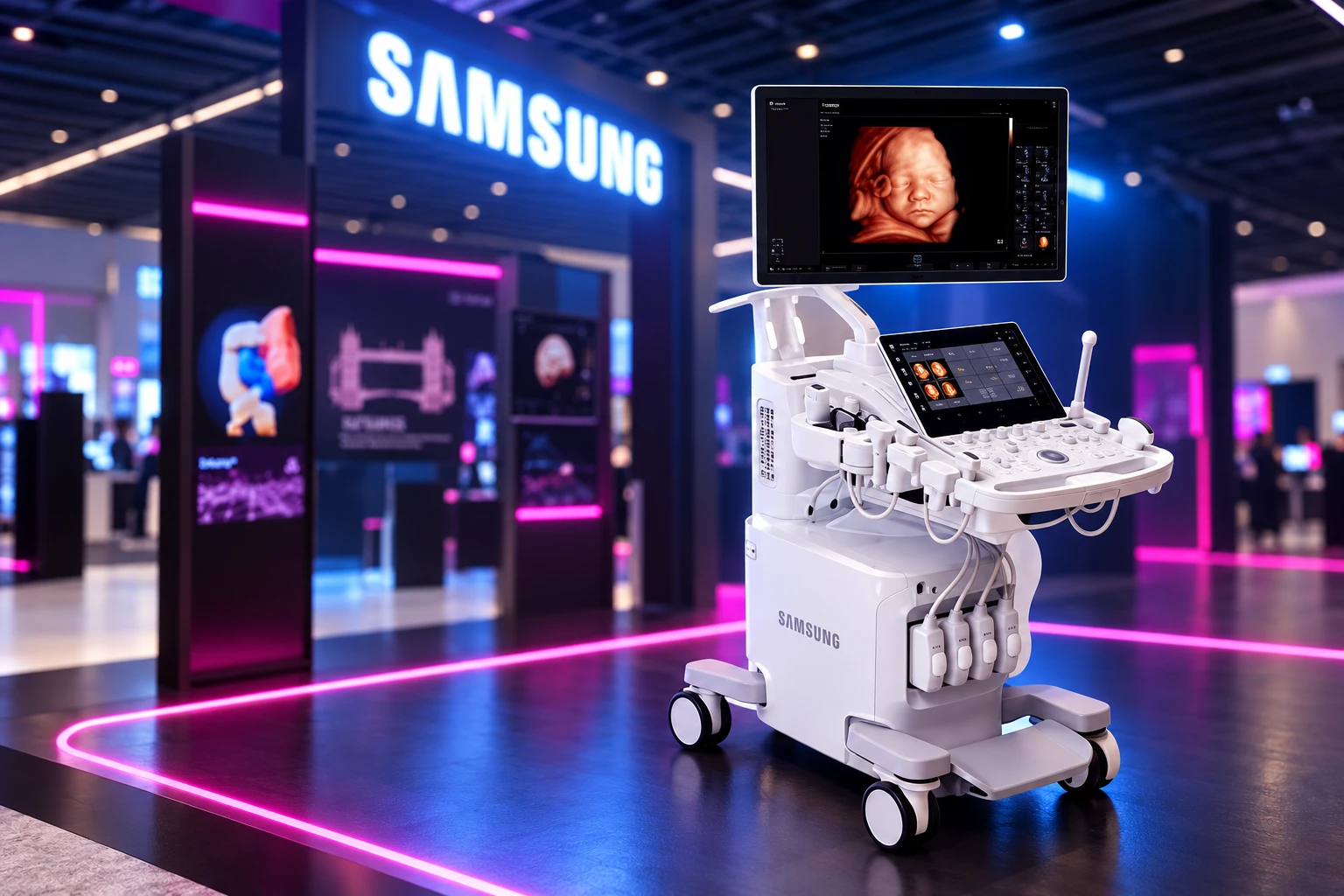
Samsung Medison launched the HERA Z10 ultrasound in London, completing a two-machine premium pair that it says can cut mid-trimester scan times by up to 52%. The cart is a hospital purchase. The hours it claims to give back belong to sonographers.
The company said the new system completes the HERA Z Series lineup with the flagship HERA Z20, and it put both machines on the floor of the 36th ISUOG World Congress in London, which runs September 4 to 7, 2026, at ExCeL. Jihyun Kim, head of the CX team at Samsung Medison, framed the Z10 as a way to take the series into a wider set of clinics. The more pointed sales job showed up in the week before the doors opened, when Samsung Healthcare kept posting that the Z10 was built to ease physical strain on the person holding the probe.
HERA Z10 Completes the Flagship Pair in London
Samsung Medison, founded in 1985 and a Samsung Electronics affiliate since 2011, already had a flagship. The Z20, sold in the United States under that shorter name, made its U.S. debut on January 29, 2025, at the Society for Maternal-Fetal Medicine meeting in Denver. Samsung spent ISUOG 2025 in Cancún pushing an upgraded Z20 as a women’s-health cart for every life stage. The Z10 is the second machine in that pair, not a clean-sheet scanner.
The newsroom copy is careful on that point. The Z10 inherits the Z20’s AI workflow tools and adds beamforming that Samsung says is meant to sharpen the picture. Hospitals get a second premium SKU. They do not get a new AI engine.
THE HERA Z PATH TO LONDON
- January 29, 2025: Samsung Medison debuts the Z20 in the United States at SMFM in Denver, with Live ViewAssist as the headline AI tool.
- September 14, 2025: An upgraded HERA Z20 is shown at ISUOG in Cancún as a single cart for fertility through later life.
- September 1 to 3, 2026: Samsung Healthcare posts HERA Z10 clips that lead on strain, comfort, and 2D/3D imaging ahead of the London congress.
- September 4 to 7, 2026: The HERA Z Series is shown at Booth 3 at ISUOG in London, and the Z10 is announced from Korea on September 7.
Kyu Tae Yoo, chief executive of Samsung Medison, said at the Z20’s U.S. launch that the company was putting money into AI because staffing shortages, high-BMI patients, and operator-to-operator variation were already hurting exam quality. Tracy Bury, vice president and head of ultrasound USA, tied that cart to telesonography, reporting, and fleet management. The Z10 arrives 19 months later as the volume play in the same argument.
Empty Sonographer Posts Around the Congress Hall
The congress is in a city that cannot fill ultrasound jobs. The Society of Radiographers, drawing on a census run from December 2024 to January 2025 and released on March 30, 2026, put the overall 24.2 percent sonographer vacancy rate across 153 analysed responses from 142 ultrasound providers. The NHS figure was 25.3 percent. Independent providers sat at 11.6 percent. The rate is 11.6 points higher than the 2019 census.
London’s shortfall was 34.6 percent. The South East was 38.2 percent, the North West 30 percent, and the North East and Yorkshire 11 percent. Some 7.6 percent of sonographers planned to retire within 12 months, up from 4.6 percent in 2019. Close to a quarter of staff absences were logged as work-related, including stress and musculoskeletal injury.
SONOGRAPHER VACANCY IN THE 2025 CENSUS
| Slice | Vacancy |
|---|---|
| Overall (SoR census) | 24.2% |
| NHS | 25.3% |
| Independent sector | 11.6% |
| South East England | 38.2% |
| London | 34.6% |
| North West | 30% |
| North East and Yorkshire | 11% |
| Planning to retire within 12 months | 7.6% |
Gill Harrison, the SoR’s professional officer for ultrasound, said the figures would feed national talks on shortages, training, and career paths, “particularly in some areas of practice such as obstetric and gynaecology ultrasound and paediatrics.” That is the desk the HERA Z Series is built for. A faster mid-trimester protocol is a staffing tool before it is a marketing slide.
Pain sits under those empty posts. A 2009 study cited in a Society of Diagnostic Medical Sonography white paper found 90% of clinical sonographers had symptoms of work-related musculoskeletal disorders. In earlier SDMS-cited work by Pike and colleagues, 20 percent of symptomatic sonographers had career-ending injuries. Samsung’s own Z20 pages still use those two figures when they sell cart design, flex cables, and fewer keystrokes. The Z10 booth copy followed the same path: alleviate strain, then talk about image quality.
The 52% Time Cut Already Lived on the Z20
The number everyone will repeat is not new to this cart. Samsung’s U.S. Z20 product pages already advertise a 52% cut in exam time on routine mid-trimester scans, credited to Live ViewAssist and a white paper titled Time Efficiency in Routine Mid-Trimester Ultrasound Using Live ViewAssist. The Z10 newsroom cites the same class of result, from joint clinical research with Professor Giuseppe Rizzo and Professor Daniele Di Mascio of Sapienza University of Rome, whom Samsung describes as founding members of ISUOG.
On the Z20, Live ViewAssist is specified in public as real-time view capture with no extra button-pushing. Samsung says it identifies 39 views, annotates up to 47 structures, and performs up to 46 key measurements, with up to 94 percent fewer keystrokes and up to 92 percent accuracy. Independent testing by Sound Ergonomics, as quoted on the Z20 launch note, said that cart met or exceeded 100 percent of the ergonomic standards measured.
WHAT THE TWO CARTS SHARE
| Item | HERA Z20 / Z20 | HERA Z10 |
|---|---|---|
| Role in the series | Flagship, U.S. debut January 29, 2025 | Second premium cart, London, September 2026 |
| Live ViewAssist | Origin system; up to 52% mid-trimester time cut | Inherited; same up to 52% claim |
| Auto labels / measurements | Up to 47 structures, 46 measurements | Same AI workflow, per Samsung |
| Keystrokes | Up to 94% fewer on the Z20 | Not separately restated for the Z10 |
| EzStructure | Present on Z20 training materials | Up to 71% less manual manipulation, per Z10 launch |
| Imaging pitch | Crystal Architecture, software beamforming | Advanced beamforming added on the inherited AI stack |
| U.S. regulatory tag | FDA 510(k) K241971 | Country availability still flagged as limited |
The U.S. filing for the Z20 family described Live ViewAssist as similar in intended use to SonoLyst Live on GE HealthCare’s Voluson Expert 22, 20, and 18. Samsung is not inventing automated OB views. It is putting a second price point under a toolset the flagship already ships, then asking clinics that will not buy the Z20 to buy into the same workflow anyway.
Mid-Trimester Anatomy Scans Still Eat the Clock
Those percentages only matter if the exam they target is the one filling the diary. In a 2026 tertiary-center study of 870 singleton obstetric ultrasounds, published in Pregnancy, median duration for the second-trimester anatomy survey was 29.9 minutes (interquartile range 25.8 to 35.3). Dating scans sat at 6.8 minutes. Detailed first-trimester work ran 18.3 minutes, fetal echocardiography 26.6 minutes, and later growth or Doppler studies 12.5 minutes. Each 10-point rise in maternal BMI added about 3 percent to adjusted scan time. Experience helped, then flattened after about five years.
MEDIAN SCAN TIMES IN THE 870-EXAM COHORT
- Dating, 6 to 10 weeks: 6.8 minutes.
- Detailed first trimester, 11 to 14 weeks: 18.3 minutes.
- Second-trimester anatomy, 18 to 22 weeks: 29.9 minutes.
- Fetal echocardiography, 22 to 24 weeks: 26.6 minutes.
- Growth or Doppler, 24 to 38 weeks: 12.5 minutes.
A separate 2026 audit in Sonography of 1,080 mid-trimester anatomy scans, with 60-minute slots that also had to cover history, a look for the family, and a technical report, found a median scanning time of 48 minutes and a completion rate of only 48.1 percent on the final physician report. An Australasian survey of 697 sonographers found 60 minutes was the most common morphology appointment (53.9 percent), with 40 minutes next (23.4 percent), and 59 percent of morphology respondents said current times could hurt scan quality.
Samsung’s “up to 52 percent” is a best-case from its own Live ViewAssist research, not a rewrite of those medians. Halving a clean 30-minute list is a different job from finishing a 48-minute anatomy study that already spills its slot. The Z10 will be judged on which of those days it actually shortens.
What Live ViewAssist Changes on the Console
Live ViewAssist is the feature Samsung wants associated with both carts. During live scanning it tries to recognise the plane, park a labelled image, run the measurements, and keep a checklist current. On the Z20, Easy Check sits next to it so the operator can see which views are still missing. Training guides let sites build their own view lists. The promise is fewer caliper clicks and fewer arguments about whether a femur was measured the same way on the morning and afternoon lists.
EzStructure is the other number in the Z10 note. Samsung says it reduces manual manipulation for key measurement parameters by up to 71%, which it ties to more consistent numbers and less fatigue. That is the claim a unit running 15 to 20 patients a day can test in a week. It is also the claim most likely to shrink in a high-BMI room, where the 2009-era pain literature and the 2026 BMI-time finding both say the body, not the software, still sets the pace.
The launch of the HERA Z10 is more than just an addition to our product lineup; it represents a major milestone in extending the distinctive clinical value of the HERA Z Series to a wider range of healthcare settings. By leveraging premium imaging technology and unparalleled AI workflows, we remain committed to meeting diverse clinical needs and driving brand innovation so that healthcare professionals worldwide can select custom-fit solutions optimized for their unique practice environments.
Jihyun Kim, Head of CX Team, Samsung Medison
Kim is talking to the buyer who has to pick a cart. The console work she is selling is still done by the person who already has a vacant chair next to them.
High-Risk Imaging Tools Arrive With a Galaxy Tab
Beyond the stopwatch, the Z10 is being sold into complicated obstetrics. MV-Flow 3D is Samsung’s high-resolution microvascular flow mode, pitched for high-risk pregnancies, placenta accreta, and odd vessels in the uterus or cord. FibroidVue uses AI to segment and measure the uterus, endometrium, and fibroids, a gynecology task that used to eat a lot of tracing. Dedicated neonatal probes sit in the same series pitch, so the cart is meant to stay in the room after delivery.
The demographic backdrop is real even if it is slower than the vacancy numbers. The National Center for Health Statistics put the U.S. mean age at first birth at a record high of 27.6 years in 2024, up from 27.5 in 2023 and 25.4 in 2010. From 2016 to 2023, first births to mothers 35 and older rose 25 percent. Older first pregnancies bring more anomaly lists, more growth scans, and more Doppler follow-up. They do not, by themselves, staff a London list that is already a third empty.
At ISUOG, Samsung also ran “ART OF ULTRASOUND,” an AI art show made from fetal images, and a digital companion on Galaxy Tab hardware so clinicians and expectant mothers can look at growth records on the same timeline. That is the consumer-electronics company walking into the exam room with a tablet, not only a cart. It is also the piece that will live or die on hospital IT rules, not on a congress demo.
Samsung Healthcare’s own pre-congress posts made the labor pitch without waiting for the newsroom’s 52 percent line.
Introducing HERA Z10, the newest addition to our flagship HERA Z series.
HERA Z10 is designed to alleviate physical strain and seamlessly support your daily workflow.
Explore the user-centric ergonomics crafted for your comfort.
👉 Learn more about HERA Z10’s ergonomic… pic.twitter.com/FMlQUPWMBp
— Samsung Healthcare (@Samsung_HC) September 4, 2026
“HERA Z10 is designed to alleviate physical strain and seamlessly support your daily workflow,” the official account wrote on September 4, 2026, pointing people to Booth 3. The same week’s clips walked through 2D, blood flow, and 3D, then circled back to comfort. That is the stakeholder Samsung is actually courting: the operator whose shoulder already hurts before lunch.
Clinics Still Have to Prove Those Saved Minutes
Samsung Healthcare’s posts carry the usual device caveats. Features, options, and transducers may not be for sale in every country. The Z10 is tagged as a general-purpose diagnostic ultrasound system, and the company tells users to read the instructions before they scan. The Z20 is the cart with a published U.S. 510(k). The Z10’s local clearances will decide how fast the second SKU can follow it into purchasing meetings.
WHAT WE KNOW
- The pair: HERA Z10 and HERA Z20 are now the HERA Z Series, shown together at ISUOG in London from September 4 to 7, 2026.
- The AI claim: Live ViewAssist is credited with an up to 52 percent cut in mid-trimester detailed scan time in research with Rizzo and Di Mascio; the same 52 percent already appears on Z20 pages.
- The labor backdrop: SoR’s census found a 24.2 percent sonographer vacancy rate, 34.6 percent in London, with obstetric and gynecology paths called out as a pinch point.
WHAT IS UNCONFIRMED
- Independent Z10 timings: No third-party trial of the Z10’s 52 percent or 71 percent figures has been put next to the launch note.
- List price and mix: Samsung has not published Z10 versus Z20 pricing, or said how it will split the two carts in tenders.
- Galaxy Tab records: The pregnancy-tracking tablet demo has not been described as a cleared medical device in the launch materials.
Live ViewAssist will have to label the right plane on a restless fetus, in a high-BMI abdomen, with a sonographer who still has 12 names on the afternoon board. EzStructure will have to cut knob time without sending the measurement into a fight with the reporting package. MV-Flow 3D and FibroidVue will have to earn their keep on the cases that already run long. Until those things show up in a real diary, the HERA Z10 is a second premium cart with a borrowed stopwatch, launched in a city that is short of the people who would use it.
Disclaimer: This article is news reporting and analysis of a medical-device launch and related workforce figures. It is for information only and is not medical advice, a clinical guideline, or a purchasing recommendation for any ultrasound system, probe, or software feature. Hospitals, clinics, and clinicians should consult qualified maternal-fetal medicine physicians, sonographers, biomedical engineers, and their own regulatory and procurement teams before changing scan protocols or buying equipment. Feature sets, clearance status, scan-time results, and vacancy rates are those given by the named companies, professional bodies, and papers cited here and may change with local approvals and later studies.

Instagram Plus Tests a Read-Only Mode That Cuts Stories

Altman Asks the Public to Accept Some AI Harm

Google Freezes OSS VRP Product Reports After AI Flood

AI Agents Make Payment Rails the Scarce Prize

Turkey’s Crypto Boom Now Runs Through Three Banks

Fable 5 Came Back Under a Commerce On-Off Switch

Google’s SpaceX GPU Lease Has a Sept. 30 Deadline

Plasma One’s XPL Locks Face a 1.81 Billion Cliff

DGO’s Rs 549 World Cup Pass Cost Fans Sleep and Data

Moonshot AI’s $30 Billion Ask Became a $35 Billion Close
-
 AI4 months ago
Fable 5 Came Back Under a Commerce On-Off Switch
-
 AI5 months ago
Google’s SpaceX GPU Lease Has a Sept. 30 Deadline
-
 CRYPTO4 months ago
Plasma One’s XPL Locks Face a 1.81 Billion Cliff
-
 APPS4 months ago
DGO’s Rs 549 World Cup Pass Cost Fans Sleep and Data
-
 AI5 months ago
Moonshot AI’s $30 Billion Ask Became a $35 Billion Close
-
 NEWS5 months ago
ColorOS 17 Device List Spans Oppo, OnePlus and Realme
-

 GAMING4 months ago
The RTX 4050 Under Rs 70,000 Hides a Wattage Gap
-

 AI4 months ago
Boris Cherny’s Loops Still Demand a Higher Production Bar