
GAMING
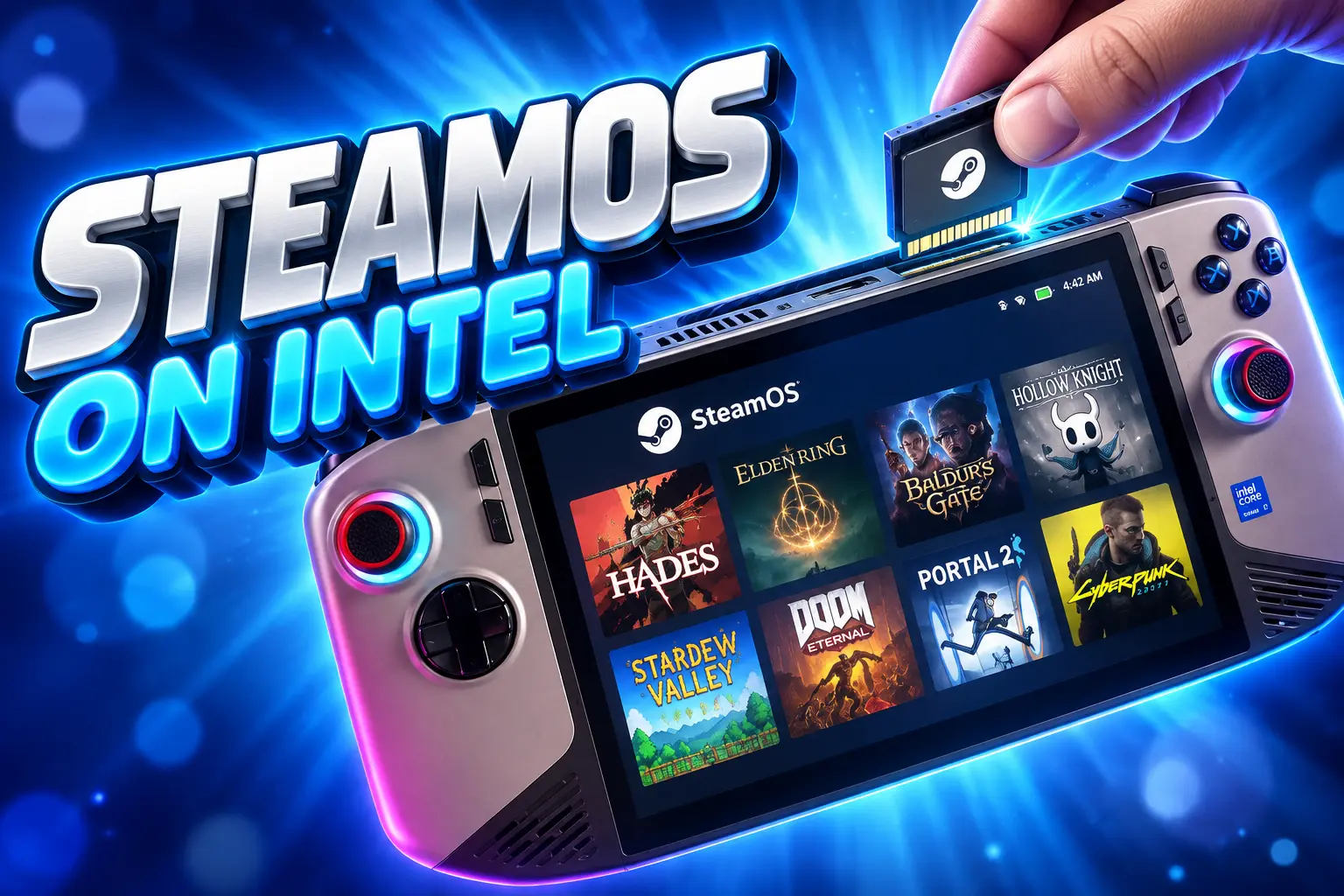
Valve Wired SteamOS for Intel Handhelds Months Ago
SteamOS 3.8.7 put Intel handheld firmware in Valve’s tree in June, yet the Claw 8 EX AI+ still ships Windows with only initial gamepad support.

Valve added initial firmware for upcoming Intel handhelds in the SteamOS 3.8.7 beta on June 5, 2026. The same notes fixed Bluetooth on some Intel units and mapped MSI Claw controllers.
SteamOS 3.8.28 reached stable on September 25, 2026 with initial gamepad support for the MSI Claw 8 EX AI+, a Panther Lake machine that still leaves the factory on Windows 11.
The Firmware Line That Named Intel
For years SteamOS treated AMD as the native chip. The Steam Deck is an AMD machine, and the first partner handheld Valve licensed, Lenovo’s Legion Go S, is AMD too. Intel showed up in the 3.8 tree as a vendor that needed its own firmware blob, not as a footnote under “other PCs.”
The June 5 notes, titled SteamOS 3.8.7 Beta: Second Clutch, were a delta on top of the whole 3.8 beta. Buried in that delta was the sentence that changed the vendor map: initial firmware for upcoming Intel handhelds. A second line fixed Bluetooth on some Intel handhelds, which is the kind of radio bug you only write down after a lab unit has already failed pairing.
Valve engineer Pierre-Loup Griffais later said the company is working closely with Intel, and that Intel has “been doing a lot of hard work on getting the graphics stack up and running there and making sure everything’s optimized.” That is vendor bring-up talk, not a Deck-only maintenance patch.
The rest of 3.8 still reads like a Deck and Steam Machine release. Kernel 6.16, KDE Plasma 6.4.3 in desktop mode after 6.2.5, Wayland as the default session, faster OS updates on a fast link, and first support for Steam Machine hardware all shipped in the same branch. The Intel firmware sat beside those items because Valve was already turning SteamOS into an OS it expected to boot on more than one board.
MSI Kept Betting on Intel When Rivals Did Not
ASUS and Lenovo built their hit handhelds on AMD. MSI did not. The Claw line has been Intel since the original A1M, and that choice looked lonely while the Ally and Legion Go ate the Windows-handheld shelf. The 3.8.7 controller list is how Valve finally treated that bet as real hardware instead of a hobby flash.
MSI’s current flagship, the Claw 8 EX AI+, is sold as the first handheld with Intel Arc G3 Extreme. MSI’s own product blog, posted June 5, 2026, the same day as the SteamOS beta, calls out an 8-inch 120Hz VRR panel, an 80Whr battery it says can run over 5 hours, and Windows-side Xbox Mode. The store SKU is still Windows 11 Home. SteamOS is the aftermarket path, not the box sticker.
CLAW MODELS VALVE NAMED
| Model | Silicon | SteamOS note |
|---|---|---|
| Claw A1M | Original Intel Claw | Controller map in 3.8.7; AccelGyro3D gyro pass |
| Claw 7 AI+ A2VM | Intel | Controller map in 3.8.7 |
| Claw 8 AI+ A2VM | Core Ultra 7 258V, Arc 140V (Lunar Lake) | Controller map in 3.8.7; early playable tests at 15 watts |
| Claw A8 BZ2EM | AMD Ryzen Z2 Extreme | Same 3.8.7 controller pass, AMD silicon |
| Claw 8 EX AI+ | Intel Arc G3 Extreme, Arc B390, 14 CPU cores, 12 Xe cores | Initial gamepad support in 3.8.25 beta, then 3.8.28 stable |
The A8 is the tell. Valve did not split the Claw family by chip vendor. It mapped Intel and AMD Claws in one pass, then left the newer G3 Extreme unit on a slower “initial” track. MSI gets a SteamOS path without a Powered by SteamOS badge, which is exactly the half-status Intel needed and still does not fully own.
What the June 5 Beta Changed
Owners who only read the Intel headlines missed the Deck-side regressions Valve was also cleaning up. The 3.8.7 “New in” block was short, and every line in it was a thing testers had already hit.
NEW IN STEAMOS 3.8.7
- Intel firmware: Initial firmware for upcoming Intel handhelds, plus a Bluetooth fix on some Intel units.
- Claw controllers: Maps for A1M, 7 AI+ A2VM, 8 AI+ A2VM, and A8 BZ2EM, with a gyro pass for AccelGyro3D devices including the A1M.
- Audio popping: A regression from earlier 3.8 builds that could pop the speakers.
- GTA V Enhanced: A GPU crash fix in Grand Theft Auto V Enhanced.
- Remote Play: Capture in desktop mode when the Wayland session is selected.
- Low battery UI: Better behavior when the pack is low and the charger is slow.
- Docked VRR: A TCL TV blank-screen bug with the Steam Deck Dock, needing a dock firmware update.
The wider Non-Deck section in the same 3.8 branch is where Valve stopped pretending third-party handhelds were a side quest. Controller, TDP, and speaker audio support landed for the ASUS ROG Xbox Ally series. Legion Go 2 got controller, RGB, firmware-update, and early charge-limit work. Input latency on supported handhelds dropped from 5-8ms to 100-500 microseconds. SD card reliability work named the Xbox Ally, Legion Go 1, Legion Go S, Legion Go 2, and MSI Claw together.
SteamOS 3.8 left beta for stable on June 18, 2026, and those Intel and Claw lines went with it. Firmware in the tree is not the same as a machine you can buy with SteamOS on the drive.
Lunar Lake Still Trails Windows in Some Games
The first public taste of that firmware was not the G3 Extreme flagship. YouTuber ETA Prime flashed a 3.8 beta onto a Claw 8 AI+, the Lunar Lake Core Ultra 7 258V unit, and called the result “not perfect.” Sleep worked. Games ran. The Steam menu button on the handheld did not always come up from the controller, so he had to drop to mouse mode, and TDP lived in a plugin instead of Valve’s overlay.
He still got playable frames down to 15 watts in a set that included Cyberpunk 2077, Spider-Man 2, Forza Horizon 6, Left 4 Dead 2, and The Witcher 3, and the Claw beat a Steam Deck in most of those runs. Cyberpunk 2077 was the exception that keeps repeating on Intel: the same handheld was faster under Windows than under SteamOS. AMD handhelds usually flip that comparison. Intel’s Arc stack on Linux is still the unfinished half of Griffais’s “graphics stack” comment.
People who actually daily a Claw on SteamOS keep running into the same unfinished edges. Volume keys, rumble, overlay TDP, and some Guide / Quick Access mappings have lagged the AMD Ally and Legion units that Valve has been tuning since 2025. Community images filled that gap for a long time. Official beta support was supposed to retire that workaround. It has not, not all the way.
Only Three Devices Wear Valve’s Official Badge
Valve’s own SteamOS page still draws a hard line. The devices it calls officially Powered by SteamOS are the Steam Deck, Steam Machine, and Legion Go S. Everything else, including the Ally family, the original Legion Go, and the Claw, is enhanced support: the OS installs, Valve will take patches, and nobody in Bellevue promises a clean out-of-box day.
That page also still talks about improved compatibility with other AMD-powered PCs. The 3.8.7 firmware line already contradicted the AMD-only framing, and the page has not caught up. Intel is in the image and the Bluetooth fix. It is not in the badge sentence.
WHO GETS THE BADGE
| Device | Valve tier | Ships with |
|---|---|---|
| Steam Deck (LCD and OLED) | Powered by SteamOS | SteamOS |
| Steam Machine | Powered by SteamOS | SteamOS |
| Lenovo Legion Go S | Powered by SteamOS | SteamOS or Windows, two SKUs |
| ASUS ROG Ally / Ally X / Xbox Ally | Enhanced | Windows 11 |
| Lenovo Legion Go (original) and Go 2 | Enhanced, with extra Go 2 firmware hooks | Windows |
| MSI Claw family, including Intel SKUs | Enhanced | Windows 11 |
Valve told developers in 2025 that SteamOS compatibility ratings would cover any SteamOS device that is not a Deck, and that more than 18,000 Steam titles would be marked compatible from Deck Verified data. That rating still does not say the Claw is a partner device. It says a game’s middleware will not fall over on SteamOS. The Claw still has to get in the door on its own.
No Panther Lake Date From Intel
The Claw 8 EX AI+ went on sale June 23, 2026, with an Arc G3 Extreme chip (2 performance cores, 8 efficiency cores, 4 low-power cores, 12 Xe3 cores on an Arc B390 GPU), 32GB of LPDDR5X, and that 80Whr pack. Intel used the launch briefing to dodge the OS question that the June firmware had already raised.
We’re very aware of the demand on the Linux side. Some of us are gaming on Linux ourselves. We are working on the Mesa driver, we are working with Valve, and that’s kind of all we can say for now. But it’s something that we’re working on.
Nick Mijuskovic, Intel, Claw 8 EX AI Plus press briefing
Mijuskovic also said Intel had nothing to share timeline-wise on SteamOS support for Panther Lake, the architecture behind G3 Extreme. Valve had already shipped “upcoming Intel handhelds” firmware 18 days before that briefing. Intel still would not put a quarter on the calendar.
Griffais, on the same day, confirmed Valve is also working with Nvidia on SteamOS GPUs and does not expect that path this year. Intel is further along than Nvidia because Mesa is the native route and Lunar Lake Claws already boot. Further along is not done. A handheld that costs flagship money and ships Windows 11 is still, for Intel, a Windows SKU with a Linux lab note attached.
Stable Finally Lists the Claw 8 EX AI+
The drip from that June sentence to a stable gamepad line took 112 days. Each step added a control or a resume fix, and none of them promoted the Claw to partner hardware.
FROM FIRMWARE TO STABLE GAMEPAD
- June 5, 2026: SteamOS 3.8.7 beta adds Intel handheld firmware, an Intel Bluetooth fix, and Claw controller maps for A1M, 7 AI+, 8 AI+, and A8.
- June 18, 2026: SteamOS 3.8 hits stable with those Non-Deck lines included.
- June 23, 2026: Claw 8 EX AI+ launches on Windows 11; Valve says it is working closely with Intel; Intel refuses a Panther Lake SteamOS date.
- August 10, 2026: SteamOS 3.8.25 beta adds initial gamepad support for the Claw 8 EX AI+, plus Konkr FIT and AYANEO Pocket S2.
- September 25, 2026: SteamOS 3.8.28 stable keeps initial gamepad support for MSI Claw 8 EX AI+, improves Claw variants, restores Guide and Quick Access on some Claw units that lost them after a firmware bump, and fixes a Claw freeze on resume when an SD card is present.
3.8.28 also moved the kernel to 6.18.50 and shipped a new Mesa major with ray-tracing work, which is the stack Intel said it was helping Valve land. Improved VRAM management in the same build matters on discrete and tight iGPU parts alike. None of that text promotes the EX AI+ off “initial.”
A Claw owner writing on September 25 said a Wi-Fi-after-resume fix they expected from the notes was still broken on their unit. That is the gap the whole Intel path still has: Valve will name the device before the radios, the overlay, and the watt slider behave like they do on a Deck. The September stable channel is where June’s firmware finally shows up in a gamepad bullet. MSI’s store still lists Windows 11 Home. Intel still has no date.

Google Says AI Agents Now Compress Thefts Into Hours

Average People Feel AI First on the Power Bill

Suno Turns the Warner Settlement Into Licensed v6 Models

Lunit Turns Routine H&E Slides Into a Lung Pre-Screen

Meta’s Muse Agent Wants Your Inbox and Your Card

Fable 5 Came Back Under a Commerce On-Off Switch

Google’s SpaceX GPU Lease Has a Sept. 30 Deadline

Plasma One’s XPL Locks Face a 1.81 Billion Cliff

DGO’s Rs 549 World Cup Pass Cost Fans Sleep and Data

Moonshot AI’s $30 Billion Ask Became a $35 Billion Close
-
 AI3 months ago
Fable 5 Came Back Under a Commerce On-Off Switch
-
 AI4 months ago
Google’s SpaceX GPU Lease Has a Sept. 30 Deadline
-
 CRYPTO4 months ago
Plasma One’s XPL Locks Face a 1.81 Billion Cliff
-
 APPS4 months ago
DGO’s Rs 549 World Cup Pass Cost Fans Sleep and Data
-
 AI4 months ago
Moonshot AI’s $30 Billion Ask Became a $35 Billion Close
-

 NEWS4 months ago
ColorOS 17 Device List Spans Oppo, OnePlus and Realme
-

 GAMING4 months ago
Xbox Cuts 3,200 Jobs After Five Years of Thin Returns
-
 GAMING3 months ago
The RTX 4050 Under Rs 70,000 Hides a Wattage Gap