
CRYPTO
Turkey’s Crypto Boom Now Runs Through Three Banks
Turkey crypto custody permits went to three banks, while most exchanges still sit on an SPK list that is not a license.

Turkey’s retail crypto market booked $34.9 billion in the first quarter of 2026, sixth in TRM Labs’ country ranking.
The same year the Capital Markets Board gave the first crypto custody activity permits to Akbank, Garanti BBVA, and Yapı Kredi, and left dozens of exchanges on a temporary list the Board says is not a license.
Turkey’s $34.9 Billion Retail Book Sits in Sixth Place
TRM Labs, a blockchain analytics firm, builds its quarterly ranking by blending SimilarWeb traffic shares with on-chain exchange data and stripping out institutional flows. Global retail activity in that window was $979 billion, down 11% from $1.1 trillion a year earlier. Turkey still landed inside the top 10 on TRM’s retail crypto volume by country.
Q1 2026 RETAIL CRYPTO VOLUME, TRM LABS
| Rank | Country | Q1 2026 (USD B) | Year on year |
|---|---|---|---|
| 1 | United States | 213.3 | -11% |
| 2 | South Korea | 66.6 | -31% |
| 3 | Russia | 47.5 | -13% |
| 4 | India | 46.2 | -5% |
| 5 | Brazil | 40.4 | -12% |
| 6 | Turkey | 34.9 | -7% |
A separate 2026 index from Chainalysis, covering July 2025 to June 2026 with a new four-factor method, is cooler on the same market. In that measure of grassroots crypto adoption across 117 countries, Turkey ranked 20th, with sub-ranks of 16th for total flows, 19th for on-chain balances, 17th for domestic peer-to-peer transfers, and 20th for cross-border flows.
Ripple still talks about scale. In a June 2026 statement it put Turkey’s annual transaction volume at nearly $200 billion, citing Chainalysis’s 2025 geography report, and it has separately put cumulative inflows at roughly $878 billion from 2021 to mid-2025. Those stock figures describe a large book. They do not describe a finished licence regime.
Akbank, Garanti and Yapı Kredi Took the Custody Gate
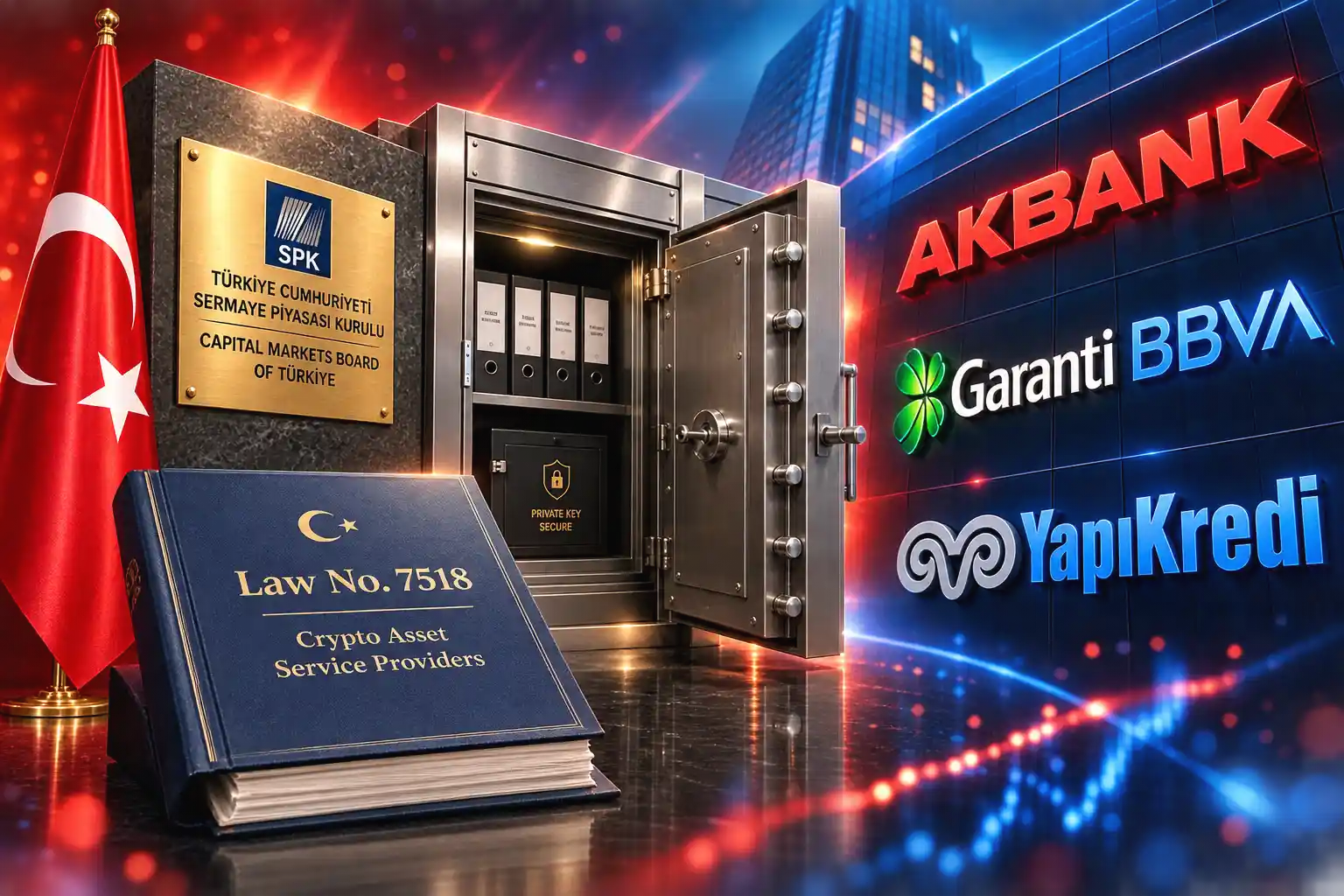
Law No. 7518, published in the Official Gazette on 2 July 2024, put crypto-asset service providers under the Capital Markets Board, known as SPK. Article 35/C says customer crypto that is not kept in a user’s own wallet must sit with a bank approved for this work, or with another firm the Board authorises as a custodian. Customer cash has to sit in banks. Using crypto to pay for goods and services has been banned since a 2021 central-bank rule.
The first activity-permit decisions under that custody track arrived in SPK Bulletin 2026/34, dated 4 June 2026 and published the next day. They went to three banks: Akbank T.A.Ş., Türkiye Garanti Bankası A.Ş., and Yapı ve Kredi Bankası A.Ş. The same bulletin accepted establishment filings for two new trading platforms, Fiba Kripto and Goldtag. Establishment is not an operating certificate.
Yapı Kredi told the public disclosure platform that the Board had approved its request to operate as a crypto-asset custody institution, and that it still had to complete remaining conditions and apply for the authorization certificate. A green light in the weekly bulletin was not, on that telling, the last piece of paper.
Cash capital is the filter that makes this a bank job. SPK Bulletin 2025/68 reset the 2026 floors after the 2025 communiqués had set lower base amounts, and the cash has to be paid in full.
MINIMUM CASH CAPITAL FOR 2025 AND 2026
| Role | 2025 floor | 2026 floor |
|---|---|---|
| Trading platform | TRY 150 million | TRY 250 million ($5.49 million as of May 2026) |
| Custody institution | TRY 500 million | TRY 630 million |
Custody sits far above the platform bar, which is one reason the first permits went to large balance sheets rather than to the retail exchanges that built the volumes.
The License Clock Stopped Until Custodians Can Serve
Platforms already on the transition roster had to apply for an operating licence by 30 June 2025 and were meant to hold one by 30 June 2026. They also had to sign a written custody contract with an authorised custodian. That second duty created a circle: the Board required contracts with firms that did not yet exist in usable numbers.
HOW THE CUSTODY RULES LANDED
- 2 July 2024: Law No. 7518 takes effect and brings crypto-asset service providers under SPK.
- 13 March 2025: Communiqués III-35/B.1 and III-35/B.2 set establishment, operating, and capital rules.
- 30 June 2025: Listed operators must have filed for an operating licence.
- 4 December 2025: Board Decision 63/2219 moves the custody-contract deadline to 31 March 2026.
- 26 March 2026: Board Decision 18/617 suspends both the custody-contract deadline and the operating-certificate deadline until authorised custodians serve platforms widely.
- 2 June 2026: Ripple says RLUSD is available to institutions through BiLira, Bitexen, and Bitlo.
- 4 June 2026: Bulletin 2026/34 records positive custody activity-permit decisions for Akbank, Garanti BBVA, and Yapı Kredi.
- 23 September 2026: SPK bars Bitexen from taking new customers or listing new assets until a further notice, while existing clients may still trade.
Unauthorized platform activity carries prison terms of three to five years under the amended Capital Markets Law. That is why the missing end date is not a paperwork footnote. Until custodians are actually serving exchanges, the Board has no date on which the temporary list becomes a licensed market.
Inflation at 31.5% Still Feeds Dollar Coins
The volumes did not appear because of a licensing brochure. A Central Bank presentation showed annual inflation of 31.5 percent in August 2026, down from 75.5% in May 2024 and still high enough to chew savings held in lira. S&P Global Ratings has put net energy imports at 70% of primary energy supply, which keeps a dollar bill in the import ledger whenever oil and gas jump.
TRM’s own country note on Turkey points at structural demand for dollar-denominated crypto when the lira is under pressure and other savings tools are thin. That is a store-of-value trade, not a leveraged bet on a token’s next print. English-language posts around Ripple’s Turkey deals treat the same fact as a distribution win for a dollar stablecoin. The local mechanic is plainer: people already use crypto as a way to hold dollars.
The payment ban still sits on top of that habit. You can hold and trade. You cannot settle a shop bill in bitcoin or in a dollar token. Any “hub” talk that skips that limit is selling a capital-markets pipe as if it were a payments network.
Ripple Sells the Rails, Garanti Holds the License
Ripple’s useful position in this market is narrower than a hub slogan. Garanti BBVA Kripto, the digital-assets unit of Garanti BBVA, uses Ripple Custody so its retail customers can hold, send, and cash in or out bitcoin, ether, and XRP. The bank ran a pilot in 2023 and later extended the service to its full customer base. In January 2026 the custody relationship was renewed. Reece Merrick, Ripple’s managing director for the Middle East and Africa, tied that product to currency pressure, not to trading theatre.
When a market is dealing with currency pressure at the scale Türkiye has faced, people don’t turn to crypto for trading purposes, they turn to it to protect what they have. We’re seeing genuine demand for regulated, dollar-backed liquidity, and that’s why stablecoins like RLUSD matter here in a very practical way.
Reece Merrick, Managing Director for the Middle East and Africa, Ripple
That sentence is a fair read of the demand. It is a poorer read of who holds the permit. Ripple does not appear on SPK’s operating list as a custodian. Garanti BBVA the bank does, as a custody applicant, and Garanti BBVA Kripto appears separately as a trading platform. The Board’s June decisions named banks, not a foreign software vendor. Ripple’s stack can still be how one of those banks stores keys. The licence, the customer relationship, and the SPK file sit with the bank.
RLUSD Reached Turkish Order Books in June
On 2 June 2026, three days before the custody bulletin, Ripple said it had RLUSD listed with three Turkish platforms, BiLira, Bitexen, and Bitlo, for institutional use. It put RLUSD’s market capitalization at $1.7 billion since a late-2024 launch. Jack McDonald, Ripple’s head of stablecoins, called the Turkey step a way for local firms to reach global dollar liquidity.
BiLira already issues TRYB, a lira-pegged token it says is backed by reserves in local banks, and it described itself in that same release as running about $300 million a month as a local market maker. Bitlo’s chief executive, Mustafa Alpay, talked about users looking for a digital-dollar hedge. Bitexen’s Alphan Göğüş framed RLUSD as the first step in a wider Bitexen Global rollout.
Those listings put a New York-supervised dollar token onto Turkish order books at the exact moment savers still wanted dollars. They did not turn those platforms into fully licensed CASPs. Bitexen was one of the three names in the Ripple release. On 23 September 2026 the Board, in meeting No. 61, told that same platform to stop taking new customers and to stop listing new assets until a further notice.
The SPK List Names 52 Firms and Is Not a License
The Board’s provisional list of operating entities is the public roster everyone still quotes as if it were a licence roll. The page itself says otherwise. It exists so the public can see who declared, under Provisional Article 11, that they would keep operating. The Board’s own line is that the list’s existence does not mean the names on it have been authorised.
WHAT THAT LIST CONTAINS NOW
- Headcount: The live page runs to 52 names, from Akbank’s custody filing at No. 1 to Yuex at No. 52.
- Custody filings: Nine rows are marked “Saklama Başvurusu,” including Akbank, Garanti BBVA, Yapı Kredi, İş Bankası, Takasbank, Misyon Yatırım Bankası, Paribu’s custody unit, Btcturk Dijital Saklama, and Dijital Muhafız.
- Platform names: The rest are trading platforms, among them Paribu, Binance Turkey, OKX TR, Btcturk, Garanti BBVA Kripto, BiLira, Bitlo, and Bitexen.
- Bitexen curb: The starred entry is the 23 September 2026 order: no new customers, no new listings, existing clients may still trade.
Ripple’s custody software is not a row on that page. The banks that can become the legal vaults are. Until those vaults are serving platforms on a wide basis, the Board has said it will not reset the dates for custody contracts or for operating certificates. That is the switch that still has not flipped, and it is why a large retail market can sit in a global volume table while its exchanges remain, in the regulator’s own words, unlicensed.
Disclaimer: This article is news reporting and analysis of Turkey’s crypto-asset rules, market figures, and company announcements. It is informational only and is not investment advice, legal advice, tax advice, or a recommendation to buy, sell, hold, or use any crypto-asset, stablecoin, token, or security, including XRP, RLUSD, bitcoin, or ether. Readers who are considering an account, a transfer, or a business filing should consult a qualified Turkish capital-markets lawyer, a licensed tax adviser, and, where money is at stake, a registered investment professional who can review their own facts. Volumes, ranks, capital floors, licence statuses, and token figures are those published by the named firms and agencies on the dates given and can change with the next bulletin, index, or attestation.

Instagram Plus Tests a Read-Only Mode That Cuts Stories

Altman Asks the Public to Accept Some AI Harm

Google Freezes OSS VRP Product Reports After AI Flood

AI Agents Make Payment Rails the Scarce Prize

Turkey’s Crypto Boom Now Runs Through Three Banks

Fable 5 Came Back Under a Commerce On-Off Switch

Google’s SpaceX GPU Lease Has a Sept. 30 Deadline

Plasma One’s XPL Locks Face a 1.81 Billion Cliff

DGO’s Rs 549 World Cup Pass Cost Fans Sleep and Data

Moonshot AI’s $30 Billion Ask Became a $35 Billion Close
-
 AI3 months ago
Fable 5 Came Back Under a Commerce On-Off Switch
-
 AI4 months ago
Google’s SpaceX GPU Lease Has a Sept. 30 Deadline
-
 CRYPTO4 months ago
Plasma One’s XPL Locks Face a 1.81 Billion Cliff
-
 APPS4 months ago
DGO’s Rs 549 World Cup Pass Cost Fans Sleep and Data
-
 AI4 months ago
Moonshot AI’s $30 Billion Ask Became a $35 Billion Close
-

 NEWS4 months ago
ColorOS 17 Device List Spans Oppo, OnePlus and Realme
-

 GAMING4 months ago
Xbox Cuts 3,200 Jobs After Five Years of Thin Returns
-
 GAMING4 months ago
The RTX 4050 Under Rs 70,000 Hides a Wattage Gap