
COMPUTERS
Lenovo ThinkStation P4 Brings 4,000 AI TOPS to the Desktop
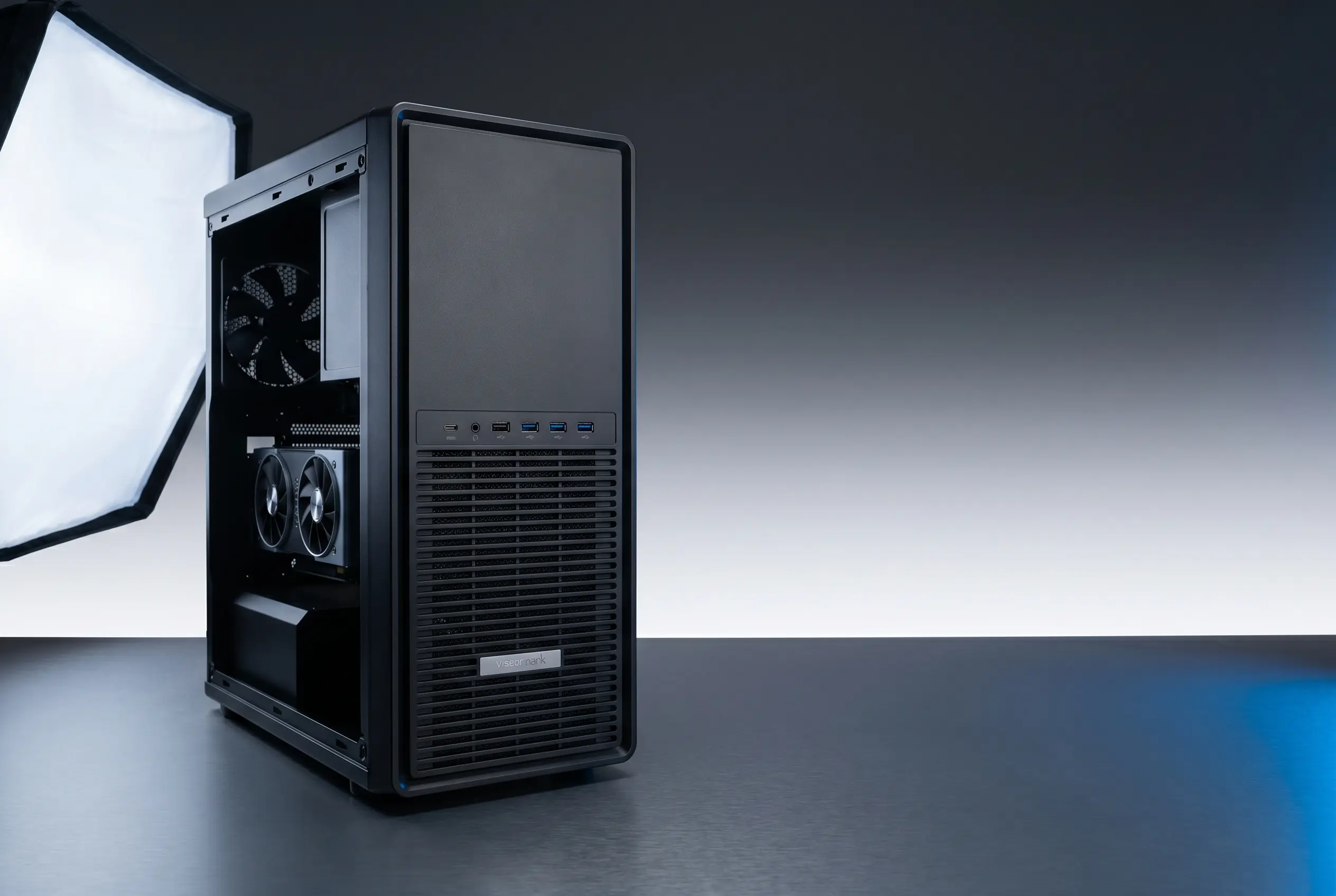
Lenovo unveiled the ThinkStation P4 on May 13, 2026, a 30-liter desktop workstation pairing AMD Ryzen PRO 9000 Series processors with NVIDIA RTX PRO 6000 Blackwell Workstation Edition GPUs in a single chassis. According to Lenovo’s official product announcement, it is the first workstation to combine those two silicon families, debuting at NXT BLD 2026, the architecture, engineering, and construction trade event held in London from May 13 to 14 at the Queen Elizabeth II Centre.
Behind the hardware announcement, Lenovo’s CIO Playbook 2026 research puts the demand case in concrete terms: two-thirds of companies now prefer hybrid AI as their primary operating model, making workstations capable of handling AI inference locally a baseline expectation for engineering and design teams rather than a premium configuration.
A 30-Liter Chassis With Server-Class AI Compute
At the core of the system sits AMD’s Ryzen PRO 9000 Series processor line, topped by the Ryzen 9 PRO 9965X3D with 16 cores and a boost clock of up to 5.5GHz. System memory scales to 256GB of DDR5 across four DIMM slots, with Lenovo supporting 64GB non-ECC CUDIMM modules to reach that ceiling and memory speeds up to 6,400 MT/s depending on configuration. Storage covers up to six drives total, combining up to three M.2 PCIe NVMe SSDs at up to 4TB each with up to three 3.5-inch SATA hard drives at up to 12TB each.
Power supply options run from 500W through 750W to 1,100W, matching configurations that include the full RTX PRO 6000 Blackwell Workstation Edition, which draws 600W on its own. PCIe Gen 5 runs across four expansion slots, leaving room for high-speed networking cards or additional accelerators without a chassis swap. Connectivity covers USB-C at 20Gbps on the front panel, DisplayPort 2.0, HDMI 2.1, 2.5Gb Ethernet, Wi-Fi 7, and Bluetooth 5.4.
The compute figures concentrated in the GPU tier put the AI processing argument in hard numbers:
- Up to 4,000 TOPS of AI performance from the NVIDIA RTX PRO 6000 Blackwell GPU at FP4 precision
- 96GB GDDR7 ECC video memory with 1,792GB/s memory bandwidth on the Workstation Edition
- 256GB DDR5 maximum system RAM at up to 6,400 MT/s across four DIMM slots
- Up to 48TB total raw storage across the six-drive hybrid architecture
AMD’s 3D V-Cache Reaches the Professional Tier
The Ryzen 9 PRO 9965X3D is built on AMD’s Zen 5 architecture and marks the first time AMD has applied 3D V-Cache technology to a PRO-series workstation chip. Lenovo describes this as the first implementation of that cache-stacking technology in the professional workstation segment altogether. The technology places a secondary cache die directly on top of the compute chiplet, substantially increasing available L3 cache and reducing how often the processor must reach out to system DRAM during data-intensive work.
Where expanded cache proves its value is in simulation, BIM (building information modeling, the parametric design format central to architecture and construction workflows) model processing, and CAD operations with irregular memory access patterns. A processor with deeper cache handles those workloads more efficiently than a higher-clocked chip that stalls waiting on memory latency, and AMD’s X3D treatment has demonstrated that effect on its consumer desktop line since the first X3D generation.
One commercial timing detail separates the P4 from any upcoming Ryzen PRO 9000 competitor: the standalone retail version of the Ryzen 9 PRO 9965X3D is scheduled to reach open market on July 15, 2026. Lenovo plans to ship the workstation in June, a full month earlier, through the OEM early-access channel that tier-one builders regularly negotiate for pre-launch silicon. For IT departments targeting a mid-year fleet refresh, that gap could matter in a competitive bid.
PRO-series Ryzen chips also layer extended validation, fleet management features, and hardware-level security capabilities on top of the desktop architecture. That enterprise layer separates a consumer X3D processor from its PRO equivalent in a procurement conversation, and it justifies the workstation-class positioning even for buyers who could theoretically self-build around the same core silicon.
The RTX PRO 6000 Blackwell: 4,000 TOPS on the Desktop
Workstation Edition vs. Max-Q Variant
Both GPU options available in the P4 share the same NVIDIA GB202 silicon, 96GB of GDDR7 ECC memory, and 24,064 CUDA (Compute Unified Device Architecture, NVIDIA’s parallel computing platform) cores. The difference is thermal envelope. The Workstation Edition runs at 600W with active blower cooling optimized for a single-GPU tower. The Max-Q variant drops to 300W for denser builds or noise-constrained environments where sustained thermal headroom is the primary design constraint rather than peak single-card throughput.
| Specification | RTX PRO 6000 Blackwell Workstation Edition | RTX PRO 6000 Blackwell Max-Q |
|---|---|---|
| CUDA cores | 24,064 | 24,064 |
| Video memory | 96GB GDDR7 ECC | 96GB GDDR7 ECC |
| Memory bandwidth | 1,792GB/s | Power-limited (reduced) |
| TDP | 600W | 300W |
| AI performance | Up to 4,000 TOPS | Power-limited (reduced) |
| Primary target | Single-GPU tower workstations | Multi-GPU or quiet build configurations |
Benchmark Position and Architecture Gains
Independent testing of the RTX PRO 6000 Blackwell Workstation Edition shows the card outpacing both the consumer RTX 5090 and the prior professional generation RTX 6000 Ada in sustained rendering tasks. In Blender’s Monster scene benchmark, it reached 7,870 samples per minute against the RTX 5090’s 7,421 and the RTX 6000 Ada’s 5,632. The lead holds consistently across Blender’s Junkshop and Classroom scenes as well, reflecting the combined benefit of the full GB202 silicon and the expanded VRAM pool. Full GPU specifications are documented in Lenovo’s official ThinkStation P4 datasheet.
Fifth-generation Tensor Cores in the Blackwell architecture deliver up to three times the AI throughput of Ada generation hardware and add FP4 precision support, which is the numerical format behind the 4,000 TOPS figure. Fourth-generation RT Cores double the ray-triangle intersection rate of Ada, enabling NVIDIA’s RTX Mega Geometry feature for up to 100 times more ray-traced triangles per render. For Linux buyers planning to run Ubuntu on this system, independent testing of the RTX PRO 6000 Blackwell on Ubuntu found the open-source Nouveau driver still trails NVIDIA’s proprietary stack significantly for professional workloads, keeping the proprietary NVIDIA Linux driver the practical choice for any billable production environment.
Expansion, Ports, and the Software Ecosystem
Lenovo rebuilt the PCIe slot layout based on direct customer feedback from the prior ThinkStation P3 generation, where large GPUs created clearance conflicts with add-in networking cards. The reworked design fits the physical depth of a 600W Blackwell GPU alongside a high-speed NIC without mechanical interference, a change that sounds minor until a deployment team discovers it in a server room.
Factory liquid cooling ships as an option for the top Ryzen PRO 9000 configurations, which draw up to 170W for the CPU alone. Air cooling stays available for lower-tier configurations, but the thermal math for sustained rendering or simulation at the platform ceiling makes liquid the practical choice for any deployment running close to maximum utilization.
ISV (Independent Software Vendor, meaning the software companies that test and certify their applications against specific hardware and driver combinations) certifications at launch cover the major professional application ecosystems:
- Design and CAD: Autodesk, Bentley, Dassault, PTC, Nemetschek
- Engineering simulation: ANSYS, Siemens, Altair
- Media and entertainment: AVID
- Operating systems: Windows 11 Pro, Ubuntu, Red Hat Enterprise Linux
Security runs through Lenovo’s ThinkShield suite, which includes a dedicated TPM 2.0 module, BIOS-based data erasure, an electronic chassis lock, and a chassis intrusion switch. Lenovo also lists EPEAT Gold registration, ENERGY STAR 9.0 certification, and TCO Certified 10 compliance, along with a chassis that uses 95% post-consumer content ABS plastics and 16% recycled steel.
The Local Inference Argument
What Cloud Routing Costs Enterprise Teams
Enterprise AI workloads have run through cloud infrastructure for years, and the economics made sense while inference was occasional and model weights lived on rented GPU clusters. That arithmetic has been shifting. Latency on interactive AI tasks, data sovereignty requirements across finance, healthcare, and defense contracting, and per-token cloud costs that compound at production scale are each pushing IT planning teams toward hybrid deployment models where the workstation handles sensitive or latency-bound inference locally.
Tom Butler, Vice President for Commercial Portfolio and Product Management at Lenovo Intelligent Devices Group, set out the commercial positioning at the May 13 launch:
As workflows become more complex and AI-driven, professionals of all levels require systems that keep pace with their evolving needs. The ThinkStation P4 provides a strong balance of performance and value, packing flagship workstation capability in a scalable offering for engineers, designers, architects, creators and more.
Butler’s statement came paired with the CIO Playbook 2026 figure: two-thirds of companies prefer hybrid AI as their primary operating model. For Lenovo, that figure is the purchase justification for every P4 sale into an enterprise account where the cloud cost line was previously untouchable.
Where Memory Capacity Changes the Equation
A workstation with the GPU’s full VRAM capacity and 256GB of system RAM can carry substantial model weights locally without multi-card pooling or memory swapping. Quantized versions of large language models in the 70-billion parameter range, reduced to 4-bit precision, typically require around 40 to 45GB and fit within the RTX PRO 6000 Blackwell’s frame buffer with inference overhead to spare. Running those models on-device eliminates the compliance question about what leaves the company network, which matters more to architecture firms protecting proprietary building data or manufacturers guarding pre-release design files than any benchmark metric.
For media production teams with large scene files, local inference removes the round-trip latency between workstation and cloud API endpoint. Both use cases rest on the same constraint: when data is too sensitive, too large, or too latency-sensitive to route through a third-party endpoint, the workstation takes the load. The NVIDIA RTX PRO 6000 Blackwell product page positions the GPU explicitly for on-device generative AI, physical AI simulation, and agentic AI development workflows, matching the use cases Lenovo targets with this platform.
Availability Window and the North America Gap
The workstation ships to select markets worldwide starting June 2026. North America availability follows in August 2026. Lenovo has not announced pricing, noting figures will come closer to each regional launch date. Given that the RTX PRO 6000 Blackwell Workstation Edition carries a standalone retail price of $8,500, fully configured units will land in a premium workstation bracket by any measure, though Lenovo’s press language around “without a premium price tag” suggests the company is targeting a competitive entry point relative to comparably configured alternatives from HP and Dell.
The two-month regional gap matters for North American IT procurement teams. Departments operating on a September fiscal year close can still land units in their Q3 purchasing window by ordering at the August opening; teams on a June or July budget deadline will be weighing alternatives or carrying forward existing hardware for one more cycle.
If Lenovo prices the P4 competitively against HP Z-series and Dell Precision workstations carrying the same Blackwell GPU tier, the Ryzen PRO 9000 architecture plus the existing ISV certification list gives procurement teams a credible third option in the high-end single-GPU segment. If pricing arrives at the premium end of the bracket, the buying decision shifts to support contract terms and fleet management tools, where Lenovo already holds strong enterprise footing among existing ThinkStation customers.
COMPUTERS
After Billions in Classroom Devices, America’s Schools Are Pulling Back
On April 21, 2026, the Los Angeles Unified School District board voted 6 to 0 to impose screen time limits across its system of roughly 600,000 students, making LAUSD (the Los Angeles Unified School District, the country’s second-largest school system) the first major American district to formally cap how long students can use school-issued devices in class. The resolution bans devices for kindergarten and first-grade students entirely, sets grade-level daily and weekly screen time limits for older students, blocks YouTube across the district network, and prohibits device use during lunch and recess in elementary and middle schools.
That vote sits at the intersection of three converging forces: parents who moved from phone bans to device bans after the distraction simply shifted sideways onto the school Chromebook, districts counting annual laptop repair bills that now run into millions, and legislatures in 16 states that introduced edtech restriction bills this spring.
The LAUSD Resolution, Item by Item
Nick Melvoin, the LAUSD board member who drafted the resolution, framed the move as recalibration rather than rejection. His estimate: few Los Angeles classrooms are using screens in ways that demonstrably benefit learning. “We have responsibility as one of the largest districts to draw a line in the sand when it comes to this recalibration and start the conversation,” he said before the April vote.
District staff must deliver a complete screen time policy to the board by June, ready for the 2026-27 school year. Schools Beyond Screens, a parent advocacy group with roughly 2,000 members in Los Angeles, spent months pressing the district at board meetings, through social media campaigns, and in private talks with administrators. Anya Meksin, deputy director of Schools Beyond Screens, called the outcome “an historic reform that we hope will trickle down to the rest of the country very, very quickly.”
Six specific requirements the resolution establishes:
- Ban all district-issued devices for students in early education through first grade
- Set maximum daily and weekly screen time limits by grade level for students in grades two and above
- Block YouTube on all school-issued devices across the district network
- Prohibit device use during lunch and recess in elementary and middle schools
- Create a clearer process for parents to opt children out of device use at school
- Audit all edtech (education technology, meaning the software platforms and learning apps districts pay vendors to provide) contracts, which the district’s teachers union estimates total $1.6 billion
That audit provision carries the most long-term weight. Most edtech purchases have never been evaluated against measurable student outcomes. Auditing a $1.6 billion portfolio would require the district to justify each platform against results, a standard the industry has largely never been held to.
How 96 Percent of Schools Got Devices Overnight
The speed of the original transformation is the context most coverage underweights. Consider the numbers that frame the current reversal:
- 96% of U.S. public schools had provided digital devices to students who needed them by the start of the 2021-22 school year, per National Center for Education Statistics data
- 88% of public schools maintained some school-issued computing program in the 2024-25 school year, according to Institute of Education Sciences figures
- $4 million: what Fresno Unified School District spends annually just to repair and replace student laptops
- $1.6 billion: the LAUSD edtech contract value the district’s teachers union has flagged for audit
Education shifted online overnight in March 2020. Schools poured pandemic relief funds, state reserves, and federal grants into closing the digital divide, the gap between households with devices and those without. What had been a multi-decade equity goal compressed into roughly two school years. By the 2021-22 start, the mission looked complete.
The recurring costs arrived later, and so did the behavioral effects nobody had budgeted for. Schools bought devices under emergency timelines, often without integration plans for teachers or protocols for managing what students could access. Many edtech vendors sold products as educational tools while relying on their own data to make the case. Critics of the current vetting process note that in most districts, school boards, IT departments, and administrators choose vendors based on what those same vendors present to them, with no independent body to confirm safety or efficacy.
The Costs Schools Are Now Counting
Hardware Repair Bills
Fresno Unified, California’s third-largest school district, is spending $4 million annually to repair and replace student laptops. Its solution this fall: the roughly 40,000 elementary students with take-home devices will return them, and computer access will shift to in-class only. AJ Kato, a Fresno Unified spokesperson, confirmed the decision is partly about cutting costs.
Simi Valley Unified, near Los Angeles, made the same call for its younger students, partly because of repair costs and partly because devices were being used for what the district described in a parent memo as “inappropriate Google searches” and video games. The devices now sit in classroom carts at school.
| District | Action | Student Scope | Primary Driver |
|---|---|---|---|
| Los Angeles Unified | Banned devices through 1st grade; grade-level screen caps; YouTube block | ~600,000 total enrollment | Distraction, parent campaigns, $1.6B contract audit |
| Fresno Unified | Recalled take-home laptops; in-class access only this fall | ~40,000 elementary students | $4M annual repair and replacement bill |
| Simi Valley Unified | Stopped sending devices home for younger students; carts stored at school | Elementary grades | Repair costs; devices used for games and inappropriate searches |
| Arlington, Virginia | Stopped issuing iPads before 1st grade; new elementary limits | Pre-K through grade 1 | Behavior concerns, parent pressure |
| Lower Merion, Pennsylvania | No device policy change; parent opt-out request denied | Full district | District says opt-out is not structurally possible |
Attention, Filters, and the Browser That Stays Open
Spending on devices was never the core problem. Spending without managing how the devices would be used is where the original decision broke down. Internal documents, as reported by NBC News, show that Google pursued school adoption partly to build a “pipeline of future users,” students who develop habits around its products before reaching adulthood. That disclosure hardened the position of parent groups who believed they were consenting to educational tools, not to brand formation.
Joe Clement, a Virginia social studies teacher who has spent roughly three decades in classrooms, has watched students’ ability to focus deteriorate alongside device adoption. He told Education Week that placing a device with an open browser next to an algebra problem is an “unfair burden” on students trying to concentrate. Filters exist, he noted, but students find routes around them without much difficulty.
One Arlington parent reviewing her sixth-grader’s device history found him visiting a game site in nearly every class period. Another said her fourth-grade son was capitalizing random letters with no correction from teachers because so little work was done on paper anymore. A third watched her son write algebra answers with his finger on a touch screen, a substitution for pencil-and-paper work that teachers say delays the handwriting and number-formation skills that show up on assessments years later.
From Phone Bans to Laptop Bans: A Parent-Led Escalation
The campaign started with personal smartphones, and it largely worked. California passed legislation restricting phone use in schools. Dozens of districts nationwide enacted outright bans. Phones went into pouches, carts, and front-desk lockboxes.
Then parents reviewed their children’s browsing histories again. The phone was gone, but the distraction had moved sideways onto the school Chromebook. Students were messaging friends through Google Docs, watching YouTube between assignments, and playing browser games that content filters did not catch. Kim Whitman, co-lead for Smartphone Free Childhood US, described the pattern plainly: “A lot of the issues with personal devices can move to the district-issued devices.”
Schools Beyond Screens formed in Los Angeles when parents recognized that phone bans, while useful, had not solved the underlying problem. Members showed up at board meetings, documented screen-saturated school days, and brought personal accounts to administrators. Katie Pace, a member of the group, tracked her eighth-grade daughter’s school Chromebook history and found hours of Spotify playlist-building, makeup tutorials, and YouTube videos. Her daughter uses the device on the bus before school even begins.
“My daughter went to middle school and was sent home with a screen addiction in her backpack,” Pace said.
Sixteen Legislatures and a Federal Warning
The legislative push is moving faster than any single district can demonstrate results. Lawmakers in 16 states introduced bills targeting education technology in public schools this year, ranging from daily screen time caps to new software vendor vetting requirements. Iowa, Missouri, Kansas, Oklahoma, Tennessee, and Utah all proposed capping or restricting daily screen time for students in kindergarten through fifth grade on school-issued laptops.
Missouri’s initial bill set a 45-minute daily cap for elementary students, drawing pushback from teachers who argued it would eliminate photography and three-dimensional printing courses. Dozens of Missouri teachers submitted opposing testimony. Rhode Island’s proposed Safe School Technology Act would ban software providers from activating audio or video functions on devices outside school activities and prohibit collection of student location data. Vermont moved a bill through its state House requiring all edtech providers to register annually with the state, submit their privacy policies for independent review, and obtain certification before schools can deploy their products.
The federal government added its own marker last week. The Surgeon General’s office issued an advisory warning that excessive screen use among young people has become a growing public health concern. The advisory does not mandate specific classroom policies, but the signal is clear: the conversation has moved beyond local school boards.
Peer-reviewed research is beginning to align with what parent groups have argued on the basis of observed behavior. A JAMA Network Open cohort study tracking more than 3,300 elementary school children in Ontario, published in late 2025, found that higher total screen time was associated with lower reading and math achievement on standardized tests in grades three and six. The findings stop short of establishing direct classroom causation, but they give legislators something beyond anecdote to cite.
This is an historic reform that we hope will trickle down to the rest of the country very, very quickly.
Anya Meksin, deputy director of Schools Beyond Screens, said that at the LAUSD board meeting after the April vote. The speed she wants may be the part educators most fear.
What Edtech’s Defenders Don’t Want Rolled Back
The edtech industry is lobbying against the strictest state proposals, arguing that limits on classroom technology could set public schools back decades, and the counter-argument carries some weight. Adaptive learning software adjusts problem difficulty based on a student’s real-time performance data. Text-to-speech tools help students with dyslexia access written material without waiting for a teacher’s individual attention. Early-warning platforms tell a teacher which students are falling behind before a grading period ends. None of those tools is equivalent to an unsupervised browser pointed at a YouTube recommendation feed.
What the backlash risks is treating every screen minute as identical. A 45-minute daily cap does not distinguish between a second-grader watching videos and a second-grader using adaptive math software. Alex Bird Becker, one of the founders of parent group PA Unplugged in suburban Philadelphia, framed the situation this way: “If there’s really no evidence that it helps, and in fact there’s evidence that it’s harmful, what are we doing? Test scores are at their lowest point.” That argument wins in a school board meeting. Whether it accurately describes every edtech product in a district’s portfolio is a different question.
The district must present its full screen time policy to the school board by June. If that policy takes effect in the 2026-27 school year and produces measurable improvements in attention, behavior, or academic scores, it gives the 16 state legislatures a test case that goes beyond parent testimony. If the $1.6 billion contract audit reveals agreements the district cannot cleanly exit, the cost of the correction will arrive on the same invoice as the original purchase.
COMPUTERS
HPQ Shares Jump as AI PC Rally Hits a Memory Cost Test
HPQ shares surged 15.3% on Friday, May 22, as investors rushed back into PC and printing company HP Inc. before the company’s scheduled May 27 earnings call, betting that demand for artificial intelligence personal computers (AI PCs, machines with on-device acceleration for AI tasks) and the Windows refresh can offset weak printing and higher memory costs.
The signal was loud because HP is usually priced like a mature cash-return hardware name. By the latest Friday quote, the stock was at $25.24 on 48.5 million shares traded, while rival computer maker Dell Technologies rose 16.8% in the same session. The read-through was simple enough: hardware stocks with an AI angle were getting a second look before HP’s numbers.
The Friday Move Was Rare for HPQ
HP has spent much of the past decade trading like a dividend and buyback story, not like a high-multiple AI proxy. That distinction matters. Traders were not reacting to a new company filing Friday afternoon; they were repricing the next report before management had answered the margin question.
The stock opened at $22.60, touched $25.55 intraday and last traded near $25.24. For a company whose daily moves are often modest, that range points to more than a routine bounce. It suggests investors were willing to pay in advance for evidence that the PC cycle has improved faster than feared.
- 15.3% one-day gain by the latest Friday quote.
- 48.5 million shares changed hands during the session.
- $25.55 marked the intraday high before the stock eased slightly.
AI PCs Gave Investors a Growth Hook
Segment math explains why the rally centered on computers. In HP’s fiscal first-quarter report, Personal Systems revenue was $10.3 billion, up 11% from a year earlier, while consumer personal-system revenue rose 16% and commercial revenue rose 9%. Printing, by contrast, fell 2% to $4.2 billion.
Personal Systems is carrying the stock because it gives investors a way to attach the company to two replacement cycles at once. One is the Windows fleet refresh in businesses. The other is a shift toward higher-spec laptops and desktops that can run some AI workloads locally instead of sending every request to the cloud.
Karen Parkhill, HP’s chief financial officer, gave traders a clean number for that story. On the latest reported quarter, she said AI-capable PCs were 35% of total shipments, up from 30% in the prior quarter and 25% the quarter before that. That progression turns AI from a product label into a mix shift investors can model.
The Windows side also has a calendar push. Microsoft, the Windows maker, says free software updates, technical assistance and security fixes ended after the Windows 10 support cutoff on Oct. 14, 2025. Corporate buyers can delay a refresh, but they cannot ignore an unsupported operating system forever.
The Cost Problem Travels With the Upgrade
The awkward part is that a richer computer can also be a more expensive computer to build. On the first-quarter call transcript, Parkhill said memory costs had increased roughly 100% sequentially. She also said memory and storage had moved from roughly 15% to 18% of the PC bill of materials in the prior quarter to roughly 35% for the year.
35% is the number that explains why Friday’s move should be treated as a test, not a victory lap. If dynamic random access memory (DRAM, the main memory chips inside PCs) and storage absorb a larger share of cost, the company must either raise prices, trim configurations, shift mix, or accept lower profit on the machines investors now want it to sell.
The table shows the split investors have to reconcile. The growth signals are visible, but the margin pressure is visible too, and both come from the same hardware upgrade cycle.
| Signal | Latest Company Data | Why It Matters After the Rally |
|---|---|---|
| PC demand | Personal Systems revenue rose 11% year over year | Gives the stock a growth story before earnings |
| AI mix | AI-capable PCs reached 35% of shipments | Moves the business toward premium hardware |
| Memory burden | Memory and storage were estimated near 35% of PC bill of materials | Puts pressure on Personal Systems margin |
| Printing revenue fell 2% while margin stayed at 18.3% | Keeps cash generation relevant, but cannot drive the rally alone |
Printing Still Buys HP Time
The old business did not cause Friday’s rally, but it still matters because it funds patience. Printing revenue was lower in the latest reported quarter, yet the segment’s operating margin of 18.3% was far above the 5.0% margin in Personal Systems. That gap is why a shrinking print line can remain important to a stock being repriced around newer PCs.
The same cash-return math showed up in the January quarter Form 10-Q. During the three months ended Jan. 31, the company returned $0.6 billion to shareholders through $0.3 billion of share repurchases and $0.3 billion of cash dividends. It also had about $8.1 billion remaining under its board-approved buyback authorization. That support has limits, though. If margins in the PC segment stay below target for longer than management expects, buybacks and dividends become a cushion while the market waits for the hardware mix to prove itself.
The Broader PC Cycle Is Pulling Demand Forward
Industry data backs part of the rally. Gartner’s first-quarter PC shipment data showed worldwide shipments of 62.8 million units, up 4% from a year earlier. The research firm also said growth had help from vendors and channel partners building inventory before expected memory cost increases.
That helps explain the strange setup. PC demand can look healthy at the same moment the forward market gets tougher, because distributors and buyers pull purchases into the first half before components become pricier. The sales then arrive early, and the second half has to clear a higher bar.
For HP, that timing matters because management has already said it expects the PC unit market to decline by double digits this calendar year as pricing actions weigh on demand. A rally built on shipped units has to survive the moment when higher device prices meet customers who can delay upgrades.
Windows refresh demand gives the cycle one stabilizer. The end of support pushed businesses to act, especially where fleets still had older machines. The same refresh also makes investors more willing to believe that new AI hardware can hold average prices above the plain replacement market.
May 27 Turns the Rally Into a Margin Exam
The next report has to do more than confirm that people are buying PCs. Investors need management to separate durable commercial refresh demand from purchases pulled forward by memory inflation. They also need a cleaner view of how much profit the company can protect while selling pricier machines.
- Earnings per share guidance needs to hold near the company’s prior adjusted earnings per share (EPS, profit per diluted share) outlook of $0.70 to $0.76 for the quarter.
- Personal Systems margin needs a credible bridge through memory costs, pricing, and mix.
- Print needs to keep funding capital returns without hiding demand weakness in hardware or supplies.
There is a cleaner upside case. Commercial buyers keep refreshing fleets, the AI mix rises, and price increases offset enough component inflation to let management sound less cautious about the back half. There is also a cleaner downside case: the first half borrowed too much demand from later quarters, and memory costs eat the premium that investors just paid for.
If the company shows AI PC growth with margin control, Friday’s move can look like the first repricing of a hardware cycle. If management has to lean on price hikes while warning about lower unit demand, the 15.3% jump starts to look like an earnings-week trade that arrived early.
Disclaimer: This article is for informational purposes only and discusses publicly traded securities. Equity prices can move sharply around earnings, component costs, and macro news. Consult a qualified financial adviser before making investment decisions. Figures are accurate as of publication.
COMPUTERS
Samsung Strike Ruling Shifts AI Chip Fight to Union Vote
The Samsung strike ruling changed the wage fight at Samsung Electronics from a shutdown threat into a controlled production dispute. A Suwon court required safety and product-protection work to continue at regular levels, and a last-minute wage accord on May 20 moved the fight to a union vote running May 22 to May 27.
For the AI supply chain, the important shift is from production outage to profit-sharing precedent. Samsung’s fabs may keep running this week, but the ballot will show whether workers in the most valuable part of the hardware stack can turn an AI memory boom into a standing claim on earnings.
The Court Order Cut Off the Production Threat
The May 18 order from Suwon District Court, a South Korean civil court, partially accepted Samsung’s request to limit unlawful industrial action by two unions, including the Samsung Group Supra-Enterprise Labor Union’s Samsung Electronics chapter. The key phrase was regular levels. In fab language, that meant the union could not treat weekend skeleton staffing as enough for a weekday strike if that staffing left safety or product-protection work below normal.
That matters because semiconductor plants are not offices with lights that can be switched off for 18 days. Wafers move through long process flows, chemicals and gases sit in controlled systems, and unfinished chips can lose value if protection work slips. The right to strike survived, but the work that could be withdrawn became narrower.
The law gave the court a practical hook. Korea’s Trade Union and Labor Relations Adjustment Act text requires work aimed at preventing equipment damage or raw-material and product deterioration to be conducted during industrial action, and it separately protects normal maintenance of workplace safety facilities. For a chip plant, that language is unusually powerful.
| Moment | What Changed | Why It Matters |
|---|---|---|
| May 18 court order | Safety and product-protection work had to stay at regular levels. | Samsung limited the risk of a sudden fab disruption. |
| May 20 tentative accord | The union put the strike on hold and sent the deal to a ballot. | Production risk shifted from factory floors to member approval. |
| May 22 to May 27 vote | Members decide whether the compromise ends the wage round. | The result sets the tone for chip-sector labor demands. |
A Wage Deal Put the Strike on Hold
By May 20, the dispute had moved from court papers to late-stage mediation. Choi Seung-ho, head of Samsung Electronics’ largest union, said the union would hold off on the planned 18-day strike and put a tentative agreement to members, according to the May 20 wage-deal report from the Associated Press. Members are due to vote from May 22 to May 27.
The union had said more than 46,000 members were willing to join the walkout. Management was also facing the awkward fact that its most important profit engine was being challenged by the people who run it. For workers, the deal offers a path to claim part of the AI recovery without absorbing fines or a separate court fight over staffing levels.
The choreography matters after Samsung’s first union strike in 2024, when organized labor showed it could pierce a company culture long known for weak union presence. This round was larger, more targeted and tied to the semiconductor unit rather than a symbolic one-day action. That gave the dispute more market weight and more political heat.
If members reject the deal, the union can revive industrial pressure, though the May 18 order would still shape how much pressure reaches production. If they approve it, the immediate strike risk fades, and the debate turns to the bonus formula.
AI Memory Profits Raised the Stakes
The bonus argument reached boiling point because Samsung’s recovery has been dramatic. In its official first-quarter earnings presentation, the company reported consolidated revenue of KRW 133.9 trillion and operating profit of KRW 57.2 trillion. Device Solutions (DS, Samsung’s semiconductor division) accounted for KRW 53.7 trillion of operating profit.
High-bandwidth memory (HBM, stacked memory used with AI accelerators) sits at the center of that surge. Samsung said memory sales surpassed its quarterly record and that high-value AI products helped drive results. The wage fight grew from a standard pay dispute into a fight over who shares in the AI cycle.
There is a second tension inside the numbers. Memory is throwing off most of the gains, while Samsung’s foundry business still has to prove it can turn advanced-node ambition into steadier earnings. A uniform bonus pool can look unfair to the high-profit team; a sharply divided one can split workers who need each other to keep the same fabs moving.
- KRW 57.2 trillion: Samsung’s total first-quarter operating profit.
- KRW 53.7 trillion: Operating profit from Device Solutions.
- 225%: Year-on-year sales growth in DS, according to Samsung’s segment table.
- KRW 11.3 trillion: Companywide research and development investment in the quarter.
The State Had Tools Beyond Mediation
South Korea’s labor system gives unions strike rights, but it also leaves the state with tools when a dispute threatens the national economy. The National Labor Relations Commission’s adjustment guide describes emergency adjustment as an exceptional step that can suspend action when public welfare or the economy is at risk.
The government avoided that hammer after the tentative deal. Still, the possibility changed the room. Kim Young-hoon, South Korea’s employment and labor minister, stepped into last-minute talks after earlier mediated talks failed, and the dispute landed in Suwon rather than on a picket line.
For Samsung, the legal shield was narrow because it covered safety, security and product protection, not the entire wage dispute. For the union, that narrowness matters too. A strike with normal staffing for protected functions can still embarrass management, slow routines and keep the bonus issue public.
That distinction is why the ruling helped management without solving management’s political problem. Courts can define illegal interference. They cannot write a bonus scheme that workers see as fair, especially when the company itself tells investors AI demand is driving record profits.
Korea’s Export Data Made the Dispute Larger
Samsung’s dispute triggered government attention because chips are now carrying Korean trade. The Ministry of Trade, Industry and Resources and the Ministry of Science and ICT (MSIT, South Korea’s digital policy ministry) said April information and communications technology exports reached $42.7 billion, up 125.9 percent from a year earlier.
Those information and communications technology (ICT, electronics and digital equipment trade category) exports accounted for 49.7 percent of Korea’s total exports in April, according to the same release. Semiconductor exports stayed above $30.0 billion for a second straight month, helped by memory contract prices and AI-server demand.
That is the reason a factory labor fight became a cabinet-level concern. A full outage could have affected HBM, dynamic random-access memory (DRAM, main memory used in servers and PCs), flash memory and solid-state drives (SSDs, storage drives using flash memory). Even a partial slowdown would have given customers another reason to worry about supply.
Customers have little patience for labor nuance when server buildouts are timed around accelerator deliveries. When memory supply tightens, buyers call other suppliers, prepay for inventory or delay system shipments long before Korean civil procedure finishes.
Rival SK hynix, a Korean memory chipmaker, matters in the background because its bonus practices became a benchmark in the dispute. If Samsung accepts a richer or more transparent incentive formula, the cost question spreads beyond one company and into the Korean memory duopoly.
The Vote Now Carries the Labor Precedent
The member ballot is the last hinge. A yes vote would spare Samsung an 18-day industrial action and give management time to sell the accord as a responsible compromise. A no vote would revive the strike threat under a court order that already defines protected work.
Union leaders also face a credibility test. They pushed the dispute to the edge of a national supply-chain alarm, then accepted a tentative deal before the first strike day. Members who wanted a direct share of record semiconductor profits will judge whether the accord does enough on incentives, transparency and future pay rounds.
Management’s calculation is just as awkward. The company protected production, but it has also taught engineers and fab workers that their labor has national bargaining value when AI demand is hot. That memory will matter the next time profits surge faster than pay formulas move.
If members approve the agreement, Samsung buys calm without ending the argument over AI profit sharing. If they reject it, the court order becomes the operating manual for a strike that no longer looks theoretical.
-
CRYPTO3 weeks agoAndreessen Horowitz Bets $2.2B on Crypto’s Quiet Cycle
-
CRYPTO2 weeks agoCathie Wood Calls SpaceX IPO Demand ‘Voracious’ Ahead Of $1.75T Debut
-
NEWS3 weeks agoGhana CSA Plants Office In Ho As Volta Cybercrime Climbs
-
APPS3 weeks agoGoogle’s Buried Page Reveals 500 Niche Websites Still Making Cash
-
NEWS3 weeks agoHormuud Bets $19 Down Will Finally Pull Somalia Online
-
NEWS3 weeks agoApple Strikes Preliminary Deal For Intel To Make iPhone And Mac Chips
-
NEWS3 weeks agoMetalenz Polar ID Hides Face Unlock Under OLED Smartphone Screens
-
AI3 weeks agoGoogle AI Overviews Adds Subscribed Label, Reddit Quotes Inline





