
COMPUTERS
Lenovo ThinkStation P4 Brings 4,000 AI TOPS to the Desktop

Lenovo unveiled the ThinkStation P4 on May 13, 2026, a 30-liter desktop workstation pairing AMD Ryzen PRO 9000 Series processors with NVIDIA RTX PRO 6000 Blackwell Workstation Edition GPUs in a single chassis. According to Lenovo’s official product announcement, it is the first workstation to combine those two silicon families, debuting at NXT BLD 2026, the architecture, engineering, and construction trade event held in London from May 13 to 14 at the Queen Elizabeth II Centre.
Behind the hardware announcement, Lenovo’s CIO Playbook 2026 research puts the demand case in concrete terms: two-thirds of companies now prefer hybrid AI as their primary operating model, making workstations capable of handling AI inference locally a baseline expectation for engineering and design teams rather than a premium configuration.
A 30-Liter Chassis With Server-Class AI Compute
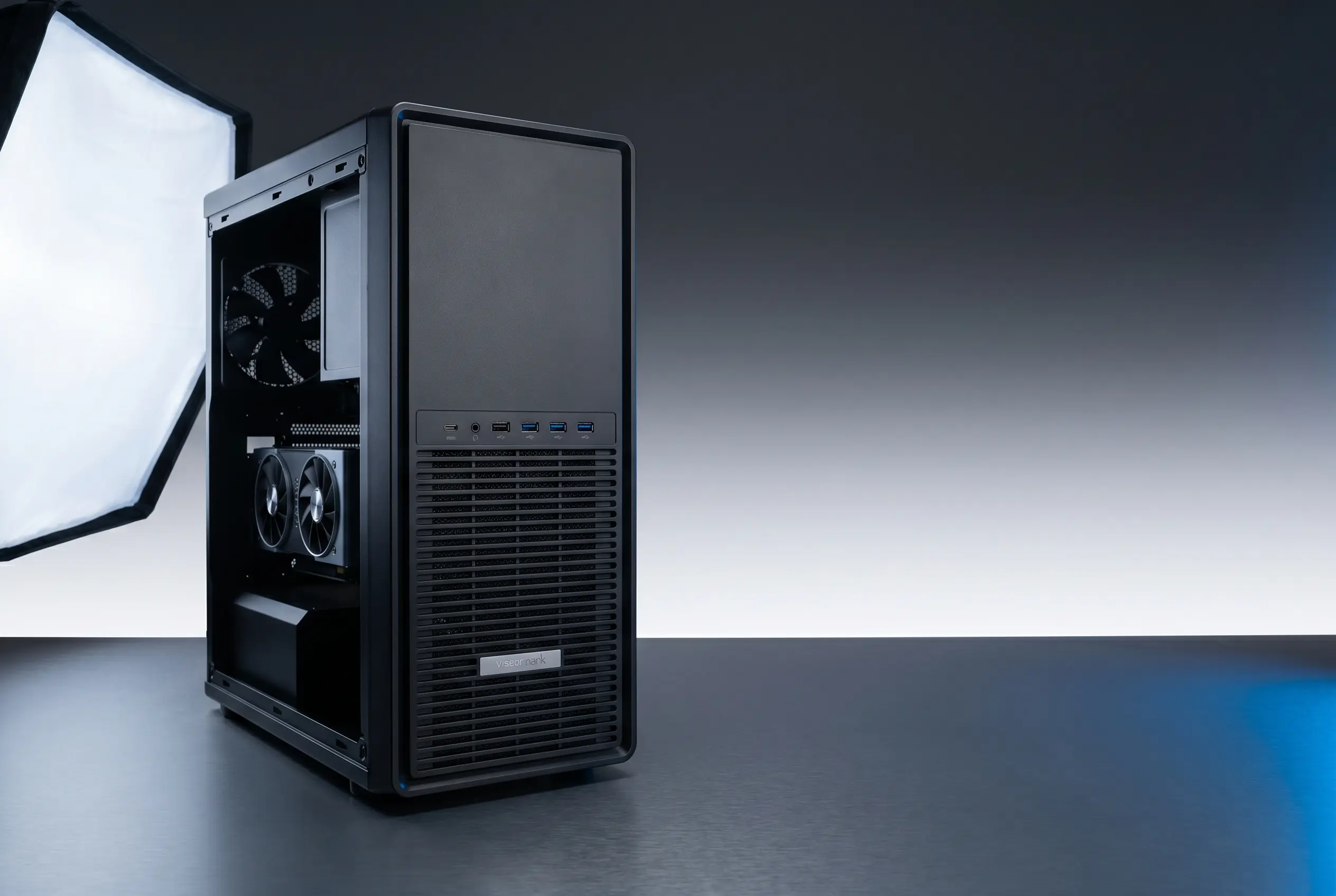
At the core of the system sits AMD’s Ryzen PRO 9000 Series processor line, topped by the Ryzen 9 PRO 9965X3D with 16 cores and a boost clock of up to 5.5GHz. System memory scales to 256GB of DDR5 across four DIMM slots, with Lenovo supporting 64GB non-ECC CUDIMM modules to reach that ceiling and memory speeds up to 6,400 MT/s depending on configuration. Storage covers up to six drives total, combining up to three M.2 PCIe NVMe SSDs at up to 4TB each with up to three 3.5-inch SATA hard drives at up to 12TB each.
Power supply options run from 500W through 750W to 1,100W, matching configurations that include the full RTX PRO 6000 Blackwell Workstation Edition, which draws 600W on its own. PCIe Gen 5 runs across four expansion slots, leaving room for high-speed networking cards or additional accelerators without a chassis swap. Connectivity covers USB-C at 20Gbps on the front panel, DisplayPort 2.0, HDMI 2.1, 2.5Gb Ethernet, Wi-Fi 7, and Bluetooth 5.4.
The compute figures concentrated in the GPU tier put the AI processing argument in hard numbers:
- Up to 4,000 TOPS of AI performance from the NVIDIA RTX PRO 6000 Blackwell GPU at FP4 precision
- 96GB GDDR7 ECC video memory with 1,792GB/s memory bandwidth on the Workstation Edition
- 256GB DDR5 maximum system RAM at up to 6,400 MT/s across four DIMM slots
- Up to 48TB total raw storage across the six-drive hybrid architecture
AMD’s 3D V-Cache Reaches the Professional Tier
The Ryzen 9 PRO 9965X3D is built on AMD’s Zen 5 architecture and marks the first time AMD has applied 3D V-Cache technology to a PRO-series workstation chip. Lenovo describes this as the first implementation of that cache-stacking technology in the professional workstation segment altogether. The technology places a secondary cache die directly on top of the compute chiplet, substantially increasing available L3 cache and reducing how often the processor must reach out to system DRAM during data-intensive work.
Where expanded cache proves its value is in simulation, BIM (building information modeling, the parametric design format central to architecture and construction workflows) model processing, and CAD operations with irregular memory access patterns. A processor with deeper cache handles those workloads more efficiently than a higher-clocked chip that stalls waiting on memory latency, and AMD’s X3D treatment has demonstrated that effect on its consumer desktop line since the first X3D generation.
One commercial timing detail separates the P4 from any upcoming Ryzen PRO 9000 competitor: the standalone retail version of the Ryzen 9 PRO 9965X3D is scheduled to reach open market on July 15, 2026. Lenovo plans to ship the workstation in June, a full month earlier, through the OEM early-access channel that tier-one builders regularly negotiate for pre-launch silicon. For IT departments targeting a mid-year fleet refresh, that gap could matter in a competitive bid.
PRO-series Ryzen chips also layer extended validation, fleet management features, and hardware-level security capabilities on top of the desktop architecture. That enterprise layer separates a consumer X3D processor from its PRO equivalent in a procurement conversation, and it justifies the workstation-class positioning even for buyers who could theoretically self-build around the same core silicon.
The RTX PRO 6000 Blackwell: 4,000 TOPS on the Desktop
Workstation Edition vs. Max-Q Variant
Both GPU options available in the P4 share the same NVIDIA GB202 silicon, 96GB of GDDR7 ECC memory, and 24,064 CUDA (Compute Unified Device Architecture, NVIDIA’s parallel computing platform) cores. The difference is thermal envelope. The Workstation Edition runs at 600W with active blower cooling optimized for a single-GPU tower. The Max-Q variant drops to 300W for denser builds or noise-constrained environments where sustained thermal headroom is the primary design constraint rather than peak single-card throughput.
| Specification | RTX PRO 6000 Blackwell Workstation Edition | RTX PRO 6000 Blackwell Max-Q |
|---|---|---|
| CUDA cores | 24,064 | 24,064 |
| Video memory | 96GB GDDR7 ECC | 96GB GDDR7 ECC |
| Memory bandwidth | 1,792GB/s | Power-limited (reduced) |
| TDP | 600W | 300W |
| AI performance | Up to 4,000 TOPS | Power-limited (reduced) |
| Primary target | Single-GPU tower workstations | Multi-GPU or quiet build configurations |
Benchmark Position and Architecture Gains
Independent testing of the RTX PRO 6000 Blackwell Workstation Edition shows the card outpacing both the consumer RTX 5090 and the prior professional generation RTX 6000 Ada in sustained rendering tasks. In Blender’s Monster scene benchmark, it reached 7,870 samples per minute against the RTX 5090’s 7,421 and the RTX 6000 Ada’s 5,632. The lead holds consistently across Blender’s Junkshop and Classroom scenes as well, reflecting the combined benefit of the full GB202 silicon and the expanded VRAM pool. Full GPU specifications are documented in Lenovo’s official ThinkStation P4 datasheet.
Fifth-generation Tensor Cores in the Blackwell architecture deliver up to three times the AI throughput of Ada generation hardware and add FP4 precision support, which is the numerical format behind the 4,000 TOPS figure. Fourth-generation RT Cores double the ray-triangle intersection rate of Ada, enabling NVIDIA’s RTX Mega Geometry feature for up to 100 times more ray-traced triangles per render. For Linux buyers planning to run Ubuntu on this system, independent testing of the RTX PRO 6000 Blackwell on Ubuntu found the open-source Nouveau driver still trails NVIDIA’s proprietary stack significantly for professional workloads, keeping the proprietary NVIDIA Linux driver the practical choice for any billable production environment.
Expansion, Ports, and the Software Ecosystem
Lenovo rebuilt the PCIe slot layout based on direct customer feedback from the prior ThinkStation P3 generation, where large GPUs created clearance conflicts with add-in networking cards. The reworked design fits the physical depth of a 600W Blackwell GPU alongside a high-speed NIC without mechanical interference, a change that sounds minor until a deployment team discovers it in a server room.
Factory liquid cooling ships as an option for the top Ryzen PRO 9000 configurations, which draw up to 170W for the CPU alone. Air cooling stays available for lower-tier configurations, but the thermal math for sustained rendering or simulation at the platform ceiling makes liquid the practical choice for any deployment running close to maximum utilization.
ISV (Independent Software Vendor, meaning the software companies that test and certify their applications against specific hardware and driver combinations) certifications at launch cover the major professional application ecosystems:
- Design and CAD: Autodesk, Bentley, Dassault, PTC, Nemetschek
- Engineering simulation: ANSYS, Siemens, Altair
- Media and entertainment: AVID
- Operating systems: Windows 11 Pro, Ubuntu, Red Hat Enterprise Linux
Security runs through Lenovo’s ThinkShield suite, which includes a dedicated TPM 2.0 module, BIOS-based data erasure, an electronic chassis lock, and a chassis intrusion switch. Lenovo also lists EPEAT Gold registration, ENERGY STAR 9.0 certification, and TCO Certified 10 compliance, along with a chassis that uses 95% post-consumer content ABS plastics and 16% recycled steel.
The Local Inference Argument
What Cloud Routing Costs Enterprise Teams
Enterprise AI workloads have run through cloud infrastructure for years, and the economics made sense while inference was occasional and model weights lived on rented GPU clusters. That arithmetic has been shifting. Latency on interactive AI tasks, data sovereignty requirements across finance, healthcare, and defense contracting, and per-token cloud costs that compound at production scale are each pushing IT planning teams toward hybrid deployment models where the workstation handles sensitive or latency-bound inference locally.
Tom Butler, Vice President for Commercial Portfolio and Product Management at Lenovo Intelligent Devices Group, set out the commercial positioning at the May 13 launch:
As workflows become more complex and AI-driven, professionals of all levels require systems that keep pace with their evolving needs. The ThinkStation P4 provides a strong balance of performance and value, packing flagship workstation capability in a scalable offering for engineers, designers, architects, creators and more.
Butler’s statement came paired with the CIO Playbook 2026 figure: two-thirds of companies prefer hybrid AI as their primary operating model. For Lenovo, that figure is the purchase justification for every P4 sale into an enterprise account where the cloud cost line was previously untouchable.
Where Memory Capacity Changes the Equation
A workstation with the GPU’s full VRAM capacity and 256GB of system RAM can carry substantial model weights locally without multi-card pooling or memory swapping. Quantized versions of large language models in the 70-billion parameter range, reduced to 4-bit precision, typically require around 40 to 45GB and fit within the RTX PRO 6000 Blackwell’s frame buffer with inference overhead to spare. Running those models on-device eliminates the compliance question about what leaves the company network, which matters more to architecture firms protecting proprietary building data or manufacturers guarding pre-release design files than any benchmark metric.
For media production teams with large scene files, local inference removes the round-trip latency between workstation and cloud API endpoint. Both use cases rest on the same constraint: when data is too sensitive, too large, or too latency-sensitive to route through a third-party endpoint, the workstation takes the load. The NVIDIA RTX PRO 6000 Blackwell product page positions the GPU explicitly for on-device generative AI, physical AI simulation, and agentic AI development workflows, matching the use cases Lenovo targets with this platform.
Availability Window and the North America Gap
The workstation ships to select markets worldwide starting June 2026. North America availability follows in August 2026. Lenovo has not announced pricing, noting figures will come closer to each regional launch date. Given that the RTX PRO 6000 Blackwell Workstation Edition carries a standalone retail price of $8,500, fully configured units will land in a premium workstation bracket by any measure, though Lenovo’s press language around “without a premium price tag” suggests the company is targeting a competitive entry point relative to comparably configured alternatives from HP and Dell.
The two-month regional gap matters for North American IT procurement teams. Departments operating on a September fiscal year close can still land units in their Q3 purchasing window by ordering at the August opening; teams on a June or July budget deadline will be weighing alternatives or carrying forward existing hardware for one more cycle.
If Lenovo prices the P4 competitively against HP Z-series and Dell Precision workstations carrying the same Blackwell GPU tier, the Ryzen PRO 9000 architecture plus the existing ISV certification list gives procurement teams a credible third option in the high-end single-GPU segment. If pricing arrives at the premium end of the bracket, the buying decision shifts to support contract terms and fleet management tools, where Lenovo already holds strong enterprise footing among existing ThinkStation customers.


Xbox Caps Game Pass Cloud Gaming at 15 Hours

GTA 6 DualSense Controllers Follow Sony’s Usual $84.99 Script

South Korea Retail Investors Face Reckoning After KOSPI AI Rally Collapses

Surrey AI Maps Three Heart Attack Paths and Their Molecular Roots

Germany Locks Neutral Apple ATT Prompts Across Most of Europe

Apple’s 5% EU Fee Quietly Rewrites Alternative App Store Math

Apple’s EU Fee Truce Cuts Complexity but Leaves Rivals Fuming

Pixel 11 Pro Fold Trades Thinness for Durability and Seven-Year Stay

Mayo AI Flags HCM Obstruction From Everyday Ultrasound Videos

Indian Brands Quietly Scale Landmark Screens and Home Tech

Oracle Cuts 21,000 Jobs in a Year, Cites AI in 10-K Filing

Fable 5 and Mythos 5 Return as US Lifts Anthropic Export Controls

SpaceX’s Google Deal Turns a Rocket Company Into a Cloud Landlord

CD Projekt Red Co-CEO: Redemption Arc Isn’t Done, Witcher 4 in 2027

XPL Rallies 30% Ahead of Plasma One Card Tier Launch

Google Search Profiles Build a Follow Graph Inside Discover

DGO App Brings Rs 549 Mobile Pass for FIFA World Cup 2026 in Nepal

Moonshot AI Targets $30 Billion in China’s Fastest AI Funding Sprint

Oppo’s ColorOS 17 Eligibility List Leaves A-Series Buyers Behind

Microsoft Xbox Layoffs Start in July as Sharma Slams 3% Margin
-
 AI2 months ago
Oracle Cuts 21,000 Jobs in a Year, Cites AI in 10-K Filing
-
 AI2 months ago
Fable 5 and Mythos 5 Return as US Lifts Anthropic Export Controls
-
 AI3 months ago
SpaceX’s Google Deal Turns a Rocket Company Into a Cloud Landlord
-
 GAMING2 months ago
CD Projekt Red Co-CEO: Redemption Arc Isn’t Done, Witcher 4 in 2027
-
 CRYPTO3 months ago
XPL Rallies 30% Ahead of Plasma One Card Tier Launch
-
 NEWS3 months ago
Google Search Profiles Build a Follow Graph Inside Discover
-
 APPS3 months ago
DGO App Brings Rs 549 Mobile Pass for FIFA World Cup 2026 in Nepal
-
 AI3 months ago
Moonshot AI Targets $30 Billion in China’s Fastest AI Funding Sprint