
AI
NYK’s AI Allocates Its Car Carriers in 10 Minutes to Cut Emissions
NYK’s AI vessel allocation system weighs millions of car-carrier schedules in about 10 minutes, a software lever the line says cuts shipping emissions and cost.

NYK’s AI vessel allocation system now does in about ten minutes what once took a handful of veteran planners days of trial and error in Excel: it sifts several million possible schedules for the world’s largest car carrier fleet and returns an optimized plan covering months of voyages. Full-scale operation began in July 2025, run jointly by the Japanese shipping line Nippon Yusen Kabushiki Kaisha (NYK) and its R&D arm MTI Co., Ltd.
The two built it over four years with GRID Inc., a Tokyo software firm that designs AI planning-optimization tools (CEO Masaru Sogabe). And the lever its engineers keep pointing to is carbon. Software, they argue, can cut shipping emissions more cheaply than the wind sails and green fuels that dominate the industry’s climate headlines.
Ten Minutes To Replace Weeks of Spreadsheet Work
Vessel allocation is the core scheduling job in car shipping: deciding which ships carry which cars, from which loading ports to which discharge ports, when, and in what volumes. Planners juggle inventory levels, customer delivery dates, ship capacity, port slots, cargo-handling windows and charter terms, then redo the whole puzzle every time a sailing slips. For a fleet running hundreds of voyages months ahead, the math is brutal.
The complexity has been climbing. Plans now also fold in sailing at speeds chosen to hold down fuel and emissions, and they have to be revised continuously as sailings slip, ports congest and cargo bookings move. NYK had long leaned on a small group of experienced planners to hold all of that in their heads for hundreds of voyages at a time, which made the work hard to scale and harder to hand on.
The new engine weighs the combinations a person cannot. According to NYK’s car-carrier allocation system announcement, it tests millions of candidate plans against the measures planners care about (KPIs, the key performance indicators they optimize) such as fleet utilization, transport efficiency and cost, then surfaces the best ones for a human to check.
- Several million possible allocation plans weighed in a single run
- About 10 minutes to return an optimized plan spanning months of voyages
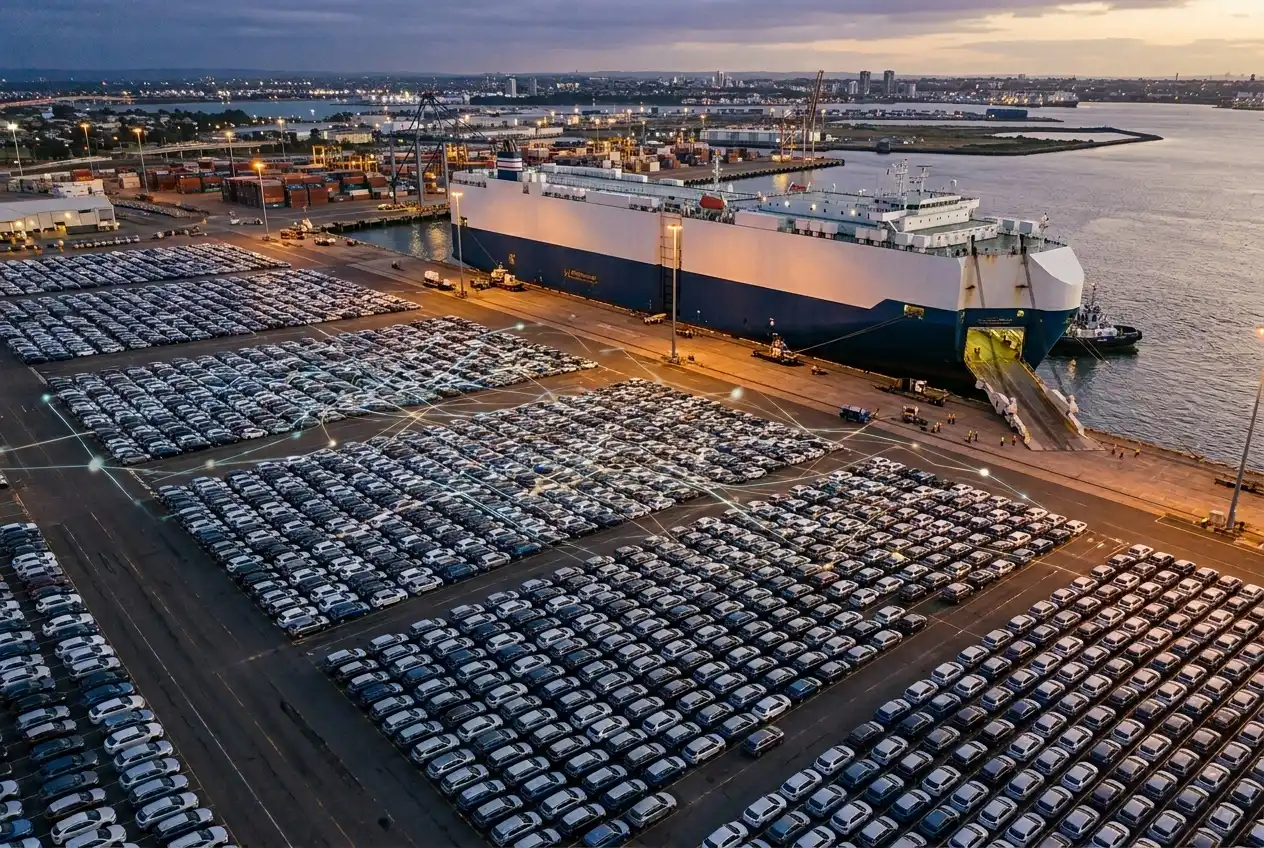
- Around 120 car carriers in NYK’s fleet, roughly a sixth of the world total
That last figure is why the job mattered. NYK holds about 15% of the global pure car and truck carrier fleet, more than any other operator, so a small efficiency gain repeats across more ships than anyone else runs.
Why the Car Carrier Division Went First
NYK began the project in 2021. It could have aimed the AI at containers or bulkers, both bigger businesses. It chose car carriers, and the reason was less glamorous than fuel burn or fleet size.
Yoshihiko Maeda, deputy general manager of MTI’s Maritime & Logistics Technology Group, says the deciding factor was that the car carrier division had already cleaned up its information. The decision-making behind allocation had been written down and structured before a single line of optimization code was written. His team’s warning to anyone copying the approach:
While AI’s computational capabilities tend to draw attention, what is fundamentally important is that there is a process of collecting high-quality data from within the company and that the mechanism for visualizing optimization results in a form that vessel allocation planners can understand and use for decision-making.
The work fell to three groups: allocation planners and the DX·BPM Team from NYK’s Automotive Business Management Group, plus MTI engineers who specialize in mathematical optimization. GRID was picked from several candidates. Hiroyuki Nozaki of the DX·BPM Team says the firm stood out for “not merely promoting their own systems or technologies, but of sincerely engaging with and seeking to understand our business operations and the challenges that we face.” NYK had no in-house AI builders, so MTI’s optimization experts sat between the planners and the developers, translating shipping requirements into something an engine could solve.
What Changed on the Planners’ Desks
Naoki Motohashi, who runs allocation operations in NYK’s Automotive Business Management Group, lists two gains beyond raw speed: fewer missed conditions and easier handovers. The system flags constraints a tired planner might overlook, like a dry-docking slot or the redelivery point at the end of a charter, the kind of error that quietly costs money.
It also recalculates fast when the outside world moves. The constraints the engine now carries include:
- Ship capacity, port arrival and departure slots, and cargo-handling windows
- Dry-docking, bunkering and charter redelivery dates and locations
- Sailing speeds set to hold down fuel burn and emissions
- External cost shocks such as US port fees or EU emissions rules
One of those shocks is now live. The Office of the United States Trade Representative (USTR, the agency that sets US trade policy) began charging foreign-built vehicle carriers $150 per car-equivalent unit (CEU) on entry to US ports on October 14, 2025, under the USTR port-fee schedule on foreign-built vehicle carriers. A fee that size rewrites which ship should call where, and the engine can re-solve for it in minutes.
Motohashi describes the old way and the new one:
“Previously, whenever something happened, we had to repeatedly rework plans through trial and error in Excel. Now, we can simply change the conditions and recalculate with the push of a button, which has significantly reduced the burden in our day-to-day operations. The amount of overtime during peak periods has also decreased.”
He adds a quieter benefit. With the AI holding the logic, a colleague can step in if he is suddenly out, which matters for business continuity planning (BCP, a firm’s plan for keeping operations running through disruption).
Can Code Cut More Carbon Than Wind Sails?
Shipping produces close to 3% of global greenhouse gas (GHG) emissions, and the International Maritime Organization (IMO, the UN body that regulates shipping) wants the sector at net zero by or around 2050. Most of the coverage of that push features hardware: rotor sails, air lubrication, ammonia and methanol engines. Maeda’s argument is that the spreadsheet may be the better-value tool.
“While hardware measures such as the installation of energy-saving devices, wind-assisted propulsion system, and fuel shift tend to attract attention, software has significant potential when considering both costs and emissions reduction effectiveness,” he says. Allocation optimization cuts emissions indirectly, by raising load factors, trimming idle and empty legs, and freeing ships to sail slower because cargo handling is tighter.
The Levers Compared
Speed is where the leverage sits. Cutting a ship’s speed by about 10% can lower its emissions by roughly a quarter, per the IMO’s work on speed management, and software that compresses port time buys room for exactly that kind of slow steaming.
| Lever | Typical emissions effect | Cost profile |
|---|---|---|
| Slow steaming | ~10% slower speed cuts emissions by about a quarter | Little to no capital cost |
| Wind-assisted propulsion | Around 9% to 12% fuel savings | Retrofit cost, payback over 3 to 7 years |
| Alternative fuels | Large lifecycle cuts, fuel-dependent | High capital spend plus a fuel premium |
| Allocation and routing software | Higher utilization, enables slower speeds | One software build, no per-ship hardware |
Where Carbon Pricing Changes the Math
Regulation is turning emissions into a line item, which makes the software pay in cash as well as carbon. The European Union now folds shipping into the EU Emissions Trading System (EU ETS, its carbon market), and under shipping’s inclusion in the EU Emissions Trading System companies surrender allowances for 70% of their 2025 verified emissions, rising to 100% from 2027; allowances have traded near €70 to €80 a tonne. The FuelEU Maritime rules add penalties on top. An engine that shaves a few percent off fuel burn across the fleet is also shaving the carbon bill, and it does so without a shipyard visit.
The Four Years Behind a Push-Button Plan
An optimization engine alone would have shipped far sooner. Nozaki is blunt about it: “If the scope had been limited to developing the optimization engine alone, it might have been delivered in a much shorter timeframe.” The slow part was everything wrapped around the engine.
A plan the AI spits out only becomes usable when a planner can read it, trust it and adjust it, so the team poured effort into the interface and into the unglamorous plumbing of data input, like the vessel-movement information the model needs to stay accurate. Building those workflows, and the high-accuracy data management behind them, ate most of the four years.
The other drag was people. Allocation sat at the heart of the car carrier business, and AI was not yet common when the project started, so there was real hesitation about handing core work to a machine. He credits a culture in NYK’s Automotive Business Headquarters that pushed operational change, plus a hard-edged sense among the planners themselves that carrying on as before would, in his words, “leave us without a future.”
Shipbuilders and Coders Are Sharing an Office
The project changed who gets hired. Maeda says MTI now brings in people trained in computer science and mathematics alongside the traditional naval architects, himself included. “The crossover of expertise between shipbuilding and IT engineers is leading to the creation of new value,” he says, and he expects more tie-ups like this one between shipping companies and research groups.
His broader claim is simple: “In efforts to reduce GHG emissions, software-based approaches are extremely effective.” NYK and MTI are already chasing related gains, using shorter cargo-handling times to enable slow steaming and lifting loading efficiency to cut emissions per car moved. Those are fixes in software and shoreside process.
The timing helps the argument. With the IMO’s net-zero framework for shipping set to put a global price on emissions later this decade, every tonne of fuel an algorithm saves turns into money as well as carbon. The next target is wider: pulling fleet-capacity decisions into the same optimization, so the engine plans not just voyages but the size of the fleet itself.
For now, the system runs across NYK’s car carriers, returning in ten minutes a plan that used to consume the best part of a week. The harder question the company has set itself is how much more of the business it can hand to the same math.


Google Opens Gmail to Voice and Gates Docs Live

Lenovo Prices the IdeaPad Vibe Against Apple’s $699 Neo

Xbox Caps Game Pass Cloud Gaming at 15 Hours

GTA 6 DualSense Controllers Follow Sony’s Usual $84.99 Script

South Korea Retail Investors Face Reckoning After KOSPI AI Rally Collapses

Surrey AI Maps Three Heart Attack Paths and Their Molecular Roots

Germany Locks Neutral Apple ATT Prompts Across Most of Europe

Apple’s 5% EU Fee Quietly Rewrites Alternative App Store Math

Apple’s EU Fee Truce Cuts Complexity but Leaves Rivals Fuming

Pixel 11 Pro Fold Trades Thinness for Durability and Seven-Year Stay

Oracle Cuts 21,000 Jobs in a Year, Cites AI in 10-K Filing

Fable 5 and Mythos 5 Return as US Lifts Anthropic Export Controls

SpaceX’s Google Deal Turns a Rocket Company Into a Cloud Landlord

CD Projekt Red Co-CEO: Redemption Arc Isn’t Done, Witcher 4 in 2027

XPL Rallies 30% Ahead of Plasma One Card Tier Launch

Google Search Profiles Build a Follow Graph Inside Discover

DGO App Brings Rs 549 Mobile Pass for FIFA World Cup 2026 in Nepal

Moonshot AI Targets $30 Billion in China’s Fastest AI Funding Sprint

Oppo’s ColorOS 17 Eligibility List Leaves A-Series Buyers Behind

Microsoft Xbox Layoffs Start in July as Sharma Slams 3% Margin
-
 AI2 months ago
Oracle Cuts 21,000 Jobs in a Year, Cites AI in 10-K Filing
-
 AI2 months ago
Fable 5 and Mythos 5 Return as US Lifts Anthropic Export Controls
-
 AI3 months ago
SpaceX’s Google Deal Turns a Rocket Company Into a Cloud Landlord
-
 GAMING2 months ago
CD Projekt Red Co-CEO: Redemption Arc Isn’t Done, Witcher 4 in 2027
-
 CRYPTO3 months ago
XPL Rallies 30% Ahead of Plasma One Card Tier Launch
-
 NEWS3 months ago
Google Search Profiles Build a Follow Graph Inside Discover
-
 APPS3 months ago
DGO App Brings Rs 549 Mobile Pass for FIFA World Cup 2026 in Nepal
-
 AI3 months ago
Moonshot AI Targets $30 Billion in China’s Fastest AI Funding Sprint