
NEWS
Elekta’s Profit Beat Couldn’t Stop a 14% Stock Selloff
Elekta’s margin beat masked a 15% order slump, job cuts and write-offs as the Swedish cancer-tech maker’s turnaround faces its toughest test.

Elekta shares dropped 14% on May 28, the day the Swedish cancer-technology maker reported a sharply improved profit margin for its full fiscal year. Adjusted EBIT margin rose to 12.3% from 11.6%. New orders fell 15%. Investors cared about the second number.
Behind that single trading day sits a longer story: a chief executive pushed out last year, a flagship product that had to withdraw its own US regulatory filing and refile it, hundreds of job cuts, and write-offs on products the company quietly killed. The margin gain is genuine. So is the bill that produced it.
A Profit Beat That Cost Elekta 14% in a Day
Elekta AB (ISIN SE0000163628), the Stockholm-based radiotherapy and oncology-software group, closed its fiscal 2025/26 year on April 30 with net sales of SEK 16.72 billion (roughly $1.6 billion), down 7% on a reported basis but up 1% in constant currency, versus a consensus estimate of SEK 16.96 billion. Full-year adjusted EBIT came in at SEK 2.05 billion, beating the consensus figure of SEK 1.96 billion.
The fourth quarter told a different story. Gross order intake for the three months through April fell 15% in constant currency to SEK 4.57 billion, missing the Infront consensus estimate of SEK 5.83 billion by more than a billion kronor. Analysts at Bank of America wrote that the margin improvement reflected cost savings from Elekta’s operating-model reset, with annualized savings above SEK 500 million, but flagged that gross margin actually fell year on year in the quarter mainly on currency effects, and that consensus expectations for the new fiscal year already looked demanding.
| Metric | Fiscal 2025/26 Result | Year-on-Year Change |
|---|---|---|
| Net sales | SEK 16.72 billion | -7% reported / +1% constant currency |
| Adjusted EBIT | SEK 2.05 billion | Down from SEK 2.10 billion |
| Adjusted EBIT margin | 12.3% | Up from 11.6% |
| Net income | -SEK 517 million | Down from +SEK 240 million |
| EPS | -SEK 1.36 | Down from SEK 0.62 |
| Cash flow after investments | SEK 1.39 billion | Up from SEK 1.06 billion, strongest in five years |
| Proposed dividend | SEK 2.40 per share | Unchanged |
Full detail sits in Elekta’s year-end report for May 2025 through April 2026, which the company filed the same day the stock fell.
Why the Board Fired Its Last CEO
The margin story did not start in May. It started fourteen months earlier, when Elekta’s board decided the man running the company was not the one to fix it.
Gustaf Salford had been CEO since November 2020, after rising from the company’s own finance department. In March 2025, the board told him to leave, citing performance that was not meeting expectations. Jonas Bolander, a 23-year Elekta veteran, stepped in as acting president while the company searched for a permanent replacement and, in the meantime, pulled its own US regulatory filing for its next-generation linear accelerator to refocus it on cybersecurity requirements.
- November 2020: Gustaf Salford is appointed President and CEO after serving as the company’s CFO.
- March 6, 2025: Salford leaves Elekta after the board says new leadership is needed to improve profitability and growth.
- March to September 2025: Acting CEO Jonas Bolander stabilizes operations and withdraws Elekta’s FDA filing for the Evo linear accelerator to strengthen its cybersecurity submission.
- September 1, 2025: Jakob Just-Bomholt, previously CEO of Danish dental-scanning firm 3Shape, becomes Elekta’s President and CEO.
- September 8, 2025: Klara Eiritz is named Chief Financial Officer, succeeding Tobias Hägglöv.
- January 16, 2026: Elekta Evo receives FDA 510(k) clearance, more than a year after the original filing was pulled.
- May 28, 2026: Fiscal 2025/26 results show the margin beat, the order-intake miss, and the stock’s 14% drop.
Just-Bomholt, a Danish executive with an INSEAD MBA, arrived from outside the medical-device industry entirely. Elekta announced the hire in a press release naming him president and chief executive effective September 1, 2025, after a board search that followed Salford’s exit.
Elekta Writes Off Its Own Failed Bets
Just-Bomholt’s first full-year report as CEO doubled as a cleanup. Elekta booked SEK 1,363 million in items affecting comparability during the fourth quarter alone, up from SEK 1,040 million a year earlier, none of it hitting cash flow directly.
Two pieces stand out. Following what the company called a more focused, commercially driven product development roadmap, Elekta impaired SEK 851 million in capitalized development costs tied to products it has now discontinued. A further SEK 519 million in goodwill and balance-sheet impairments followed, also linked to discontinued products.
- 500-plus jobs cut, generating annualized savings above SEK 500 million, much of it already showing up in fourth-quarter profitability.
- SEK 851 million written off in capitalized R&D spending on products the company killed.
- SEK 519 million in further goodwill impairments tied to those same discontinued products.
- Net debt fell for the first time in five years, even after roughly SEK 300 million in severance costs.
Cash flow after continuing investments reached SEK 1.39 billion for the year, its strongest level in five years despite the severance payments. Book-to-bill for the full year held at 1.04, meaning orders still edged ahead of revenue even with the rough fourth quarter. None of that erases the fact that the company spent years developing products it has now decided to abandon, and is only now taking the accounting hit.
Evo’s Long Detour Into American Clinics
Elekta’s newest linear accelerator, Evo, launched in 2024 and won European CE marking well before it reached American clinics. Its path to a US launch ran through the same turmoil as the executive suite.
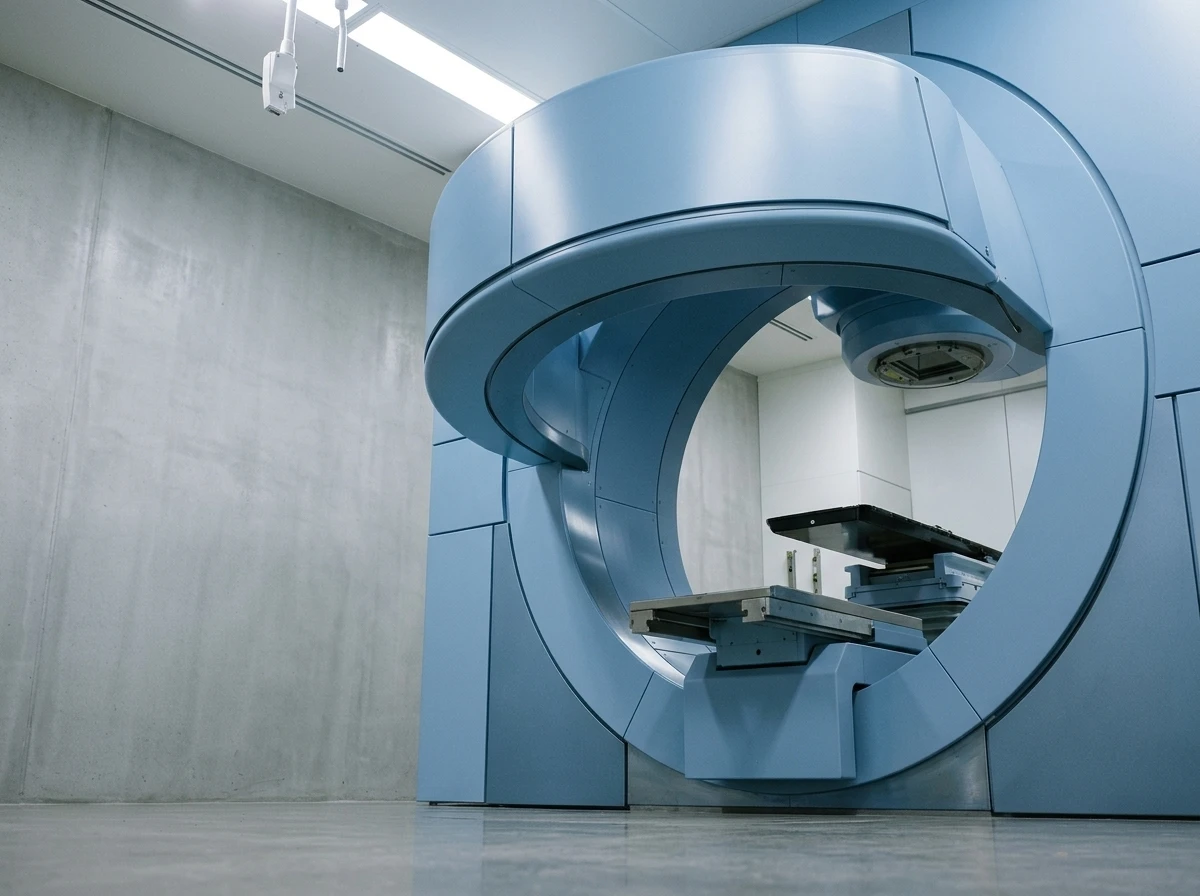
Elekta originally filed for FDA clearance, then withdrew that filing during Bolander’s tenure as acting CEO so the submission could better align with the agency’s cybersecurity review process. The company resubmitted, and on January 16, 2026, the Elekta Evo CT-Linac received 510(k) clearance, opening it to US radiation oncology providers roughly a year after the European launch. The system uses Iris, Elekta’s AI-enhanced imaging technology, to sharpen cone-beam CT images and cut scatter compared with conventional imaging, and it can be installed as a software upgrade on some existing Elekta linacs rather than requiring a full machine replacement.
We have seen a very substantial order growth in the U.S.
Jakob Just-Bomholt, Elekta’s chief executive, told analysts on the company’s third-quarter earnings call that US customers who had been waiting for Evo’s clearance began ordering once approval looked certain, converting existing Versa HD backlog into the newer platform. Ardie Ermers, Elekta’s executive vice president for the Americas region, called the clearance “a pivotal step in our commitment to the U.S. market” in the company’s official clearance announcement.
A Two-Company Race Elekta Keeps Losing
Radiotherapy hardware has narrowed to something close to a duopoly. Siemens Healthineers bought Varian Medical Systems in April 2021, folding the long-time market leader into a much larger diagnostics and imaging group. Before that deal, Varian held over 55% of the global linear-accelerator installed base in 2019, with Elekta and smaller player Accuray splitting most of the remainder. Accuray’s own regulatory filings describe Varian as having held the majority of worldwide radiation-therapy market share for years, a position Siemens Healthineers inherited and has continued to build on.
Morningstar’s equity research notes that Elekta’s position is still formidable, but its future depends on uptake of its newest platform and Unity, its MRI-guided linear accelerator. The same research flags a fresh complication: Siemens Healthineers is preparing a refresh of its own linear-accelerator lineup, a move Morningstar says will make Elekta’s push into the US market more difficult. China adds another layer. A multi-year anti-corruption drive through the country’s hospital procurement system hit Elekta’s China orders hard in recent years, and Just-Bomholt’s turnaround plan explicitly counts on recovery there alongside the US launch of Evo.
Is Elekta’s Turnaround Actually Working?
Elekta shares have settled well above the crash-day low, trading around SEK 55 in recent weeks, with a consensus analyst price target near SEK 58, an implied upside of roughly 5%, and an average rating of Hold across 15 covering analysts. That is not a market betting heavily either way.
The split shows up clearly in analyst notes. One camp expects software and service expansion, plus a China and emerging-markets recovery, to drive sustained earnings growth as global radiotherapy demand keeps climbing. Another camp points to trade barriers, reimbursement pressure and aggressive competition squeezing margins, plus what it calls underinvestment in R&D eroding Elekta’s technological edge. Simply Wall St’s fair-value estimate for the shares recently moved to SEK 58.27 from SEK 56.77, with one firm raising its target to SEK 60 while another turned more cautious on the same numbers.
Management’s own yardstick is public: mid-single-digit revenue growth and a 14% to 16% adjusted EBIT margin by fiscal 2028/29. The year that just closed delivered 12.3%. Whether the job cuts, the write-offs and Evo’s American rollout close that gap is the entire bet the market is now pricing.
Frequently Asked Questions
What is the difference between Elekta Evo and Elekta Unity?
Evo is a CT-guided linear accelerator using Iris AI-enhanced imaging that received FDA clearance in January 2026, while Unity is Elekta’s older MRI-guided linear accelerator, built with Philips and UMC Utrecht and launched in 2018. Unity wraps a full MRI magnet around the accelerator for continuous soft-tissue imaging during treatment, while Evo uses CT-style imaging, making it a lighter, less costly system to install in existing radiotherapy vaults.
Does Elekta still pay a dividend after the swing to a net loss?
Yes. Elekta’s board proposed an unchanged dividend of SEK 2.40 per share for fiscal 2025/26, paid in two instalments, matching the prior year despite the accounting loss caused by impairments. The dividend is funded from cash flow rather than reported net income, which is why it held steady even as EPS turned negative.
How many countries does Elekta operate in?
Elekta sells directly or through distributors in more than 100 countries and keeps offices in more than 40 of them, with roughly 4,500 employees worldwide as of its most recent company materials. That geographic spread is why no single country’s hospital budget or procurement policy, including China’s, can sink the company on its own.
Who else competes with Elekta beyond Siemens Healthineers?
Accuray and ViewRay compete in narrower segments such as robotic radiosurgery, though at far smaller scale than Elekta or Siemens Healthineers’ Varian unit. Accuray’s own securities filings describe both larger rivals as better resourced, and neither smaller player has meaningfully dented the two-company grip on new linear-accelerator installations.
Disclaimer: This article is for informational purposes only and is not investment advice or a recommendation to buy or sell any security. Share prices, analyst targets and financial figures are accurate as of publication and can change; consult a licensed financial adviser before making investment decisions.


Sony’s 10 Percent Disc Drop Leaves the 2028 Cutoff Intact

Chip Allocation Sidelines the Base iPhone 18 This Fall

Miami-Dade Fights the Vice City Brand It Already Wears

IFA 2026 Awards Put Tecno Ahead of Flagship Phones

USB-C Gadgets Made the Junk Drawer Rechargeable

Pixel 11 Pro Asks $1,099 for a Light Google Locked

The iPhone Ultra Sells Two Retired Minis as One Foldable

Google Opens Gmail to Voice and Gates Docs Live

Lenovo Prices the IdeaPad Vibe Against Apple’s $699 Neo

Xbox Caps Game Pass Cloud Gaming at 15 Hours

Oracle Cuts 21,000 Jobs in a Year, Cites AI in 10-K Filing

Fable 5 and Mythos 5 Return as US Lifts Anthropic Export Controls

SpaceX’s Google Deal Turns a Rocket Company Into a Cloud Landlord

CD Projekt Red Co-CEO: Redemption Arc Isn’t Done, Witcher 4 in 2027

XPL Rallies 30% Ahead of Plasma One Card Tier Launch

Google Search Profiles Build a Follow Graph Inside Discover

DGO App Brings Rs 549 Mobile Pass for FIFA World Cup 2026 in Nepal

Moonshot AI Targets $30 Billion in China’s Fastest AI Funding Sprint

Oppo’s ColorOS 17 Eligibility List Leaves A-Series Buyers Behind

Microsoft Xbox Layoffs Start in July as Sharma Slams 3% Margin
-
 AI2 months ago
Oracle Cuts 21,000 Jobs in a Year, Cites AI in 10-K Filing
-
 AI2 months ago
Fable 5 and Mythos 5 Return as US Lifts Anthropic Export Controls
-
 AI3 months ago
SpaceX’s Google Deal Turns a Rocket Company Into a Cloud Landlord
-
 GAMING3 months ago
CD Projekt Red Co-CEO: Redemption Arc Isn’t Done, Witcher 4 in 2027
-
 CRYPTO3 months ago
XPL Rallies 30% Ahead of Plasma One Card Tier Launch
-
 NEWS3 months ago
Google Search Profiles Build a Follow Graph Inside Discover
-
 APPS3 months ago
DGO App Brings Rs 549 Mobile Pass for FIFA World Cup 2026 in Nepal
-
 AI3 months ago
Moonshot AI Targets $30 Billion in China’s Fastest AI Funding Sprint