
AI
Oracle’s $20 Billion Raise Can’t Outrun a Blocked Desert Pipeline
A second New Mexico pipeline rejection is colliding with Oracle’s fiscal 2027 cash crunch, turning OpenAI concentration risk into a timing problem for credit investors.

Oracle shares closed Friday at $126.41, up 1.77%, a small bounce that barely dented a brutal month. The stock is down more than 60% from last September’s record high near $345.72, and S&P Global Ratings just cut Oracle’s credit rating to one notch above junk. Behind both moves sits the same culprit: a data center in the New Mexico desert that state regulators have now blocked twice.
Analysts still call the stock cheap. The average Wall Street price target sits near $264.64, more than double Friday’s close, according to Benzinga data on recent analyst actions. That gap increasingly comes down to concrete and steel, not just contracts: whether Oracle can physically finish the data centers it has already promised before its cash runs dry.
A Fresh Low Meets a One Notch Cushion Above Junk
Friday’s session captured the split screen. Oracle touched $121.50 intraday, a new 52 week low, then clawed back to close higher. The relative strength index sits near 29, deep in oversold territory, a reading that normally invites bargain hunters.
Bargain hunters have not shown up in force. S&P Global Ratings downgraded Oracle’s long term issuer credit rating to BBB minus from BBB on July 9, leaving the software giant one step from speculative grade. Moody’s has attached a negative outlook of its own, a second agency flagging the same worry from a different angle.
The company’s market value has fallen to roughly $364 billion. Oracle is still one of the twenty largest companies in the world by that measure, which only sharpens the question of how a business this size ended up graded like a company fighting for its investment grade badge.
Half of a $638 Billion Backlog Rides on One Customer
Oracle’s remaining performance obligations, the contracted revenue it has not yet booked, stand at $638 billion. It is the number Oracle’s own executives point to first. S&P points to it too, but for a different reason: roughly half of that backlog traces to a single customer, OpenAI.
The relationship runs through Stargate, the data center program tying OpenAI to Oracle for an estimated $300 billion in compute purchases over roughly five years, with power needs alone reaching about 4.5 gigawatts once fully built. Construction under that umbrella is already underway across five states, from Texas to the upper Midwest, a scale few cloud contracts have ever attempted.
That does not change what S&P actually said. The agency calls the OpenAI exposure a core credit risk, not a footnote, because a single renegotiation or slowdown would leave Oracle holding data center leases and equipment with no other tenant lined up to fill them.
New Mexico Blocks the Jupiter Pipeline for a Second Time
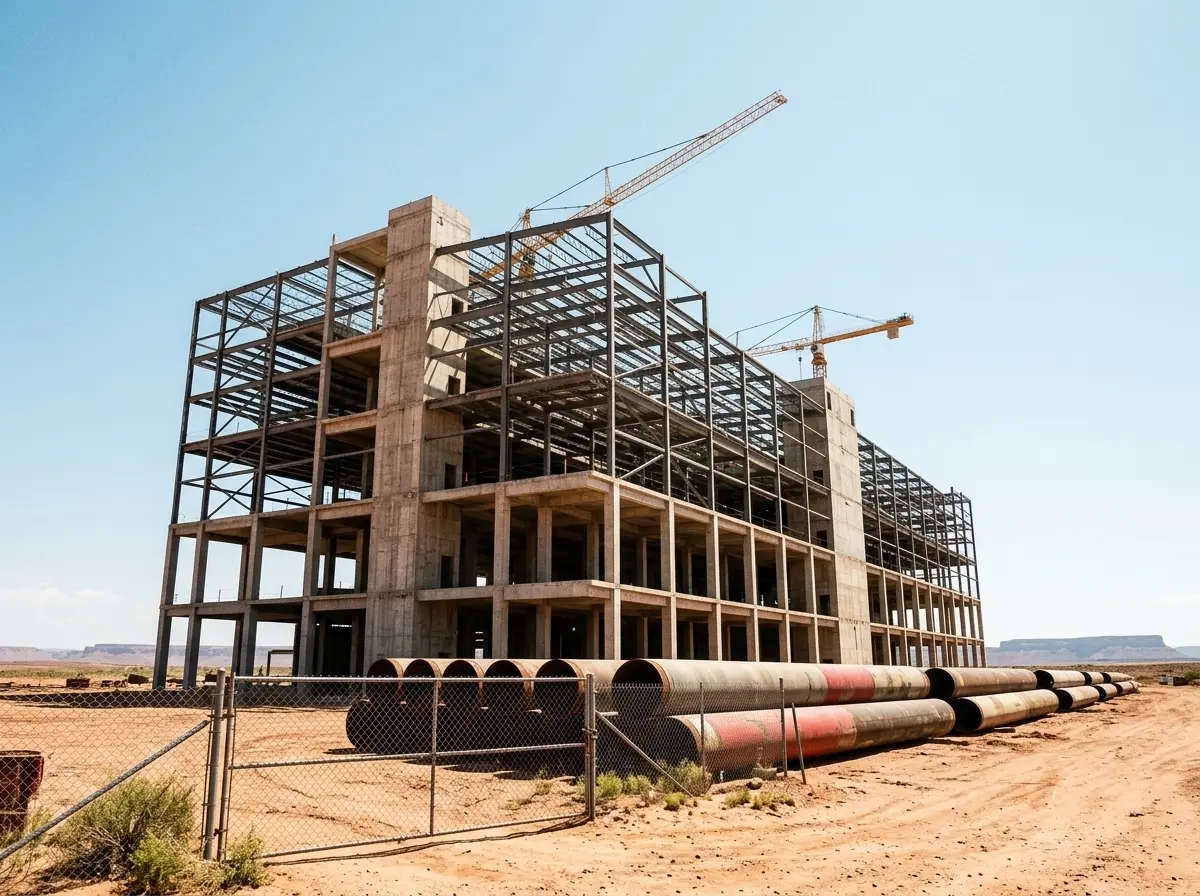
Project Jupiter, Oracle’s roughly $165 billion campus in southern New Mexico, was supposed to run partly on a new 17 mile natural gas pipeline built by Energy Transfer, carrying up to 400 million cubic feet of gas a day to feed as much as 2.45 gigawatts of Bloom Energy fuel cells.
New Mexico’s State Land Office rejected the pipeline’s rights of way in March. Energy Transfer asked the state to reconsider. On July 14, Land Commissioner Stephanie Garcia Richard said no again, citing water use and emissions, and the decision kept weighing on Oracle’s stock through Friday’s session.
In New Mexico, we truly mean it when we say water is life.
Garcia Richard, an elected Democrat currently running for her party’s lieutenant governor nomination, wrote that line into her rejection letter. She added that the pipeline offered too little benefit to the state’s trust lands or surrounding communities to justify approval.
A Project With No Clean Backup
- Oracle’s original plan for a gas fired power plant at the site was already abandoned after objections over emissions and water use.
- The State Land Office first rejected Energy Transfer’s rights of way request in March 2026.
- Garcia Richard denied a reconsideration request on July 14, 2026, the second rejection in four months.
- The air quality permit needed for the backup Bloom Energy fuel cells is still pending, with no public hearing yet scheduled.
- A mid August target for Jupiter’s commercial launch now looks likely to slip into 2027.
Even the fallback plan has a catch. Filings tied to the fuel cells’ own air permit describe a dependence on what developers call a robust natural gas pipeline system, meaning the same rejected route may still be needed to run Oracle’s supposed workaround.
How a Stalled Pipeline Becomes a Credit Problem
This is where the two stories that dominate Oracle coverage, the OpenAI concentration risk and the New Mexico permitting fight, actually meet. S&P’s downgrade rests on a timing mismatch: Oracle is spending capital now against revenue it expects to book later. Every month Jupiter sits idle stretches that gap further.
| Fiscal 2027 Metric | Earlier Estimate | S&P’s Updated View, July 2026 |
|---|---|---|
| Capital expenditure | $60 billion | $90 billion to $95 billion |
| Free cash flow | Deficit of $24 billion | Deficit near $42 billion |
| Adjusted leverage | About 4.8x | Mid 4x range |
| Issuer credit rating | BBB | BBB minus |
Here is the sequence, in order. Feb 2026, Oracle raises $5 billion through convertible preferred stock rather than plain debt. March 2026, the first pipeline rejection lands. July 9, S&P cuts the rating. July 13, shares plunge more than 6% to a fresh low. July 14, the second pipeline rejection. July 17, another intraday low before a modest close.
- February 2026: Oracle raises $5 billion through a convertible preferred stock sale.
- March 2026: New Mexico’s State Land Office first rejects the Jupiter pipeline’s rights of way request.
- July 9, 2026: S&P Global Ratings cuts Oracle to BBB minus, one notch above junk.
- July 13, 2026: Shares fall more than 6% to a fresh 52 week low.
- July 14, 2026: Land Commissioner Garcia Richard denies Energy Transfer’s reconsideration request.
- July 17, 2026: Shares touch $121.50 intraday before closing at $126.41.
Each delay pushes Jupiter’s commercial revenue further right on the calendar while the capex and interest clock keeps running on the left. That is a mechanical problem, not a sentiment problem, and it does not care what OpenAI decides to do.
The Resistance Spreads Beyond New Mexico
New Mexico is not an isolated holdout. New York has adopted a one year statewide moratorium on new data center approvals, a sign that permitting friction is becoming state level policy rather than a single county’s objection.
Bloom Energy, the fuel cell maker Oracle was counting on for Jupiter’s backup power, has felt the same squeeze. Its stock has come under pressure as what was one of its most visible growth opportunities now sits stuck behind an unscheduled hearing.
Compare that with how Oracle’s biggest cloud rivals are funding their own buildouts. Alphabet generated roughly $73 billion in free cash flow last year, enough to cover its AI spending without leaning on outside capital the way Oracle now must. S&P has said plainly that Oracle carries less financial flexibility than Microsoft, Google or Amazon if the AI cycle turns.
Ellison’s Paper Losses and a Dividend That Keeps Flowing
The stock’s slide has a face attached to it. Larry Ellison, Oracle’s co-founder and chairman and its largest individual shareholder, has seen roughly $213 billion wiped from his net worth in the crash, according to TipRanks data cited on CNN’s markets page Friday.
Oracle has cut costs elsewhere too. The company eliminated about 21,000 positions in fiscal 2026, near 13% of its workforce, taking $1.8 billion in severance and exit charges along the way.
Yet the quarterly dividend has not moved. Oracle paid out $0.50 a share again with a July 10 ex-dividend date. On a market cap near $364 billion at Friday’s price, that implies roughly 2.9 billion shares outstanding and a dividend bill approaching $1.4 billion a quarter, close to $5.8 billion a year, even as the company plans to raise $20 billion in fresh equity to defend its credit grade.
Oracle is not standing still operationally either. On July 20 it expanded its AI Agent Studio for Fusion Applications, letting enterprise customers build autonomous agents into its cloud ERP suite using models from Google and OpenAI. The product pipeline is moving even as the power pipeline is stuck.
Can the Backlog Turn Into Cash Fast Enough
Wall Street’s equity desks and the credit desks are reading the same company two different ways. Bernstein raised its target to $325 in June, an outright bull case. RBC Capital, more cautious, holds its target at $190. Both sit above Friday’s close, which is the part equity bulls keep repeating.
Credit analysts are less interested in twelve month upside. Their question is narrower: does Jupiter, and projects like it, start generating cash before Oracle’s leverage and debt load outrun its patience. A blocked pipeline in the desert is now part of that arithmetic, not a footnote to it.
The air quality hearing for Jupiter’s backup fuel cells still has no date on the calendar. Until it does, the clock on Oracle’s cash keeps running.
Frequently Asked Questions
What would push Oracle’s credit rating lower still?
S&P has said it could cut Oracle again if adjusted leverage stays above 4.5x on a sustained basis, if the company is not clearly on track for positive free cash flow by fiscal 2029, or if the agency turns negative on Oracle’s AI strategy or the wider AI infrastructure trade.
Could Oracle earn its old rating back?
S&P calls an upgrade unlikely over the next two years. It would require leverage falling back toward the mid 3x range on a sustained basis while Oracle still hits its growth targets and generates consistently positive free cash flow.
How does Oracle’s cash burn compare with rivals like Google?
Alphabet posted about $73 billion in free cash flow last year while funding its own AI buildout internally. Oracle is forecast to burn nearly $42 billion in fiscal 2027, which is why rating agencies treat it differently from its larger, more cash rich hyperscale peers.
Does Project Jupiter have a way around the blocked pipeline?
Oracle’s stated backup already relies on Bloom Energy fuel cells rather than a gas power plant, but permitting documents show those fuel cells still depend on pipeline gas, and the air quality permit covering them remains pending with no hearing scheduled.
Disclaimer: This article is for general information only and is not investment advice; Oracle’s stock and credit ratings carry real financial risk, and readers should consult a qualified professional before making investment decisions based on figures accurate as of publication.


Sony’s 10 Percent Disc Drop Leaves the 2028 Cutoff Intact

Chip Allocation Sidelines the Base iPhone 18 This Fall

Miami-Dade Fights the Vice City Brand It Already Wears

IFA 2026 Awards Put Tecno Ahead of Flagship Phones

USB-C Gadgets Made the Junk Drawer Rechargeable

Pixel 11 Pro Asks $1,099 for a Light Google Locked

The iPhone Ultra Sells Two Retired Minis as One Foldable

Google Opens Gmail to Voice and Gates Docs Live

Lenovo Prices the IdeaPad Vibe Against Apple’s $699 Neo

Xbox Caps Game Pass Cloud Gaming at 15 Hours

Oracle Cuts 21,000 Jobs in a Year, Cites AI in 10-K Filing

Fable 5 and Mythos 5 Return as US Lifts Anthropic Export Controls

SpaceX’s Google Deal Turns a Rocket Company Into a Cloud Landlord

CD Projekt Red Co-CEO: Redemption Arc Isn’t Done, Witcher 4 in 2027

XPL Rallies 30% Ahead of Plasma One Card Tier Launch

Google Search Profiles Build a Follow Graph Inside Discover

DGO App Brings Rs 549 Mobile Pass for FIFA World Cup 2026 in Nepal

Moonshot AI Targets $30 Billion in China’s Fastest AI Funding Sprint

Oppo’s ColorOS 17 Eligibility List Leaves A-Series Buyers Behind

Microsoft Xbox Layoffs Start in July as Sharma Slams 3% Margin
-
 AI2 months ago
Oracle Cuts 21,000 Jobs in a Year, Cites AI in 10-K Filing
-
 AI2 months ago
Fable 5 and Mythos 5 Return as US Lifts Anthropic Export Controls
-
 AI3 months ago
SpaceX’s Google Deal Turns a Rocket Company Into a Cloud Landlord
-
 GAMING3 months ago
CD Projekt Red Co-CEO: Redemption Arc Isn’t Done, Witcher 4 in 2027
-
 CRYPTO3 months ago
XPL Rallies 30% Ahead of Plasma One Card Tier Launch
-
 NEWS3 months ago
Google Search Profiles Build a Follow Graph Inside Discover
-
 APPS3 months ago
DGO App Brings Rs 549 Mobile Pass for FIFA World Cup 2026 in Nepal
-
 AI3 months ago
Moonshot AI Targets $30 Billion in China’s Fastest AI Funding Sprint