
GAMING
Nintendo Quietly Patented a Universal Switch Dock It Never Built
A Nintendo patent filed in January 2025 describes a dock that detects a Switch or Switch 2 and adjusts power, video and cooling automatically.

Nintendo filed a patent in January 2025, six months before Switch 2 reached stores, describing a dock that automatically detects which console is plugged in and adjusts its power, video output and cooling to match. The filing surfaced publicly this week after a Bluesky account that tracks Nintendo’s patent filings found it sitting in a Chinese patent database.
Nintendo shipped a different dock, one the company has confirmed in writing won’t accept any version of the original Switch.
A Patent Filed Six Months Before Switch 2 Existed
Nintendo filed the application in China in January 2025, six months ahead of Switch 2’s release, and it published on July 10, 2026. Nintendo Patents Watch, a hobbyist account that tracks patent filings tied to Nintendo hardware, shared the document on Bluesky this week, and gaming outlets picked it up within hours.
The console that eventually reached stores shipped with its own dock, a design with nothing in common with the cross-generation concept described in the patent.
Patent filings protect ideas a company may never build. Nintendo produces far more of them than finished accessories, and this document could easily join the pile of concepts that stayed on paper.
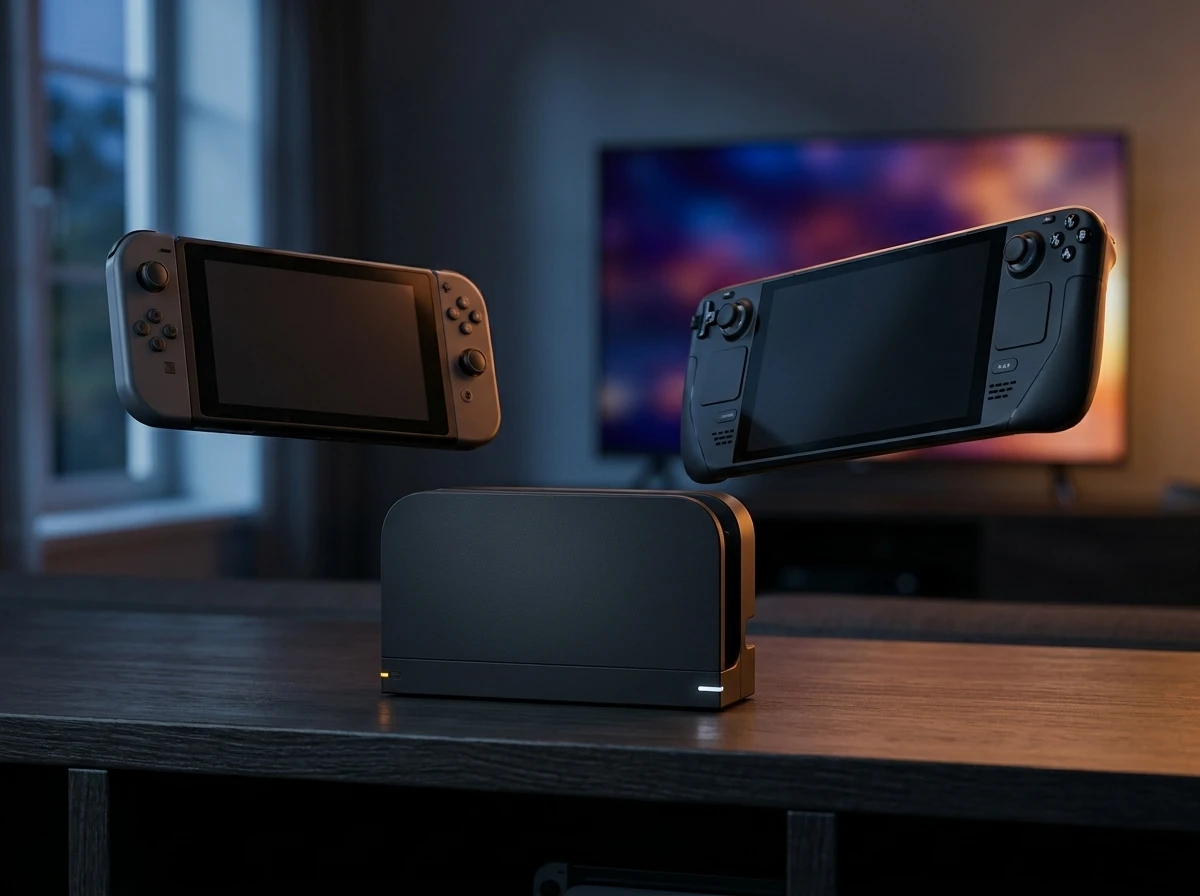
One Dock, Two Consoles, Different Rules
The patent describes a dock that reads which console has been inserted and reconfigures itself in response, adjusting its USB data mode, its maximum video resolution and its fan speed to match whichever console is plugged in. The fan also cools the dock’s own electronics as well as the console resting inside it, a dual role the current Switch 2 dock’s fan already performs for a single console.
Switch 2 itself already straddles both data speeds, carrying a USB 2.0-only port alongside a USB 3.2 port, according to Nintendo’s own specifications. The patent’s detection system would need to manage that same split across two different consoles instead of two ports on one machine.
The two consoles negotiate power differently too, which is the underlying reason a single dock has never served both. The original Switch is rated for a maximum of 18 watts. Switch 2 is rated for up to 60 watts, though in real play it rarely draws more than 25 watts.
| Console Detected | USB Data Mode | Max Video Output | Fan Behavior |
|---|---|---|---|
| Original Nintendo Switch | USB 2.0 | 1080p | Lower RPM (revolutions per minute) |
| Nintendo Switch 2 | USB 3.0 | 4K | Higher RPM |
For now, all of this exists only in patent drawings.
Nintendo’s Real Dock Draws a Hard Line
Nintendo Everything reported that Nintendo confirmed no version of the original hardware, not the standard console, the Lite or the OLED model, would work with the new dock, a statement the company posted on April 27, 2025, two months before the console launched.
The shipping Switch 2 dock added a LAN (local area network) port and the console line’s first-ever dock-mounted active cooling fan. Both are firsts for the accessory, and both reflect engineering built specifically around Switch 2’s needs.
A teardown from ChargerLab found a Delta cooling fan rated at 5 volts, 0.21 amps, built around an internal hub using chips from STMicro, TI and Infineon. Charging through the dock’s bundled 60-watt adapter measured out at roughly 17 watts in practice.
That hardware was engineered for the newer console’s higher power draw and its first cooling fan. The original Switch simply falls outside the specs it was built around.
Why Doesn’t Nintendo Just Sell the Compatible Version?
Nintendo has not said. The shipping dock was engineered around Switch 2’s higher power draw and its first-ever active cooling fan, and reworking a design already on store shelves would mean rebuilding a finished product. Nintendo’s own record with hardware patents suggests it files far more concepts than it ships, and this filing may simply join that list.
The dock Nintendo actually sells shows little of that adaptability. Testing from LTT Labs, a hardware test lab, found the dock requests its full 60-watt power budget the instant it is plugged in, regardless of what the console actually needs at that moment. A third-party dock the lab tested only asks for extra power once the console switches on.
A dock built to read two different consoles and adjust three separate systems in response would be a meaningfully smarter piece of hardware than the one currently shipping in Switch 2 boxes.
A Filing Cabinet Full of Docks That Never Shipped
Hardware accessories make up a recurring share of Nintendo’s hundreds of patented concepts that never reached a store shelf.
- A rotating dock panel designed to let cables exit from either side appeared in a 2024 patent aimed at fixing dock wiring complaints. It never reached production.
- A playable Game Boy phone case exists only as fan-made three-dimensional renders, built from the diagrams inside an old, unused Nintendo filing.
- Joy-Con designs built around hinges appear in multiple past patents, none of which made it past the paperwork stage.
Rotating panels, playable phone cases and hinged controllers all made it into patents before disappearing. A universal dock would fit easily into that same list.
Europe’s Right-to-Repair Deadline Shrinks the Market
Nintendo will stop selling the original Switch in Europe after February 2027, a deadline tied to right-to-repair rules the console’s fixed battery does not meet. Outside Europe, Nintendo has no stated plans to end support for the older hardware, and new games for it continue to arrive.
A dock built to serve both consoles would matter most to households running one of each, letting them skip a second cradle and a second cable run behind the television. That households is exactly the group that shrinks first once a region stops selling new units of the older console.
What we know:
- Nintendo filed the patent in China in January 2025 and it published on July 10, 2026.
- The design changes USB data mode, maximum video resolution and fan speed based on which console it detects.
- The fan cools both the dock’s own electronics and the console resting inside it.
What’s unconfirmed:
- Whether Nintendo intends to manufacture the dock at all.
- Whether it would add features the current dock still lacks, such as variable refresh rate support.
- Any price, release window or region for a potential release.
Nintendo has not said whether the patent will ever become a real product. The clock on the console it was designed to support keeps running regardless, with European sales set to stop after February 2027.
Frequently Asked Questions
Can an original Nintendo Switch use the Switch 2 dock right now?
No. Nintendo confirmed on April 27, 2025, that the Switch 2 dock will not accept the standard Switch, the Switch Lite or the Switch OLED. Nintendo’s own support response to customer queries in the UK cited a shape difference around the console’s USB-C port that keeps the older hardware from sitting correctly inside the newer dock.
How would the patented dock tell a Switch from a Switch 2?
It reads how each console negotiates power delivery over USB-C, since the original Switch and Switch 2 handle that negotiation differently at the hardware level. Once it identifies the console, the patent describes the dock switching its USB data mode, maximum video resolution and fan speed automatically, with no manual switch for the user to toggle.
Will Nintendo actually release this universal dock?
There is no confirmation either way. Adding to the uncertainty, gaming outlets have reported Nintendo is developing a Switch 2 variant with a replaceable battery for European markets, which could mean any future dock redesign targets that hardware rather than the design shown in this filing.
What is Nintendo Patents Watch?
It is the Bluesky account that surfaced this filing, describing itself as a “Human-run account covering patents, tech, and business behind Nintendo products.” It regularly posts Nintendo filings from Japanese, American and Chinese patent offices well before mainstream outlets cover them.
Has Nintendo issued any official statement about this specific patent?
No. Nintendo has not commented on the filing beyond the document itself, which reached the public through China’s patent office rather than through any company announcement.


Google Opens Gmail to Voice and Gates Docs Live

Lenovo Prices the IdeaPad Vibe Against Apple’s $699 Neo

Xbox Caps Game Pass Cloud Gaming at 15 Hours

GTA 6 DualSense Controllers Follow Sony’s Usual $84.99 Script

South Korea Retail Investors Face Reckoning After KOSPI AI Rally Collapses

Surrey AI Maps Three Heart Attack Paths and Their Molecular Roots

Germany Locks Neutral Apple ATT Prompts Across Most of Europe

Apple’s 5% EU Fee Quietly Rewrites Alternative App Store Math

Apple’s EU Fee Truce Cuts Complexity but Leaves Rivals Fuming

Pixel 11 Pro Fold Trades Thinness for Durability and Seven-Year Stay

Oracle Cuts 21,000 Jobs in a Year, Cites AI in 10-K Filing

Fable 5 and Mythos 5 Return as US Lifts Anthropic Export Controls

SpaceX’s Google Deal Turns a Rocket Company Into a Cloud Landlord

CD Projekt Red Co-CEO: Redemption Arc Isn’t Done, Witcher 4 in 2027

XPL Rallies 30% Ahead of Plasma One Card Tier Launch

Google Search Profiles Build a Follow Graph Inside Discover

DGO App Brings Rs 549 Mobile Pass for FIFA World Cup 2026 in Nepal

Moonshot AI Targets $30 Billion in China’s Fastest AI Funding Sprint

Oppo’s ColorOS 17 Eligibility List Leaves A-Series Buyers Behind

Microsoft Xbox Layoffs Start in July as Sharma Slams 3% Margin
-
 AI2 months ago
Oracle Cuts 21,000 Jobs in a Year, Cites AI in 10-K Filing
-
 AI2 months ago
Fable 5 and Mythos 5 Return as US Lifts Anthropic Export Controls
-
 AI3 months ago
SpaceX’s Google Deal Turns a Rocket Company Into a Cloud Landlord
-
 GAMING2 months ago
CD Projekt Red Co-CEO: Redemption Arc Isn’t Done, Witcher 4 in 2027
-
 CRYPTO3 months ago
XPL Rallies 30% Ahead of Plasma One Card Tier Launch
-
 NEWS3 months ago
Google Search Profiles Build a Follow Graph Inside Discover
-
 APPS3 months ago
DGO App Brings Rs 549 Mobile Pass for FIFA World Cup 2026 in Nepal
-
 AI3 months ago
Moonshot AI Targets $30 Billion in China’s Fastest AI Funding Sprint