
NEWS
Why Nigerian SMEs Are Online but Still Can’t Find Customers
Nigeria’s SMEs are online but customers can’t find them. Buchi Madiebo explains why social media activity and discoverability are different problems.

Nigerian small businesses are online in record numbers, but a persistent majority still can’t attract customers despite daily activity on Instagram, WhatsApp Business, and Facebook adverts. Wetinuneed, a Nigerian business directory and discovery platform, has built its pitch around a specific argument: social media presence and commercial discoverability are different infrastructure problems, and most of the country’s nearly 40 million MSMEs are solving only one. The sector contributes roughly half of Nigeria’s GDP and accounts for 84% of all employment, yet over 40% of businesses still list inadequate customer demand among the reasons they fail, according to Moniepoint’s Nigeria small business statistics. Nigeria also logs the world’s highest social media brand discovery rate.
The Scale of a Digital Participation Paradox
Nigeria had roughly 39.7 million active micro, small and medium enterprises as of 2020, per a joint count by the Small and Medium Enterprises Development Agency of Nigeria (SMEDAN) and the National Bureau of Statistics (NBS). The figure accounts for 96% of all registered businesses in the country.
- 48% – share of Nigeria’s national GDP attributed to the SME sector (National Bureau of Statistics, 2023)
- 84% – share of formal and informal employment absorbed by the sector
- 66.9% – share of Nigerian internet users discovering new businesses on social media, the highest rate globally (DataReportal, 2025)
- 40%+ – businesses listing inadequate customer demand among their reasons for failure
Nigeria’s social media audience reached 38.7 million users in 2025, representing 16.3% of the population. Product research on social platforms sits at 98.2% among Nigerian users, the world’s top rate. The infrastructure for businesses to reach potential customers digitally is present. The transaction, in too many cases, still isn’t.
“Many businesses are online,” Buchi Madiebo, founder of Wetinuneed, told The Guardian, “but customers still cannot find them easily. The digital space is becoming more competitive every day. Businesses now need more structured visibility, not just social media activity.”
Built for Scroll, Not for Search
How Algorithms Reward Engagement Over Access
The primary optimization target for Instagram, Facebook, and TikTok is user retention inside the app. Meta’s algorithm ranks content using signals including watch time, video completion rate, and comment velocity. Posts containing external links, which businesses use to direct customers to ordering pages or contact forms, are deprioritized because the platform weights internal engagement over outbound traffic.
For a small business, the practical result is that a post advertising a catering firm in Surulere competes for feed placement against creators producing entertainment content built for maximum engagement scores. A study of 1,524 small Nigerian businesses published in the International Journal of Research and Scientific Innovation’s analysis of social media marketing and SME performance found that 73% of respondents said algorithm changes and platform migration challenges directly affected their business continuity.
“Most businesses believe that posting regularly on social media automatically translates to visibility,” Madiebo told ThisDay. “But the reality is different. Being online is not the same as being found.”
The SEO Tool Nigerian SMEs Ignore
Search engine optimization (SEO) is designed to make a business findable when someone types a purchase-intent query: “affordable caterer Abuja,” “phone repair Lagos Island.” Among Lagos-based SMEs surveyed in a study published in the International Journal of Innovative Research in Accounting and Sustainability (IJIIRAS), SEO recorded the lowest adoption score of any digital marketing tool at 3.38 out of 5, well below SMS and mobile marketing tools and social media platforms, which led all categories. Researchers attributed the gap to a lack of technical expertise and the ongoing effort SEO demands compared to a social post.
The Nigerian Communications Commission (NCC) reported in 2024 that 67% of SMEs in Southeast Nigeria cite digital literacy gaps as a barrier to effective digital marketing, with 54% pointing to poor internet infrastructure. Both conditions hit SEO harder than social media, where a smartphone and a camera are enough to begin.
When Customers Have Intent
The moment that matters most to a small business isn’t when a customer scrolls past an ad. It’s when they’ve decided to buy and are looking for who provides it nearby. EMARKETER’s 2026 analysis of global social commerce described the medium as one that “thrives on discovery, inspiration, and impulse,” a design orientation suited to large brands with awareness-building budgets. A local caterer who needs Tuesday bookings is looking for something the feed wasn’t built to provide.
Businesses are spending money trying to get attention, but attention is no longer the most valuable currency. Access is. The businesses that win will be the ones that are easiest to find when customers are ready to act.
Madiebo, speaking to ThisDay, framed this as the core shift her platform was built to address. Working with businesses on Wetinuneed, she observed that those struggling most to attract customers often have viable offerings; what’s absent is the mechanism for customers to find them specifically at the point of need.
Nigeria’s data makes the tension visible. The country records 66.9% of internet users discovering brands through social media, the highest rate globally, yet over 40% of SMEs still cite inadequate customer demand in failure analyses. Both consumers and businesses operate on the same platforms. The conversion from discovery to transaction is where the system breaks.
The Directory Sector’s Argument
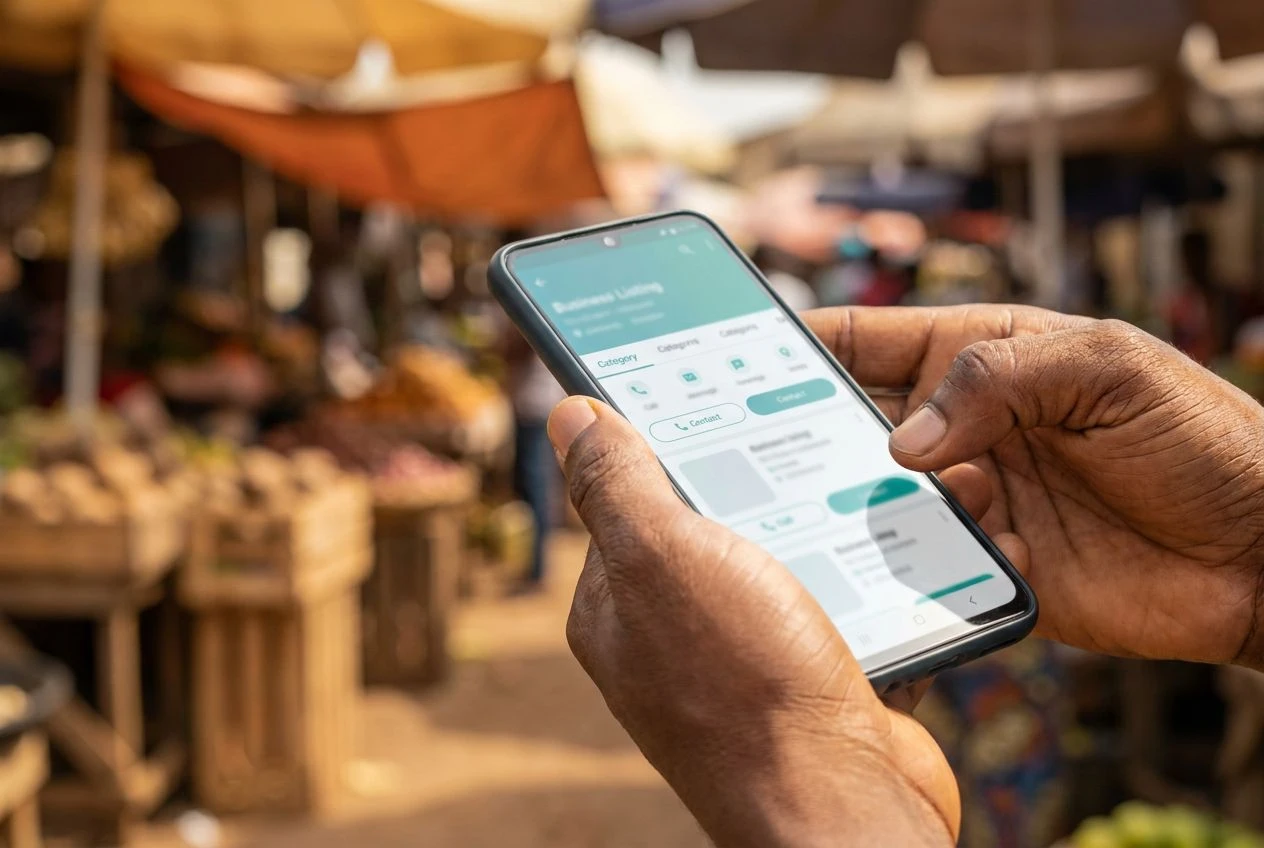
Nigeria already has a directory ecosystem. BusinessList.com.ng, ConnectNigeria, Finelib, and NaijaDirectory each operate on a basic model: organize businesses by category and location, make them searchable by query, and provide enough contact detail that a prospective customer can decide to act. With its structured business directory, the platform extends that model to include product listings, job postings, events, and opportunities, functioning as a discovery layer on top of feed-based platforms.
On the dimensions that matter to SMEs trying to attract purchase-ready customers, social media platforms and business directories differ significantly:
| Dimension | Social Media Platforms | Business Directory Platforms |
|---|---|---|
| Primary design goal | User engagement and in-app retention | Business findability by category and location |
| Customer behavior served | Passive discovery, scrolling, entertainment | Active search at point of purchase intent |
| Content reach mechanism | Dependent on engagement signals and post frequency | Category-based search and keyword queries |
| Trust signals available | Follower count, post engagement, ad spend | Verified address, contact details, category, reviews |
| External search visibility | Posts typically not indexed; external links deprioritized | Listings indexed directly by search engines |
The directory model is old. What Yellow Pages did for print directories, these platforms attempt for mobile search. Nigerian consumers spend hours daily inside social apps, and directory-based search requires a deliberate habit those same apps have trained users away from.
Why Followers Don’t Guarantee Buyers
The broader case the platform makes extends past findability to credibility. “If customers cannot find your business,” the platform’s founder told The Guardian, “they are less likely to trust it. And if they don’t trust it, they may never buy from you.” A social media page, however active, offers a limited set of trust signals. Follower count, post frequency, and engagement rate tell a customer nothing about whether a business is real, open, and capable of fulfilling an order.
What a structured business listing provides that a social profile typically does not:
- Physical address with map coordinates, letting customers verify a location before traveling or paying
- Contact number and opening hours, removing the most common reason customers abandon a business search: uncertainty about whether the business is open
- Category context (electronics repair, event catering, legal advisory) that sets expectations before a customer clicks or calls
- Product and service listings confirming capability and pricing without a DM exchange
- Third-party reviews on a neutral platform, distinct from testimonials a business selects for its own page
A 2026 analysis of digital scaling for Nigerian SMEs, published on NigerianEye.com, noted that platforms categorizing businesses and verifying information “help SMEs convey legitimacy and reliability,” a function distinct from marketing and aimed at clearing the credibility threshold before a first transaction.
Nigeria’s $14 Billion Digital Bet
Nigeria’s digital transformation market reached an estimated $13.96 billion in 2026, up from $11.86 billion in 2025, with a projected 17.72% compound annual growth rate (CAGR) through 2031, per Mordor Intelligence. The SME segment within that total is forecast to grow digital technology adoption at a 20.12% CAGR, outpacing large enterprises as subscription-based pricing removes upfront barriers and mobile-first platforms bundle payments, lending, and analytics into a single interface.
The investment flows mostly into transaction infrastructure: payments, fintech rails, cloud deployment, and credit scoring. The US International Trade Administration’s guide to Nigeria’s digital economy notes that SMEs account for 80% to 90% of all customer-to-business payments in the country, and the rails for those transactions are increasingly in place.
For businesses unable to attract customers in the first place, the payment infrastructure isn’t the pressing need. Paying for a transaction presupposes a connection has already been made. The discoverability gap sits above the transaction layer the $14 billion transformation budget is targeting.
Nigeria tops every global chart for social media brand discovery; its small businesses still rank finding customers among their three biggest operational failures.


Google Opens Gmail to Voice and Gates Docs Live

Lenovo Prices the IdeaPad Vibe Against Apple’s $699 Neo

Xbox Caps Game Pass Cloud Gaming at 15 Hours

GTA 6 DualSense Controllers Follow Sony’s Usual $84.99 Script

South Korea Retail Investors Face Reckoning After KOSPI AI Rally Collapses

Surrey AI Maps Three Heart Attack Paths and Their Molecular Roots

Germany Locks Neutral Apple ATT Prompts Across Most of Europe

Apple’s 5% EU Fee Quietly Rewrites Alternative App Store Math

Apple’s EU Fee Truce Cuts Complexity but Leaves Rivals Fuming

Pixel 11 Pro Fold Trades Thinness for Durability and Seven-Year Stay

Oracle Cuts 21,000 Jobs in a Year, Cites AI in 10-K Filing

Fable 5 and Mythos 5 Return as US Lifts Anthropic Export Controls

SpaceX’s Google Deal Turns a Rocket Company Into a Cloud Landlord

CD Projekt Red Co-CEO: Redemption Arc Isn’t Done, Witcher 4 in 2027

XPL Rallies 30% Ahead of Plasma One Card Tier Launch

Google Search Profiles Build a Follow Graph Inside Discover

DGO App Brings Rs 549 Mobile Pass for FIFA World Cup 2026 in Nepal

Moonshot AI Targets $30 Billion in China’s Fastest AI Funding Sprint

Oppo’s ColorOS 17 Eligibility List Leaves A-Series Buyers Behind

Microsoft Xbox Layoffs Start in July as Sharma Slams 3% Margin
-
 AI2 months ago
Oracle Cuts 21,000 Jobs in a Year, Cites AI in 10-K Filing
-
 AI2 months ago
Fable 5 and Mythos 5 Return as US Lifts Anthropic Export Controls
-
 AI3 months ago
SpaceX’s Google Deal Turns a Rocket Company Into a Cloud Landlord
-
 GAMING2 months ago
CD Projekt Red Co-CEO: Redemption Arc Isn’t Done, Witcher 4 in 2027
-
 CRYPTO3 months ago
XPL Rallies 30% Ahead of Plasma One Card Tier Launch
-
 NEWS3 months ago
Google Search Profiles Build a Follow Graph Inside Discover
-
 APPS3 months ago
DGO App Brings Rs 549 Mobile Pass for FIFA World Cup 2026 in Nepal
-
 AI3 months ago
Moonshot AI Targets $30 Billion in China’s Fastest AI Funding Sprint