
AI
AI Notetakers Turn Meetings Into Searchable Legal Records
AI notetakers recap meetings, then leave a file people edit their speech around, lawyers treat as a third party, and vendors may train on.

AI notetakers now sit in most professional meetings, then leave a transcript that outlives the call. Fellow’s 2025 survey of people in IT, operations, and business leadership found that 75% already use one at work. The same survey found that 84% of respondents change what they say when the bot is in the room.
That is the part the recap email does not mention. A verbatim file can be searched, forwarded, trained on, or produced in a lawsuit, and it is already changing who speaks and how lawyers run a call.
Three in Four Professionals Now Run a Notetaker
Fellow, which sells a meeting assistant of its own, published those figures on Oct. 22, 2025. Among respondents, 41% worked in IT and 31% in operations, the groups that usually own security reviews. Half of the people who still refuse the tools named privacy and security as the reason. Among people who already use one, 47% said a notetaker had recorded or shared something they never meant to capture.
THE FELLOW 2025 SNAPSHOT
- Adoption: 75% of surveyed professionals said they use an AI note-taker in work meetings.
- Speech change: 84% of respondents said they modify what they say when a notetaker is present.
- Unintended capture: 47% of active users said the tool recorded or shared something they did not intend to capture.
- Holdouts: 50% of non-users named privacy and security as the main reason they stay off.
Those numbers describe a professional sample, not the whole U.S. workforce. A July 2026 Pollfish survey of 500 employed adults, commissioned by Kolmogorov Law, put the share who had even seen a bot in their meetings at 33.4%, with another 22.4% unsure. The gap is the job mix. Many paid roles still have no Zoom grid to join.
The product is simple. A bot, or a quiet app on someone’s laptop, records the call, labels speakers, and sends a summary with action items. Otter.ai, Fireflies, Fathom, Granola, Zoom’s built-in recap tools, and Microsoft Copilot all sell some version of that loop. The fight is over the file that remains after the summary is skimmed.
People Talk Differently Once the Bot Joins
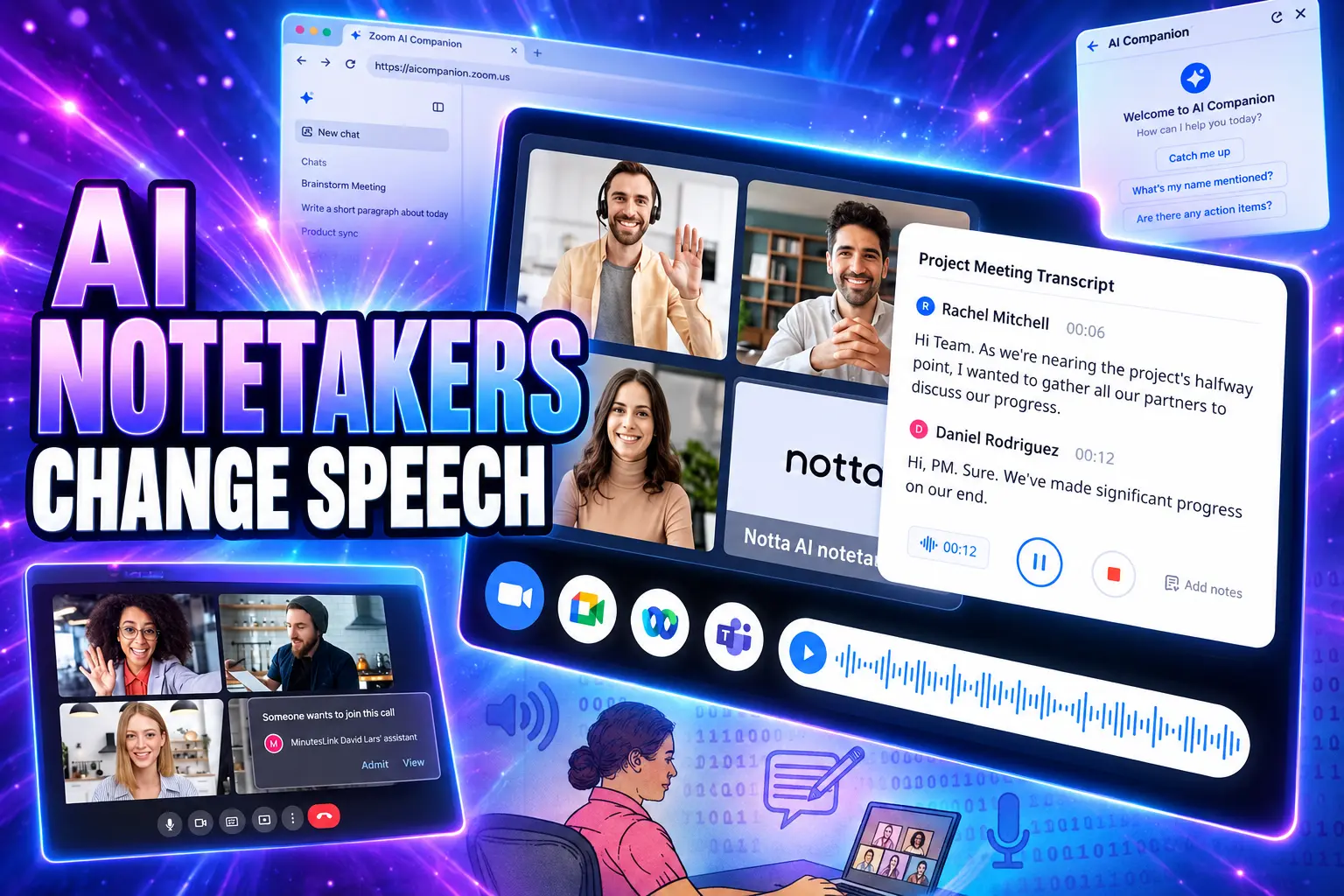
Harvard University Information Technology warned in February 2025 that transcripts and summaries “could stifle open conversation and discourage some meeting attendees from fully participating.” Fellow’s later survey put a number on that instinct. People clean up jokes, skip guesses, and hold back the half-formed thought that used to be the point of a working session.
That is not a small cultural tweak. If 84% of the people in a leadership sample are already editing themselves, the transcript is not a neutral copy of the meeting that would have happened anyway. It is a copy of a more careful meeting. Junior staff have the most to lose if a rough idea is later read as a commitment, or if a complaint is later read as insubordination.
Inaccuracy cuts the other way. Employment lawyers Zoe Argento and Bradford Kelley, writing for Littler on Feb. 26, 2026, noted that the tools still mangle industry jargon, accents, and high or low voices. If a company then uses that text to score interviews or to back a disciplinary file, a bad transcript is not a harmless draft. It is a personnel record with a speaker tag on it.
Accessibility is the honest exception. Captions and a written recap can be the difference between following a call and missing it. Harvard’s own rules carve out approved tools for disability accommodations. The rest of the room still has to live with the record those tools create.
Most Recorded Workers Were Not Asked First
Kolmogorov Law’s survey was fielded on July 8, 2026. Among the 167 workers who said a notetaker had joined their meetings, only 34.7% said they were always asked before it recorded. The subsample’s margin of error is about plus or minus 7.6%, so treat the splits as a range, not a census.
CONSENT ON THE CALLS THAT HAD A BOT
- Always asked: 34.7% said they were asked every time before recording started.
- Sometimes asked: 36.5% said permission was inconsistent.
- Never asked: 25.1% said the bot simply appeared in the meeting.
- Told later: 3.6% learned about the recording only after the fact.
Kolmogorov reports that 65.3% of that exposed group described consent as inconsistent or absent. Across the full sample, 18.8% said they had later discovered that a meeting or call had been recorded without their knowledge, and 8% said it had happened more than once. Only 35% already knew that some states require every participant’s consent. Another 41.8% had no idea recording laws applied to work meetings at all.
Federal law and most states are one-party consent, meaning a person on the call can record it. About a dozen states require everyone to agree, and Pennsylvania is in that group. Littler’s note is that wiretap statutes still carry real money. The federal Wiretap Act allows the greater of $10,000 or $100 per day of violation, and Illinois’s Biometric Information Privacy Act allows up to $5,000 when voiceprints are collected without the required consent.
Otter tells customers they “must always ask for consent and indicate when they are recording and transcribing conversations with others.” A visible bot is not the same thing as a yes. Bot-free apps that capture audio from a laptop make the ask even easier to skip, because nobody sees an extra name in the participant list.
Otter’s Class Action Survives the First Cut
Justin Brewer, a California resident with no Otter account, filed in the Northern District of California on Aug. 15, 2025, after a Zoom sales call that another participant had wired to OtterPilot. Three more suits followed. On Oct. 22, 2025, Judge Eumi K. Lee consolidated them as In re Otter.AI Privacy Litigation, No. 5:25-cv-06911. The consolidated complaint, filed Dec. 5, 2025, covers seven people in California, Illinois, and Washington.
Plaintiffs say the Otter Notetaker joined as a “silent participant,” recorded sensitive medical, financial, and work talks, kept voiceprints, and used the audio to train speech models. Those are allegations. The case is not a finding that Otter broke the law.
THE OTTER DOCKET
- Aug. 15, 2025: Brewer files the first putative class action in San Jose federal court.
- Oct. 22, 2025: Judge Lee consolidates four related cases into lead case 5:25-cv-06911.
- Dec. 5, 2025: Plaintiffs file the consolidated class complaint against Otter.ai Inc.
- Aug. 13, 2026: The court issues an order granting the motion in part and denying it in part, with 14 days to amend.
The Aug. 13 ruling is the first real test of whether an auto-joining meeting bot looks like eavesdropping under old wiretap statutes. Judge Lee held that the alleged harm is concrete enough for standing, analogizing it to intrusion upon seclusion rather than to a website that merely logs mouse movements. Claims under the Electronic Communications Privacy Act, California’s Invasion of Privacy Act, and Illinois’s BIPA were allowed to go forward. A Computer Fraud and Abuse Act count and several other claims were dismissed with leave to amend. Withdrawn counts were dropped without prejudice.
Otter had argued it was a “party” to the calls, which can be a defense under federal wiretap law. The court let the ECPA claim proceed anyway at the pleading stage, including on the theory that a tortious purpose can knock out that defense. None of that decides the merits. It does mean a meeting bot can be treated, in court, as something other than a helpful notepad.
Why Lawyers Treat the Transcript as a Third Party
Once a vendor’s servers hold the audio, the conversation is no longer only among the people on the calendar invite. Employment counsel at Littler warn that sending privileged talk through an outside notetaker can invite a waiver fight, and that even a privileged transcript still adds pages to discovery. They peg a typical hour-long meeting at about 16 single-spaced pages. Keep a year of standing meetings and the archive is a warehouse.
The New York City Bar Association’s Professional Ethics Committee, chaired by Michael E. Salzman, made that risk a rule of practice. Formal Opinion 2025-6, issued in December 2025, told lawyers they must notify clients and get consent before an AI tool records them, and that secret recording is deceptive even in a one-party-consent state. Formal Opinion 2026-2, issued Aug. 5, 2026, extended the same logic to opposing counsel, witnesses, prospective clients, co-counsel, and investigators. The committee’s default practice should be not to record unless there is a good reason in that instance.
AI systems that record, transcribe, and summarize conversations can be useful tools, but attorneys must be mindful of the ethical issues that arise when AI is used for this purpose. This opinion provides a non-exhaustive list of some of the ethical issues-and potential risks-that arise when attorneys use AI to record, transcribe, and summarize conversations with people other than their clients, and the default practice should be not to use AI tools to record, transcribe or summarize conversations absent a good reason in a particular instance.
New York City Bar Association, Formal Opinion 2026-2
Competence, the opinion says, includes knowing how to turn the recorder off. Witness interviews are a special trap, because a preserved recording can be discoverable and can freeze a messy answer out of context. Some tools also lock a person out of the call if they refuse to be recorded, which makes consent look less free than the ethics rules assume.
In February 2026, Judge Jed S. Rakoff of the Southern District of New York held that transcripts a litigant generated through the public Claude app were not privileged, because the user could not expect privacy from a consumer AI service. That case was about a chatbot, not a meeting bot. Lawyers still read it as a warning that a third-party model can break the seal on a conversation.
California attorney Caroline Massey put the working rule in plainer words on Sept. 12, 2026. “Attorneys kick the AI notetaker off meetings because their job is protecting your attorney-client privilege,” she wrote. Counsel who want the notes, she added, have to plan storage and access in advance rather than hope a default setting will hold up later.
Training Defaults Split the Vendor Field
The other hidden stakeholder is the vendor’s model. Otter’s privacy and security page says it will de-identify user data before training its own systems, that the process is automatic, and that humans do not review those recordings. Its privacy policy, current as of mid-September 2026, is blunter still: it uses de-identified audio recordings and transcriptions, “which may contain Personal Information,” to improve and train its proprietary AI. Otter says third-party AI providers do not train on customer data, and that imported documents are excluded.
Fireflies takes the opposite written default. Its security page says customers own their data, that it does do not train on customer data by default, and that it keeps a 0-day retention policy with AI vendors. Both companies advertise SOC 2 Type II, GDPR, and HIPAA-ready setups. The split that matters for a general counsel is the training toggle, not the logo on the recap.
WHAT THE VENDORS SAY THEY DO WITH MEETING AUDIO
| Vendor | Training on meeting content | Stated consent rule |
|---|---|---|
| Otter.ai | Trains on de-identified audio and transcripts; third-party AI providers are barred | Users “must always ask for consent” and flag that recording is on |
| Fireflies.ai | Says it does not train on customer data by default; 0-day retention with vendors | Customer owns the data; deletion is available |
| Harvard-approved tools only | Enterprise contracts must block model training on Harvard data | Announce at the start; stop if anyone objects |
Otter encrypts stored audio with AES-256, offers two-factor sign-in, and auto-deletes conversations from Trash after 30 days. It also says it will not hand over customer data without legal process, and that it tries to notify users of government requests unless a court forbids it. That last point is the discovery problem in another costume. A deleted recap is still a recap if a copy left the workspace, or if a subpoena arrived first.
Local-only apps have become the product answer to that fear. Open-source tools that transcribe on the laptop, with no cloud copy, are the version of this market that treats the vendor as the risk. They do not solve consent. They do cut the number of companies that can be asked for the file.
Harvard Drew a Hard Line on Unvetted Bots
Harvard’s February 2025 guidance is still the cleanest public policy in this category. HUIT’s page states that AI meeting assistants should not be used in Harvard meetings, except for tools covered by an enterprise agreement, limited pilots, or disability accommodations. Hosts are told to enable the waiting room, watch for names like “Michael’s OtterPilot,” and remove anything that was not invited.
RISKS HARVARD TELLS HOSTS TO WEIGH
- Chilling effect: Transcripts can discourage people from speaking as freely as they would without a recorder.
- Vendor training: Confidential talk can be exposed to a third party or used to train a model without a protecting contract.
- Bad summaries: Notes can miss sarcasm, hedge words, and context, or invent detail.
- Discovery: Recordings and summaries may have to be produced in later litigation, and holds require that they be kept.
- Consent gaps: Participants can be recorded without knowing the tool is on.
If someone objects, Harvard’s script is to shut the assistant off. Sensitive meetings, meaning patient data, student records, employee actions, donor strategy, or legal advice, get an even harder stop. Hosts are told to review every summary before it circulates, mark it as machine-made, share it narrowly, and delete it when the purpose expires, unless a litigation hold says otherwise.
That is the grown-up version of the same instinct lawyers now use when they hit Remove. The bot is easy to add from a calendar. The file it writes is hard to walk back. Companies that skip a policy will still get the archive, because staff will keep inviting Fred or OtterPilot on their own, and an outright ban that nobody can enforce is just shadow IT with better audio.
The next fight is not whether recaps are handy. It is whether a visible bot and a buried privacy clause count as consent, and whether a vendor that trains on de-identified meeting audio is still a stranger in the room. Judge Lee has not answered that on the merits. Until someone does, the safest meeting is still the one that ends when people hang up.
Disclaimer: This article is news reporting and analysis of public court filings, bar opinions, company policies, and surveys. It is for information only and is not legal advice, not a privacy compliance guide, and not a recommendation to adopt or ban any product. Readers who need to set a recording policy, respond to a class claim, or protect attorney-client privilege should consult a licensed attorney in the relevant state before they record a call or change vendor settings. Figures, docket events, and product rules reflect the cited sources as they stood in September 2026 and can change with a later court order, a policy rewrite, or a new survey.

Instagram Plus Tests a Read-Only Mode That Cuts Stories

Altman Asks the Public to Accept Some AI Harm

Google Freezes OSS VRP Product Reports After AI Flood

AI Agents Make Payment Rails the Scarce Prize

Turkey’s Crypto Boom Now Runs Through Three Banks

Fable 5 Came Back Under a Commerce On-Off Switch

Google’s SpaceX GPU Lease Has a Sept. 30 Deadline

Plasma One’s XPL Locks Face a 1.81 Billion Cliff

DGO’s Rs 549 World Cup Pass Cost Fans Sleep and Data

Moonshot AI’s $30 Billion Ask Became a $35 Billion Close
-
 AI4 months ago
Fable 5 Came Back Under a Commerce On-Off Switch
-
 AI4 months ago
Google’s SpaceX GPU Lease Has a Sept. 30 Deadline
-
 CRYPTO4 months ago
Plasma One’s XPL Locks Face a 1.81 Billion Cliff
-
 APPS4 months ago
DGO’s Rs 549 World Cup Pass Cost Fans Sleep and Data
-
 AI4 months ago
Moonshot AI’s $30 Billion Ask Became a $35 Billion Close
-

 NEWS4 months ago
ColorOS 17 Device List Spans Oppo, OnePlus and Realme
-

 GAMING4 months ago
Xbox Cuts 3,200 Jobs After Five Years of Thin Returns
-

 GAMING4 months ago
The RTX 4050 Under Rs 70,000 Hides a Wattage Gap