
AI
D&O Insurers Start Carving AI Out of Board Cover
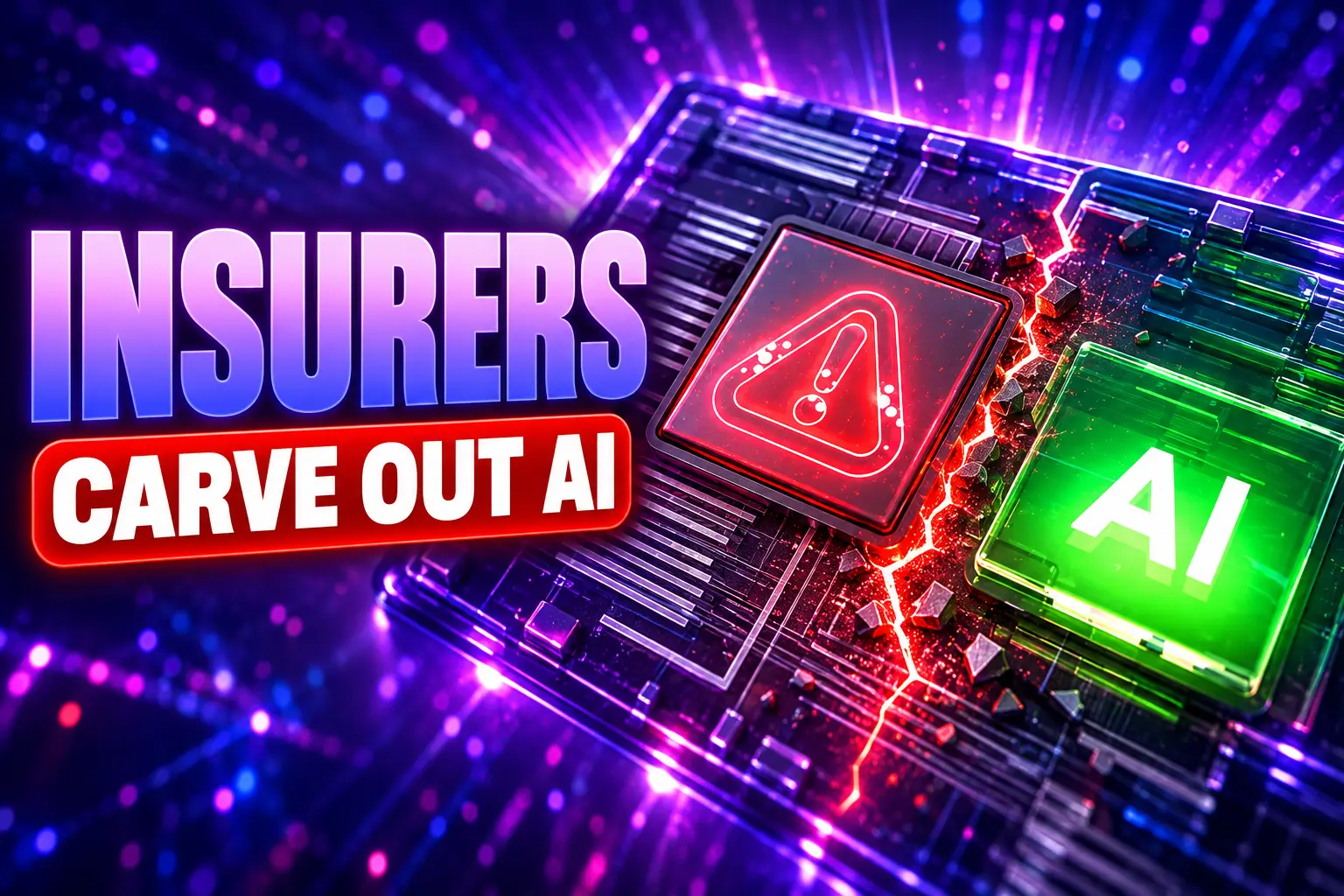
Carriers are writing AI out of D&O, cyber and E&O forms, so an AI miss can land on directors just as the policies meant to pay go quiet.

Berkley Insurance Company has begun selling an absolute AI exclusion on directors and officers policies, the cover boards still count on after a public AI failure. Reed Smith insurance partners told CIOs in August how to keep a hallucination, a breach or a boast about model performance from becoming a personal claim. The people who will pay, or refuse to pay, are the carriers writing those forms.
Reporting packs still matter in Delaware. They do not bind the underwriter who can take AI off the page at renewal.
The Carriers Who Will Decide Personal AI Liability
For several years AI losses hid inside cyber and tech errors and omissions forms that never used the words. Coverage lawyers now call that quiet. Insurers are ending it, some by granting AI in so many words, more by taking it out.
Verisk’s Insurance Services Office published optional generative AI endorsements for commercial general liability in July 2025. The forms, CG 40 47, CG 40 48 and CG 35 08, took effect on January 1, 2026. CG 40 47 is the broad one. It pulls bodily injury, property damage and personal and advertising injury “arising out of generative artificial intelligence.” The endorsements are optional. Carriers choose whether to file them, swap in their own language or sell a buy-back.
Trades Coverage, a licensed producer that read SERFF metadata, counted 4,078 state-level generative AI exclusion records across 49 states and the District of Columbia through July 31, with 2,369 already in force. Of those records, 3,955 sat on the commercial lines small firms actually buy, general liability, umbrella, package, businessowners and errors and omissions. That tally is a filing count, not a headcount of carriers, and it is mostly a general-liability story.
The D&O story is a manuscript. In an April 2026 commentary, Jones Day insurance recovery lawyers Tyrone Childress and Tara Kowalski described Berkley’s absolute AI exclusion for D&O policies and E&O forms. The carve-out reaches loss “based on, arising out of, or attributable to” the use of AI, and it defines AI as any machine-based system that infers from its input how to generate predictions, content, recommendations or decisions, including synthetic images, video, audio and text. Incidental use is not carved back in the language they quoted.
THE EXCLUSION CALENDAR
- July 2025: ISO publishes optional generative AI exclusion forms for commercial general liability.
- January 1, 2026: Those ISO forms take effect for carriers that adopt them.
- April 2026: Jones Day quotes Berkley’s absolute AI exclusion on D&O and E&O.
- August 18, 2026: Carolyn Rosenberg and Andy Moss tell CIOs to stress-test D&O, cyber and tech E&O together.
- September 3, 2026: Reed Smith partner David Halbreich warns that AI answers on an insurance application can harden into a warranty.
Gregory C. Allen, in a September 2026 CSIS analysis, wrote that more than 60 carriers filed AI carve-outs in the property and casualty market in 2026, and that state commissioners had approved more than 80 percent of those requests. The named filers include Berkshire Hathaway, Chubb, Travelers, AIG, Tokio Marine, W.R. Berkley, Great American and Fairfax Financial. AIG, Allen wrote, described generative AI as a wide-ranging technology whose claims will likely grow, then said it had no current plan to use the exclusion it had cleared. The option sits in the drawer.
Rosenberg Warns Against Siloing the Risk
Carolyn H. Rosenberg and Andy Moss, partners who counsel companies on D&O recoveries at Reed Smith, sat for an ISMG video interview on August 18, 2026. They were not selling a new duty. They were describing the moment an AI miss stops being an IT ticket.
A hallucination, a data breach or a misleading claim about how a system performs becomes a board problem, they said, when it hits financial results, draws a regulator or spills into public view. Moss said directors generally must be reasonably informed and must have reporting systems that bring serious risks upstairs. The business judgment rule still gives a board room to make a call that later fails. It does not excuse the absence of a system that would have put the risk in the packet.
I don’t think you can silo this, and I think that’s where you get into some trouble.
Carolyn H. Rosenberg, partner, Reed Smith Insurance Recovery Group, ISMG video interview
AI risk, Rosenberg said, touches technology, legal, compliance, audit, customer relations and corporate communications. Companies should brief boards on new developments, peer practice and the risks that actually sit in the business. Committees can grind the detail and hand directors a shorter list of open points and possible moves. CIOs need paths that let staff escalate fast and let executives tell the board when an issue is material.
That is the governance half of their advice. The other half is a coverage test across D&O, cyber and technology E&O, run before the claim letter arrives. Brokers looking at live towers keep finding programs that never mention AI at all, while a handful of carriers write the absolute form. Silence is not a grant. It is a fight waiting for a pleading.
One Hallucination Can Miss Every Policy
The same event can be a securities case, a privacy case, a professional-failure case and an advertising case, depending on how the complaint is written. Childress and Kowalski walked through the split. A hiring tool that screens people unfairly may land on employment practices cover or on D&O. A company that overstates what its model can do may draw a securities claim or a regulatory inquiry that D&O and cyber are built to defend. A logistics model that goes down may look like cyber or property. A chatbot that defames or copies may look like advertising injury on a general liability form, until CG 40 47 is attached.
HOW AN AI CLAIM MAPS TO COVER
| Line | Typical AI claim | 2026 form pressure |
|---|---|---|
| D&O | Overstated AI claims, governance failures, investigations | Berkley-style absolute exclusion on D&O and E&O |
| Cyber | Breach, ransomware, AI-enabled attacks | Still the most stable line; weak on pure output errors |
| Tech E&O | Hallucination, model error, client financial loss | Output carve-outs and some affirmative grants, both appearing |
| CGL | Bodily injury, property damage, advertising injury from generative AI | Optional ISO CG 40 47, CG 40 48 and CG 35 08 in force from January 1, 2026 |
| EPLI | Bias in hiring or workplace tools | Absolute exclusions spreading into EPLI and fiduciary forms |
Cyber remains the line that is still writing AI-driven attacks in, not out. That does not save a board if the complaint is about a forecast the company made on an earnings call, or about a model that quietly steered a customer to a bad result. Tech E&O is where a hallucination that costs a client money would usually go, and it is also where some of the widest carve-outs now live. Each line is being narrowed on its own paper. The hole is the claim that touches all of them and is answered by none.
Delaware Treats AI Deployment as a Caremark Event
Patrick Meson, a corporate counsel at a New York investment bank, wrote in June 2026 that turning on a third-party AI tool is not a software buy. It is a Caremark event. Two-thirds of Fortune 500 companies are incorporated in Delaware. There, the oversight duty is a loyalty duty, not a care duty. Charter language under DGCL § 102(b)(7) can wipe personal damages for care breaches. It does not wipe a claim that directors never tried to install a reporting system, or that they saw red flags and sat still.
The chain Meson traces is familiar. Caremark in 1996 set the two prongs, no system or a system ignored. Stone v. Ritter in 2006 put the duty in loyalty. Marchand v. Barnhill in 2019 said a mission-critical risk needs board-level monitoring, not a hope that management will mention it. The 2021 Boeing derivative case applied that logic to airplane safety. In re McDonald’s in 2023 extended the same oversight duty to officers inside their own functions. A CIO who never builds an escalation path, or a general counsel who signs a vendor deal and never checks what the model does, is in the frame.
Directors are not asked to explain a transformer. They are asked to show a good-faith process for relying on a system they cannot fully inspect. Meson says litigators, examiners and large buyers already treat NIST’s voluntary AI risk framework as that yardstick. NIST released AI RMF 1.0 on January 26, 2023, and a generative AI profile (NIST-AI-600-1) on July 26, 2024. The document is voluntary. It is also the binder a plaintiff’s lawyer can hold up and ask why the board never opened it.
That process demand now sits next to provenance gaps that already bind directors when they cannot show where an AI output came from. A packet that never records the model, the data or the human who signed off is a Caremark problem and a claims-file problem at the same time.
WHERE EXPERTS DISAGREE
- Duty at switch-on: Meson treats the decision to deploy AI as an oversight event that attaches before the tool runs, especially where the system touches credit, hiring, AML or sensitive data.
- A high pleading bar: On August 14, 2026, the Delaware Court of Chancery dismissed Caremark claims against Boeing directors and officers at the pleading stage, a reminder that bad faith remains hard to plead when a monitoring process exists.
- Cover still possible: Childress and Kowalski say many AI losses are old risks in a new wrapper and may still fit traditional forms, if the tower has not taken the absolute endorsement.
The practical money is often not a Caremark judgment. It is defense costs, an investigation and a securities complaint about what the company said its AI could do. Those are D&O events. They need a D&O form that still responds after the word AI appears in paragraph one of the complaint.
Application Answers That Later Deny the Claim
David Halbreich, another insurance recovery partner at Reed Smith, described a quieter trap on September 3, 2026. Underwriters have started asking how the company uses AI, who owns it and what governance sits around it. When those answers are incorporated into the policy by reference, a description written to win the quote can harden into a warranty. A later claim then fails because the company’s real AI use does not match the application, not because a judge found a Caremark breach.
Halbreich’s fix is unglamorous. Add knowledge, intent and materiality so a misstatement is not a strict forfeiture. Limit the penalty to the people who knew, or to the company only if named individuals knew. Decide who is allowed to sign the AI questions, because a CIO, a GC and a business owner will not describe the same stack. He also flagged straddle claims after a merger, where a slow AI failure crosses the cut between a tail policy and a go-forward policy and both carriers point at the other.
That is the second-order cost of the reporting culture Rosenberg wants. The same log that shows the board was informed can show the underwriter that last year’s application was thin. Build the pack with both readers in mind, or the pack becomes exhibit A in the coverage denial.
Vendor Contracts Leave the Board Holding the Loss
Boards still talk as if the model maker will pay when the model is wrong. Meson cited a 2026 Jones Walker market analysis: 88% of AI vendors cap their own liability at the monthly subscription fee, while pushing broad indemnities onto the customer for discrimination, IP and regulatory claims that arise from use of the tool. Liability does not travel with the contract. It stays with the company that deployed the system, and with the officers who were supposed to watch it.
WHERE THE LOSS STICKS
- The fee cap: Most vendor paper limits the maker’s payout to a month of subscription, which will not fund a securities defense.
- The indemnity flip: The customer often agrees to hold the vendor harmless for claims the tool helped create.
- The warranty mismatch: A promise made to a customer or to an underwriter can exceed what any policy on the tower will pay.
- The oversight duty: McDonald’s puts officers on the hook inside their functions, so a CIO cannot treat vendor terms as the end of the job.
Some professions are already seeing the next turn. Liability forms have started to exclude agents, doctors, lawyers, architects and other licensed work unless the insured can show a human reviewed the AI output. Carriers are writing a standard of care into the exclusion list. Documented human review is becoming the price of remaining on cover, not a best practice slide.
What Still Responds After an Overstated AI Claim
Directors still have a path. Traditional D&O and cyber forms can defend an overstated AI claim or a breach if the tower has no absolute exclusion, and Childress and Kowalski say policyholders can try to kill vague “arising out of” language, add incidental-use carve-backs and define AI so a spell-checker does not void the policy. Standalone AI products exist, mostly in surplus lines, and they are still few. The work is a page-by-page read at renewal, not a binder labeled governance.
Moss’s reporting system is the other half of that path. Employees need a way to raise a model failure before it is a press story. Executives need a rule for when that failure is material to the board. Committees need to keep the grind off the full board without hiding the unresolved points. Those records are how a Caremark claim dies at the pleading stage. They are also how a later coverage fight shows the company told the truth on the application.
AIG cleared an AI exclusion and said it does not plan to use it. Berkley put an absolute form on D&O and E&O. ISO gave every general-liability underwriter a standard way to take generative AI off Coverage A and Coverage B. The veto on personal AI liability is already in the market. It is being exercised, or held in reserve, one endorsement at a time.
Disclaimer: This article is news reporting and analysis of public legal commentary, insurance-form developments and board-oversight doctrine. It is informational only and is not legal advice, insurance advice or a recommendation to buy, sell, keep or change any policy. Readers should consult a qualified insurance-coverage lawyer and a licensed broker about their own D&O, cyber, E&O and general-liability forms before acting on any of the practices described here. Figures, form numbers, filing counts and carrier positions reflect the sources cited as of the dates in this piece and can change at the next renewal or the next endorsement.

Instagram Plus Tests a Read-Only Mode That Cuts Stories

Altman Asks the Public to Accept Some AI Harm

Google Freezes OSS VRP Product Reports After AI Flood

AI Agents Make Payment Rails the Scarce Prize

Turkey’s Crypto Boom Now Runs Through Three Banks

Fable 5 Came Back Under a Commerce On-Off Switch

Google’s SpaceX GPU Lease Has a Sept. 30 Deadline

Plasma One’s XPL Locks Face a 1.81 Billion Cliff

DGO’s Rs 549 World Cup Pass Cost Fans Sleep and Data

Moonshot AI’s $30 Billion Ask Became a $35 Billion Close
-
 AI4 months ago
Fable 5 Came Back Under a Commerce On-Off Switch
-
 AI4 months ago
Google’s SpaceX GPU Lease Has a Sept. 30 Deadline
-
 CRYPTO4 months ago
Plasma One’s XPL Locks Face a 1.81 Billion Cliff
-
 APPS4 months ago
DGO’s Rs 549 World Cup Pass Cost Fans Sleep and Data
-
 AI4 months ago
Moonshot AI’s $30 Billion Ask Became a $35 Billion Close
-

 NEWS4 months ago
ColorOS 17 Device List Spans Oppo, OnePlus and Realme
-
 GAMING4 months ago
Xbox Cuts 3,200 Jobs After Five Years of Thin Returns
-
 GAMING4 months ago
The RTX 4050 Under Rs 70,000 Hides a Wattage Gap