
NEWS
The AI-171 Engine Files Came Back Without a Cause
GE sent the Air India AI-171 engine analysis in June. The cause is still unpublished as a Seattle module exam and an Annex 13 draft window run into October.

GE Aerospace sent its analysis of the Air India AI-171 engines to Indian investigators in June, removing the public reason the final crash report missed the one-year mark. The Boeing 787-8 that killed 260 people on 12 June 2025 still has no published cause.
Solicitor General Tushar Mehta told the Supreme Court on 28 July the file would be out by the middle of September, with a buffer to the end of October. Civil Aviation Minister Ram Mohan Naidu said on 1 September the probe was in its final stage. No final report has been posted.
Ohio Sent the Engine Files in June
The Aircraft Accident Investigation Bureau had spent the spring waiting on a teardown of the two GEnx-1B engines recovered from VT-ANB, the Ahmedabad-London Gatwick Dreamliner that hit a medical-college hostel 32 seconds after liftoff. Officials said the cores were burnt but largely intact and had been shipped to GE’s Ohio plants for specialised bench work. GE, citing Annex 13 rules on live probes, declined to discuss the case and pointed reporters to AAIB and the NTSB. Boeing gave the same answer.
By late June, people tracking the inquiry said those engine reports had been sent and that every awaited input had reached Delhi. Senior investigators expected the paperwork to show the engines stopped after they were starved of fuel, which is what the 15-page preliminary report already recorded on 12 July 2025. That finding never explained why both fuel control switches left RUN.
THE CRASH FILE IN BRIEF
- The toll: 241 of 242 people on board died, plus 19 on the ground; one passenger survived.
- The crew: 12 crew and 229 passengers were on the flight, a Boeing 787-8 registered VT-ANB.
- The last public tech note: both engine fuel switches moved from RUN to CUTOFF one second apart at 08:08:42 UTC.
- The court window: a sealed report promised from mid-September through the end of October, with the next hearing on 13 October.
The first fatal 787 crash since the type entered airline service in 2011 is no longer waiting on Ohio. It is waiting on everything the engine papers could not settle.
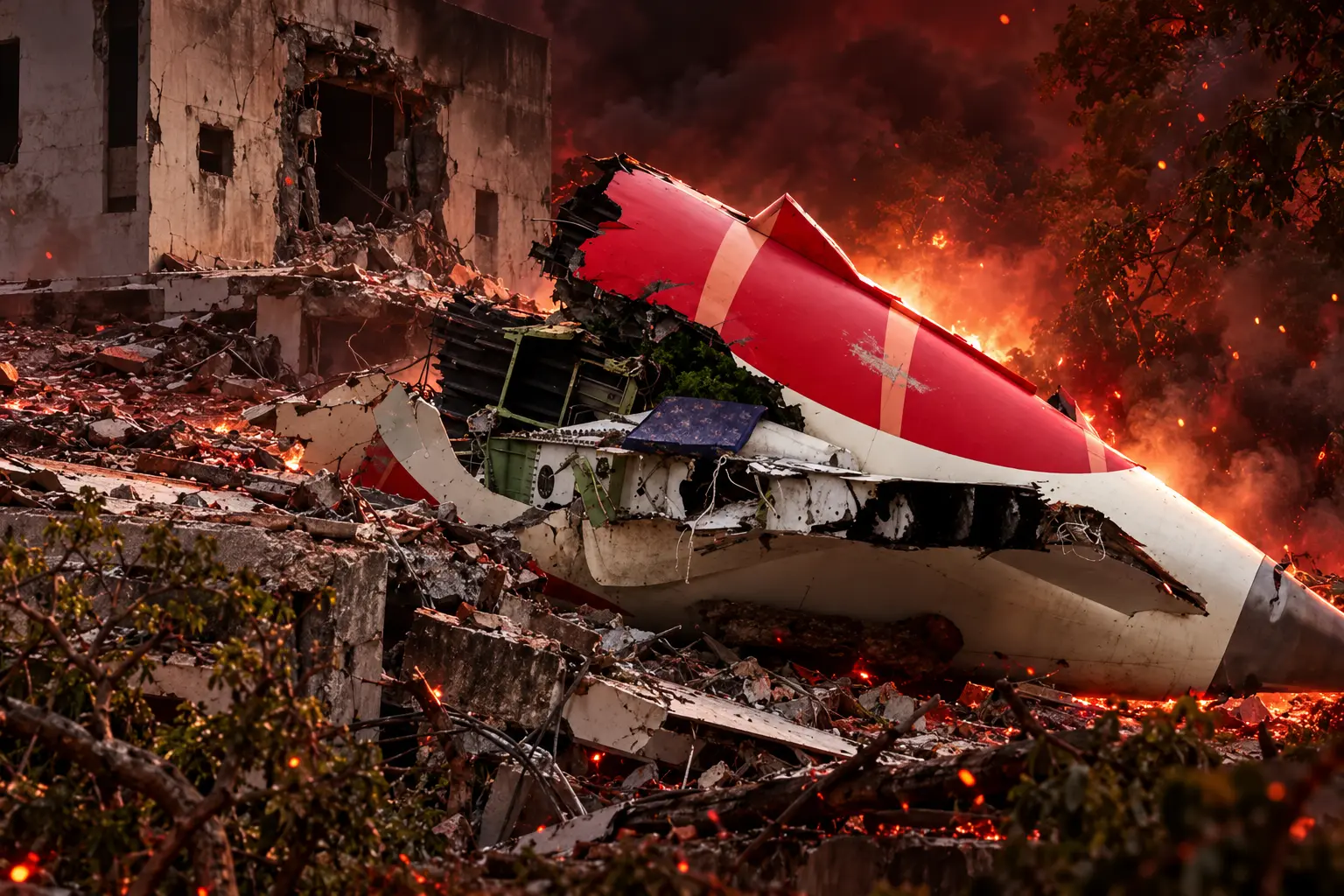
The Anniversary Statement Named No Cause
Annex 13 of the Chicago Convention tells the state that leads a probe to publish a final report within 12 months, or to issue an interim statement on each anniversary if that clock cannot be met. AAIB used that second door on 12 June 2026.
The statement said significant progress had been made on aircraft systems, flight-recorder data, engine-related parts, maintenance files and operational records. It named no new technical finding, set no date, and asked the public not to guess. It also restated the legal purpose of the work: safety lessons, not blame or liability. The final report, it said, would follow all remaining checks and the international review Annex 13 requires.
Mike Andrews, a lawyer for more than 135 affected families, said the anniversary note held no new technical or factual information. Federation of Indian Pilots president C.S. Randhawa had already asked AAIB not to publish an interim paper at all, arguing a status note without conclusions would feed more speculation. He wanted the final report or nothing.
HOW THE PROBE HAS MOVED
- 12 June 2025: VT-ANB crashes 32 seconds after takeoff from Ahmedabad; 260 people are killed.
- 12 July 2025: AAIB publishes a 15-page preliminary report recording both fuel switches moving to CUTOFF.
- 12 June 2026: AAIB issues an anniversary interim statement and withholds a cause.
- Late June 2026: people tracking the case say GE’s engine analysis has arrived in Delhi.
- 14 July 2026: AAIB tells the Supreme Court a draft final report should be ready in October, after about six more weeks of work.
- 28 July 2026: Mehta tells the court the report will be out by mid-September, with a buffer to the end of October.
- 29 July 2026: Parliament is told the fuel-switch lock shows no defect; the full thrust control module is still in Seattle.
- 1 September 2026: Naidu says the inquiry is in its final stage and that remaining steps are being finished under international rules.
That sequence is why the engine review that held the file last June is no longer the live bottleneck. The anniversary paper met the treaty form. It did not move the public record past July 2025.
Why Did Both Fuel Switches Move?
The preliminary report is still the last official reconstruction. Liftoff is logged at 08:08:39 UTC. Three seconds later the jet reached 180 knots, and the Engine 1 and Engine 2 fuel cutoff switches “transitioned from RUN to CUTOFF position one after another with a time gap of 01 second.” Fuel on board was 54,200 kg. Takeoff weight was 213,401 kg, under the 218,183 kg limit.
The cockpit voice recorder captured one pilot asking why the other had cut off. The other said he had not. The report does not identify who spoke which line. The Engine 1 switch went back from CUTOFF to RUN at about 08:08:52 UTC, and that core’s deceleration stopped, reversed and began to recover. Engine 2 relit but could not hold core speed. Thrust levers stayed at takeoff power until impact. Fuel tests on the uplift were normal. The throttle control module on VT-ANB had been replaced in 2019 and 2023 for reasons AAIB said were not tied to the fuel switch, and no fuel-switch defect had been logged on the jet since 2023.
THE 32 SECONDS IN THE RECORDERS
| Time (UTC) | What the recorders logged |
|---|---|
| 08:08:39 | Liftoff; aircraft enters air mode |
| 08:08:42 | Peak 180 knots; both fuel switches move RUN to CUTOFF, one second apart |
| 08:08:52 | Engine 1 switch returns CUTOFF to RUN; core deceleration stops and begins to recover |
| About 08:08:56 | Engine 2 is commanded toward recovery; it relights but cannot hold core speed |
| About 32 seconds after liftoff | Impact with the medical-college buildings |
Those times do not settle the fight that has run for a year. A GEnx core that has already dropped below idle cannot spin itself back up without starter power from an APU or a live engine, and the preliminary report itself notes the APU was not yet online. Pilots’ federation simulator runs have been used to argue the switches were still in RUN when any genuine relight window existed, which would mean the crew recycled them only as a dual-engine memory item after thrust was already gone. AAIB has not adopted that reading. The court has told the bureau to take federation input and to weigh timed evidence on when the ram air turbine came out, including frames that petitioners say show the RAT deploying while the jet was still on the runway.
A Thrust Control Module Remains in Seattle
Minister of State for Civil Aviation Murlidhar Mohol told the Rajya Sabha on 29 July that OEM testing in Seattle found no abnormality in the fuel control switch, including the locking detents meant to stop an accidental knock. The Directorate General of Civil Aviation ordered that work as a continuing airworthiness check after a separate Air India 787 was grounded in February 2026 over a reported fuel-cutoff control problem on a London-Bengaluru sector. Inspection of the complete thrust control module at the OEM facility, Mohol said, was still under way.
That is a different bench from the Ohio engine teardown, and it is the hardware that actually carries the two switches. If the lock is sound, a “switch slipped” account gets harder to hold. It does not prove a hand moved the toggles, and it does not prove software or electrical logic did. It leaves the module, and the wiring and computers around it, as the part still being asked to explain a dual cutoff three seconds after the wheels left the ground.
Mohol also told the House there was “no delay” in the AAIB inquiry, because a major accident probe cannot be run to a fixed calendar. Naidu has used the same line. Families have been living inside that calendar since 12 June 2025.
The Supreme Court Is Waiting on a Sealed File
A three-judge bench led by Chief Justice Surya Kant is hearing petitions from 91-year-old Pushkaraj Sabharwal, father of Captain Sumeet Sabharwal, from the Federation of Indian Pilots, and from others who want a court-watched inquiry. They argue the probe is too close to the regulator. Advocate Prashant Bhushan told the bench that three of five members of the investigation team came from DGCA, which AAIB’s own rules were written to keep at arm’s length.
Mehta, for the government, said experts from countries that lost citizens are in the room and that this is not an in-house exercise. AAIB told the court that since July 2012 it has closed 218 inquiries: 97 accidents, 120 serious incidents and one incident. It also said there is an absolute statutory bar, under the Aircraft (Investigation of Accidents and Incidents) Rules, 2025, on disclosing cockpit-voice audio or airborne image recordings to the public or to any outside committee. Four simulation tests sought by a petitioner have been run.
WHAT THE COURT WAS PROMISED
- The date: Mehta said the final report would be out by the middle of September, keeping a buffer to the end of October.
- The form: the bureau is to file the paper in a sealed cover; the next listing is 13 October.
- The RAT: AAIB must consider contemporaneous, technically grounded evidence on when the ram air turbine deployed.
- The pilots’ body: the federation may give inputs, and AAIB may use them if they are needed.
Chief Justice Kant said the path of the case will depend on whether the AAIB report is “well-merited and accepted.” The plea for a parallel inquiry is paused, not dead. Fifty-two British nationals died in the crash, and the UK Air Accidents Investigation Branch is an accredited participant. In a 27 May note to families, principal inspector Geraint Hebert said he had asked Indian authorities for a publication timeline and had not received one.
The Draft Must Sit With Washington First
Even a finished Indian draft is not a public report. AAIB’s July affidavit said the remaining investigative work, subject to external dependencies, should take about six weeks, after which a draft final report would be ready in October. Under Annex 13 that draft goes first to the states entitled to take part. The NTSB sits in as the accredited representative of the state of design and manufacture. Comments are due in 30 days, extendable to 60 if a state asks. Only after that exchange is the paper finalised and posted.
That is the 12-month final-report clock working as designed, and it is also why a “report in October” can still mean a public document weeks later. IATA has already flagged how often the clock is missed: of 242 accidents from 2018 to mid-2023, 113, or 47 percent, had a published final report. On 27 March 2026, ICAO’s Council adopted Amendment 20 to Annex 13 after probes that were halted, handed off, or left without a final paper. The new Annex 13 rules on conflicted probes become applicable on 23 November 2028. They do not rewrite AI-171. They describe the pressure the file is under.
By the middle of September, the final report would be out… But keeping a buffer, by the end of October.
Tushar Mehta, Solicitor General of India, Supreme Court, 28 July 2026
Former AAIB director general Aurobindo Handa has said defect analysis of components is specialised work that depends on the manufacturer’s test benches, so a final report waits on the OEM. The Ohio engines have now had that turn. The Seattle module, as of 29 July, had not.
Pushkaraj Sabharwal Still Has No Answer
Sabharwal has spent the year asking the court to keep the inquiry from hardening around a cockpit line that the preliminary report never assigned to a named pilot. The federation has said no pilot touched the fuel control, and it has asked investigators to treat witness accounts of the captain being brought in with his hands still on the controls. Those claims are before AAIB. They are not findings.
The last official public technical sentence remains the July 2025 one: both switches moved, fuel stopped, the jet had no height left to trade. Engine papers from Ohio, a clean bill on the switch lock, and a module still in Seattle have not replaced that sentence with a cause. Mehta’s mid-September date has arrived on the calendar. The buffer he asked the bench to keep runs to the end of October, and the sealed file is listed for 13 October.
Until AAIB posts the report, the 260 dead are still recorded as a sequence without a reason, and the 787 fleet is still flying on a preliminary paper that stopped at the switches.

Instagram Plus Tests a Read-Only Mode That Cuts Stories

Altman Asks the Public to Accept Some AI Harm

Google Freezes OSS VRP Product Reports After AI Flood

AI Agents Make Payment Rails the Scarce Prize

Turkey’s Crypto Boom Now Runs Through Three Banks

Fable 5 Came Back Under a Commerce On-Off Switch

Google’s SpaceX GPU Lease Has a Sept. 30 Deadline

Plasma One’s XPL Locks Face a 1.81 Billion Cliff

DGO’s Rs 549 World Cup Pass Cost Fans Sleep and Data

Moonshot AI’s $30 Billion Ask Became a $35 Billion Close
-
 AI4 months ago
Fable 5 Came Back Under a Commerce On-Off Switch
-
 AI5 months ago
Google’s SpaceX GPU Lease Has a Sept. 30 Deadline
-
 CRYPTO4 months ago
Plasma One’s XPL Locks Face a 1.81 Billion Cliff
-
 APPS4 months ago
DGO’s Rs 549 World Cup Pass Cost Fans Sleep and Data
-
 AI5 months ago
Moonshot AI’s $30 Billion Ask Became a $35 Billion Close
-

 NEWS5 months ago
ColorOS 17 Device List Spans Oppo, OnePlus and Realme
-

 GAMING4 months ago
Xbox Cuts 3,200 Jobs After Five Years of Thin Returns
-

 GAMING4 months ago
The RTX 4050 Under Rs 70,000 Hides a Wattage Gap