
GAMING
Alibaba Sells a Profitable Games Studio to Private Equity
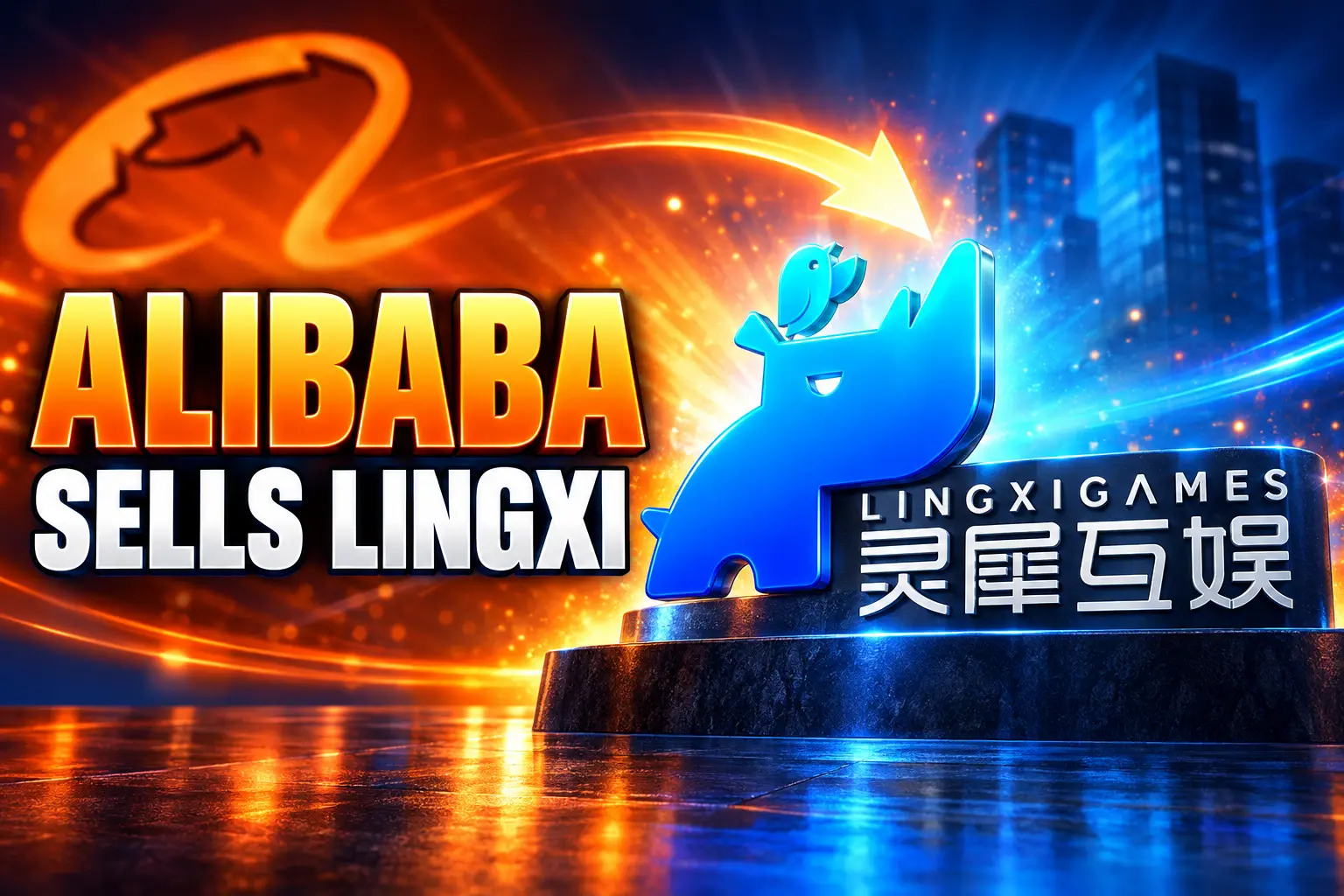
Alibaba is selling Lingxi Games to Trustar for over $1.5 billion, a profitable Three Kingdoms studio private equity wanted more than game companies did.

Alibaba Group agreed on August 17, 2026 to sell Lingxi Games to Trustar Capital for more than $1.5 billion (about 10.1 billion yuan). Trustar, the buyout arm tied to CITIC Capital, beat listed game companies to a Guangzhou studio built around Three Kingdoms: Strategy Edition.
Chief executive Eddie Wu has been selling businesses that sit outside e-commerce, cloud, and AI. A studio that still makes money sat outside that line anyway.
A Private Equity Firm Beat the Game Studios
Alibaba put Lingxi on the block in June 2026 with an asking range of 7 billion to 9 billion yuan. 37 Interactive Entertainment, China Ruyi, Century Huatong, and Giant Network all hovered around the process. Two unnamed private equity groups did too.
Game companies priced synergy, overlap, and the cost of merging live-ops teams. Century Huatong already had SLG capacity and said a deal starting at 7 billion yuan would have crossed a board-approval threshold tied to net assets. Giant Network’s 2025 sales were 5.047 billion yuan, so a check in that range would have been a full-size bet on a single asset. China Ruyi looked, on paper, like the cleaner industrial fit.
Trustar did not need a games portfolio. It needed cash flow it could hold, run, and sell later. That is why a buyout shop could raise the bid by more than 1 billion yuan over the early 9 billion yuan mark and still have the math work. The last round, in early August, came down to Trustar and Giant Network. The private equity firm won.
Trustar, formerly CITIC Capital Partners, is a control-buyout platform with offices in China, Japan, and the United States. The firm lists USD10.5 billion of committed capital, more than 100 investments since 2002, and more than 70 buyouts. McDonald’s China sits in that pattern: buy a known cash machine, keep the operators, look for a later exit. Lingxi is the same trade in a different wrapper.
Zhou Bingshu’s Letter Skips the Price
Lingxi chief executive Zhou Bingshu told staff on Monday, August 17, that Alibaba and Trustar had reached a deal after several rounds of talks. Alibaba will transfer its entire stake. Trustar becomes the controlling shareholder. Zhou said he and the current managers will stay.
As part of Alibaba’s broader strategy to sharpen its focus, the group has decided to entrust Lingxi to Trustar Capital.
Zhou Bingshu, chief executive, Lingxi Games, internal staff letter
He called the talks friendly, stable, and mutually beneficial. The letter did not name a price, a closing date, or any regulator that still has to sign off. Trustar said the same night that it had reached a transaction agreement. Alibaba did not publish terms. Fangda Partners and Haiwen & Partners were still described as counsel on the sale on August 26, which is the posture of a signed deal that has not yet closed.
WHAT WE KNOW
- The stake: Alibaba agreed to transfer its entire holding in Lingxi Games to Trustar Capital.
- The managers: Zhou Bingshu and the current leadership stay in place under the new owner.
- The date: Staff were told on August 17, 2026, a Monday.
WHAT IS UNCONFIRMED
- The price: People familiar with the talks put the deal at more than $1.5 billion; neither company has published a figure.
- The close: No completion date, closing conditions, or regulator list has been disclosed.
- The hooks: The letter is silent on cloud hosting, publishing rights, and the Koei Tecmo Holdings license after the transfer.
Alibaba’s results for the quarter ended June 30, 2026, released on August 20, still folded Lingxi into All others, alongside Alibaba Health, Hujing Digital Media and Entertainment Group, and Amap. That is how a deal looks when the accountants have not yet taken it off the books.
Three Kingdoms Still Pays Most of the Bills
Three Kingdoms: Strategy Edition launched in September 2019 as a mobile SLG set in China’s Three Kingdoms era, built with Japan’s Koei Tecmo Holdings, the company behind Romance of the Three Kingdoms and Nobunaga’s Ambition. Sensor Tower estimated more than $1 billion of App Store and Google Play revenue in the title’s first two years. Global registered users later passed 100 million.
Seven years on, the game still behaves like a long-running annuity. China gross in 2025 held at 2.1 billion to 2.2 billion yuan, with monthly gross between 180 million and 250 million yuan. Sensor Tower’s current publisher board still has the title taking about $5 million in the last 30 days, half of Lingxi’s listed take of about $10 million across 13 active apps.
THE LINGXI CASH MACHINE
| Metric | Amount |
|---|---|
| Global registered users | more than 100 million |
| Share of sales from Three Kingdoms: Strategy Edition | about 70% |
| Flagship China gross, 2025 | 2.1 billion to 2.2 billion yuan |
| Lingxi annual sales | 3 billion to 4 billion yuan |
| Lingxi annual net profit | close to 2 billion yuan |
| Alibaba’s 2017 buy-in | about 1 billion yuan |
| Agreed 2026 sale | more than $1.5 billion |
That concentration is the asset and the risk. Lingxi has tried card games, a female-oriented title, an MMORPG, and a premium paid game. None of them replaced the flagship. A buyout model can live on one long-running SLG. A listed game company that already owns the same genre has a harder time paying a premium for it.
Why Alibaba Sold a Studio That Prints Cash
Alibaba did not stumble into this studio. It spent years trying channels and publishing, then paid about 1 billion yuan in 2017 for Guangzhou Jianyue, later known as Ejoy, to buy a real development team. Jianyue had been founded in 2011 by Zhan Zhonghui, a former NetEase chief operating officer, with Chen Weian and Wu Yunyang. Two years after the buyout, Three Kingdoms: Strategy Edition shipped, and for a stretch Lingxi sat as its own business group.
The 1+6+N split in 2023 dropped it back under digital entertainment. In August 2025 the reporting line moved to group chief financial officer Toby Xu, which the market read as a prep-for-sale signal and which turned out to be one. Zhan and Chen stepped down in March 2024. Zhou, the producer of the hit, became CEO. Wu Yunyang left after the Ant Engine project was shut. The people who sold Alibaba the original dream were already gone when the bid book opened.
LINGXI’S PATH OUT OF ALIBABA
- 2011: Guangzhou Jianyue is founded by Zhan Zhonghui, Chen Weian, and Wu Yunyang.
- September 2017: Alibaba buys the studio for about 1 billion yuan and builds a games group around it.
- September 2019: Three Kingdoms: Strategy Edition launches with Koei Tecmo.
- 2020: Alibaba Games is renamed Lingxi and sits as its own business group.
- 2023: The 1+6+N overhaul drops Lingxi back under digital entertainment.
- March 2024: The founders step down and Zhou Bingshu becomes chief executive.
- August 2025: Lingxi starts reporting to chief financial officer Toby Xu.
- June 23, 2026: Alibaba shops the whole package, five studios plus 9game and Jiaoyimao, at 7 billion to 9 billion yuan.
- August 17, 2026: Zhou tells staff that Trustar will take the entire stake.
Alibaba’s fiscal 2026 sales were 1,023.67 billion yuan. Lingxi’s 3 billion to 4 billion yuan is about 0.3% to 0.4% of that pile. Wu has already raised nearly 20 billion yuan by selling Sun Art Retail and Intime Retail. He has also told investors the company is chasing a US$100 billion cloud and AI revenue goal over five years, backed by more than 380 billion yuan of cloud and AI hardware spend announced in February 2025. A close to 2 billion yuan profit stream is real money. It is not, in that mix, a reason to keep a content business whose next hit might take five more years.
The AI Labs Loss That Redefined Non-Core
The June quarter, reported three days after the staff letter, shows what Wu is buying instead. Group revenue was RMB268,953 million (US$39,639 million), up 9%. Income from operations fell 57% to RMB15,161 million. Cloud is the part of the AI story that already pays. AI Labs is the part that does not.
THE JUNE QUARTER ALIBABA PUT INTO AI
- Group revenue: RMB268,953 million (US$39,639 million), up 9% from a year earlier.
- AI Cloud and Compute Services: RMB48,437 million (US$7,139 million), up 45%.
- AI-related products: RMB12,376 million (US$1,824 million), the 12th straight quarter of triple-digit growth.
- Capital expenditure: RMB67,678 million (US$9,975 million), up 75%, with free cash flow an outflow of RMB44,670 million.
The filing puts an AI Labs loss of RMB13,861 million (US$2,043 million) against a loss of RMB3,224 million a year earlier, on revenue of RMB3,338 million. Third-party tallies still put Lingxi’s annual net profit close to 2 billion yuan. One quarter of chip and data-center spend, at US$9,975 million, is more than six times the games sale. The $1.5 billion does not fund the build. It clears a line on the org chart.
Wu used the same results to talk up Qwen3.8-Max, a 2.4 trillion parameter model opened in August, and QwenWork, an office agent. The Qwen series has been downloaded more than 3 billion times, with more than 300,000 derivative models. Cloud adjusted EBITA rose 133% to RMB5,628 million. The perimeter is not “AI is losing money.” It is “only AI, cloud, and commerce get to stay.”
What Trustar Gets With the Flagship Title
Trustar is not buying a logo. It is buying a live-ops machine of about 1,000 people, a seven-year-old hit, and a pipeline that has not yet produced a second one of the same size. Zhou stays, which is the cleanest handover Alibaba could offer and the one industrial buyers would have been least likely to match, because they would have wanted to merge teams.
THE STUDIO TRUSTAR AGREED TO BUY
- Five in-house studios: Pingpingwuqi, Pumpkin, Star, Yuan, and Innovation, plus a live-ops culture built around season cards and new generals.
- Two platforms: 9game and Jiaoyimao, the old distribution pipes from Alibaba’s first games years.
- The catalogue around the hit: Three Kingdoms Fantasy Land, Ruyuan, Wind of the Continent, Forest Kingdom, Ragnarok Online: Rebirth, and Uncharted Waters: Legends among others.
- A license Alibaba did not address: the Koei Tecmo arrangement that sits under the flagship, which the staff letter does not mention.
Investors around the process described the bid as a discounted-cash-flow on a game with more than 100 million users, not a wager on a new China games boom. The domestic market is not shrinking. First-half 2026 sales were 188.45 billion yuan, up 12.17%, with 684 million users, up 0.82%. Trustar can still starve mid-tier projects once the first full budget cycle lands. A PE owner does not need a second Three Kingdoms. It needs the first one to keep billing.
That is also why the studio may be worth more on Trustar’s books than it was on Alibaba’s. Inside a group chasing cloud and Qwen, Lingxi was a rounding error with a long product cycle. Outside it, the same annuity can be held, levered, and sold again, through a listing or a second sale, if licenses and policy cooperate. Game companies could not stretch for that. A buyout fund could.
Moonton Went to a Saudi Fund in March
Lingxi is not the first Chinese internet games shop to leave a parent that decided AI is the job. On March 20, 2026, ByteDance agreed to sell Moonton, the Mobile Legends studio, to Savvy Games Group, tied to Saudi Arabia’s Public Investment Fund, for more than $6 billion. ByteDance had paid about $4 billion in 2021. Zhang Yunfan stayed as chief executive. Headquarters stayed in Shanghai. The template matches: keep the managers, take the cash, put the capital into AI.
The two deals are not the same size, and Moonton’s flagship is a different kind of global hit. The structure is the same. Both parents spent years building games divisions, then decided a profitable studio was still leftover once the AI slide was written. Both buyers were capital, not a rival publisher hunting a bargain.
Alibaba still has to close. Until it does, Lingxi remains in All others, Zhou still writes to staff as an Alibaba CEO, and Three Kingdoms: Strategy Edition still bills on the same live-ops calendar it used when the group wanted a games dream. Trustar is waiting on that calendar. Wu is already spending past it.

Instagram Plus Tests a Read-Only Mode That Cuts Stories

Altman Asks the Public to Accept Some AI Harm

Google Freezes OSS VRP Product Reports After AI Flood

AI Agents Make Payment Rails the Scarce Prize

Turkey’s Crypto Boom Now Runs Through Three Banks

Fable 5 Came Back Under a Commerce On-Off Switch

Google’s SpaceX GPU Lease Has a Sept. 30 Deadline

Plasma One’s XPL Locks Face a 1.81 Billion Cliff

DGO’s Rs 549 World Cup Pass Cost Fans Sleep and Data

Moonshot AI’s $30 Billion Ask Became a $35 Billion Close
-
 AI4 months ago
Fable 5 Came Back Under a Commerce On-Off Switch
-
 AI4 months ago
Google’s SpaceX GPU Lease Has a Sept. 30 Deadline
-
 CRYPTO4 months ago
Plasma One’s XPL Locks Face a 1.81 Billion Cliff
-
 APPS4 months ago
DGO’s Rs 549 World Cup Pass Cost Fans Sleep and Data
-
 AI4 months ago
Moonshot AI’s $30 Billion Ask Became a $35 Billion Close
-

 NEWS4 months ago
ColorOS 17 Device List Spans Oppo, OnePlus and Realme
-

 GAMING4 months ago
Xbox Cuts 3,200 Jobs After Five Years of Thin Returns
-
 GAMING4 months ago
The RTX 4050 Under Rs 70,000 Hides a Wattage Gap