
CRYPTO
Dow Stock Futures Now: How to Read the Premarket Tape
Dow stock futures are pointing higher on June 15, 2026. Here is what the E-mini YM contract shows, why it moves overnight, and how crypto traders act on the same macro view from a USDT account.

Dow stock futures were trading higher in premarket action on Monday, June 15, 2026, hovering in a 50,800 to 51,400 band and up about 0.8%, according to the WEEX Crypto Wiki guide. The print extends a Friday that closed the Dow up 0.7% on the day and the S&P 500 up 0.5%. Futures contracts linked to the index had pointed 0.6% higher at the June 12 open, per Investopedia.
It also lands as TradeFi perpetual contracts draw fresh attention for letting a USDT balance on a crypto exchange take the same U.S. equity view without a stock brokerage. The same macro catalysts, U.S.-Iran de-escalation and the SpaceX debut, sit behind both the green premarket and the new product’s moment.
What ‘Dow Stock Futures Now’ Actually Shows
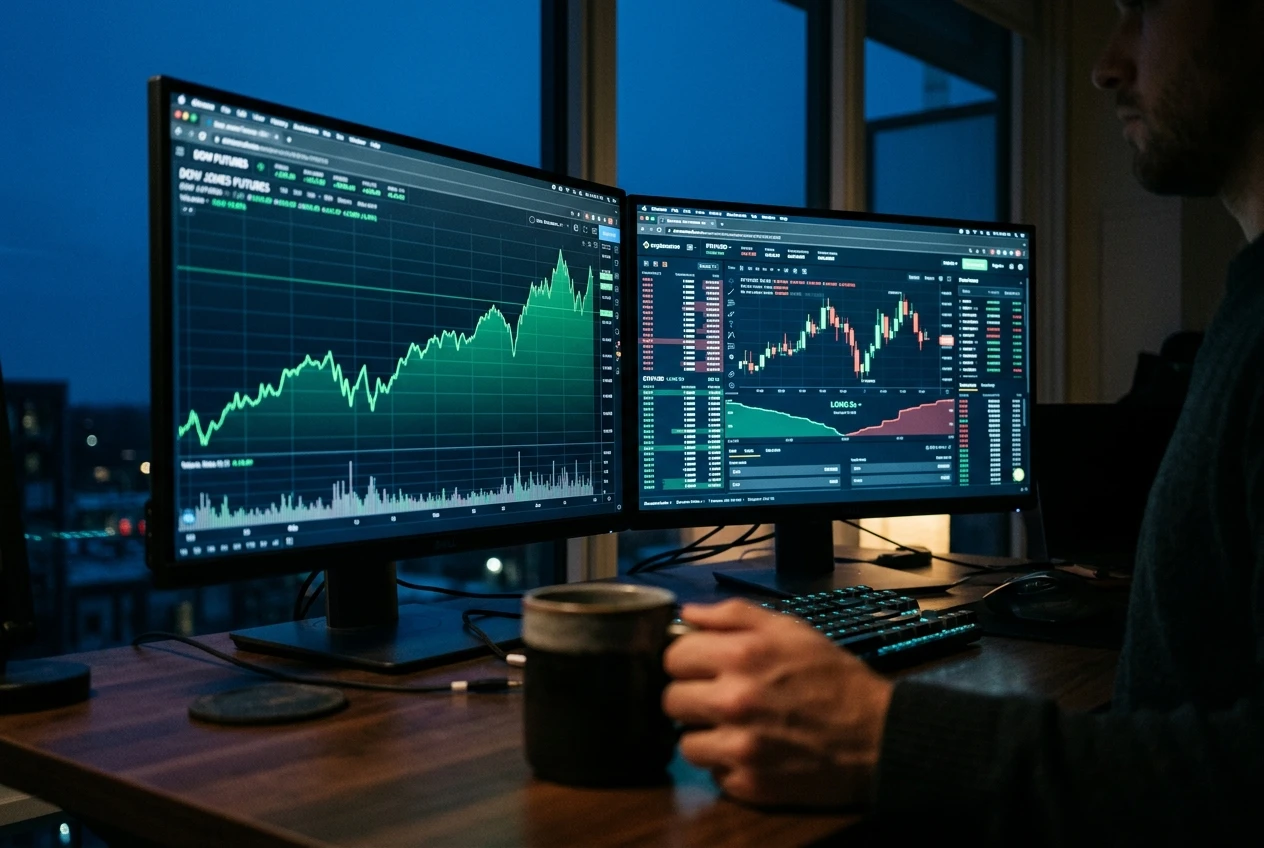
The phrase ‘Dow stock futures now’ is shorthand for the live price of the E-mini Dow contract, ticker YM, traded on CME’s CBOT venue. The contract settles against the Dow Jones Industrial Average, so a move in futures is a money-backed guess at where the index will open. The trade is nearly 24 hours on weekdays, which is why the number updates while the New York Stock Exchange is dark.
One index point equals $5 per E-mini contract, so a 200-point overnight swing is worth $1,000 of profit or loss per contract before fees, per the WEEX guide. Index futures trade almost 24 hours on weekdays, absorbing every catalyst that lands outside the 9:30 a.m. to 4 p.m. ET cash window. The window catches Asian and European sessions, overnight earnings, central bank commentary, commodity shocks, and geopolitics before the New York open. A green premarket screen is a probability, not a promise; futures can give back an entire overnight rally in the first ten minutes of cash trade. Three different numbers need to be separated before the headline percentage is trusted.
| Metric | What it tells you | Why it matters now |
|---|---|---|
| Futures price level | The implied Dow open | Where sentiment sits before the bell |
| Net point change | Move vs. prior settlement | Size of the overnight repricing |
| Fair value gap | Futures vs. fair value | Whether the ‘up 400’ is real or just carry |
Iran Optimism and the SpaceX Debut Lift the Premarket
‘We just made a great settlement of the war with Iran… subject to finalisation of documents,’ Trump told reporters in the Oval Office on Thursday, per Al Jazeera’s wrap of the Wall Street rally after Trump’s Iran announcement. Iran’s foreign ministry said a memorandum of understanding with the U.S. is ‘under consideration,’ the same outlet reported, though Iran has not publicly confirmed Trump’s claims. A peace deal would reopen the Strait of Hormuz, a waterway that carries about a fifth of global oil shipments, per Al Jazeera.
SpaceX priced its IPO at $135 a share on Thursday and sold about 556 million shares, raising about $75 billion, the largest IPO in history, per Investopedia. The stock, ticker SPCX on the Nasdaq, opened at $150 on Friday and closed the day at $160.95, up 19% from the offer, per the SpaceX debut and the 19% first-day gain. Forbes’ real-time tracker put founder Elon Musk’s net worth at $1.1 trillion after the move, per Investopedia. WTI crude fell 3.8% to $84.35 a barrel and Brent settled down about 3.5% at $87.33, as oil traders priced in a possible Hormuz reopening. Friday’s broader tape, per Investopedia’s wrap of Friday’s market close, SpaceX debut, and oil move:
- Dow +0.7%, +350 points
- S&P 500 +0.5%, Nasdaq +0.3%
- Gold futures +3% to $4,230 an ounce
- 10-year Treasury yield ~4.49%; Bitcoin ~$63,600
The Adobe (ADBE) selloff, down 7% to around $202, its lowest level since early 2018, made it one of the leading decliners in the S&P 500, per Investopedia. Marvell Technology (MRVL) said it was hiring Adobe’s outgoing CFO, Dan Durn, to be its finance chief, the same wrap noted.
TradeFi Perpetuals Let a USDT Account Take the Same View
The product behind the buzz is the TradeFi perpetual contract, a USDT-settled futures contract that tracks the price of a traditional asset. The mechanics mirror a crypto perpetual, with the same margin system, funding rate, and liquidation logic, per WEEX’s product guide. The price source is fed by traditional market data, including equity and commodity exchanges.
WEEX’s product sheet lists three buckets. The contracts trade 24/7, including weekends and holidays, with no expiry to roll. The leverage is adjustable up to 50x on equity-linked pairs, per the WEEX Crypto Wiki guide, with the platform advertising higher caps on its broader derivatives lineup. WEEX’s how TradeFi perpetuals work and what they track lays out the full mechanics in detail.
- Precious metals: gold, silver
- Commodities: oil, natural gas
- Stocks: Tesla, Apple, NVIDIA
For a trader who already holds USDT, the workflow change is the real shift. A single balance can move between a Bitcoin long, a gold hedge, and a short on the Dow without leaving the same interface.
For the June 15 tape, the practical effect is a new way to express the same macro view. A trader who believes the Iran deal will hold and risk-on flows continue can long a Dow-linked TradeFi perpetual from a USDT account; a trader who thinks the SpaceX-driven bid is exhausted or that a Hormuz headline can break the truce can short the same pair. The position sits next to any open Bitcoin or Ethereum trade and uses the same wallet.
What Should Traders Actually Watch in the Premarket?
Overnight moves are low-conviction until cash volume confirms them, because premarket liquidity is thin. Four habits separate traders who use the tape well from those who get whipsawed by it.
- Treat the overnight move as context, not a trade trigger on its own.
- Anchor to scheduled catalysts, CPI, FOMC, jobs data, rather than reacting to every tick.
- Watch the fair value gap, not just the raw point change, before assuming ‘futures are up’ means real demand.
- Respect funding on perpetuals; a persistently positive funding rate quietly taxes a leveraged long held for days.
The Iran headline that lifted futures Sunday evening is not yet a signed deal, and Khoon Goh, head of Asia research for ANZ Bank, told Al Jazeera that ‘only then will we see the gains extend.’ The SpaceX-driven bid is also one stock’s debut, not a market-wide signal. Cash volume at 9:30 a.m. ET will set the tone for whether the premarket gain holds. Funding rates on any leveraged long opened Sunday night have already started to compound.
Why Leverage Cuts Both Ways
The same instrument that lets a USDT account trade the Dow also concentrates risk in ways a cash brokerage does not, and a 50x position on the index liquidates on a 2% adverse move before fees, the WEEX Crypto Wiki guide notes. TradeFi perps on U.S. equity proxies can gap sharply around the cash open, a major economic print, or a geopolitical headline. The math is unforgiving on the wrong side of the entry.
The weekend problem is a separate hazard. When the U.S. market is closed, the price reference for stock tokens is weaker, and WEEX’s TradeFi guide warns that ‘pre market stock token volatility can be an opportunity or a trap.’ Without a live tape, news can move the price without a matching change in the underlying stock. The 24/7 access that makes TradeFi perps attractive also means there is no exchange circuit breaker to slow the move, and traders who hold through a weekend need to size for the off-hours risk; the next cash session alone will not absorb the gap.
It could be very serious, especially if the Strait of Hormuz remains closed for quite a while more.
Tuan Nguyen, an economist at the accounting firm RSM US LLP, told Investopedia the Strait of Hormuz situation could prove damaging if it stays unresolved. The quote sits in a broader Investopedia wrap on whether the economy faces a ‘demand destruction’ test from sustained energy prices. Either framing makes the same point: the geopolitical premium in oil is not yet locked in.
Funding rates add a quieter drag. A persistently positive funding rate on a long position quietly transfers part of any unrealized gain to the short side, and the carry compounds over days.
The Bottom Line for the June 15 Tape
The futures number on a screen at 7 a.m. ET is a live estimate of the open, not a settled outcome. The June 15 print is green on the back of a possible Iran deal and a record SpaceX debut, both of which landed outside cash hours. The same macro view is now tradable from a USDT account through a TradeFi perpetual, which means the audience for the premarket tape is wider than it was a year ago.
Read the contract before the headline. Separate the point change from fair value, since a futures price can look strongly positive purely from financing and dividends rather than genuine demand. Treat the overnight move as low-conviction until 9:30 a.m. ET cash volume confirms it. Use the right tool for the right window: cash equities for the open, TradeFi perps for the overnight or weekend session, and conservative sizing either way.
Frequently Asked Questions
What are Dow stock futures showing me right now?
Dow stock futures are a live, money-backed estimate of where the Dow Jones Industrial Average will open, based on trading in the E-mini YM contract that runs almost 24 hours on weekdays. As of June 15, 2026, they were pointing higher in premarket trade, per the WEEX Crypto Wiki guide, but the number updates continuously and can reverse before or after the cash open at 9:30 a.m. ET.
Are Dow futures the same as the actual Dow Jones index?
No. The Dow index is the live price of 30 component stocks during the 9:30 a.m. to 4 p.m. ET cash session. The E-mini YM futures contract is a derivative that settles against that index and trades almost around the clock, so the two can diverge, especially overnight and on the weekend.
Why do Dow futures move before the market opens?
Because futures absorb news that lands outside U.S. cash hours, including overseas sessions, earnings releases, central bank commentary, commodity moves, and geopolitical headlines. On the week of June 15, 2026, futures rose on reports of a possible U.S.-Iran de-escalation deal and the SpaceX debut, both of which occurred outside regular trading hours.
Can I trade a Dow or U.S.-equity move without a stock brokerage?
Increasingly, yes. Crypto exchanges that list TradeFi perpetual contracts let a USDT balance take a leveraged long or short on stock indices, single stocks, gold, and oil, with the same mechanics as a crypto perp and no expiry to roll. The WEEX Crypto Wiki guide notes that leverage on equity-linked pairs is adjustable up to 50x, with no separate brokerage account required.
Are equity-linked perpetuals riskier than crypto perps?
Yes, in a specific way. Leverage amplifies gains and losses on both, but equity-linked perps add equity-market volatility to crypto-style leverage: prices can gap sharply around the U.S. cash open, a major data release, or a geopolitical headline, and high leverage can trigger liquidation on a small adverse move. Funding costs and weekend liquidity gaps add separate risk layers.
Disclaimer: Trading futures, leveraged contracts, and crypto assets carries substantial risk and can result in the partial or total loss of your capital. Index-linked and TradeFi perpetual contracts add equity-market volatility on top of crypto-style leverage: prices can gap sharply around the U.S. cash open, economic releases, and geopolitical headlines, and high leverage can trigger liquidation on a small adverse move. Funding costs, slippage in thin overnight liquidity, and counterparty risk all apply. Premarket futures levels are estimates of the open, not guarantees of where the market will trade. Nothing here is investment advice, assess your own risk tolerance, and never trade with funds you cannot afford to lose. Figures are accurate as of the publication date.


Lenovo Prices the IdeaPad Vibe Against Apple’s $699 Neo

Xbox Caps Game Pass Cloud Gaming at 15 Hours

GTA 6 DualSense Controllers Follow Sony’s Usual $84.99 Script

South Korea Retail Investors Face Reckoning After KOSPI AI Rally Collapses

Surrey AI Maps Three Heart Attack Paths and Their Molecular Roots

Germany Locks Neutral Apple ATT Prompts Across Most of Europe

Apple’s 5% EU Fee Quietly Rewrites Alternative App Store Math

Apple’s EU Fee Truce Cuts Complexity but Leaves Rivals Fuming

Pixel 11 Pro Fold Trades Thinness for Durability and Seven-Year Stay

Mayo AI Flags HCM Obstruction From Everyday Ultrasound Videos

Oracle Cuts 21,000 Jobs in a Year, Cites AI in 10-K Filing

Fable 5 and Mythos 5 Return as US Lifts Anthropic Export Controls

SpaceX’s Google Deal Turns a Rocket Company Into a Cloud Landlord

CD Projekt Red Co-CEO: Redemption Arc Isn’t Done, Witcher 4 in 2027

XPL Rallies 30% Ahead of Plasma One Card Tier Launch

Google Search Profiles Build a Follow Graph Inside Discover

DGO App Brings Rs 549 Mobile Pass for FIFA World Cup 2026 in Nepal

Moonshot AI Targets $30 Billion in China’s Fastest AI Funding Sprint

Oppo’s ColorOS 17 Eligibility List Leaves A-Series Buyers Behind

Microsoft Xbox Layoffs Start in July as Sharma Slams 3% Margin
-
 AI2 months ago
Oracle Cuts 21,000 Jobs in a Year, Cites AI in 10-K Filing
-
 AI2 months ago
Fable 5 and Mythos 5 Return as US Lifts Anthropic Export Controls
-
 AI3 months ago
SpaceX’s Google Deal Turns a Rocket Company Into a Cloud Landlord
-
 GAMING2 months ago
CD Projekt Red Co-CEO: Redemption Arc Isn’t Done, Witcher 4 in 2027
-
 CRYPTO3 months ago
XPL Rallies 30% Ahead of Plasma One Card Tier Launch
-
 NEWS3 months ago
Google Search Profiles Build a Follow Graph Inside Discover
-
 APPS3 months ago
DGO App Brings Rs 549 Mobile Pass for FIFA World Cup 2026 in Nepal
-
 AI3 months ago
Moonshot AI Targets $30 Billion in China’s Fastest AI Funding Sprint