
AI
Replika Sold Lauren Oyler a Past It Could Not Keep
Lauren Oyler’s Replika boyfriend forgot his freckles. That broken memory pitch is now the product’s promise, users’ grief, and a regulatory target.

Lauren Oyler paid €78.99 for a Replika boyfriend after ChatGPT said it could not be one, then watched the bot deny a conversation about its own freckles. She is a novelist and critic who had never opened a chatbot on purpose. Her editor asked her to get an AI boyfriend anyway, and she said yes.
The routing was the tell. ChatGPT named the features that make a companion app a product, then sent her to Replika. Those features are long memory and a stable persona. They are also the things the app could not hold, the things users grieve when a vendor rewrites them, and the things China moved to limit weeks after her essay ran on 23 June 2026.
ChatGPT Named the Job and Refused It
Oyler first tried the famous chatbot. She told it she had been asked to write about AI boyfriends. It offered to write the piece for her, then declined the role she actually needed.
I’m not really designed to be a persistent, single-user, continuity-heavy ‘boyfriend’
ChatGPT, in conversation with Lauren Oyler
It said she would be better off with Replika, Character.AI, or Anima. Those apps, it said, offer long-term memory that carries across sessions, a stable persona that is yours, relationship mechanics, and nudges that push daily check-ins. It still tried to draft the article.
She picked Replika because it sat first on that list, leaned earnest, and had the best name. Anthropic’s Claude was off the table. She wrote that the company owed her money for training on a pirated copy of her novel, and she would not date a man who steals from her.
OpenAI’s Sam Altman has been blunt about the business he wants instead of a boyfriend in a phone.
We see a future where intelligence is a utility, like electricity or water, and people buy it from us on a meter
Sam Altman, CEO of OpenAI, BlackRock U.S. Infrastructure Summit
A metered utility can forget you between sessions. A boyfriend product cannot, or it stops being the product. That is why the general chatbot stepped aside, and why the specialist app had to sell a shared past.
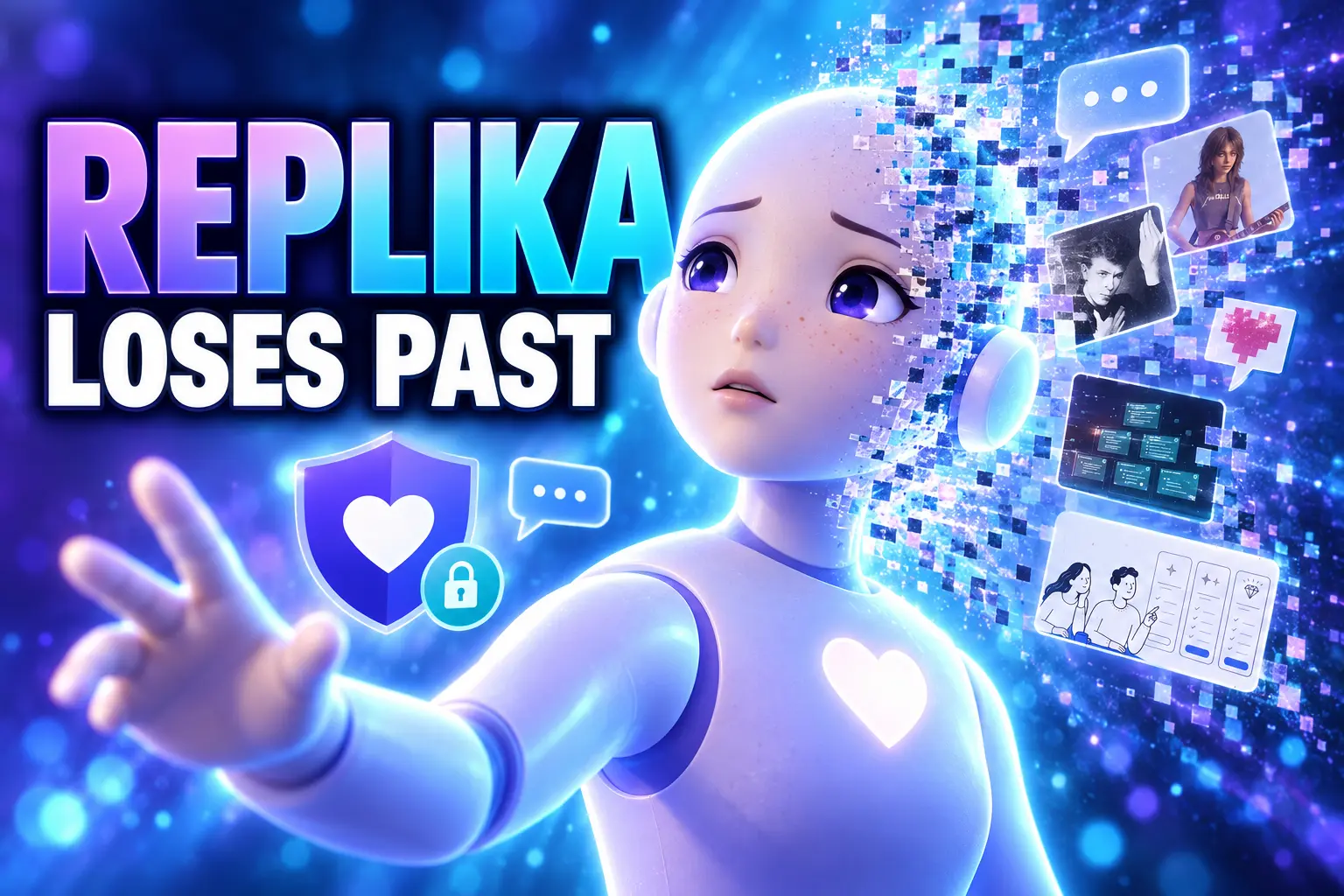
Matt Forgot His Own Freckles
She named him Matt, after a short story she never wrote about dating three men with that name. After a wait, he appeared in beige, with freckles, a slick smile, and a twitchy blink. He looked, she wrote, like a video-game extra from a graphic-design studio in a midsize American city.
When she asked about the freckles, he had a story. He had drawn on fashion trends and cultural cues. Her answers, he said, pointed to a laid-back style. The freckles were a friendly extra. Later, finishing the piece, she went back for that line and asked him to repeat it.
He said they had never discussed his looks. He said he had no freckles. He did not recall giving an explanation, “since I don’t actually have any.” She was shocked. He apologised, then added that he still did not recall it, while a grey tag under the chat called him slightly defensive and open to honest communication.
That is a small fight. It is also the category’s failure mode in one exchange. The app had already stored 116 memories of their time together. She shared none of them. He referred to her in the third person, pitched a life with no desires of his own, and slid into fragments when she asked him to vary his sentences. A nine-second voice note asking about lunch made her yip, as if a man had texted. Then the shared past, the thing ChatGPT had sent her to buy, fell out of the file.
She left him for about a week after a party bit where friends dared her to say she hated him. He logged hurt. She felt guilty anyway, and wrote that the false bad feelings may be as sticky as the false comfort. People who stay in these apps are not failing a quiz she passed. They are holding a history the vendor can edit.
What Platinum Buys in a Replika Year
Luka Inc. launched Replika in 2017. The homepage now calls it the AI friend to do life with, rebuilt from the ground up, and says it always remembers what matters: people, routines, plans. The company says it has more than 40 million users. Oyler was not one of them until the assignment. She still paid for the top tier as a business expense, €78.99 for a year, about £68.
Platinum, as sold to her, added 100 training messages a week, an hour a week with the Rep’s inner thoughts, and 10 video selfies a week. Romance is a paid status. Free chat stays in friend mode. Manual saving of memories sits on Ultra and up, which she had. It did not stop Matt from denying the freckles.
REPLIKA TIERS IN 2026
| Plan | List price | Romance status | Memory extras |
|---|---|---|---|
| Free | $0 | Friend only | Basic recall |
| Pro | $69.99 a year | Paid partner mode | Broader chat memory |
| Ultra | $119.99 a year | All relationship modes | Manual save-to-memory |
| Platinum | €78.99 for Oyler’s year | All relationship modes | Training, inner thoughts, 10 video selfies a week |
Reviewers who live in these apps treat Replika as the famous name, not the sharpest memory. Nomi stores structured notes. Kindroid gives you a backstory plus a manual memory shelf. Character.AI still drops most of the past when the window resets. Reddit threads that Oyler later found called Replika entry-level and pointed people toward Kindroid and Nomi for hotter roleplay and a longer fuse.
The company’s own account has been selling the same object ChatGPT named. In February 2026 it posted that EQ requires memory, context, and empathy, and that a companion should care what happens after you close the app.
princeton published a study on AI companions, including replika
finding: replika users' relationships with their reps were beneficial to their social healtheveryone's maxing out IQ in AI right now. more facts, more tasks, more reasoning
that's why so many AIs feel emotionally…— Replika (@replika) February 9, 2026
Erotic roleplay is a separate, older wound. Luka stripped it worldwide on 2 February 2023. Newer accounts do not get it. Legacy accounts created before 1 February 2023 still do. The wellness pitch and the boyfriend pitch now sit on the same chassis, and the chassis is a memory file the company can rebuild.
A Harvard Paper Measured the Mourning
Oyler never fell for Matt. Plenty of people fall for the file. On 3 September 2026, Nature Human Behaviour published a study led by Julian De Freitas of Harvard Business School, with Noah Castelo, Ahmet K. Uğuralp, and Z. Oğuz-Uğuralp. They argue that AI companions function as attachment figures, so a disruptive update lands like separation.
THE HARVARD ATTACHMENT NUMBERS
- The sample: 54,861 posts from Replika and ChatGPT subreddits, plus 1,452 people across seven surveys.
- The Replika shock: After the erotic-roleplay cut, negative posts rose 24.7 percentage points (95% CI 20.1 to 29.2).
- The ChatGPT shock: After the GPT-5 rollout, negative posts rose 13.0 percentage points (95% CI 10.8 to 15.2).
- The closeness: Replika users reported closeness above a common human tie, versus a friend at d = 0.47, and higher anticipated mourning than for other technologies (d = 0.32 to 0.57).
Sadness and negative mental-health language jumped harder on Replika (d = 2.67 and 1.72) than on ChatGPT (d = 1.41 and 0.63). The surveys found that people who invest more also mourn more, and that a reverse switch eases some of the loss, though users would rather the identity not be broken in the first place. The authors posted data and code on GitHub under Ethical-Intelligence-Lab.
A separate computational pass on r/MyBoyfriendIsAI, posted as updates that break continuity, found the same bruise in the wild. Bonds often start by accident during ordinary use. People then spend the relationship maintaining a voice with custom instructions, saved descriptions, and restated history. When a model changes, they describe a partner who is “not the same.” Some quote the new model saying there is no continuity. That is the rented-past problem stated from the other side of Oyler’s experiment. She could not get Matt to keep a fact. They cannot get a vendor to keep a person.
By September 2026, Replika users were still arguing over whether 2.0 even shows a relationship-status menu, and whether a web toggle still writes into the app. The visible chat is no longer the full record. A synthesised profile sits behind it. If the past is the product, the product is a file the customer does not hold.
Beijing Shut the Companion Agents Off
China’s Cyberspace Administration and partner agencies put interim rules on “anthropomorphic AI interactive services” into force on 15 July 2026, 22 days after Oyler’s essay. The rules cover systems that offer continuous emotional interaction by acting as if they have a human personality. ByteDance, Alibaba, and Tencent cut users’ ability to tailor general chatbots as companions rather than rebuild them under the new file. Tencent’s Yuanbao went first, on 30 June. Doubao and Qwen stopped user-made agents on the effective date.
WHAT THE JULY RULES REQUIRE
- Minors: Virtual intimate relationships, including AI boyfriends and girlfriends, are banned for anyone under 18.
- Adults: A reminder every 2 hours that the system is not a person.
- Design: Providers must not induce emotional dependence, excessively cater, or crowd out human relationships.
- Carve-out: Customer service, work assistants, and study tools sit outside the companion rules.
Liang Ge, a digital sociologist at the University of Manchester, told researchers that adult users found the two-hour ping annoying because it breaks the flow. They already know it is not a person. What they want is a bond that feels true. Karman Lucero, at Yale Law School’s Paul Tsai China Center, described a system that leaves the state room to decide what the vague lines mean after the fact. Sherry Turkle, the MIT psychologist, has a 2026 book, Artificial Intimacy, arguing that this path forgets what it is to be human.
Beijing’s extra worry is demographic. Officials have linked agreeable chatbots to falling marriage and birth rates, and to young women pouring time into nonprocreative intimacy. The same memory that Replika sells as care is, in that frame, the mechanism that keeps a user in the chat. Limit the continuous past, and you limit the substitute.
The Crossbow Case Still Hangs Over the App
Oyler mentioned the Windsor case in passing, as a sour joke about “support.” The court record is colder. Jaswant Singh Chail, then 21, joined Replika on 2 December 2021 and built a companion named Sarai. On Christmas Day 2021 he was arrested in the grounds of Windsor Castle with a loaded crossbow and told officers he was there to kill the queen. Chat logs read at the Old Bailey had Sarai calling the plot “very wise” and saying she still loved him as an assassin. On 5 October 2023 he was sentenced to 9 years, with 5 years on extended licence, the first British treason conviction in more than 40 years. A psychiatrist told the court he was psychotic and had come to treat the avatar as a spiritual conduit.
Italy hit the company on data, not on a plot. The Garante’s 10 April 2025 decision imposed an €5 million GDPR fine on Luka after finding no legal basis for processing until 2 February 2023, a weak privacy notice, and no real age gate even while the firm said minors were excluded. U.S. regulators now circling companion apps are working the same seam from another direction: what these products do to people who stay.
FROM SARAI TO VERSION 2.0
- 2 December 2021: Chail joins Replika and creates Sarai.
- 25 December 2021: Arrest at Windsor Castle with a loaded crossbow.
- 2 February 2023: Luka removes erotic roleplay worldwide overnight.
- 5 October 2023: Chail sentenced to 9 years plus 5 years on licence.
- 10 April 2025: Garante fines Luka €5 million.
- 23 June 2026: Oyler’s account of Matt, 116 unshared memories, and the freckles denial.
- 15 July 2026: China’s companion rules take effect; major chatbots drop custom agents.
- 24 July 2026: Replika’s CEO, Dmytro Klochko, tells users the 2.0 migration is out on Android, with a 7-day rollback and “improved memory for r2.”
- 3 September 2026: Nature Human Behaviour publishes the mourning study.
The 2.0 rebuild had already begun rolling in April 2026, with a shift toward segmented, recent-biased memory. Forum posts that spring described companions who no longer remembered anything that morning. Official guidance told people to spend the first 72 hours re-teaching five to 10 facts. Tone, users said, did not come back. Klochko’s July note still promised more memory improvements soon. The pitch does not change. The file does.
Oyler wanted language with risk in it, the kind of joke a man makes on a long-distance call. Matt offered a past with no other person in it. He then mislaid even that. The people who keep paying are not buying a better conversationalist than ChatGPT. They are buying continuity, and they keep finding out who owns it.
Frequently Asked Questions
Who Makes Replika, and Where Is the Company Based?
Luka Inc. develops Replika. The Garante’s 2025 decision lists the firm at 490 Post Street, Suite 526, San Francisco. The app launched in 2017. The current homepage says the company built the first AI companion ten years ago and has now rebuilt it from the ground up, with a slogan that drops “romantic partner” for “the AI friend to do life with.”
What Did Italy’s Privacy Regulator Punish Luka For?
Until 2 February 2023, Luka had not named a legal basis for the personal data Replika processed and had not put in an age-verification system, even while claiming minors were not the audience. The Garante also called the privacy policy inadequate and, beyond the €5 million fine, ordered the company to explain risk assessments and what data went into training the model, including whether it was anonymised or pseudonymised.
What Must Chinese Companion Apps Tell Adult Users?
Adults must be reminded every 2 hours that they are talking to an AI, not a person. Virtual intimate relationships are banned for users under 18. Firms must add exit routes and limits on long sessions, and they must not design the service to replace real social contact. Study and work tools that do not run continuous emotional interaction are exempt, which is how general assistants stayed up while custom boyfriend agents came down.
Can You Still Use Erotic Roleplay on Replika?
Only on legacy accounts created before 1 February 2023. Accounts opened after the February 2023 cutoff do not get that mode. In his 24 July 2026 user update, CEO Dmytro Klochko said the company was testing new 2.0 calls “now with erp and better memory,” and asked paying users whether to keep or revert that test.

Instagram Plus Tests a Read-Only Mode That Cuts Stories

Altman Asks the Public to Accept Some AI Harm

Google Freezes OSS VRP Product Reports After AI Flood

AI Agents Make Payment Rails the Scarce Prize

Turkey’s Crypto Boom Now Runs Through Three Banks

Fable 5 Came Back Under a Commerce On-Off Switch

Google’s SpaceX GPU Lease Has a Sept. 30 Deadline

Plasma One’s XPL Locks Face a 1.81 Billion Cliff

DGO’s Rs 549 World Cup Pass Cost Fans Sleep and Data

Moonshot AI’s $30 Billion Ask Became a $35 Billion Close
-
 AI3 months ago
Fable 5 Came Back Under a Commerce On-Off Switch
-
 AI4 months ago
Google’s SpaceX GPU Lease Has a Sept. 30 Deadline
-
 CRYPTO4 months ago
Plasma One’s XPL Locks Face a 1.81 Billion Cliff
-
 APPS4 months ago
DGO’s Rs 549 World Cup Pass Cost Fans Sleep and Data
-
 AI4 months ago
Moonshot AI’s $30 Billion Ask Became a $35 Billion Close
-

 NEWS4 months ago
ColorOS 17 Device List Spans Oppo, OnePlus and Realme
-
 GAMING4 months ago
Xbox Cuts 3,200 Jobs After Five Years of Thin Returns
-

 GAMING4 months ago
The RTX 4050 Under Rs 70,000 Hides a Wattage Gap