
NEWS
IBM Wraps OpenAI Cyber Models Around a $5 Billion Patch Factory
IBM joined OpenAI’s Daybreak program and launched an app-security service, while Lightwell sells signed open-source patches through consultants.

IBM on June 22 joined OpenAI’s Daybreak Cyber Partner Program and launched an application security service that runs inside client codebases through IBM Consulting. Shares rose 3.6% after the bell.
The models stay on IBM’s delivery platform. What customers pull down is a catalog of signed open-source fixes from Project Lightwell, the IBM and Red Hat program that went on sale in July.
IBM Puts OpenAI Inside a Consulting Harness
The June service is sold as managed work, not a scanner a security team runs on its own. IBM Consulting Advantage, the firm’s AI platform for client work, hooks a company’s application environment to OpenAI cyber models in what IBM calls a security harness. The hook is read-only access to code repositories, plus bounded execution, so the models can inspect software without permission to change it.
Clients can start with a review of a few applications, then move to continuous monitoring as the code changes. IBM says the analysis goes past pattern matching: it ranks the paths most likely to be exploitable, then tries to prove the flaw can be used. Jayesh Kamat, IBM’s global competency leader for application security, said on the company’s Security Intelligence podcast that the models look for chained flaws across pieces of code, and that the harness can send them to prove those flaws can be exploited.
Attackers are already using AI to probe, exploit, and scale threats at machine speed. Defenders need the same advantage, with the security and control enterprises require.
Mark Hughes, Global Managing Partner, Cybersecurity Services, IBM Consulting, June 22 announcement
Hughes said Daybreak widens IBM’s set of advanced models, which the firm deploys inside client environments to surface the risks that matter faster. Dane Stuckey, OpenAI’s chief information security officer, said the program is how OpenAI works with firms such as IBM to speed defensive workflows for companies and governments while keeping the controls those environments require. The service was available from June 22, with more Daybreak hooks planned.
A $5 Billion Clearinghouse for Open Source Code
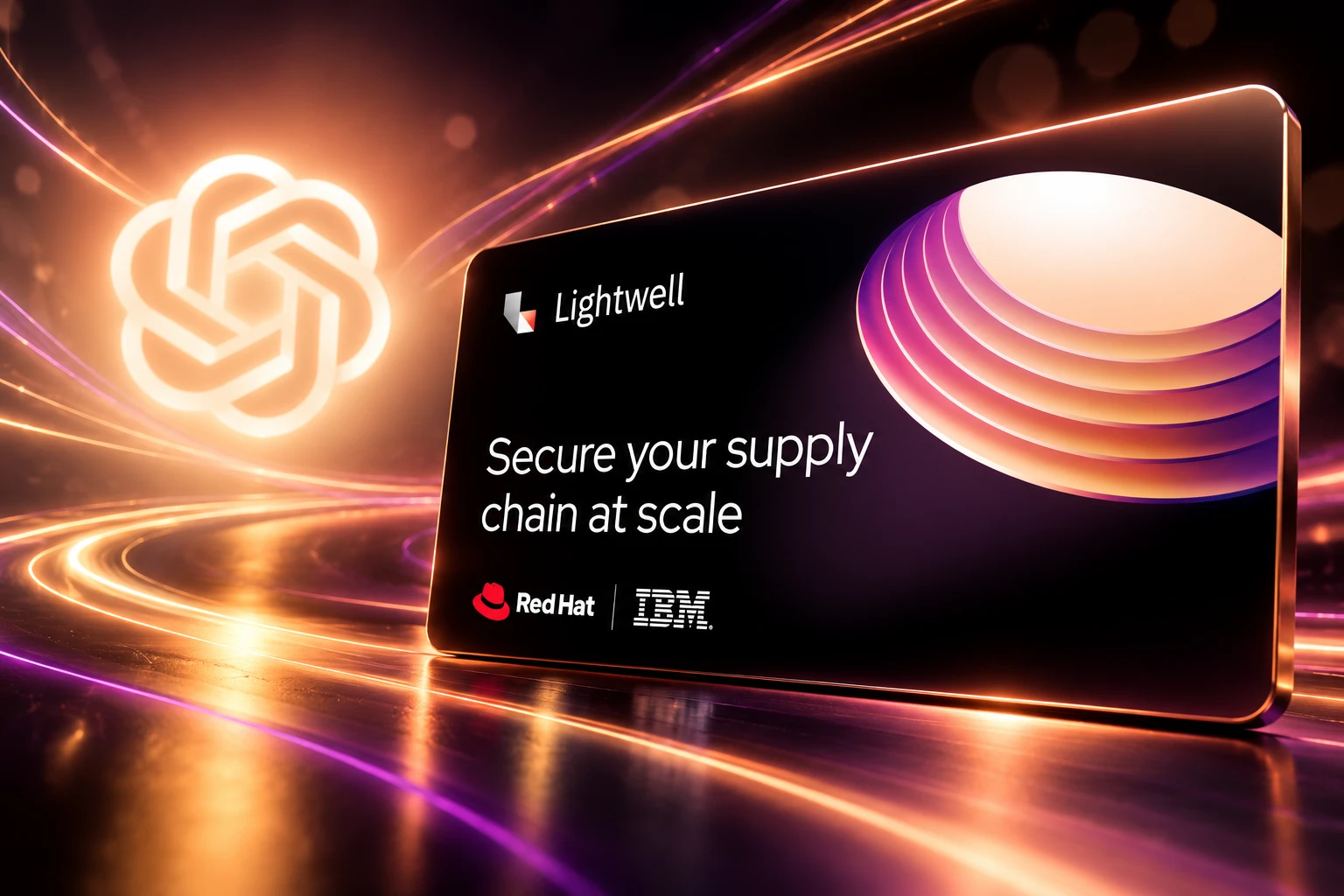
The OpenAI badge arrived 25 days after a much larger bet. On May 28, IBM and Red Hat announced Project Lightwell, a $5 billion commitment and 20,000 engineers to build a trusted enterprise clearinghouse for open-source software. The pitch is a security coordination layer: companies report flaws under a trusted intermediary, get patches built for the versions they already run, and send fixes upstream so communities can take them into long-term maintenance.
IBM already uses more than 62,000 open-source packages and claims deep expertise in over 10,000, spanning Linux, Java, Kubernetes, Kafka, Ansible, Terraform, Flink and Cassandra. Red Hat’s May note said more than 90% of Fortune 500 companies rely on open source, citing Worldmetrics, and that Anthropic’s Mythos Preview model had found nearly 3,900 high- or critical-severity flaws in open-source software. Lightwell, the companies said, also draws on Anthropic’s Project Glasswing and OpenAI’s Trust Access for Cyber, so the June Daybreak join sits on top of a multi-lab stack rather than a single exclusive deal.
HOW LIGHTWELL MOVED FROM PLEDGE TO PRODUCT
- May 28, 2026: IBM and Red Hat announce Project Lightwell with a $5 billion commitment and more than 20,000 engineers, and name 11 financial early adopters.
- June 22, 2026: IBM joins OpenAI Daybreak and launches the managed application security service on IBM Consulting Advantage.
- June 24, 2026: IBM, Red Hat and Palo Alto Networks tie Lightwell remediation to network-level virtual patching.
- July 8, 2026: Lightwell Network goes generally available and Clearinghouse Premier enters limited commercial onboarding.
- August 4, 2026: IBM and Red Hat offer Lightwell at no charge to selected U.S. universities, NGOs and think tanks.
- September 2, 2026: Red Hat says Lightwell remediations will flow into JFrog Artifactory pipelines.
- September 11, 2026: LTM starts a dedicated practice to land Lightwell fixes in customer environments.
Arvind Krishna, IBM’s chairman and CEO, called open source the backbone of the digital economy and the foundation of modern AI, and said Lightwell is meant to secure that software at its source and across the supply chain.
Lightwell Network Opens With 6,500 Signed Fixes
Finding a flaw does not close it. On July 8 IBM and Red Hat put Lightwell on sale as two SKUs, built around an AI remediation engine they said was already running, mixing frontier and open models with human engineers. The commercial move is the second-order turn: Daybreak helps IBM prove a bug; Lightwell sells the package a build pipeline can ingest.
The launch catalog is 6,500+ remediated, digitally signed packages across major ecosystems, including Java and Python. Members get a stream of signed binaries, source, and compliance artifacts, including full software bills of materials, pushed into existing pipelines. The companies said they expect that catalog to grow from thousands of packages toward millions. They also said open source can make up as much as 90% of enterprise codebases, drove 9.8 trillion downloads in 2025, and that $50 AI-generated exploits have left codebases with an average of 581 vulnerabilities.
THE TWO LIGHTWELL SKUS
| Offering | Status on July 8 | What it delivers | Who it is for |
|---|---|---|---|
| Lightwell Network | Generally available | 6,500+ remediated, digitally signed, certified application-layer dependencies, plus SBOMs and signed binaries, including current and legacy libraries | Enterprises that want fixes in existing pipelines without a major upgrade |
| Lightwell Clearinghouse Premier | Limited commercial onboarding | Trusted intermediary for patch embargoes, vertical threat coordination, and targeted version remediation | First gated to financial services; later planned for government, healthcare and telecom |
The engineering trick is backporting. Lightwell aims to drop critical fixes onto the long-lived production versions companies already run, so teams are not forced into a major upstream upgrade that triggers months of regression tests. Matt Hicks, Red Hat’s president and CEO, called that a structural shift in how enterprise software is secured. Rob Thomas, IBM’s senior vice president of software and chief commercial officer, said firms get certified fixes they can pull into systems they already run, with no retooling.
Who Gets Paid to Land the Patches?
IBM’s clearinghouse writes and signs the fix. Someone still has to map a software bill of materials, pick a version, test it, and push it through a change window. That labor is the consulting product, and it is why systems integrators began staffing Lightwell practices after the July launch.
On June 24, IBM, Red Hat and Palo Alto Networks said they would pair Lightwell software fixes with Palo Alto virtual patching at the network layer, so a shop can block an exploit while the code fix is still in test. On September 2, Red Hat said Lightwell insights would flow into JFrog Artifactory with an audit trail, as part of JFrog’s Zero-Touch Remediation work. On September 10, IBM News said LTM, IBM and Red Hat were working to address vulnerabilities at scale through Lightwell. LTM, the Larsen & Toubro services firm formerly known as LTIMindtree, is building a practice around strategy, dependency analysis, risk ranking, DevSecOps integration, testing and large-scale rollout. IBM’s clearinghouse produces the validated patch; LTM’s job is getting it into the customer’s estate.
Finding vulnerabilities is only the first step.
Through Lightwell, @ltm_ofcl, @IBM and @RedHat are helping enterprises address vulnerability at scale, enabling rapid risk mitigation for stronger software supply chains and greater resilience.
Learn more about this collaboration… pic.twitter.com/6k78z2DFHu
— IBM News (@IBMNews) September 10, 2026
WHERE THE MONEY SITS AFTER THE SCAN
- IBM and Red Hat: They run the catalog, the 20,000-engineer bench, and the subscription that delivers signed packages.
- IBM Consulting: It sells the Daybreak-powered application security harness and, with Red Hat Consulting, the work to prepare a firm for Lightwell.
- Delivery partners: Accenture, Atos, Cognizant, Deloitte, EY, HCLTech, Infosys, Kyndryl, LTM, NTT DATA, Tata Consultancy Services and Tech Mahindra were named in July to map SBOMs, ingest registries and ready pipelines.
- Pipeline and network vendors: JFrog wants the signed fix in Artifactory; Palo Alto Networks sells the temporary network shield while the code catch-up runs.
Independent maintainers are not on that invoice. Lightwell staffs IBM and Red Hat engineers, then says it submits fixes back under Red Hat’s upstream-always model so commercial protection and community health reinforce each other. The cash still lands on the firms that certify, subscribe and deploy, not on the original authors of the library.
Daybreak Leaves the Models With IBM
OpenAI’s August 10 expansion of Daybreak makes the wrapper explicit. Approved partners can bring frontier cyber models into products, managed services and client work. They get Daybreak Blue for a broad set of defensive workflows, or Daybreak Red for more tightly governed red-team and penetration-test jobs. Access stays with the approved partner and is not transferred directly to the customer. Partners set the scope, review findings, and apply their own expertise before anything is acted on.
That is why the June IBM deal is a services story. A bank does not receive OpenAI’s first critical cyber model as a tool it operates. It receives IBM people, IBM’s harness, and, if it buys Lightwell, a signed package. Hughes later told OpenAI that combining the lab’s cyber models with IBM Autonomous Security helps firms find and rank the flaws that matter, and that Lightwell then speeds trusted remediation across open-source supply chains.
IBM is also not the only wrapper. OpenAI’s partner roster includes Accenture, Capgemini, Cognizant, EY, KPMG, PwC, NCC Group and SpecterOps on the services side, plus Palo Alto Networks, CrowdStrike, Cisco, Sophos, Akamai, Fortinet and Cloudflare on the product side. Daybreak is how OpenAI rents cyber models to firms that already own the CISO relationship. Lightwell is what IBM uniquely stacks on top: a backport mill with a subscription.
Eleven Banks Helped Write the Subscription Rules
Lightwell did not start as a mass-market SKU. It started as a design project with the banks that already live inside old Java and Python stacks they cannot casually upgrade. IBM and Red Hat said those early deployments would shape how flaws are found, checked and fixed at scale.
THE DESIGN BENCH AND THE FOOTPRINT
- The 11 names: Bank of America, BNY, Citi, Goldman Sachs, JPMorganChase, Mastercard, Morgan Stanley, Royal Bank of Canada, State Street, Visa and Wells Fargo.
- IBM’s own stack: More than 62,000 open-source packages in use, with deep expertise claimed in over 10,000.
- The July gate: Clearinghouse Premier stays limited at first because of the legal, geographic and disclosure rules needed to run a sector-specific embargo network.
Those banks get a private channel to submit a sensitive flaw and ask for a fix on the exact version they run, under embargo. Everyone else gets the Network catalog. The clearinghouse is the product the design partners helped specify, then are expected to buy. Premier is planned to widen later into government, healthcare and telecommunications, still as a gated network rather than a public feed.
Free Campus Access Spreads the Patch Catalog
On August 4, IBM and Red Hat said they would offer Lightwell at no charge to universities, plus NGOs and think tanks. The offer covers over 185 leading research universities and 100 major nongovernmental organizations and think tanks in the United States. Onboarding was set to begin in August 2026. Eligible shops get the library of validated fixes, signed binaries, source, SBOMs and compliance files, aimed at the software versions they already run. IBM said the service does not require access to an institution’s proprietary source code, data or research.
Krishna framed the giveaway as a public-interest move for science and education. It is also how a signed-package format becomes the default in labs that train the next round of engineers. A campus that builds on IBM-signed Java and Python dependencies is a future Lightwell Network customer with the plumbing already in place.
Open source is essential infrastructure for science, education and organizations addressing some of the world’s most consequential challenges. By providing Lightwell at no cost, @IBM and @RedHat are helping these institutions secure the software behind work that creates broad… pic.twitter.com/6nq0Yo6kBF
— Arvind Krishna (@ArvindKrishna) August 4, 2026
By September the pattern was stable. OpenAI’s models hunt and, in IBM’s harness, try to prove an exploit. Lightwell turns the proof into a signed backport. Palo Alto can throw a virtual patch on the wire while that backport is tested. JFrog can drop the signed artifact into Artifactory. LTM and the other delivery firms bill for the last mile. The June headline was a partnership with OpenAI. The thing that shipped is a patch factory with consultants on the loading dock.

Instagram Plus Tests a Read-Only Mode That Cuts Stories

Altman Asks the Public to Accept Some AI Harm

Google Freezes OSS VRP Product Reports After AI Flood

AI Agents Make Payment Rails the Scarce Prize

Turkey’s Crypto Boom Now Runs Through Three Banks

Fable 5 Came Back Under a Commerce On-Off Switch

Google’s SpaceX GPU Lease Has a Sept. 30 Deadline

Plasma One’s XPL Locks Face a 1.81 Billion Cliff

DGO’s Rs 549 World Cup Pass Cost Fans Sleep and Data

Moonshot AI’s $30 Billion Ask Became a $35 Billion Close
-
 AI4 months ago
Fable 5 Came Back Under a Commerce On-Off Switch
-
 AI5 months ago
Google’s SpaceX GPU Lease Has a Sept. 30 Deadline
-
 CRYPTO4 months ago
Plasma One’s XPL Locks Face a 1.81 Billion Cliff
-
 APPS4 months ago
DGO’s Rs 549 World Cup Pass Cost Fans Sleep and Data
-
 AI5 months ago
Moonshot AI’s $30 Billion Ask Became a $35 Billion Close
-

 NEWS5 months ago
ColorOS 17 Device List Spans Oppo, OnePlus and Realme
-

 GAMING4 months ago
Xbox Cuts 3,200 Jobs After Five Years of Thin Returns
-

 GAMING4 months ago
The RTX 4050 Under Rs 70,000 Hides a Wattage Gap