
AI
Qualcomm’s $15 Billion AI Bet Gets Amazon’s Warrant
Qualcomm’s $15 billion fiscal-2029 data center target now sits under an Amazon warrant that vests against up to $60 billion in chip purchases through 2036.

Qualcomm told investors on June 24, 2026 that data center chips should exceed $15 billion in sales by fiscal 2029. Shares jumped as much as 16% after hours on that print. The company was asking the market to fund a server business it had not yet shipped at scale.
On September 8 it showed the first hyperscaler paper under that target: a multi-generation collaboration with Amazon on custom inference silicon and optical links, backed by a ten-year warrant. The $15 billion figure is still a target. Amazon is now the customer whose orders that target needs.
Qualcomm Put $15 Billion on the Data Center
At Investor Day in New York, CFO and COO Akash Palkhiwala walked through a layered ramp rather than a single product launch. Connectivity silicon already on the books from the Alphawave deal would contribute in fiscal 2026. Custom chips would start in the first quarter of fiscal 2027. AI accelerators would follow in the second half of that year. Server CPUs would arrive in the second half of fiscal 2028.
Against that calendar he set a $5 billion data center target for fiscal 2027 and a written goal of more than $15 billion by fiscal 2029. Two hyperscalers at global scale, he said, would drive at least $1 billion of that fiscal 2027 figure. He called the data center a market of more than $1 trillion and said the wider set of auto, IoT, robotics and cloud opportunities reaches about $1.7 trillion by 2030.
The same morning, Qualcomm raised its fiscal 2029 target for chips outside phones to $40 billion, from $22 billion about 18 months earlier, a move the company described as approximately 2x. Handsets would fall to about one-third of QCT revenue by then. Automotive was lifted to $10 billion on a $65 billion design-win pipeline. IoT was set at more than $14 billion, including $8 billion in industrial, networking and robotics and $6 billion in personal AI and compute. Non-GAAP earnings were targeted above $18 a share, with GAAP diluted earnings above $14.50.
THE FISCAL 2029 STACK QUALCOMM PUT ON THE BOARD
- Data center: More than $15 billion, built from connectivity, custom silicon, accelerators and CPUs layered in sequence.
- Automotive: $10 billion of revenue against a $65 billion design-win pipeline.
- IoT and adjacent: More than $14 billion, split as $8 billion industrial, networking and robotics and $6 billion personal AI and compute.
- Outside phones: $40 billion in total, with handsets about one-third of the QCT mix.
CEO Cristiano Amon framed the shift as Qualcomm’s next chapter, from an edge-chip supplier into a company that also sells into the rack. Tony Pialis, the former Alphawave chief now running the data center group, said customers had been pulling Qualcomm in rather than the other way around. The June Investor Day data center targets were the wager. September was when a hyperscaler put money-adjacent paper behind it.
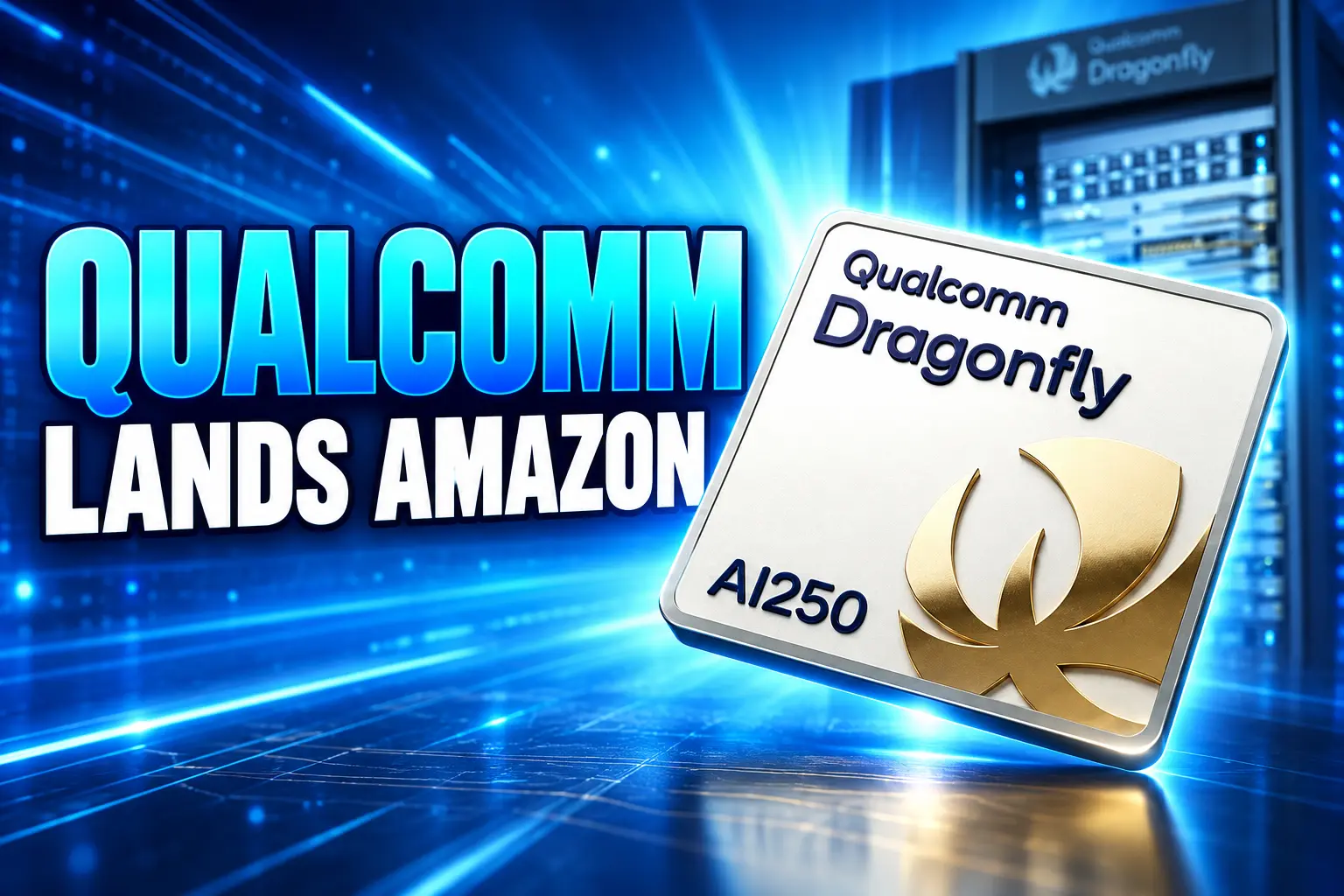
What Amazon’s Warrant Ties to the Chips
Amazon Web Services is buying custom inference silicon and optical connectivity from Qualcomm across several product generations, including links up to 1.6 terabits per second that use Qualcomm’s SerDes and optical DSP. Prasad Kalyanaraman, vice president at AWS, said the work is meant to deliver more efficient, lower-cost infrastructure for AWS customers. Qualcomm, in turn, said it will push more of its own chip-design workloads onto Amazon Bedrock to shorten design cycles.
The commercial terms sit in an 8-K filed September 8 for a warrant issued September 3 to Amazon.com NV Investment Holdings LLC. Qualcomm granted a warrant for up to 25 million shares at $161.26 each, cashless exercise allowed, expiring September 3, 2036. At the strike, that block is worth about $4.03 billion. The holder gets no votes until the warrant is exercised.
Vesting is the mechanism that makes the headline number honest. Shares unlock against commercial arrangements, binding purchase orders and actual buys of server chips, systems and manufacturing services, up to a maximum of $60 billion in payments. 3.75 million shares, 15% of the grant, vested at issuance on initial purchase commitments. The other 21.25 million shares, 85% of the grant, wait on Amazon actually spending.
You should think of this as really a landmark deal for us in the data center business. This kicks us off there.
Akash Palkhiwala, CFO and COO, Goldman Sachs Communacopia + Technology Conference, September 8, 2026
Palkhiwala told that same audience Qualcomm is already in production with Amazon and will start booking the revenue in the December quarter, the first quarter of fiscal 2027. He said the $5 billion fiscal 2027 data center target now sits at very high confidence. He also said Qualcomm is proceeding with another data center customer discussed at Investor Day.
We're announcing a multi-generation collaboration with @awscloud to build next-generation AI data center infrastructure, working together on customized silicon and AI inference at scale.
Read the announcement: https://t.co/dsGwzI0PFh
Read the 8-K: https://t.co/YlngSiczfD pic.twitter.com/6hOJYpHveY— Qualcomm (@Qualcomm) September 8, 2026
Ryan Shrout, president of Signal65, noted that AWS already designs its own accelerators through Annapurna Labs, so Qualcomm is being added to that supply base rather than replacing it. The optical DSP work still has a path into every AWS rack, including racks that keep Annapurna parts in the accelerator slot. That is a second way for Qualcomm to get paid if the custom inference die is slower to ramp than the interconnect.
The Dragonfly Calendar Runs Through 2028
Qualcomm bundled the hardware under the Dragonfly name: a C1000 server CPU, a High Bandwidth Compute memory stack it wants to sell as an alternative to HBM, and a line of rack-scale inference accelerators that already includes the AI200 and AI250, with the AI300 added in June. The C1000 uses custom Oryon cores, a chiplet layout with more than 250 cores, and clock targets above 5 GHz. Qualcomm rates it at more than twice the performance per watt of the server CPUs it is measuring against. Commercial availability is 2028.
HBC is the technical claim underneath the accelerator story. Qualcomm is stacking DRAM on the logic die and arguing that this coupling can feed decode-heavy inference without HBM’s power and packaging bill. It says the AI250, the first HBC generation, is designed for 133 TB/s per card, 18 times the effective memory bandwidth of the AI200 with LPDDR5X. The AI300 with HBC Gen 2 is rated at 54 times the AI200. Commercial samples of HBC Gen 1 with the AI250 are due in mid-2027. The AI300 is a 2028 part.
HOW THE DATA CENTER PRODUCTS ARE SUPPOSED TO STACK
- Fiscal 2026: Connectivity silicon from the Alphawave deal already produces revenue. AI200 racks sample, using LPDDR5X and up to 43 TB of DRAM per rack.
- First quarter of fiscal 2027: Custom silicon for hyperscalers begins to ramp, including the Amazon work already in production for the December quarter.
- Second half of fiscal 2027: Merchant AI accelerators ramp. AI250 with HBC Gen 1 is due to sample in mid-2027.
- Second half of fiscal 2028: Dragonfly C1000 CPUs ramp, including Meta’s next server fleet, with AI300 and HBC Gen 2 on a 2028 cadence.
That sequence is why fiscal 2027 can be mostly custom silicon and interconnect while fiscal 2029 still needs the CPU and the later accelerators to show up. Palkhiwala compared it to automotive, where Qualcomm stacked connectivity, cockpit and driver-assist chips over several years instead of betting on one socket.
Meta, Microsoft and a Second Unnamed Hyperscaler
Amazon is the named custom-silicon anchor. It is not the only logo Qualcomm put on the June stage, and it is not the only relationship Palkhiwala said was still live in September.
WHO IS ON THE BOARD, AND WHAT THEY ARE BUYING
- Amazon: Multi-generation custom inference silicon plus optical connectivity up to 1.6T, already in production, revenue due in the December quarter, warrant vesting against up to $60 billion in payments through 2036.
- Meta: A multi-year, multi-generation deal for Dragonfly C1000 data center CPUs in Meta’s next server fleet, with production planned for the second half of 2028.
- Microsoft: A public endorsement at Investor Day that Azure will deploy Qualcomm’s HBC architecture, the memory stack that sits under the AI250.
- HUMAIN: A commitment to deploy 200 MW of Qualcomm accelerator racks for the Saudi operator’s language-model and government workloads.
- A second unnamed hyperscaler: Custom accelerator work Palkhiwala said continues alongside Amazon, matching the two global-scale custom programs Qualcomm described in June.
Matt Kimball, vice president at Moor Insights & Strategy, said the multi-generation structure is what makes the Amazon deal notable, because hyperscalers do not usually lock several generations for a part they treat as a commodity. Patrick Moorhead, founder of Moor Insights & Strategy, put the 25 million shares at about 2.4% of Qualcomm’s July 27 share count and noted the $161.26 strike sat about 4.4% below the September 4 close. He also flagged an earlier Qualcomm comment that initial custom-chip revenue would dilute QCT gross margin by 1.5 to 2 points while still adding at the operating line.
Software was the other June bolt-on. Qualcomm said it would buy Modular, the AI software shop, and completed that deal on July 29. It also deepened a Hugging Face tie so models can be deployed on Qualcomm hardware with less manual porting. Those pieces do not print the $15 billion. They are how Qualcomm wants customers to land on Dragonfly without building a CUDA-class stack from scratch. Amon has been explicit that Qualcomm is not going to try.
The Wager Is on Inference Economics
Qualcomm is not pitching a training GPU. Nvidia still holds the training market, and Broadcom still holds most of the custom-accelerator design work for Google, Meta, OpenAI and others. Qualcomm’s opening is decode and inference, where tokens per watt and memory bandwidth per watt matter more than peak training FLOPS, and where LPDDR stacked on logic is cheaper and less power-hungry than HBM if the architecture holds up in the rack.
That is a different race than the one that made Nvidia’s training franchise. It is also a race Qualcomm can enter with mobile-derived CPU cores, modem-class SerDes, and a foundry-scale custom-silicon offer, without pretending it can clone CUDA. The C1000 is an Oryon server play for agentic head nodes and general-purpose clouds. The accelerators are an inference play. The Amazon warrant is a custom-silicon play. Three products, three clocks, one fiscal 2029 number.
As AI demand accelerates, data center infrastructure will require advances in both computing and connectivity to deliver greater performance with more efficiency. Qualcomm is pleased to work with AWS on customized silicon and connectivity solutions, bringing decades of leadership in advanced processing and power-efficient compute, to deliver breakthrough performance and enable the next generation of AI infrastructure.
Cristiano Amon, President and CEO, Qualcomm, September 8, 2026 press release
The objection that keeps coming back is execution, not ambition. Custom ASIC work at this scale has been a Broadcom and Marvell business. Qualcomm’s last data center accelerator line, Cloud AI 100, never became a hyperscaler staple. HBC has to sample in 2027 and then survive power, yield and software bring-up. The C1000 has to land in Meta’s fleet in 2028. Fiscal 2029 is three product cycles away from a company that still makes most of its chip money in phones.
Up to $60 Billion, With 15% Vested
Treat the Amazon figure as a cap on a vesting schedule, not as revenue Qualcomm has won. The 8-K does not set a minimum purchase, does not disclose the dollar size of the initial commitments, and does not name the dies Amazon is buying. Only the 3.75 million shares that vested on signing are tied to commitments already made. Everything else waits on orders and actual payments over ten years.
THE FIGURES THAT GET CONFUSED WITH EACH OTHER
| Item | Amount | What it is |
|---|---|---|
| Fiscal 2027 data center target | $5 billion | Company target; Palkhiwala called it very high confidence after Amazon, with chips in production |
| Fiscal 2029 data center target | More than $15 billion | Company target, not a contract |
| Non-handset fiscal 2029 target | $40 billion | Raised from $22 billion; data center is $15 billion of this stack |
| Amazon warrant ceiling | $60 billion in payments through 2036 | Maximum qualifying spend for full vesting, not booked sales |
| Warrant grant | 25 million shares at $161.26 (about $4.03 billion at strike) | 3.75 million vested at issuance; 21.25 million still unvested |
Srini Pajjuri at RBC Capital Markets kept a Sector Perform rating, lifted his target to $180 from $160, and said the Amazon relationship could add about $6 billion of annual revenue over the next decade if the milestones are hit. That $6 billion run-rate, if it arrived, would sit inside the $15 billion fiscal 2029 print rather than replace it. It would also sit well inside the $60 billion ten-year ceiling, which is the point of a ceiling.
Shares were changing hands at $181.97 at the close on September 11, after the Amazon filing. That is below the June after-hours spike and above the $161.26 strike. The market has now priced the wager twice: once on the June slides, again on Amazon’s paper. Neither print is the $15 billion. The $15 billion is still a fiscal 2029 number on a product calendar that does not put a CPU into Meta until 2028.
The Phone Business Funds the Ramp
Qualcomm remains a phone-chip company that is paying for a data center build with handset cash. Palkhiwala said non-handset revenue growth, including data center, should accelerate from 24% in fiscal 2026 to more than 60% in fiscal 2027. That inflection is the whole diversification argument. It only works if custom silicon actually bills in the December quarter, if Amazon’s vested 15% turns into follow-on purchase orders, and if the later Dragonfly parts do not slip.
The phone franchise is also the reason the bet exists. Apple has been cutting Qualcomm out of modems. Android demand has been chewing through memory that AI racks now want first. Amon’s “next chapter” line is a polite way of saying the old chapter is getting smaller as a share of the company. Automotive at $10 billion and IoT at more than $14 billion are the other legs. Data center is the one that can re-rate the stock if the silicon ships, and the one that can sit on a slide if it does not.
Amazon will start paying in the December quarter. The warrant keeps paying Amazon in stock only if Amazon keeps paying Qualcomm in cash, through September 3, 2036. Fiscal 2029 is when Qualcomm said the data center line should exceed $15 billion. Those three dates now describe the same bet.
Disclaimer: This article is news reporting and analysis of Qualcomm’s public targets, product roadmap and Amazon warrant, and it is for information only. It is not investment advice, a recommendation to buy or sell Qualcomm, Amazon or any other security, and it is not a valuation of the warrant or of the $15 billion and $5 billion figures. Readers should consult a qualified financial adviser or securities professional before making any investment decision. Revenue targets, vesting conditions, share prices and product dates reflect the company filings and statements cited here and can change with later results, orders or disclosures.

Instagram Plus Tests a Read-Only Mode That Cuts Stories

Altman Asks the Public to Accept Some AI Harm

Google Freezes OSS VRP Product Reports After AI Flood

AI Agents Make Payment Rails the Scarce Prize

Turkey’s Crypto Boom Now Runs Through Three Banks

Fable 5 Came Back Under a Commerce On-Off Switch

Google’s SpaceX GPU Lease Has a Sept. 30 Deadline

Plasma One’s XPL Locks Face a 1.81 Billion Cliff

DGO’s Rs 549 World Cup Pass Cost Fans Sleep and Data

Moonshot AI’s $30 Billion Ask Became a $35 Billion Close
-
 AI4 months ago
Fable 5 Came Back Under a Commerce On-Off Switch
-
 AI4 months ago
Google’s SpaceX GPU Lease Has a Sept. 30 Deadline
-
 CRYPTO4 months ago
Plasma One’s XPL Locks Face a 1.81 Billion Cliff
-
 APPS4 months ago
DGO’s Rs 549 World Cup Pass Cost Fans Sleep and Data
-
 AI4 months ago
Moonshot AI’s $30 Billion Ask Became a $35 Billion Close
-

 NEWS4 months ago
ColorOS 17 Device List Spans Oppo, OnePlus and Realme
-
 GAMING4 months ago
Xbox Cuts 3,200 Jobs After Five Years of Thin Returns
-
 GAMING4 months ago
The RTX 4050 Under Rs 70,000 Hides a Wattage Gap