
AI
SIEPR Finds AI Hits New Grads, Not the Jobless Rate
SIEPR finds AI’s aggregate job hit still small, while new-grad unemployment hit 5.6% and FERC is rewriting who pays to plug 50 MW AI halls into the grid.

Stanford’s SIEPR brief finds AI’s aggregate job effect still small, while new-grad unemployment reached 5.6 percent in early 2026. The same week’s ledger puts six grid operators on a federal clock over loads above 50 MW and records a White House order that offers a 30-day look at frontier models without a license.
The wipeout is not on the national scoreboard. The pressure is at the hiring door, and on the tariffs that decide who studies, who posts security, and who pays when an AI hall wants a transmission hookup.
Unemployment Rose Faster in the Least-Exposed Jobs
Neale Mahoney, Trione Director of the Stanford Institute for Economic Policy Research, wrote the July 2026 policy brief with Erika McEntarfer, a SIEPR research scholar, and Karsen Wahal, separating AI hype from reality for people who have been told a collapse is either here or fake. Using IPUMS-CPS data and Felten-Raj-Seamans exposure ranks, they find unemployment in the most AI-exposed occupation quintile rose 0.77 percentage points since 2022. The least-exposed quintile rose 0.85 points over the same span.
That gap runs the wrong way for a clean automation shock. Employment in highly exposed occupations is fairly stable, the authors write, and growth in coding-heavy work has slowed but stays positive. Online postings for software developers grew faster than for other occupations over the last year. Among firms that adopted enterprise AI, employment grew 10 percent in the two years after adoption, an effect they tie to the heaviest per-person AI spenders.
THE LABOR SCOREBOARD SIEPR CITES
| Group | Reading |
|---|---|
| Most AI-exposed occupations | Unemployment +0.77 pp since 2022 |
| Least-exposed occupations | Unemployment +0.85 pp since 2022 |
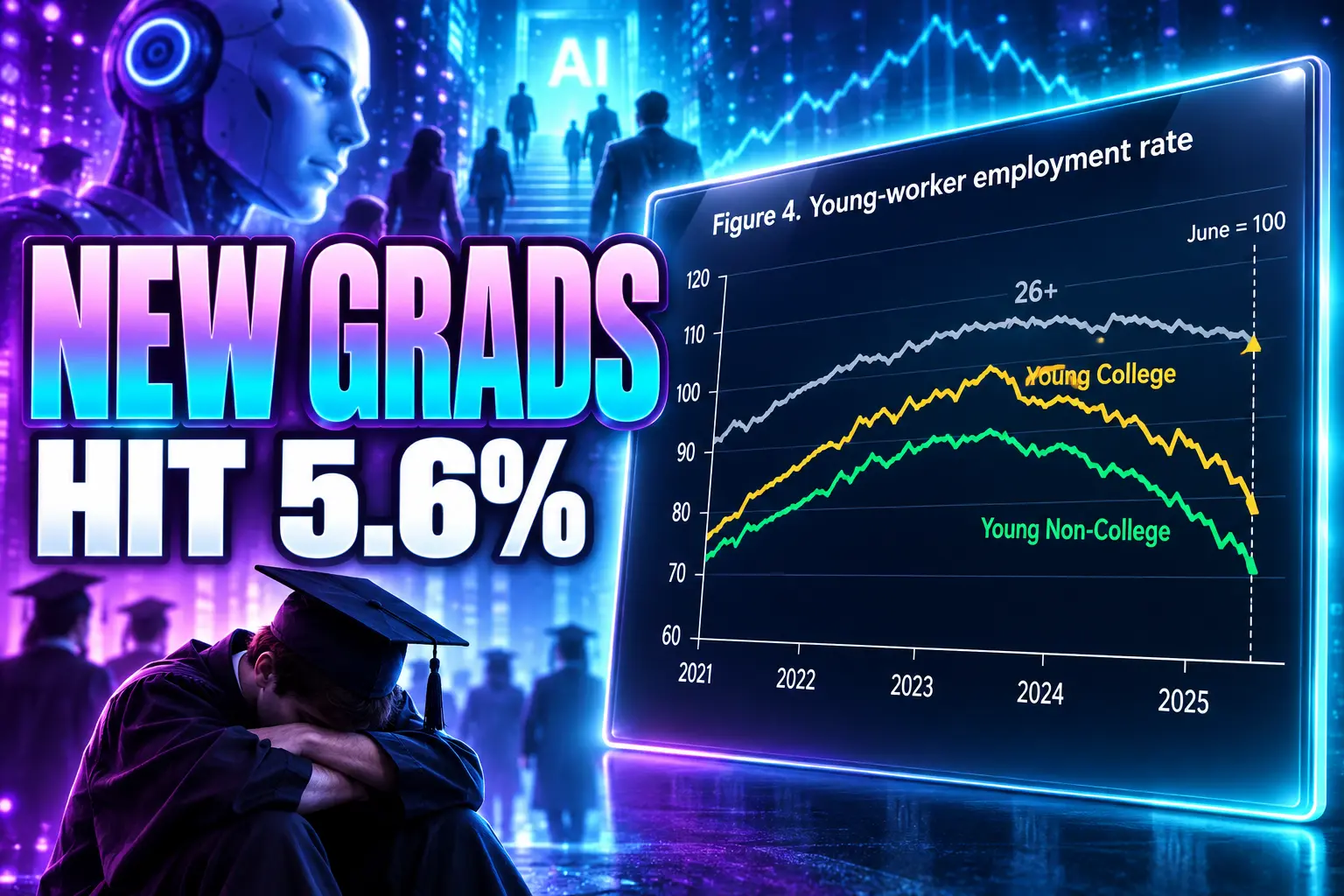
| Recent graduates, early 2026 | 5.6% unemployed, up 1.6 pp in three years |
| Firms after enterprise AI adoption | Employment +10% over two years |
The brief still quotes the louder forecast. Anthropic CEO Dario Amodei has predicted that AI could wipe out half of white-collar jobs and push unemployment to 20 percent, Mahoney and co-authors note, before walking through why the aggregates do not show that break. Layoff notices that mention AI, they add, often mix automation with a desire to free cash for AI spend or to cut headcount after pandemic over-hiring. Human-resource executives they cite point to role consolidation and hiring avoidance, not a mass firing wave.
SIEPR announced the brief on its account in July.
What’s really going on with AI and jobs? With #AI rapidly advancing, so too are fears of a “jobs apocalypse.” In this SIEPR Policy Brief, @nealemahoney, Erika McEntarfer and @karsenleewahal synthesize what the fast-growing body of research is saying: https://t.co/xpymKG2u3j pic.twitter.com/D89XE6q48g
— Stanford Institute for Economic Policy Research (@SIEPR) July 22, 2026
Why New-Grad Unemployment Hit 5.6 Percent
The channel that moved is younger. Recent graduates faced the toughest market in years, the brief says, with the 5.6 percent jobless rate up 1.6 points from three years earlier, when the comparable figure was 4.0 percent. Junior roles often bundle routine research, analysis, and writing, work a model can now draft. Brynjolfsson, Chandar, and Chen’s payroll study, which SIEPR recaps, finds a notable drop in employment among early-career workers in exposed occupations such as software developers and customer-service representatives since ChatGPT’s 2022 launch, while older workers in the same jobs held up or kept growing. The authors of that study call the young workers canaries.
Stanford Digital Economy Lab’s August 12, 2026 update, using ADP payroll records through June 2026, sharpened the same split. Employment of workers ages 22-25 in highly AI-exposed occupations stood about 19 percent below where it would have been had it kept pace with less-exposed peers, a shortfall the Lab put at 15 percent in its July 2025 vintage. In levels, employment of 22-25-year-olds in the two most exposed quintiles fell about 11 percent between November 2022 and June 2026, while the same age group in the three least-exposed quintiles grew about 10 percent. The Lab says the adjustment runs mainly through reduced hiring, not through more separations, and shows up in headcount rather than base pay.
SIEPR will not call that an open-and-shut AI result. Hiring in exposed occupations began to soften after the Federal Reserve started raising rates in March 2022, months before ChatGPT’s public debut that November, and two papers the brief flags date the turn to that monetary shift. Remote work, which can slow on-the-job learning, also pushed some firms toward experienced hires. After new controls, Brynjolfsson’s team finds the entry-level drop is not notable until 2024, when both adoption and model skill had moved. Isolating AI remains, in the brief’s words, empirically challenging.
Peter McCrory, head of economics at Anthropic, drew a similar line in July. He wrote that the United States looks close to full employment and that AI, so far, has the hallmarks of a skill-biased, labor-augmenting tool, even as he flagged weaker hiring for young workers in highly exposed roles.
In my view, AI has caused no material increase in the unemployment rate to date. Even if we focus on workers with high exposure to current patterns of AI automation, we don’t see unexpected increases in unemployment in recent years.
Peter McCrory, Head of Economics, Anthropic, July 22, 2026
That is why a calm jobless rate and a closed first rung can sit in the same month. Firms skip the posting. Payrolls of people already in the chair hold up. The monthly survey never sees the hire that did not happen. In experimental work SIEPR compiles, the same tools that squeeze junior tasks also lift novices who keep the job: a call-center assistant raised overall issues resolved per hour by 15 percent, with a 30 percent gain for less-skilled agents, and GitHub Copilot let programmers finish tasks 56 percent faster, with gains concentrated among less-experienced coders. Productivity for people on the payroll is not the same fact as a graduate getting a first offer.
Campus rules add a second kink. Many students spent four years told not to use a chatbot on assignments, then walk into shops that require the same tools on day one, so the screening task and the doing task no longer match.
FERC Put Six Operators on a 60-Day Clock
If hiring is where labor data first bent, interconnection is where the buildout bends. On June 18, 2026, the Federal Energy Regulatory Commission issued six show-cause orders under Federal Power Act Section 206 to the regional operators it oversees: PJM, MISO, SPP, CAISO, ISO-NE, and NYISO, plus their transmission owners. Each had 60 days, until August 17, to show why existing open-access tariffs remain just and reasonable for large loads, or to file reforms. Informational reports on generation adequacy were due in 30 days.
The orders follow a Department of Energy directive and an advance notice of proposed rulemaking, rather than a single national tariff rule. FERC said it reviewed more than 3,500 pages of public comments in that docket. Commissioner Lindsay S. See, concurring the same day, wrote that most existing systems were not designed for loads this large, this concentrated, and this fast, and that delay adds costs the commission wants to avoid while still protecting other customers.
Today’s orders support both just and reasonable rates and speed to reliable power.
Lindsay S. See, Commissioner, Federal Energy Regulatory Commission, June 18, 2026 open meeting
The June clock did not land as a stack of finished tariffs. On August 3, ISO-NE and its participating transmission owners filed a joint motion to hold the New England docket, EL26-72, in abeyance for 90 days while they finish stakeholder work and prepare a Federal Power Act Section 205 filing, including a region-specific definition of large load and a pro forma transmission service agreement. That pause, if granted, pushes the New England rewrite well past the original August 17 answer date.
THE LARGE-LOAD CLOCK
- June 18, 2026: FERC issues six Section 206 show-cause orders to PJM, MISO, SPP, CAISO, ISO-NE, and NYISO.
- Mid-July 2026: Informational reports on generation adequacy come due, 30 days after the orders.
- August 3, 2026: ISO-NE and its transmission owners ask FERC to pause EL26-72 for 90 days for a Section 205 filing.
- August 17, 2026: Original deadline for show-cause answers or tariff revisions.
See’s concurrence keeps states in the picture. FERC’s reach, she wrote, extends only to matters the states do not regulate, and retail rates, siting, and resource choices stay with them. The federal piece is study rules, cost assignment on the interstate system, and whether a tariff that never contemplated hyperscale load still produces a just rate.
Who Pays When a Campus Wants 50 MW
The New England counsel memo on the ISO-NE order records FERC’s preliminary definition of a large load: a new commercial or industrial customer at a single site, peak load of 50 MW or greater, interconnecting at voltage above 69 kV, and not part of a co-location arrangement. That is campus scale, not a shop floor annex. Five reform buckets run through the orders.
THE FIVE REFORM BUCKETS
- Study speed: Efficient transmission-service applications and study processes, including a hard look at alternative transmission technologies before defaulting to traditional upgrades.
- Who pays: Cost transparency and recovery so large-load customers make a minimum financial contribution, backed by credit support, rather than shifting network-upgrade risk onto families and small businesses.
- Co-location: Rates, terms, and a dedicated study path for generation that sits electrically close to the load, including behind-the-meter supply.
- Flexible service: New products for constrained periods and interim non-firm service while upgrades proceed, so a hall can connect without pretending every megawatt is must-serve from day one.
- Nearby generation: A process to study generating facilities that serve electrically proximate large loads, including paths described in the White & Case alert as within two buses or substations.
See said transmission providers that skip grid-enhancing tools and choose conventional upgrades must show why the alternatives are not feasible or would not be cheaper or faster. She also flagged stranded-asset risk if a speculative hall never shows up, and she backed cost-recovery agreements plus the option to reuse security a large load already posted under a retail deal. Affordability, in that telling, is not a slogan. It is the question of whether a 50 MW study lands on the campus that caused it or on the residual rate.
That is the second-order bind for AI infrastructure. Model labs can ship weights on a product calendar. A transmission queue cannot. Until each region writes the study path, the security gate, and the flexible-load product into its tariff, “speed to power” stays a press phrase sitting on top of open dockets.
The Order Bars Licensing in Plain Language
Washington’s model-policy choice, signed June 2, 2026, runs the other direction: access without a gate. Executive Order 14409, Promoting Advanced Artificial Intelligence Innovation and Security, tells Treasury, the National Security Agency through the Secretary of War, and CISA, consulting NIST and others, to keep a classified benchmarking process for advanced cyber capabilities. The NSA Director may designate a “covered frontier model.” Developers may join a voluntary setup: ask whether a system meets that designation, give the government a voluntary 30-day access window before release to other trusted partners, and help pick those partners for critical-infrastructure cyber defense. Confidentiality, cybersecurity, insider-risk, and intellectual-property terms apply.
Section 3(c) is the line that matters for labs. Nothing in the section, the order says, authorizes mandatory governmental licensing, preclearance, or permitting for the development, publication, release, or distribution of new AI models, including frontier models. Draft language that would have asked for up to 90 days of pre-release access was cut to 30 in the signed text. Section 4 tells the Attorney General to prioritize 18 U.S.C. 1028, 1030, and 1343 against people who use AI to break into systems, steal data, or further other crimes.
Agencies had 60 days from June 2 to stand up the benchmark and the voluntary terms, a clock that ran to early August. The order also directs an AI cybersecurity clearinghouse, binding operational directives for civilian systems, and easier access to AI-enabled defensive tools for rural hospitals, community banks, and local utilities. The binding U.S. choice on that page is early, optional access plus criminal enforcement, not a permit to train or ship.
MoChiFormer Hits 0.91 on Preterm Labour
The clinical paper in the same ledger is a different kind of pressure: whether routine records can forecast obstetric trouble without extra genetic tests or imaging. Nature Medicine posted the mother-child EHR agent paper on September 4, 2026, by Sian Liu, Wenxin Zheng, Jin Kang, and colleagues for the International Consortium of Digital Twins in Healthcare and Medicine, with authors at Chongqing Medical University, Wenzhou Medical University, Shanghai Jiao Tong University, Stanford School of Medicine, and NYU Langone among others.
MoChiAgent is an LLM-based assistant that calls tools over sequential electronic health records, including ordinary lab panels. Its engine, MoChiFormer, was trained and checked internally on 4,401,599 longitudinal clinical visits, then tested on independent cohorts of 263,452 maternal visits and 23,192 infant visits. A knowledge-search tool then pulls guideline text against those forecasts.
MOCHIFORMER DISCRIMINATION SCORES
| Endpoint | Result |
|---|---|
| Preterm labour | AUROC 0.91 |
| Placental abruption | AUROC 0.89 |
| Premature rupture of membranes | AUROC 0.89 |
| Neonatal jaundice, paired clusters | Hazard ratio 2.81 (95% CI 2.60-3.03) |
| Infant haematological disease, paired clusters | Hazard ratio 2.83 (95% CI 2.62-3.05) |
AUROC here is a discrimination score: 0.5 is a coin flip, and values near 0.9 mean the model ranked patients who later had the event above those who did not, in this retrospective set. Paired mother-infant analysis found infants born to mothers in specific risk clusters had those elevated hazards for jaundice and blood disease. Combining maternal gestational records with infant records also improved prediction of infant chromosomal abnormalities and respiratory disorders, the authors write. They present MoChiAgent as decision support, not as a bedside proof. The study is not a randomized trial, and the scores still need prospective validation in live clinics before anyone treats the assistant as a standard of care.
UNESCO Brought the China U18 Winners to Paris
The youth line in the ledger is not only the 5.6 percent jobless rate. On August 4, 2026, UNESCO hosted 41 students from China at Headquarters in Paris for a Media and Information Literacy Day, with workshops and the award ceremony of the 2026 UNESCO Youth Hackathon U18 China Edition, co-organized with Yugui, a Shanghai education group in UNESCO’s MIL Alliance. Under-18s in China were asked to “Play Smart with AI.” The drive drew more than 1,500 young participants from Shanghai and beyond; the 41 winners went to Paris.
Sessions at the Play Smart with AI workshops in Paris covered algorithmic bias, AI-generated inaccuracies, and personalized recommendations, with a push to check model output against reliable sources. Projects ran at online fraud, emotional well-being, AI education, and cultural heritage. UNESCO’s frame is that minors can help design what systems should do, not only consume what they can do.
After the discussion with UNESCO experts and teachers, I realized that using AI without limits can mislead us and create cognitive biases. Media and information literacy teaches us to set boundaries with AI, think critically about its responses, and distinguish AI-generated content from reality, rather than accepting it as fact.
Zhou Shuhui, Shanghai Quyang No. 2 Secondary School, UNESCO Headquarters, August 4, 2026
Dai Shiyin of Shanghai Experimental School said she had treated AI as a convenient tool and left thinking that it cannot replace face-to-face interaction. That is a classroom answer to a labor market that is already sorting young workers by whether a firm still needs a junior to do the draft. The Paris cohort is still in school. The 5.6 percent figure is the class that just tried to enter the same economy the grid is being asked to electrify at 50 MW a site, under an order that will not license the models and a tariff docket that has already asked for more time.
Disclaimer: This article is news reporting and analysis of a policy brief, federal energy orders, an executive order, a medical journal paper, and a UNESCO education event. It is informational only and is not medical advice, investment advice, or legal advice, and it does not recommend any diagnostic tool, treatment, energy tariff, or model-release practice. Readers who are patients, clinicians, or health-system operators should consult a licensed physician or other qualified clinician before acting on any obstetric or neonatal prediction score, including retrospective AUROC or hazard-ratio results. Figures, docket statuses, and paper findings reflect the cited documents as of the article’s date and may change as FERC proceedings, agency guidance, and clinical validation continue.

Instagram Plus Tests a Read-Only Mode That Cuts Stories

Altman Asks the Public to Accept Some AI Harm

Google Freezes OSS VRP Product Reports After AI Flood

AI Agents Make Payment Rails the Scarce Prize

Turkey’s Crypto Boom Now Runs Through Three Banks

Fable 5 Came Back Under a Commerce On-Off Switch

Google’s SpaceX GPU Lease Has a Sept. 30 Deadline

Plasma One’s XPL Locks Face a 1.81 Billion Cliff

DGO’s Rs 549 World Cup Pass Cost Fans Sleep and Data

Moonshot AI’s $30 Billion Ask Became a $35 Billion Close
-
 AI4 months ago
Fable 5 Came Back Under a Commerce On-Off Switch
-
 AI4 months ago
Google’s SpaceX GPU Lease Has a Sept. 30 Deadline
-
 CRYPTO4 months ago
Plasma One’s XPL Locks Face a 1.81 Billion Cliff
-
 APPS4 months ago
DGO’s Rs 549 World Cup Pass Cost Fans Sleep and Data
-
 AI4 months ago
Moonshot AI’s $30 Billion Ask Became a $35 Billion Close
-

 NEWS4 months ago
ColorOS 17 Device List Spans Oppo, OnePlus and Realme
-

 GAMING4 months ago
Xbox Cuts 3,200 Jobs After Five Years of Thin Returns
-

 GAMING4 months ago
The RTX 4050 Under Rs 70,000 Hides a Wattage Gap