
AI
Siri AI Finally Ships, Still a Beta With Holes
Siri AI arrives with iOS 27 on September 14 as an English beta, two years late, still blocked on iPhones in the EU and China.

Apple’s rebuilt Siri AI reaches supported iPhones on September 14 as an English-language beta, two years after the company first showed a personal assistant it could not ship. It can search mail, messages, and photos, hold a back-and-forth chat, and it still will not run on iPhones in the European Union or in China.
The download is the reckoning for a promise made at WWDC in June 2024, delayed in March 2025, and rebuilt for iOS 27. Testers say the new Siri finally does the demo. The product that lands is still labeled beta, still metered in the cloud, and still fenced off from the two markets that would stress it hardest.
An English Beta Hits iPhones on September 14
Apple confirmed the date at its September 9 hardware event: iOS 27 is a free update on Monday, September 14. The company’s own pages now say new Apple Intelligence features start that day, and that Siri AI is rolling out in English. Usage limits may apply.
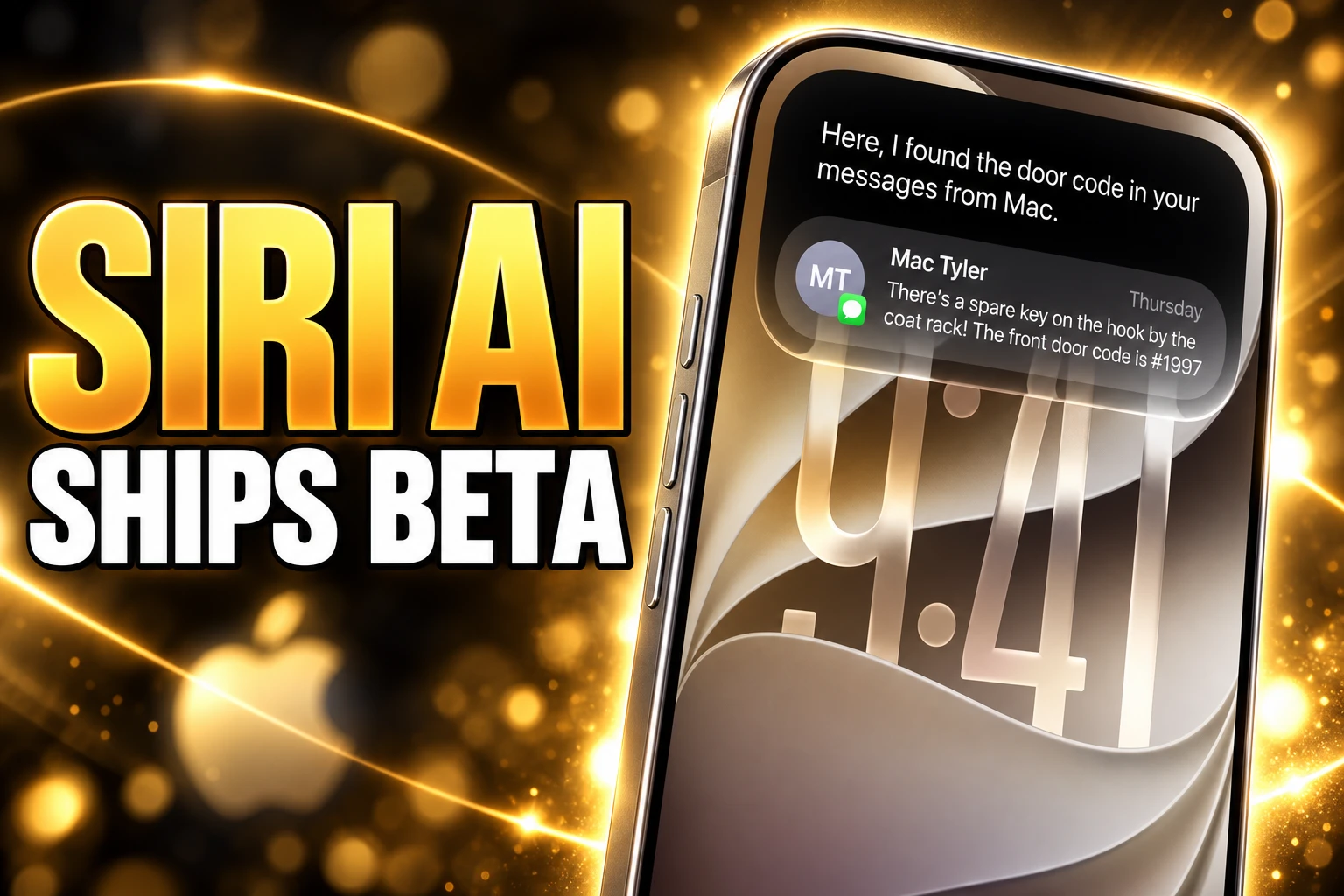
In June, Apple described a rebuilt assistant with personal context, onscreen awareness, and what it calls broad world knowledge from the web. Craig Federighi, Apple’s senior vice president of Software Engineering, said Siri AI was designed to help people “find information and get things done throughout the day,” and to take action across apps “more naturally than ever.”
The visible change is a dedicated Siri app. Conversations sync through iCloud, so a chat that starts on a Mac can continue on an iPhone, iPad, Apple Watch, or Vision Pro. On iPhone, you can still say “Hey Siri,” press the side button, or swipe down from the Dynamic Island. On iPad and Mac, the same assistant sits inside Spotlight and in context menus.
WHAT SIRI AI CAN DO AT LAUNCH
- Personal search: Pull a restaurant a friend texted, a hotel confirmation in old mail, or photos from a trip.
- Onscreen help: Answer questions about what is on the display, then drop a recipe into Notes after a potluck text.
- Live web answers: Look up an eclipse time or a tour date and keep the thread going with follow-ups.
- Camera mode: Point the camera, tap the shutter, split a bill with Apple Cash, or ask what is on a plate.
- Writing: Draft from a prompt anywhere you type, and match the tone you already use with that person in Mail and Messages.
Andrew Cornwall, a senior analyst at Forrester, had flagged a chat mode and a personal-context switch before WWDC. Both showed up. Patrick Moorhead, founder of Moor Insights & Strategy, had a blunter brief: Apple had to make Siri work, and it also had to give developers a way into the data. The second half of that job is the part that still has a gate on it.
Apple Already Missed This Siri Once
Siri debuted in 2011. For most of the next 15 years it stayed a command box while people moved their longer questions to ChatGPT, Claude, and Gemini. Apple answered at WWDC in June 2024 with Apple Intelligence and a Siri that would know your messages, your screen, and your apps. That Siri did not ship on the advertised clock.
In March 2025 the company said the personalized features were taking “longer than we thought.” Federighi later said a first architecture, the one Apple thought it could deliver by late 2024 or spring 2025, would not meet its quality bar, so the team moved to a deeper V2 design. Buyers who felt the iPhone 16 ads had sold them an assistant that never arrived took Apple to court. Apple asked a judge to throw the case out, arguing that two delayed Siri features could not support a sweep across the whole phone.
HOW THE PROMISE TURNED INTO A BETA
- June 2024: Apple demos a Siri that reads personal context and acts on screen content as the centerpiece of Apple Intelligence.
- March 2025: The company delays those features and says the work will take longer than planned.
- June 8, 2026: WWDC introduces Siri AI. Developer betas open the same day on iOS 27, iPadOS 27, macOS 27, and visionOS 27.
- September 1, 2026: John Ternus becomes CEO, with Tim Cook moving to executive chairman.
- September 9, 2026: Apple dates iOS 27 to September 14 and keeps Siri AI in English at first.
- September 14, 2026: The public beta lands on supported devices.
- October 2026: Apple has said French, Japanese, Korean, Portuguese, and Spanish follow.
People who installed the summer developer builds say the new Siri can find homework in a tutor thread, guess when a keyboard was bought from old photos, and stop answering with a pile of web links. They also hit timeouts, cut-off multi-part requests, and the kind of misses any chatbot still makes on live event dates. Apple never claimed the fall build would leave beta.
Who Gets Siri AI on September 14?
Any recent iPhone can take iOS 27. Siri AI is an Apple Intelligence feature, so the cutoff is much higher. Apple’s list starts at iPhone 15 Pro and iPhone 15 Pro Max, then iPhone 16 and every iPhone after that, including the new 18-series phones that are not in people’s hands on launch day.
THE LAUNCH GATES FOR SIRI AI
| Gate | What ships on September 14 |
|---|---|
| iPhone hardware | iPhone 15 Pro, iPhone 15 Pro Max, iPhone 16 and later |
| Other Apple products | iPad mini (A17 Pro), iPad and Mac with M1 or later, MacBook Neo (A18 Pro), Vision Pro, Watch Series 9 or later, Ultra 2 or later, and SE 3 when paired with a supported iPhone |
| Language | English at launch; French, Japanese, Korean, Portuguese, and Spanish due in October |
| European Union | No Siri AI on iPhone, iPad, or Apple Watch; Mac and Vision Pro can run it |
| China | Held while Apple works through regulatory requirements |
| Status | Beta, with no date for the label to come off |
A standard iPhone 15, and everything older, gets the system update and keeps the old assistant. On Apple Watch, Siri AI needs a paired iPhone that already has it, which is why a Watch in the EU is locked out too. Feature-availability pages list Siri AI in English and mark it unavailable in China mainland and the European Union.
The DMA Blackout Has No End Date
Apple’s June note on Europe is unusually blunt. Because of the Digital Markets Act, Siri AI will not ship in the EU with iOS 27 or iPadOS 27. EU developers cannot test the new Siri features in iPhone or iPad apps. There is no timeline for Siri AI on iOS or iPadOS in the bloc.
We’re deeply disappointed that our EU users won’t have Siri AI on iPhone or iPad when we share our new software releases later this year. Our hope is to eventually bring Siri AI to the EU, and we will continue to engage with EU regulators on a path forward. However, their refusal to engage constructively on solutions that preserve privacy and security means we do not currently have a timeline for Siri AI’s availability on iOS and iPadOS in the EU.
Craig Federighi, senior vice president of Software Engineering, Apple
Apple’s account is that the Commission’s reading of the DMA would force it to give any virtual assistant direct access to private data and the ability to drive other apps, including mail, payments, and files, without the user staying in the loop. The company offered a buffer it calls Trusted System Agent, plus an 18-month phased launch. It says the European Commission accepted none of the proposals. The footnote on that note lists all 27 EU member states.
The Commission had already designated Apple as a DMA gatekeeper, alongside Alphabet, Amazon, ByteDance, Meta, Microsoft, and later Booking. Apple’s fight with that law is now a missing assistant on the most personal device it sells in Europe. People in the EU can run Gemini and other chat apps on an iPhone. They cannot run Apple’s own rebuilt Siri on that phone. iOS developers in the bloc have been leaving the EU just to test Siri AI support, because the features are blocked on the hardware they ship to European customers.
WHAT WE KNOW
- The iPhone cutoff: Siri AI is off iOS, iPadOS, and watchOS in the EU at launch, and on for Mac and Vision Pro.
- The China hold: Apple says Siri AI and the other new Apple Intelligence features stay out while it works through regulatory requirements.
- The buffer Apple offered: Trusted System Agent plus an 18-month ramp, which Apple says the Commission rejected.
WHAT IS UNCONFIRMED
- A date for Europe: Apple still has none for iPhone and iPad.
- When beta ends: Apple has not said when the Siri AI label comes off.
- How the first-day switch works: Apple has not published a launch hour, and it has not spelled out every Settings toggle in public.
China is a separate hold, written into the June availability list rather than the DMA note. Apple’s public feature grid still shows Siri AI as not available in China mainland.
Personal Context Runs Through Spotlight, Not Every App
The reason this Siri is supposed to beat a generic chatbot is the pile of mail, texts, photos, and calendar entries sitting on the phone. Apple spent years locking that pile down so third-party apps could not read each other, and so Apple itself could not reach much of it without permission. Siri AI is the company opening a controlled window on that store.
The window is not the whole phone. Personal context extends to third-party apps only when developers integrate with Spotlight. Apple’s on-device system orchestrator taps the Spotlight index and App Toolbox, which it says stay on the device. If a bank, a travel app, or a notes rival never wires that index, Siri can see Apple’s own apps and go blind at the next icon.
That is the developer job Moorhead described before WWDC, and it is also how Apple chose to open Siri to rival AI assistants instead of trying to win every chat on its own model. The assistant becomes a router with a private index. The apps that show up in that index decide how personal the product actually feels after September 14.
World knowledge is the other half of the pitch, the part that answers questions a phone cannot. Apple’s newsroom never names a partner for that work. The WWDC sessions and the Google-backed models inside the new Siri filled in the blank the keynote left. Heavy reasoning still leaves the handset. Apple’s privacy claim is that Private Cloud Compute does not store the request, and that outside researchers can keep checking that promise.
Private Cloud Compute Comes With a Daily Meter
Simple Siri work can finish on the phone. Harder jobs go to Private Cloud Compute, Apple’s private cloud path for Apple Intelligence. Developer documents for iOS 27 spell out the trade in plain numbers. The on-device system model has a 4K context window and no daily cap. The PCC model has a 32K window, stronger reasoning, no offline mode, and a limit per day.
ON-DEVICE MODEL VS PRIVATE CLOUD COMPUTE
| Capability | On-device model | Private Cloud Compute |
|---|---|---|
| Privacy claim | On device | Processed, not stored |
| Works offline | Yes | No |
| Daily cap | Unlimited | Limit per day |
| Reasoning levels | Not supported | Light, moderate, deep |
| Context window | 4K tokens | 32K tokens |
When a person hits the PCC quota, the system can show an upgrade path through iCloud+. Apple’s marketing site puts the same warning in smaller type: usage limits may apply. The rebuilt Siri is free with iOS 27, and the larger brain is rationed. That is a different product from ChatGPT or Gemini on an unlimited plan, and it is the cost of keeping the heavy model off the phone’s own chip.
Apple is still not shipping the kind of PC agent stack that can log into a user’s web accounts and run a fleet of tasks without a person watching. Ben Bajarin, CEO of Creative Strategies, said before WWDC that this class of tool was “way too early for the consumer,” and that he was not sure businesses were ready for it in an uncontrolled setting. The September Siri can act in apps it is allowed to see. It is not an unsupervised worker.
Ternus Inherited a Beta, Not a Finished Assistant
John Ternus became CEO on September 1, then ran his first product event eight days later. He put the iPhone at the center of Apple’s AI story, calling it a personal hub because it already holds the calendar, the camera, and the messages. “Others see that data as something to collect and store,” he said, and he repeated that Apple Intelligence runs on the device whenever it can.
The software drop that follows him onto the stage is the delayed 2024 demo, running as a beta, in English, on a slice of the hardware base, with Europe’s iPhones and China’s market still dark. The new Siri app will look like every other chatbot home screen. The thing Apple can sell that those apps cannot copy in a week is the on-device index, and only if enough developers plug into Spotlight, and only if people in the EU and China are eventually allowed to turn it on.
On September 14 the update is real, and the beta tag is still on the box. Apple has not said when that tag comes off, and Federighi still has no date for the iPhone in Europe.

Huang Sells Cybersecurity as AI’s Next Always-On App

Gemini for Windows Cannot Act on Gmail or Drive

Apple Health App Will Sell $119 Quest Blood Tests

AMD’s EPYC Playbook Now Runs Against NVIDIA’s AI Lead

A Nevada Ring Clip Turns a Door Kick Into Evidence

Fable 5 Came Back Under a Commerce On-Off Switch

Google’s SpaceX GPU Lease Has a Sept. 30 Deadline

Plasma One’s XPL Locks Face a 1.81 Billion Cliff

DGO’s Rs 549 World Cup Pass Cost Fans Sleep and Data

Moonshot AI’s $30 Billion Ask Became a $35 Billion Close
-
 AI3 months ago
Fable 5 Came Back Under a Commerce On-Off Switch
-
 AI4 months ago
Google’s SpaceX GPU Lease Has a Sept. 30 Deadline
-
 CRYPTO4 months ago
Plasma One’s XPL Locks Face a 1.81 Billion Cliff
-
 APPS4 months ago
DGO’s Rs 549 World Cup Pass Cost Fans Sleep and Data
-
 AI4 months ago
Moonshot AI’s $30 Billion Ask Became a $35 Billion Close
-
 NEWS4 months ago
ColorOS 17 Device List Spans Oppo, OnePlus and Realme
-

 GAMING4 months ago
Xbox Cuts 3,200 Jobs After Five Years of Thin Returns
-

 GAMING3 months ago
The RTX 4050 Under Rs 70,000 Hides a Wattage Gap