
AI
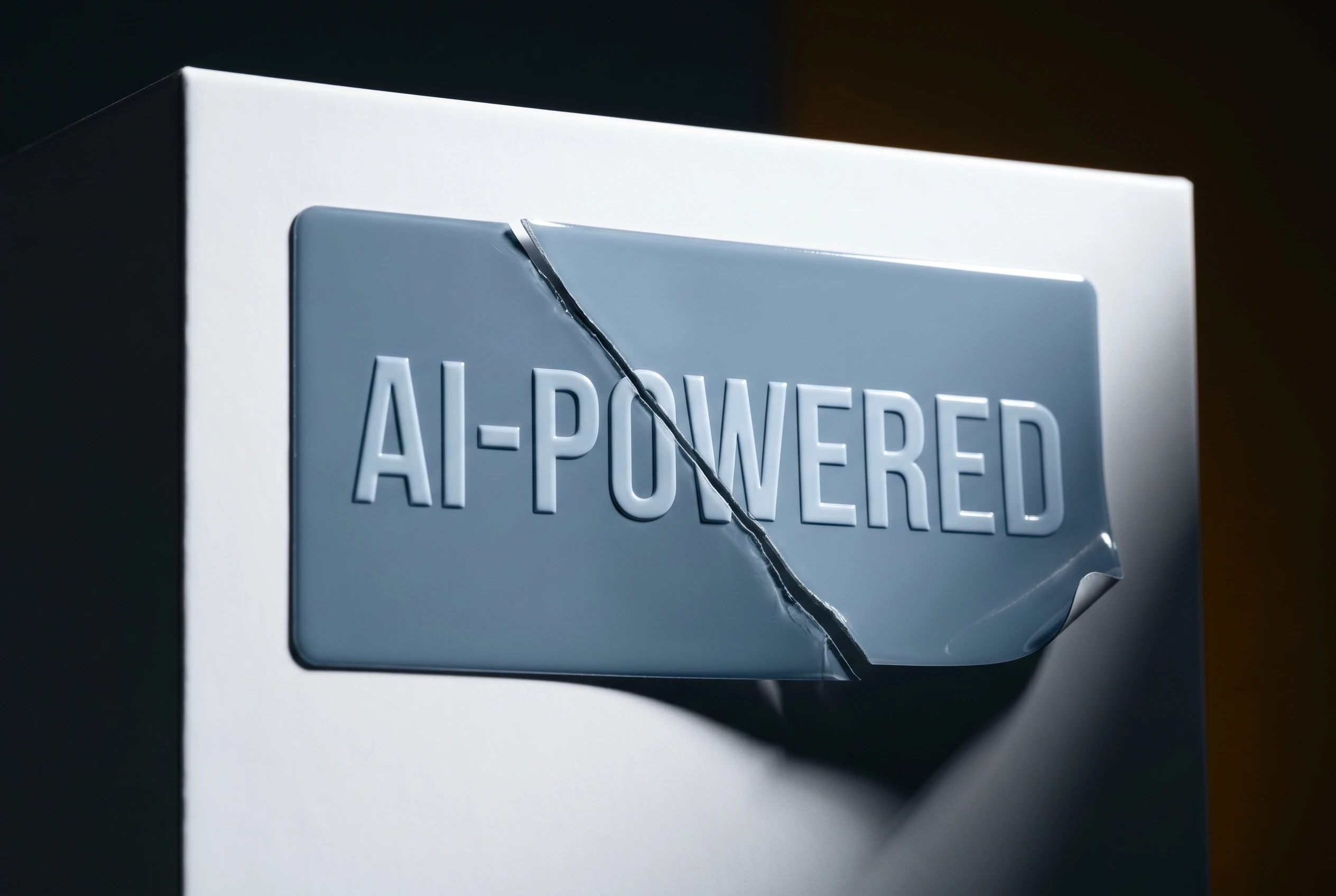
Why ‘AI-Powered’ Has Become a Marketing Liability
AI fatigue hit 54% of Americans as consumer excitement for the tech collapsed to 19%. Brands that led with ‘AI-powered’ labels are managing pulled campaigns and FTC scrutiny. The fix is selling outcomes, not technology.

Consumer enthusiasm for “AI-powered” features dropped from 50% to 19% in just two years, and the AI marketing backlash that brands once treated as a niche complaint has grown into something with measurable costs: pulled campaigns, regulatory scrutiny, and a trust gap that a quieter cohort is filling. Mentions of “AI slop,” shorthand for the low-quality generative content flooding digital platforms, surged ninefold in 2026 to 2.4 million, with 82% of those carrying negative sentiment. Merriam-Webster made “slop” its 2025 Word of the Year.
McDonald’s Netherlands pulled its AI-generated Christmas advertisement after audiences rejected it publicly, filling comment sections with dismissals. Amazon’s “Just Walk Out” checkout system, marketed as autonomous AI, was revealed in 2025 to rely on more than 1,000 offshore workers manually reviewing footage per transaction, per BBC reporting on the disclosure. The Federal Trade Commission (FTC, the US consumer protection agency) began formally asking brands whether they can demonstrate their AI claims live. A cross-section of industry executives now argues the more durable route is burying the technology in operations and advertising outcomes to consumers instead.
A Label That Became a Liability
Technology marketing terms run the same arc every cycle. “Eco-friendly” started as differentiation, became noise, and eventually required third-party certification to carry any weight. “Crypto-ready” lasted barely a year before it became a punchline. “Digital transformation” ran so long it stopped carrying information. Each followed the same path from genuine signal to saturation to skepticism, and the time between the first two stages has compressed with every generation of terminology.
“AI-powered” hit that turning point faster than any predecessor. Consumer excitement has fallen sharply over the past two years, per a 2026 analysis reported by Storyboard18, the Indian marketing trade publication, drawing on multiple consumer research studies. Several dimensions of the shift stand out:
- 54% of Americans report experiencing AI fatigue in 2026
- 52% of consumers reduce their engagement when they detect AI-generated content in their feeds
- 59.9% of consumers now doubt the authenticity of online content broadly
- 82% of Americans want businesses legally required to disclose AI use in marketing, content creation, and customer service
“AI slop” moved from niche insult to Merriam-Webster’s 2025 Word of the Year in under twelve months. The ninefold mention surge to 2.4 million instances in 2026, with 82% of those carrying negative sentiment, tracks what a peer-reviewed study on AI washing and consumer trust cycles formalizes as a self-reinforcing loop: exaggerated claims inflate expectations, unmet expectations generate backlash, and each wave reduces tolerance for the next AI label in the market.
Ajay Varma, Managing Partner at 0101.Today, the Indian digital strategy consultancy, describes the saturation directly. “Today, there are enough examples like AI Astrology, AI Pillow and Kundli Apps, or AI Skin and Hair Diagnosis Apps, where companies are merely using AI to be part of the race, rather than bringing much value,” Varma says. The FTC published guidance asking whether brands can demonstrate AI claims accurately, whether AI products outperform non-AI versions, and whether the product contains actual AI at all.
The Campaigns That Got Pulled
Several brands that competed hardest on the AI-powered label made the cost concrete and public.
McDonald’s Netherlands produced an AI-generated Christmas advertisement hitting every expected convention: snow, warmth, a seasonal sale pitch, familiar holiday chaos. Audiences identified the work as machine-made and flooded comment sections with “AI slop” dismissals, driving an early campaign withdrawal. McDonald’s Netherlands confirmed to several publications that it pulled the ad, describing the experience as “an important learning” as it re-evaluates how it deploys generative tools.
Three other cases that became industry reference points:
- Amazon’s “Just Walk Out” checkout, marketed as autonomous AI allowing shoppers to exit without any register interaction, was revealed to rely on more than 1,000 offshore workers in India reviewing camera footage to verify each transaction. Amazon discontinued the technology at its own retail stores in 2025.
- Ryanair’s AI chatbot, positioned as intelligent automated support, was found to run on simple keyword-matching rules, a case now cited in academic research on AI washing and digital legitimacy as representative of the wider credibility gap between AI claims and actual operations.
- Industrial Light and Magic, the visual-effects studio, hosted a talk on AI use in production and was publicly condemned by audiences accusing the company of abandoning craft for automation. Industry observers described the reaction as broadly representative of creative industry sentiment.
The Nuremberg Institute for Market Decisions, the German consumer research institution, put a formal number to the mechanism in a 2025 study: simply labeling an advertisement as AI-generated reduced ad attitudes and willingness to purchase, even when the creative was otherwise identical to a human-made version. The label itself carried a penalty, before any quality judgment was possible.
Invisible AI, Visible Results
iHeartMedia, the US audio company operating more than 850 stations, turned the consumer preference into an explicit brand commitment. Chief Programming Officer Tom Poleman issued an internal memo in late 2025 formalizing iHeartMedia’s “Guaranteed Human” editorial strategy as a core part of its on-air identity, embedded in hourly station IDs and promotional sweepers. The company’s own research found that 90% of its listeners, including those who use AI tools, want media created by humans. Poleman’s memo acknowledged that iHeartMedia uses AI for scheduling, audience insights, and workflow automation; the pledge covers creative content and on-air personalities, with the operational layer invisible to listeners.
Much like ‘digital’ or ‘cloud’ eventually became invisible infrastructure, AI too is moving into the background of consumer and enterprise expectations. Brands must shift toward communicating tangible business outcomes: speed, efficiency, personalisation, and reliability.
Pramod Pawar, Quantitative Research Vice President at Hansa Research Group, the Mumbai-based consumer research firm, is the source of that framing. What the iHeartMedia commitment demonstrates at the product level is the same principle operating as business architecture: move the technology to the foundation, surface the human experience at the front.
Raahul Seshadri, Director of AI and Tech at WebEngage, the customer engagement platform, describes the target state as “invisible AI”: hyper-personalized email timing driven by behavioral prediction models, machine-learning triage routing support tickets to the right agent, recommendation engines running behind a human-curated interface. The consumer experiences a faster, more relevant outcome without any signal about what produced it.
Varun Kashyap, founder of Zithara.AI, the customer engagement startup, argues that information access and processing speed have both been commoditized, and the premium available to human-led brands now rests on creative and cultural choices that behavioral models can optimize around but cannot generate.
Outcomes Over Architecture
Pankaj Srivastava, founder and chief executive of UnoSearch, the AI search optimization firm, applies one test to every marketing claim his company makes: if a team member cannot demonstrate the capability live in 60 seconds to a client, the label comes off. No roadmap ambitions, no feature descriptions, nothing that can’t be shown on a live screen in real time.
UnoSearch stopped describing itself as an “AI-powered SEO” platform. It now tells prospective clients it helps brands appear inside ChatGPT answers, a claim verifiable in an open browser in under a minute. “Vague AI claims decay,” Srivastava says. “Specific AI outcomes compound.” The company’s DigiOps reporting platform gives clients direct dashboard access to automated strategy performance in real time, making client-side verification the default rather than the exception.
Pramod Pawar of Hansa Research Group advocates a structural fix at the organizational level. Every AI-related marketing claim should pass a cross-functional review involving product, engineering, legal, and marketing teams, checked against demonstrably live functionality and not against the product roadmap. The governance failure most brands encounter, Pawar argues, is that marketing moves faster than product: the claim enters the market before the capability is ready to demonstrate, and the gap between the two is where the liability accumulates.
Kartik Mehta, Chief Business Officer and Head of Asia at Channel Factory, the brand suitability platform, draws the operational division explicitly: human-driven creative covers messaging, emotional framing, and artistic direction; AI-powered scale and suitability runs behind the scenes, analyzing placement environments to ensure brand-safe, contextually aligned delivery for those human-made campaigns. “An over-reliance on automated content creation invariably triggers a trust deficit,” Mehta says, adding that Channel Factory’s architecture treats the two layers as distinct and complementary rather than interchangeable.
Where the Trust Dividend Lives
The consumer backlash against AI labels and the consumer preference for AI recommendations coexist in the same market, serving the same shoppers. The data that separates the two behaviors comes from conversion analytics, not brand sentiment surveys.
A 12-month Google Analytics study by Visibility Labs, covering 94 e-commerce sites through 2025, found that ChatGPT-referred shoppers converted at 31% higher rates than non-branded organic search: 1.81% versus 1.39%, outperforming organic in 10 of the 12 months analyzed. Similarweb data across a broader e-commerce sample found AI referral traffic converting at 11.4% against 5.3% for organic search. Visibility Labs attributes the gap to “intent compression”: users arrive at a product page from an AI recommendation having already compared alternatives and refined their requirements inside the conversation. By the time they click through, the consideration stage is largely complete.
The three positioning strategies most visible in the current market produce measurably different outcomes:
| Strategy | Claim example | Consumer-verifiable | Trust signal |
|---|---|---|---|
| AI-label marketing | “AI-powered customer experience” | No | Purchase intent drops on disclosure (Nuremberg Institute, 2025) |
| Outcome-led claims | “Resolves tickets 40% faster via ML triage” | Yes, in 60 seconds | Attributable, auditable in real time |
| AI in recommendation engines | Platform-driven product surfacing (ChatGPT, etc.) | N/A to consumer | 31% higher conversion than non-branded organic search |
Srivastava describes the gap in commercial terms: the conversion premium from AI recommendations comes from those recommendations feeling like knowledgeable guidance to users who sought them out. The same consumers, encountering an “AI-powered” badge on the product itself, register the response the Nuremberg Institute measured: reduced purchase intent, present before any quality judgment is made. The variable in both cases is whether the consumer encountered the AI or was told about it.
The brands now capturing that conversion premium are those that never made “AI-powered” the pitch in the first place.


Edge AI Forces Hybrid Data Centers Into a Split Reality

Qi2 25W Magnets Quietly Rewrite Desk and Car Charging

Spotify AI Persona Badges Wall Off Synthetic Discovery

GCCs Build AI Bullet Trains on Incomplete Data Tracks

Coreum Bridge Multisig Signed Off on Its Own 200k XRP Drain

AI Shrinks Solar Inspection Crews While Paying Hybrid Skills Far More

Intel Graphics Driver Fixes Still Fight Windows and OEMs

Codex Now Runs Your Mac Apps and Remembers Across Days

Mercado Takes DOH as Dual Leadership Faces Health Funding Test

Gmail Keeps Breaking in iPhone Mail for a Deeper Reason

Fable 5 and Mythos 5 Return as US Lifts Anthropic Export Controls

Oracle Cuts 21,000 Jobs in a Year, Cites AI in 10-K Filing

SpaceX’s Google Deal Turns a Rocket Company Into a Cloud Landlord

CD Projekt Red Co-CEO: Redemption Arc Isn’t Done, Witcher 4 in 2027

XPL Rallies 30% Ahead of Plasma One Card Tier Launch

Google Search Profiles Build a Follow Graph Inside Discover

DGO App Brings Rs 549 Mobile Pass for FIFA World Cup 2026 in Nepal

Moonshot AI Targets $30 Billion in China’s Fastest AI Funding Sprint

Microsoft Xbox Layoffs Start in July as Sharma Slams 3% Margin

Oppo’s ColorOS 17 Eligibility List Leaves A-Series Buyers Behind
-
 AI1 month ago
Fable 5 and Mythos 5 Return as US Lifts Anthropic Export Controls
-
 AI2 months ago
Oracle Cuts 21,000 Jobs in a Year, Cites AI in 10-K Filing
-
 AI2 months ago
SpaceX’s Google Deal Turns a Rocket Company Into a Cloud Landlord
-
 GAMING2 months ago
CD Projekt Red Co-CEO: Redemption Arc Isn’t Done, Witcher 4 in 2027
-
 CRYPTO2 months ago
XPL Rallies 30% Ahead of Plasma One Card Tier Launch
-
 NEWS2 months ago
Google Search Profiles Build a Follow Graph Inside Discover
-
 APPS2 months ago
DGO App Brings Rs 549 Mobile Pass for FIFA World Cup 2026 in Nepal
-
 AI2 months ago
Moonshot AI Targets $30 Billion in China’s Fastest AI Funding Sprint