
AI
Siri AI Ships September 14 as a Gated Beta
Apple’s rebuilt Siri AI reaches iPhones on September 14 as an English beta, with Europe locked out and a $250 million delay settlement still open.

Apple will ship Siri AI as an English-only beta with iOS 27 on September 14, 2026, two years after it first promised a rebuilt assistant. The company confirmed the date at its Surprise and Shine event on September 9, and its iOS 27 page now says the new Siri is rolling out in English, with usage limits that may apply.
That is the end of the wait that started at WWDC 2024. It is also a narrower landing than the June demos implied, because the assistant still carries a beta label, a hardware floor, and a map with two giant holes.
An English-Only Beta Arrives on September 14
Siri AI is the rebuilt assistant Apple showed on June 8 at WWDC 2026, powered by the next generation of Apple Intelligence. Craig Federighi, Apple’s senior vice president of Software Engineering, called it a dramatically more capable and conversational assistant designed to help people find information and get things done through the day. Developer testing opened the same day on iOS 27, iPadOS 27, macOS 27, and visionOS 27. A public beta followed on July 14. The September 14 build is the first one that lands on regular iPhones.
It does not land on every iPhone that can install iOS 27. Apple’s June note limits Apple Intelligence and Siri AI to iPhone 16 models or later, plus iPhone 15 Pro and iPhone 15 Pro Max. iOS 27 itself still runs back to iPhone 11. Owners of a base iPhone 15 or anything older get the system update and keep the Siri they already have. Apple’s iOS 27 release notes add a second cut inside the yes list: the most expressive on-device voices, and the strongest on-device dictation, are reserved for iPhone Air and iPhone 17 Pro models and later.
iPhone 18 Pro and iPhone 18 Pro Max are eligible, but they will not be in pockets on September 14. Pre-orders opened September 12. Those phones ship September 18, four days after the software, so the first people to tap the new Siri app will be the ones already holding a 15 Pro or a 16.
WHO GETS SIRI AI ON SEPTEMBER 14
| Who | Siri AI on Sept. 14 | The limit |
|---|---|---|
| iPhone 15 Pro, 15 Pro Max, iPhone 16 and later | English beta | Hardware floor in Apple’s June note |
| iPhone 11 through base iPhone 15 | No | iOS 27 installs; old Siri stays |
| EU iPhone, iPad, and Apple Watch | No | DMA dispute; Apple has published no date |
| EU Mac and Vision Pro | Yes, in a supported language | The exception in Apple’s DMA update |
| China | No at launch | Apple has said the assistant will not ship there yet |
| French, Japanese, Korean, Portuguese, Spanish | October | After the English beta |
Apple has said it will expand languages quickly. French, Japanese, Korean, Portuguese, and Spanish are the five it has put on the October list. Until then, a supported phone set to English is the ticket in.
What Siri AI Can Do on Day One
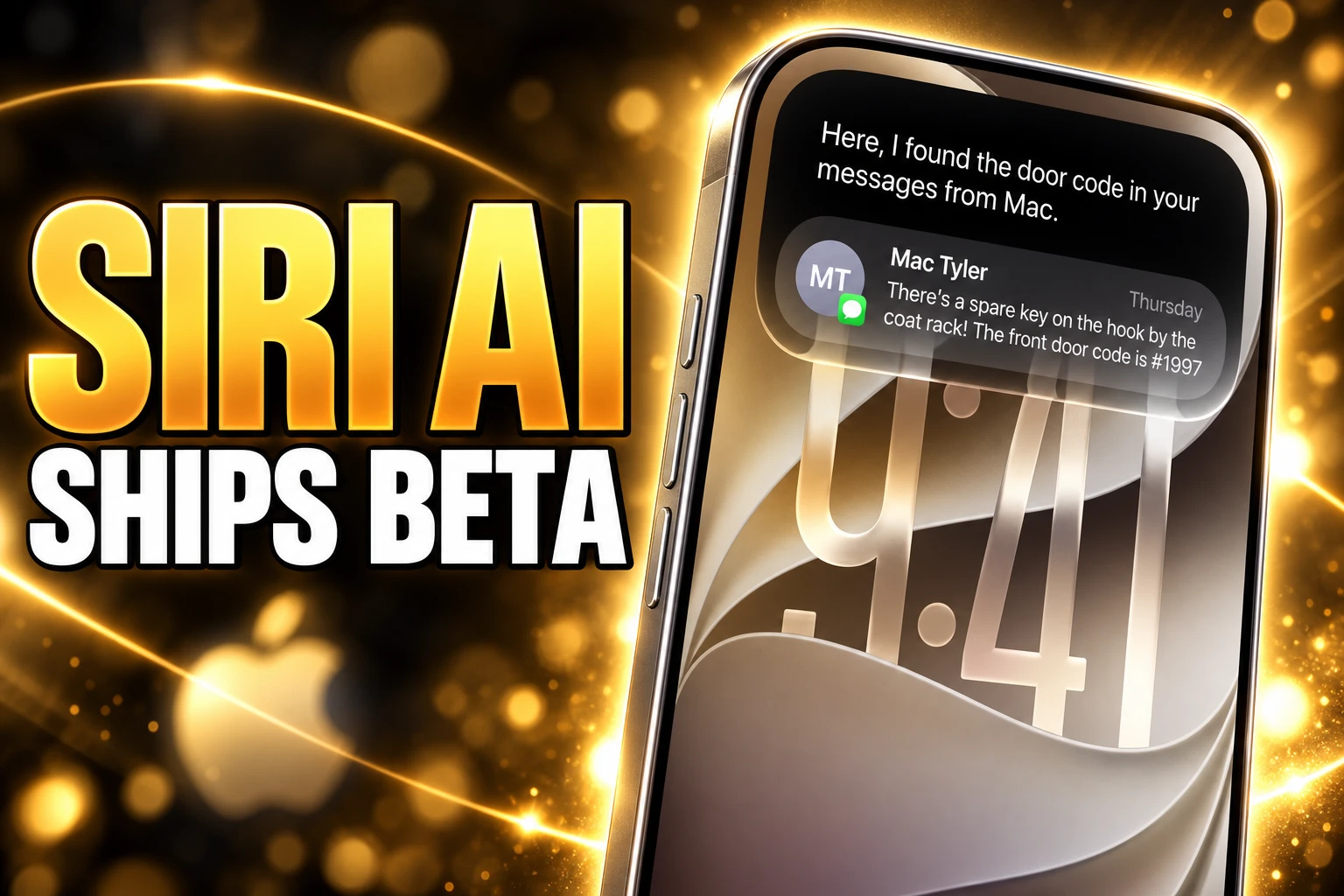
The June demos are the product that is supposed to show up in the beta. Apple says the new Siri can hold a back-and-forth chat, read what is on the screen, pull live answers from the web, and use personal context across messages, mail, and photos. A friend texts a restaurant name. An old email holds a hotel confirmation. A trip lives in Photos. Those are the examples Apple keeps using, because they are the jobs the 2011 Siri never learned.
WHAT THE FIRST BUILD IS SUPPOSED TO HANDLE
- Personal search: Siri looks through Messages, Mail, Photos, and other on-device stores to answer questions about a user’s own life.
- Onscreen awareness: It can talk about what is already on the display, then take a next step, such as dropping a recipe into Notes after a potluck text.
- App actions: It can draft an email from scratch, or edit and share a set of photos, without the user hopping through menus.
- A dedicated app: Conversation history syncs over iCloud, so a chat that starts on a Mac can continue on iPhone, iPad, Watch, or Vision Pro.
- Camera Siri mode: On iPhone, a new Camera mode lets Siri see what the viewfinder sees, including jobs like splitting a bill with Apple Cash or reading a plate of food.
- Writing in place: Siri can generate a draft, revise on command, match the tone a user already uses with a given contact in Mail and Messages, and proofread across most third-party apps.
iPhone users can still say “Hey Siri,” press the side button, or swipe down from the Dynamic Island. On iPad and Mac, the assistant sits inside Spotlight. On Vision Pro, Apple says people can look at a floating Siri object and start talking. Visual Intelligence, once an iPhone extra, comes to iPad screenshots, a Mac keyboard shortcut, and objects in a Vision Pro space.
With access to broad world knowledge for up-to-date answers on virtually any topic, along with onscreen awareness and personal context understanding, Siri AI can help users take action across apps more naturally than ever.
Craig Federighi, senior vice president of Software Engineering, Apple newsroom, June 8, 2026
Under the hood, Apple describes a split that keeps the privacy pitch intact on paper. Next-generation Apple Foundation Models run on the device and on servers using Private Cloud Compute. When those servers handle a request, Apple says personal data is not stored and is not accessible to Apple or anyone else, and outside experts can keep checking that claim. A system orchestrator is supposed to tap Spotlight and an App Toolbox entirely on the device. Apple’s public pages do not name Google. The rebuilt stack has still been widely described as a Siri overhaul that runs on Gemini, through a multi-year license reported at about $1 billion a year, with heavier reasoning routed in a way Apple still markets as Private Cloud Compute rather than as a rival’s chatbot bolted on.
Europe and China Keep the Old Assistant
The feature list is not the fight that followed WWDC. The map is. On June 8 Apple published a separate update blaming the Digital Markets Act for blocking Siri AI on iOS 27 and iPadOS 27 in the European Union. Mac and Vision Pro in the EU still get it in a supported language. Watch does not, because watchOS 27 Siri AI needs a paired iPhone that also has it. EU developers, Apple added, cannot test or use the new Siri features for their apps on iPhone, iPad, or Watch.
Apple said it has no date for closing that gap. The June update states there is no timeline for Siri AI on EU iPhones and iPads, and that the company will keep talking to EU regulators while it looks for a path that preserves privacy and security. Apple has also said Siri AI will not ship in China at launch.
That split is already showing up in how software gets made. Louisa Gareiss, an iOS developer and a 2023 Swift Student Challenge winner, said she had to leave the bloc to wire her app into the new assistant: “I had to fly to a non EU country just to add Siri AI Support because I had no way to test if it was working.” If that remains the workflow after September 14, EU iPhone users will install iOS 27 and still talk to last year’s Siri, while the apps they use are being taught new tricks on hardware that sits outside the union.
The $250 Million Bill for a Two-Year Delay
Monday’s beta is also the product Apple already paid to explain. In 2024 it showed a Siri that understood personal context, saw the screen, and drove apps. Those spots ran while iPhone 16 went on sale without the features. In March 2025 the company delayed the personalized Siri. On May 5, 2026, it settled a U.S. consumer class action for $250 million without admitting fault.
The class covers people in the United States who bought an iPhone 15 Pro, iPhone 15 Pro Max, or any iPhone 16 model, including iPhone 16e, between June 10, 2024, and March 29, 2025. Payouts are set at $25 per eligible device, and can rise as high as $95 per device if fewer claims come in. A judge gave the deal preliminary approval on July 24, 2026. Apple’s statement said it had already shipped many Apple Intelligence features and had settled claims tied to two additional ones so it could keep building products.
HOW THE TWO-YEAR SIRI DEBT STACKED UP
- June 10, 2024: Apple previews a personal, onscreen, in-app Siri as part of Apple Intelligence and starts the clock on the later class period.
- Fall 2024: iPhone 16 goes on sale without those Siri features, while other Apple Intelligence tools begin to arrive.
- March 2025: Apple delays the personalized Siri, and the class window closes on March 29, 2025.
- May 5, 2026: Apple settles the Landsheft case for $250 million, with no admission of fault.
- June 8, 2026: WWDC 2026 introduces Siri AI, opens developer betas, and posts the EU DMA delay.
- July 14, 2026: The iOS 27 public beta puts Siri AI on a wider set of English-language test phones.
- September 1, 2026: John Ternus becomes CEO, with Tim Cook moving to executive chairman after 15 years in the top job.
- September 14, 2026: iOS 27 ships, and Siri AI opens as an English beta on supported hardware outside the blocked markets.
Siri first showed up in 2011. Fifteen years later, the assistant still has to earn a label that is not beta. The settlement is the cash reminder of what happened when Apple advertised the 2024 version as closer than it was.
Third-Party Apps Stay Invisible Until Developers Index Them
Personal context is not a free pass through every icon on the Home Screen. Apple says that reach extends to third-party apps only when developers integrate with Spotlight. If a travel app, a bank, or a chat client never donates its objects, Siri can be fluent inside Mail and still blind inside that app. That is the unglamorous half of the June event, and it is the half that decides whether the assistant feels system-wide or Apple-only after September 14.
Apple’s developer documentation tells teams to wrap actions and content as App Intents, App Entities, and App Enums, then index app entities in Spotlight so semantic search can find them even when a user is vague. Schemas act as a contract with the system. Onscreen views can be tied to entities so someone can say “this photo” and be understood. Donated actions give the system a history to guess from. Sample code covers mail, calendar, music, and photos. None of that ships for a user unless the app maker does the work, and EU app makers still cannot do that work on iPhone.
A separate door never made the keynote. iOS 27 developer builds have pointed to a settings path that opens Siri to rival AI models, with Google, OpenAI, and Anthropic in the conversation. Apple did not show that switcher on June 8. Until it is on by default, the assistant that arrives on September 14 is Apple’s routing layer, not a picker on the model market.
John Ternus Inherits a Gated Launch
Ternus took over on September 1 and ran his first keynote eight days later. He used that stage to describe the iPhone as an intelligent personal hub that already knows a person’s calendar, relationships, and routines. “In other words, you would arrive at something remarkably familiar, because there’s no product in the world better designed to be your intelligent personal hub than iPhone,” he said. The software that is supposed to prove that line still arrives as a beta, in English, on a subset of the 2.5 billion Apple devices in the installed base.
WHAT WE KNOW
- The date: iOS 27 and the Siri AI English beta are set for September 14, 2026, as a free software update.
- The floor: Siri AI needs iPhone 15 Pro, iPhone 15 Pro Max, or iPhone 16 and later, including the new iPhone 18 models once they ship on September 18.
- The blocked markets: EU iPhone, iPad, and Watch users are out, with Mac and Vision Pro as the EU exception; China is out at launch.
WHAT IS UNCONFIRMED
- Opt-in: Apple has not said whether Siri AI appears the moment iOS 27 finishes installing or whether it needs a separate toggle.
- The caps: Apple’s iOS 27 page says usage limits may apply and has not published the numbers.
- The EU clock: Apple has still not attached a month, or even a year, to Siri AI on EU iPhones and iPads.
On September 18, iPhone 18 Pro and iPhone Duo start reaching buyers and boot into iOS 27. The assistant on those phones, and on the older Pro hardware that updates four days earlier, will still be the English beta Apple has been testing since June.

Google Says AI Agents Now Compress Thefts Into Hours

Average People Feel AI First on the Power Bill

Suno Turns the Warner Settlement Into Licensed v6 Models

Lunit Turns Routine H&E Slides Into a Lung Pre-Screen

Meta’s Muse Agent Wants Your Inbox and Your Card

Fable 5 Came Back Under a Commerce On-Off Switch

Google’s SpaceX GPU Lease Has a Sept. 30 Deadline

Plasma One’s XPL Locks Face a 1.81 Billion Cliff

DGO’s Rs 549 World Cup Pass Cost Fans Sleep and Data

Moonshot AI’s $30 Billion Ask Became a $35 Billion Close
-
 AI3 months ago
Fable 5 Came Back Under a Commerce On-Off Switch
-
 AI4 months ago
Google’s SpaceX GPU Lease Has a Sept. 30 Deadline
-
 CRYPTO4 months ago
Plasma One’s XPL Locks Face a 1.81 Billion Cliff
-
 APPS4 months ago
DGO’s Rs 549 World Cup Pass Cost Fans Sleep and Data
-
 AI4 months ago
Moonshot AI’s $30 Billion Ask Became a $35 Billion Close
-
 NEWS4 months ago
ColorOS 17 Device List Spans Oppo, OnePlus and Realme
-

 GAMING4 months ago
Xbox Cuts 3,200 Jobs After Five Years of Thin Returns
-

 GAMING3 months ago
The RTX 4050 Under Rs 70,000 Hides a Wattage Gap