
APPS
Apple Design Awards 2026 Winners Map the Road to WWDC26
Apple named its 2026 Apple Design Awards winners from 36 finalists, and the 12 apps and games hint at WWDC26 priorities: Vision Pro and Liquid Glass.

Apple announced the Apple Design Awards 2026 winners on June 2, honoring 12 apps and games chosen from 36 global finalists across six categories. One app and one game won in each. Winners include India’s Guitar Wiz, the puzzle game Blue Prince, and Cyberpunk 2077: Ultimate Edition, with the developers due to be recognized during WWDC26 on June 8.
Read the list straight and it looks like a celebration of clever indie work. Read it as a signal and it looks like something else: a roadmap for the keynote six days later. Two of the six app winners are built for Apple Vision Pro, Apple’s spatial headset, and two more lean on Liquid Glass, the translucent design system Apple shipped last year. That is the company telling developers where it wants the next year of building to go.
All 12 Winners, Listed by Category
The categories have been stable for a few cycles now: Delight and Fun, Inclusivity, Innovation, Interaction, Social Impact, and Visuals and Graphics. Apple picked one app and one game in each, and the full slate is laid out in the company’s 2026 Apple Design Awards announcement. Here is the complete table, with the studio and home country behind each title.
| Category | App winner (developer, country) | Game winner (developer, country) |
|---|---|---|
| Delight and Fun | grug (Ocho, Netherlands) | Is This Seat Taken? (Poti Poti Studio, Spain) |
| Inclusivity | Guitar Wiz (Bijoy Thangaraj, India) | Pine Hearts (Hyper Luminal Games, UK) |
| Innovation | NBA: Live Games & Scores (NBA Media Ventures, US) | Blue Prince (Dogubomb, US) |
| Interaction | Moonlitt: Moon Phase Tracker (Flipping Hues, Italy) | Sago Mini Jinja’s Garden (Sago Mini, Canada) |
| Social Impact | Primary: News in Depth (Wood Metal Rocks, US) | Consume Me (Jenny Jiao Hsia and AP Thomson, US) |
| Visuals and Graphics | Tide Guide: Charts & Tables (Condor Digital, US) | Cyberpunk 2077: Ultimate Edition (CD Projekt, Poland) |
The geographic spread is wider than the headlines suggest. Of the 12 studios, only five are based in the United States, with winners coming out of India, the Netherlands, Spain, Italy, Canada, the United Kingdom, and Poland. Susan Prescott, Apple’s vice president of Worldwide Developer Relations, framed the group this way.
This year’s Apple Design Award winners are a remarkable reflection of how developers are creating exceptional experiences. Whether delivering intuitive features or exciting gameplay, these apps and games represent the very best of what our platform makes possible.
Vision Pro Runs Through the Top App Categories
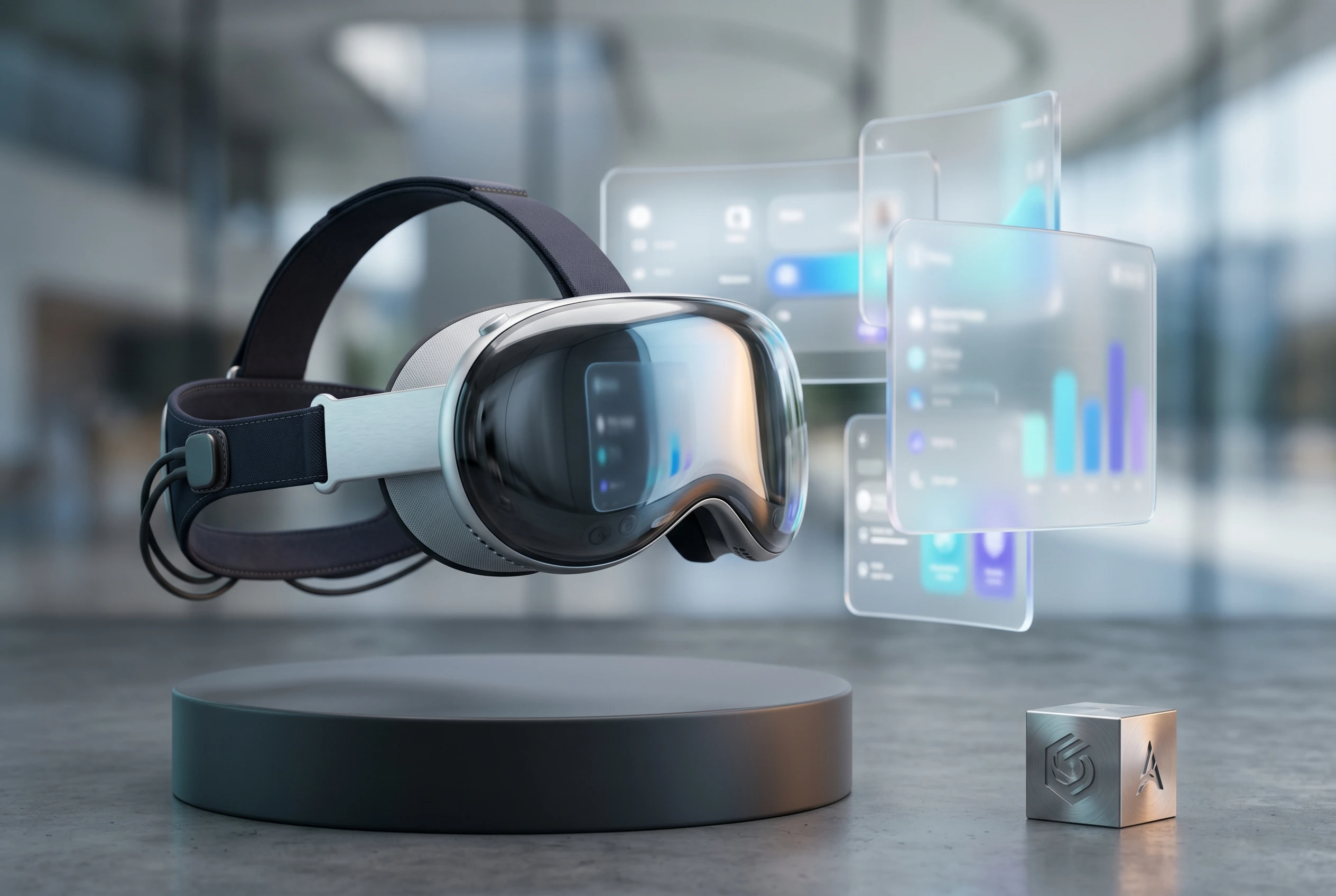
Look at where Apple placed its spatial winners. The Innovation app award and the Social Impact app award both went to titles built for Apple Vision Pro, the categories where Apple has the most room to make a point about platform direction. That is not an accident of timing. It is a curatorial choice from a company that controls every name on the list.
What the NBA App Does in Spatial
NBA: Live Games & Scores, built by NBA Media Ventures, took Innovation for its Vision Pro experience. The app lets fans watch up to five live games at once, follow floating real-time leaderboards, and see player movement rendered on a 3D court in a tabletop view. It also pipes games in Spatial Audio. These are the kinds of features Apple has been trying to sell as the reason a headset belongs in a living room, and handing the app an award puts a marquee sports brand behind that pitch.
Primary Puts News in 3D Space
The Social Impact app, Primary: News in Depth from Wood Metal Rocks, is also a Vision Pro title. It uses a spatial interface to arrange and present news stories, with a team of editors curating what surfaces. Apple has struggled to show everyday, non-game uses for the headset, and a calm reading-and-news app is exactly the sort of utility case the company wants third parties to model. The full winner write-ups, including these two, sit in the App Store editorial feature on the 2026 winners.
Liquid Glass Turns Up in the Craft Picks
The other pattern shows up in the two categories built around look and feel. Moonlitt: Moon Phase Tracker, the Interaction app winner from Italian studio Flipping Hues, and Tide Guide: Charts & Tables, the Visuals and Graphics app winner from Condor Digital, both got cited by Apple for their use of Liquid Glass, the translucent material that refracts what sits behind it and shifts to bring content forward.
That matters because of where Liquid Glass is in its life. Apple introduced the design language at last year’s developer conference and pushed it across iOS, iPadOS, macOS, watchOS, and tvOS, calling it the biggest visual change since iOS 7 in its 2025 design overhaul. A year in, plenty of apps still treat it as a coat of paint. By awarding two apps specifically for integrating it well, Apple is publishing a worked example of what good adoption looks like, days before it talks up the next version of the system on stage.
Moonlitt got the nod for an onboarding flow and interface that folds the material into a moon-tracking tool without making it gimmicky. Tide Guide pairs Liquid Glass with custom animations and an aquatic theme to turn dense marine and weather data into something a casual user can read at a glance. Both are small, single-purpose apps, which is part of the message: you do not need a big team to do this right.
How a Solo Developer in India Won Inclusivity
The most-shared winner outside the Apple faithful is Guitar Wiz, built by Bijoy Thangaraj, an independent developer in India who took the Inclusivity award. The app is a toolkit for guitar players that gives spoken instructions for pitch, tuning, chords, and finger placement, so a learner can follow along without staring at a screen the whole time.
Apple singled out how the app uses the accessibility features baked into its platforms, rather than building bespoke workarounds. The cited list:
- Dynamic Type, which scales text to a user’s preferred reading size system-wide
- Increased Contrast, which sharpens the line between foreground and background for low-vision users
- Differentiate Without Color, which adds shapes and labels so information is not carried by color alone
The win lands for two reasons. It is a one-person operation beating funded studios, and it is a developer outside the usual US and Europe clusters taking a top award. India has a large iOS developer base relative to its install share, and Apple has been courting that talent pool as it expands manufacturing and retail in the country. The game side of Inclusivity went to Pine Hearts, a UK cozy adventure from Hyper Luminal Games that was recognized for legible text, customizable controls, and adjustable motion and sensory feedback.
Why the Calendar Points at June 8
Apple times these awards every year, but the gap is unusually tight this cycle. The winners dropped on June 2, and the developers get their on-stage moment when WWDC26 opens on June 8. The conference is where Apple shows developers the next versions of its operating systems and, this year, where the industry expects the next evolution of its software look to surface.
Liquid Glass is widely reported to be heading into another refinement pass with the next OS releases, and Apple has already started rolling the material through its own properties, redesigning its developer app ahead of the show. The award winners give Apple living proof points to wave at: here is a Vision Pro app worth your time, here is what a small team did with the new material, now go build. For context on where the underlying software roadmap is pointed, the company’s longer-range plans have leaked through internal codenames, including reporting on Apple’s iOS roadmap and the 2027 supercycle.
There is also a quieter read for developers chasing the same recognition next year. The 36 finalists were public before the winners, and the categories barely move from cycle to cycle, so the signal is legible: build for the headset, master the new material, and use the accessibility tools already in the box. Apple’s full finalist and winner archive lives on the Apple Design Awards developer page.
Frequently Asked Questions
When were the 2026 Apple Design Awards winners announced?
Apple revealed the 12 winners on June 2, 2026. The developers will be formally recognized during WWDC26, the company’s developer conference, which begins June 8 in Cupertino.
How many apps and games won, and how were they chosen?
Twelve titles won in total, one app and one game in each of six categories: Delight and Fun, Inclusivity, Innovation, Interaction, Social Impact, and Visuals and Graphics. They were selected from a pool of 36 global finalists Apple named ahead of the awards.
Which Apple Design Award winner came from India?
Guitar Wiz, an all-in-one toolkit for guitar players developed by independent developer Bijoy Thangaraj, won the Inclusivity award. It gives spoken instructions for tuning, chords, pitch, and finger placement, and uses Dynamic Type, Increased Contrast, and Differentiate Without Color.
Which winners are built for Apple Vision Pro?
Two of the six winning apps run on Apple Vision Pro: NBA: Live Games & Scores, which won Innovation, and Primary: News in Depth, which won Social Impact. The NBA app lets users watch up to five live games at once with a 3D tabletop court view.
Did any major commercial games win in 2026?
Yes. Cyberpunk 2077: Ultimate Edition from Poland’s CD Projekt won Visuals and Graphics, and Blue Prince from Dogubomb won Innovation. The rest of the game winners are smaller studio releases, including Pine Hearts, Sago Mini Jinja’s Garden, Is This Seat Taken?, and Consume Me.
The trophies go out on June 8. The titles Apple chose to put under the lights tell developers what to build before they have heard a word of the keynote.


South Korea Retail Investors Face Reckoning After KOSPI AI Rally Collapses

Surrey AI Maps Three Heart Attack Paths and Their Molecular Roots

Germany Locks Neutral Apple ATT Prompts Across Most of Europe

Apple’s 5% EU Fee Quietly Rewrites Alternative App Store Math

Apple’s EU Fee Truce Cuts Complexity but Leaves Rivals Fuming

Pixel 11 Pro Fold Trades Thinness for Durability and Seven-Year Stay

Mayo AI Flags HCM Obstruction From Everyday Ultrasound Videos

Indian Brands Quietly Scale Landmark Screens and Home Tech

Navin Vatsa Turns Grief Into a Lifetime of Quiet Seeing

Google Bets Pixel 11 Agentic AI Will Redefine Phones

Oracle Cuts 21,000 Jobs in a Year, Cites AI in 10-K Filing

Fable 5 and Mythos 5 Return as US Lifts Anthropic Export Controls

SpaceX’s Google Deal Turns a Rocket Company Into a Cloud Landlord

CD Projekt Red Co-CEO: Redemption Arc Isn’t Done, Witcher 4 in 2027

XPL Rallies 30% Ahead of Plasma One Card Tier Launch

Google Search Profiles Build a Follow Graph Inside Discover

DGO App Brings Rs 549 Mobile Pass for FIFA World Cup 2026 in Nepal

Moonshot AI Targets $30 Billion in China’s Fastest AI Funding Sprint

Oppo’s ColorOS 17 Eligibility List Leaves A-Series Buyers Behind

Microsoft Xbox Layoffs Start in July as Sharma Slams 3% Margin
-
 AI2 months ago
Oracle Cuts 21,000 Jobs in a Year, Cites AI in 10-K Filing
-
 AI2 months ago
Fable 5 and Mythos 5 Return as US Lifts Anthropic Export Controls
-
 AI3 months ago
SpaceX’s Google Deal Turns a Rocket Company Into a Cloud Landlord
-
 GAMING2 months ago
CD Projekt Red Co-CEO: Redemption Arc Isn’t Done, Witcher 4 in 2027
-
 CRYPTO3 months ago
XPL Rallies 30% Ahead of Plasma One Card Tier Launch
-
 NEWS3 months ago
Google Search Profiles Build a Follow Graph Inside Discover
-
 APPS3 months ago
DGO App Brings Rs 549 Mobile Pass for FIFA World Cup 2026 in Nepal
-
 AI3 months ago
Moonshot AI Targets $30 Billion in China’s Fastest AI Funding Sprint