
AI
The Forced AI Draft Behind Zuckerberg’s Mistakes Memo
Zuckerberg’s mistakes memo followed a forced AI draft of 7,000 staff, a 50-to-1 span of control, and a cancelled second layoff wave.

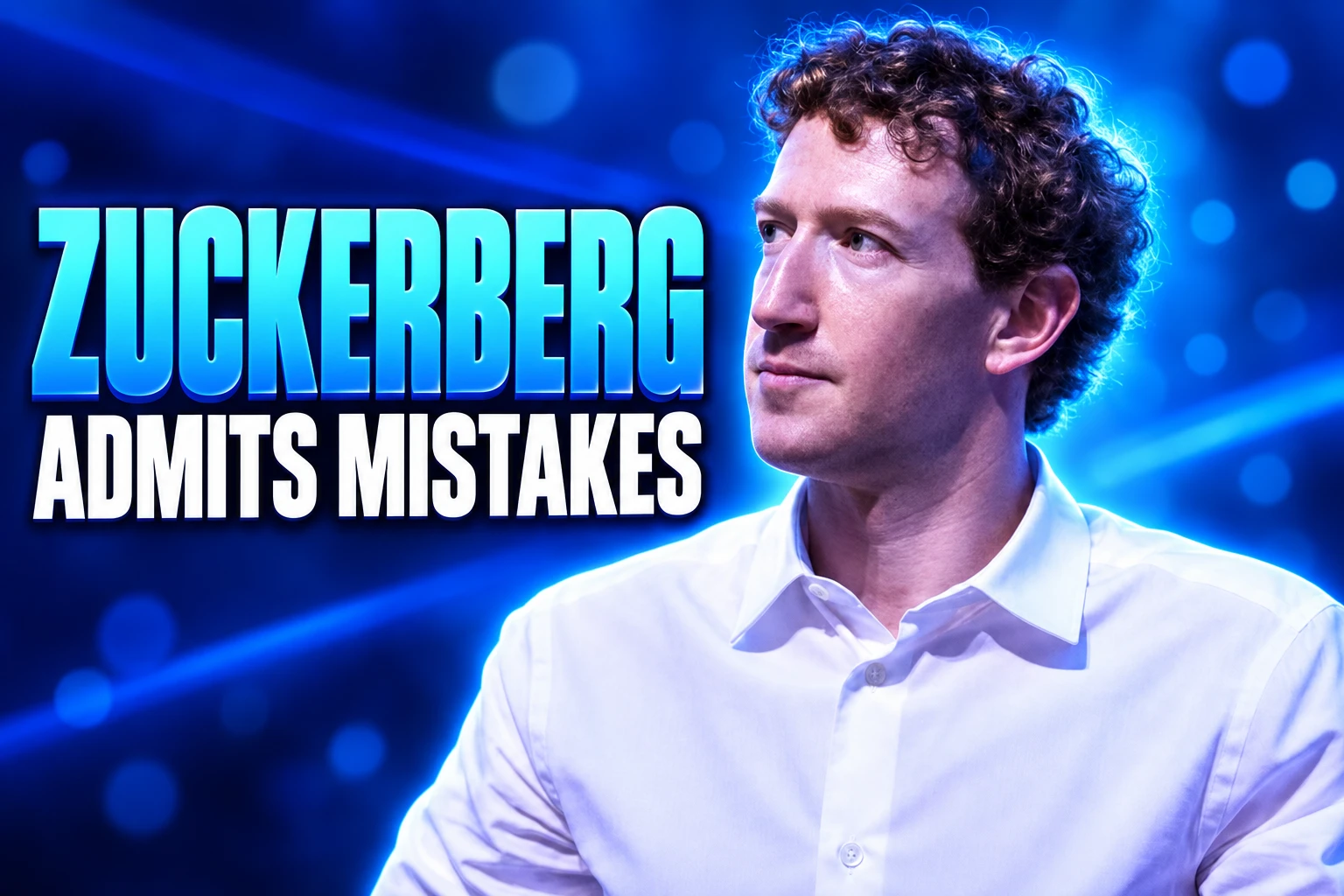
Mark Zuckerberg told Meta staff on June 12 that the company had “made mistakes” in its AI workforce shift, three weeks after cutting about 8,000 jobs and moving 7,000 people into new AI units.
The memo promised as much stability as he could give, and no more company-wide layoffs in 2026. It did not mention the program’s internal name, Project OT, or that he had already killed a second cut planned for November.
Project OT Was Built to Swap People for Agents
In January, Zuckerberg and his top lieutenants used their annual leadership retreat at his Hawaii compound to sketch an “AI native” company. Internal planning documents described virtual workers doing much of the daily work now done by thousands of people, with smaller “talent-dense” human groups supervising them.
Scenario planning went as far as cutting the size of many teams by as much as 60%. The work was meant to run in two waves, a first purge in May and another shake-up in November, with open jobs closed and weak performers pushed out along the way. Meta later confirmed Project OT existed, described it as a year-long effort on costs, team design, and moving staff into priority work such as producing training data, and said the starkest scenarios included some teams shrinking by up to 60%. It also said it never intended to lay off 60% of the whole company, and that leaders cancelled the second wave before they had even fixed how many people would lose their jobs.
THE PROJECT OT CALENDAR
- January 2026: Zuckerberg and senior leaders hatch Project OT at the Hawaii retreat.
- March 2026: Applied AI takes shape under vice president Maher Saba to feed Meta Superintelligence Labs.
- April 2026: Transfers into the new units accelerate, and U.S. staff laptops start carrying mouse-and-keystroke capture for model training.
- May 19, 2026: Hours before the first layoff emails, Zuckerberg calls off planning for the November wave.
- May 20, 2026: Meta begins cutting about 10% of staff, roughly 8,000 people.
- June 12, 2026: Zuckerberg sends the mistakes memo and says he wants organizational stability.
On May 18, chief people officer Janelle Gale told employees the May 20 cuts would arrive with a fresh org design built around AI workflows. “As org leaders worked on the changes, many of them incorporated AI native design principles into their new org structures,” she wrote. “We’re now at the stage where many orgs can operate with a flatter structure with smaller teams of pods/cohorts that can move faster and with more ownership.”
Headcount stood at 77,986 at the end of March, according to company filings Gale’s memo sat beside. Ten percent of that base is about 8,000 people. Gale said the layoffs and the transfers together would hit about 20% of staff. Meta also closed 6,000 open roles, a separate cut to the hiring pipeline, not part of that 20% figure.
Meta’s own statement on the planning exercise said teams were asked to model redeployments, closed roles, and cuts, “moving thousands of employees to do priority work on several newly-established teams,” and that “we didn’t move forward with every scenario from the exercise, and it was never assumed we would.”
The 7,000 People Who Got Drafted
Gale named the destinations: Applied AI Engineering, Agent Transformation Accelerator XFN, Central Analytics, and Enterprise Solutions. The first two sat under chief technology officer Andrew Bosworth as part of an “AI for Work” push to build agents that could do tasks humans still handle. Central Analytics was supposed to measure whether those agents actually raised output.
Staff called the moves a draft. An internal note to managers said Applied AI was “a high priority initiative, directly from Mark,” and that joining was not optional. Wired later described Applied AI as about 6,500 engineers and product managers assembled to support researchers at Meta Superintelligence Labs, a smaller slice of Gale’s 7,000-person transfer pool. Some people on the team were told to finish two tasks a week, writing software puzzles so scientists could train and score coding models.
One employee called the unit “literally the gulag.” Another said most people found the work soul-crushing. On an employee-only livestream open to thousands of staff, a speaker interrupted the call and asked the hosts to tell a Meta AI executive he was “a piece of shit.” Presenters asked everyone to mute and went back to the technical talk.
Work like AAI is critical to advancing our models and it lets very talented people contribute to those efforts while we create other roles they can contribute to around Meta over the coming months as well.
Mark Zuckerberg, CEO, June 12 internal memo
That line treated Applied AI as a waypoint. It also fitted a design Zuckerberg stated in the same note: new roles let Meta shrink teams, “knowing that if we make mistakes in some places, then we could transfer some people back.” The 7,000-person pool was a holding pen as much as a talent upgrade. Meta had already put $14.3 billion into Scale AI, a labeling specialist, then still pulled its own product engineers onto puzzle-writing and data work.
Fifty Engineers, One Manager
Applied AI was built to run with an ultra-flat span of control, up to 50 to 1 individual contributors per manager. An internal “AI-Native Playbook” went further for product work. Traditional groups of 10 to 20 specialists would become pods of 3 to 5 “builders” plus a direction lead, with designers, researchers, and data staff pooled across pods. Job titles for engineers and designers were supposed to blur. Middle layers would go.
Some units tried a “village” model in which org leads oversaw 30 to 50 people, while pod leads ran the day-to-day work with no formal manager tools. One pod lead wrote internally that they were not getting manager training or access to ratings systems. Meta said performance ratings and promotions “were and are made by people, not AI,” and that teams “experimented in different ways with how to be more agile.”
By the end of May, headcount in some engineering units was down as much as 30% from transfers and layoffs combined. Managers were a clear target. Some of the people moved into Applied AI had been managers and were dropped into individual-contributor seats.
Zuckerberg’s June memo said he had heard the complaints about widened oversight and planned to scale the practice back. He also said budgets for offsites and corporate events would rise, many offices would get assigned desks again by year end, and a large hackathon in July would try to put teams on the latest models together. Ime Archibong, a vice president of product management, later put the hackathon on the calendar for July 14 to 16 and said it would focus “exclusively on AI Innovation.” One staffer wrote, “I’m literally preoccupied with keeping the lights on for my team.”
Why the Agents Did Not Arrive on Time
The org chart assumed agents would take over daily work fast enough to justify smaller human teams. Internal data did not cooperate. In a June internal post, Bosworth recorded that code changes on internal platforms and infrastructure were up 220% from a year earlier. Changes that reached users as new or upgraded features were up 36%.
INTERNAL PRODUCTIVITY READINGS
- Code volume: Internal platform and infrastructure changes were up 220% year on year in Bosworth’s June post.
- User-facing work: Changes that landed as new or upgraded features were up 36%.
- Breakage: Major technical and security incidents were up 40% from a year earlier.
- Cleanup time: Time staff spent firefighting those incidents was up 70%.
More commits did not mean more product. An April internal post warned that unchecked agents were taking “large-scale, disruptive actions that humans are unlikely to execute.” Meta’s half-year Pulse survey put favorable employee sentiment at 55%, down from 74%.
Bosworth, on a June 2 “Tuesdays with Boz” call, told staff morale was “probably one of the worst it’s ever been,” with Cambridge Analytica the only comparison that came to mind. At Instagram, chief product officer Chris Cox called the stretch “brutal” and likened it to “running a marathon in the middle of a hailstorm.” He said AI “is neither god, nor is it the devil,” and that “it’s nowhere near as good as you think it is, and it is nowhere near as bad as you think it is.”
In early July, Zuckerberg told staff the trajectory of agentic development over at least the prior four months “hasn’t really accelerated in the way that we expected,” and that bets on the new structure “haven’t come to fruition yet.” He said leaders had miscalculated the timing, and that he still expected more benefit within three to six months. Meta told investigators later that data from Applied AI had already helped train a model released in July, so the factory produced something. It did not produce the smaller company Project OT had drawn on the whiteboard.
A $130 Billion Bill Beside an 8,000-Person Cut
The people math sat next to a compute bill that kept rising. Meta entered 2026 guiding capital spending to $115 billion to $135 billion. After first-quarter results on April 29 it raised that range to $125 billion to $145 billion. On July 29 it narrowed the floor again. The company’s results release now puts 2026 capital expenditures of $130 to $145 billion, including principal payments on finance leases, against $72.2 billion spent in 2025.
THE CAPEX CLIMB
| Checkpoint | Capital spending |
|---|---|
| Start of 2026 guidance | $115 billion to $135 billion |
| April 29 revision | $125 billion to $145 billion |
| July 29 revision | $130 billion to $145 billion |
| Second-quarter spend | $31.08 billion |
| Full-year 2025 actual | $72.2 billion |
Second-quarter revenue was $60.8 billion, up 28%. Free cash flow in the same quarter was $784 million, down from $8.5 billion a year earlier, after that $31.08 billion of capital spending. The company also booked $2.4 billion in charges tied to legal proceedings and raised its 2026 expense outlook to $165 billion to $169 billion. Cash, cash equivalents, and marketable securities were $90.26 billion as of June 30.
Impacted staff in May were told the headcount reduction was part of running the company more efficiently “and to allow us to offset the other investments we’re making.” Zuckerberg’s prepared line on the July results was that AI is “accelerating our core business today, powering our next generation of products, and opening the door to entirely new enterprise opportunities.” In the June memo he said the products would range from more personalized Facebook and Instagram to tools for small businesses and personal agents that work around the clock, a bet that now shows up in consumer software such as the Muse agent Meta is wiring into checkout.
He has kept that public product story going even while the internal agent plan lagged, including a public pitch for Meta’s cheapest AI. The workforce experiment and the infrastructure checkbook were supposed to be one strategy. Only the checkbook stayed on its original path.
What Zuckerberg Walked Back After May
The night of May 19 is the hinge. Meta still cut 10% the next morning. It stopped planning the November wave before those emails had even gone out. From that point the company spent the summer taking pieces of the AI-native design back off the table, without putting Project OT’s original org chart back in place.
WHAT META HAS UNWOUND
- Second wave: Planning for the November shake-up is cancelled hours before the May 20 notices.
- Mouse tracking: On June 22, spokesperson Tracy Clayton said Meta was pausing the Model Capability Initiative while it investigated a data-security report, after more than 1,600 employees signed a petition against the tool.
- The draft: Some Applied AI staff are later allowed to transfer back to old teams, and a later note tells remaining engineers the company will “defer to each individual’s choice.”
- Span of control: Zuckerberg says he will scale back the widened manager ratios that hit 50 to 1 on Applied AI.
- Layoff pledge: He repeats that he does not expect more company-wide layoffs in 2026, a promise that covers the rest of the year and does not speak to 2027 or team-level cuts.
Clayton said the tracking program had been “carefully designed” with privacy safeguards, and that Meta had “no indication at this time that any data was improperly accessed by Meta employees.” The pause still followed a high-priority security incident filed by a staffer, and it followed weeks of flyers, Workplace posts, and employees answering executive notes with pictures of elephants, a visual stand-in for the layoff talk leaders would not have.
CFO Susan Li was sent to boost perks. Offsite budgets went up. Assigned desks were promised. The July hackathon was framed as camaraderie. None of that restored the old bargain in which Meta engineers picked their teams. It did mark the end of the idea that agents would make a second, deeper cut safe in the same calendar year.
The Same Team Is Being Asked to Manage Again
On September 10, Meta began asking some individual contributors in Applied AI to move back into management. The program is voluntary. Some of those people had been managers before they were dropped into the unit as individual contributors. Meta declined to comment.
That ask sits on top of the June memo, not in place of it. Zuckerberg already wrote that the new roles existed so Meta could shrink teams and still move people back if the chart was wrong. In September the company started using that valve on the very span of control Applied AI had advertised as the future.
Project OT still produced a smaller payroll, a training-data factory, and a compute budget at the top of Big Tech. It did not produce the agent-run company drawn up in Hawaii. The mistakes memo is what that gap looks like when it reaches the CEO’s inbox.

Lunit Turns Routine H&E Slides Into a Lung Pre-Screen

Meta’s Muse Agent Wants Your Inbox and Your Card

Police Chase Mules as AI Chatbots Run Romance Scams

ChatGPT Mil and Grok Take the Desk Anthropic Lost

Chewy Turns Vet Clinics Into the New Pet Aisle

Fable 5 Came Back Under a Commerce On-Off Switch

Google’s SpaceX GPU Lease Has a Sept. 30 Deadline

Plasma One’s XPL Locks Face a 1.81 Billion Cliff

DGO’s Rs 549 World Cup Pass Cost Fans Sleep and Data

Moonshot AI’s $30 Billion Ask Became a $35 Billion Close
-
 AI3 months ago
Fable 5 Came Back Under a Commerce On-Off Switch
-
 AI3 months ago
Google’s SpaceX GPU Lease Has a Sept. 30 Deadline
-
 CRYPTO3 months ago
Plasma One’s XPL Locks Face a 1.81 Billion Cliff
-
 APPS3 months ago
DGO’s Rs 549 World Cup Pass Cost Fans Sleep and Data
-
 AI3 months ago
Moonshot AI’s $30 Billion Ask Became a $35 Billion Close
-

 NEWS3 months ago
ColorOS 17 Device List Spans Oppo, OnePlus and Realme
-

 GAMING3 months ago
Xbox Cuts 3,200 Jobs After Five Years of Thin Returns
-

 GAMING3 months ago
The RTX 4050 Under Rs 70,000 Hides a Wattage Gap