
GADGETS
OpenAI’s $230 Codex Micro Ships While Its Bigger Hardware Bet Sits in Court
OpenAI shipped its first hardware product, a $230 Codex Micro keyboard built with Work Louder, as Apple’s trade secret lawsuit clouds its bigger device plans.

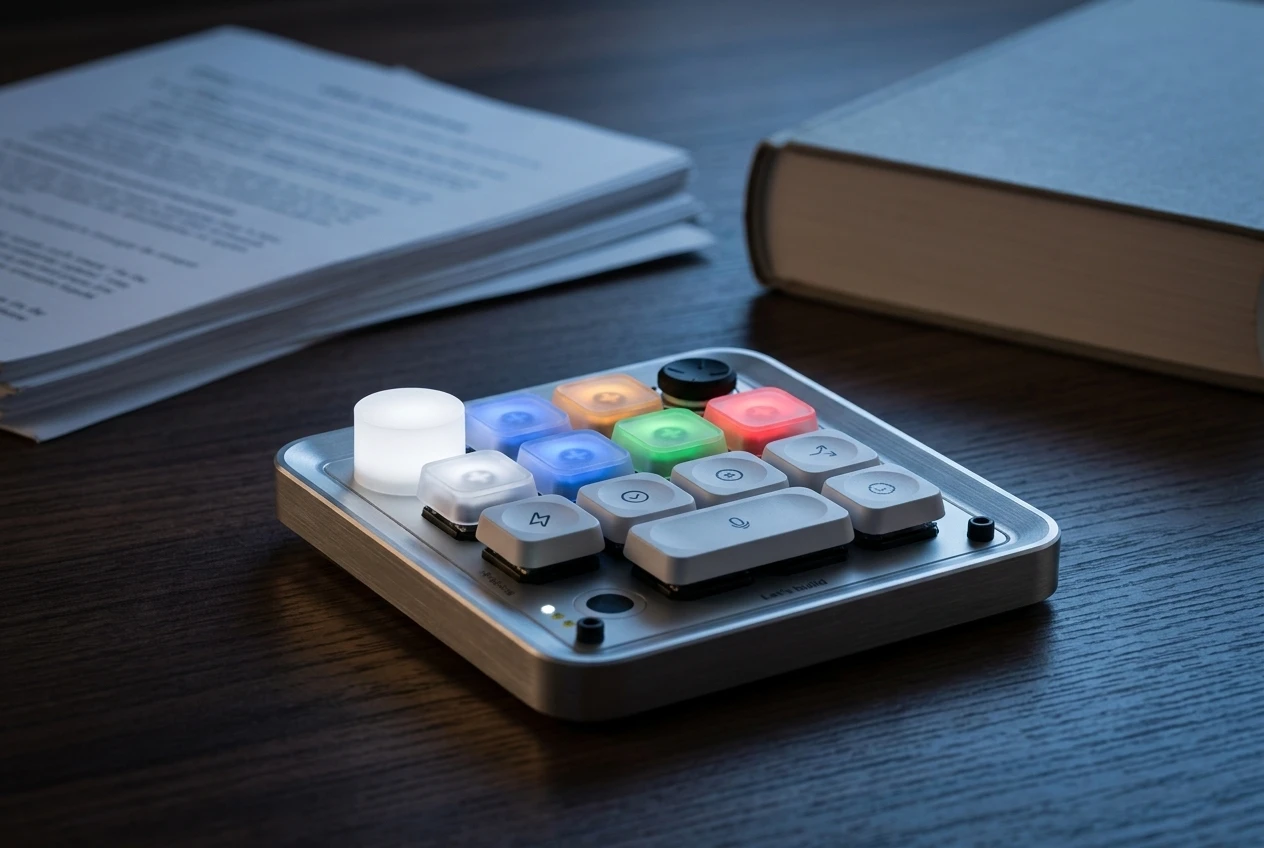
OpenAI shipped its first branded hardware product this week: a $230 programmable macropad called the Codex Micro, built with Montreal keyboard maker Work Louder for developers running AI coding agents. Six backlit keys on top glow to show what an agent is doing before anyone opens the app. Orders are live on OpenAI’s Supply Co. page, with the first units shipping July 24.
The larger question is whether OpenAI can plant a lasting flag on developer desks while its marquee hardware bet, a screenless AI companion designed with former Apple engineers, sits tangled in a federal lawsuit.
Six Lights Meant to Kill the Alt-Tab
The device itself is a small, square macro pad built on 13 low-profile mechanical switches, a rotary dial, a capacitive touch sensor and a tiny joystick, matching the chassis of Work Louder’s existing Creator Micro 2.
Buyers choose clicky or silent switches. Both are rated for 50 million keystrokes at roughly 40 grams of actuation force and 2.8 millimeters of travel, according to OpenAI’s own listing.
Connectivity runs through USB-C or Bluetooth Low Energy. An LED-lit acrylic edge strip circles the device and glows whenever the microphone is active, a small cue against leaving a live channel open by accident.
What separates the Codex Micro from a Stream Deck or any other shortcut box is what happens inside its six Agent Keys. Those devices fire keystrokes at whatever window happens to be in focus. The Codex Micro’s keys instead receive live data pushed from Codex itself, through a bidirectional protocol OpenAI calls its App Server.
A single tap on an Agent Key selects that thread. A double tap brings it to the foreground. The color already told the developer what happened before a finger touched anything.
The joystick, by default, triggers common workflows: reviewing a pull request, debugging an error, refactoring a block of code. The rotary dial does something different, sliding Codex’s reasoning effort up for a hard problem or down for something trivial, without opening a settings menu.
OpenAI capped the dashboard at six keys, about as many parallel agent threads as one developer can realistically track at once. Run a seventh agent, and it simply does not get a light.
| Thread State | LED Color | What It Tells the Developer |
|---|---|---|
| Idle | White | Nothing queued for this agent right now |
| Thinking | Blue | Agent is actively reasoning through the task |
| Awaiting input | Amber | Needs approval or a decision to continue |
| Done | Green | Task finished and ready for review |
| Error | Red | Something broke and needs attention |
Every one of those signals depends on a piece of software running quietly in the background, which is where the device’s real limitation shows up.
Does Codex Micro Work Without the ChatGPT Desktop App?
Mostly, no. The standard keys, accept, reject, push-to-talk and new chat, send ordinary keystrokes that work in any application. But the six Agent Keys stay dark unless the ChatGPT desktop app is running as the bridge that turns Codex’s thread state into light, so developers working only in the CLI, VS Code or a browser never see live status at all.
OpenAI folded Codex into a unified ChatGPT desktop app on July 9, under the ChatGPT Work banner. Anyone who updated on or after that date is already running the software the Agent Keys need. Anyone still on an older Codex client has to update first.
The six-key ceiling has its own workaround, sort of. Owners can wire the keys to pinned tasks, the most recent threads, or whichever agents are waiting on a human decision. What no one has published yet is what happens to thread seven, eight or nine once a team outgrows the dashboard.
Apple’s Lawsuit Looms Over OpenAI’s Hardware Plans
Apple sued OpenAI last week in federal court in California, accusing the company’s senior leadership of a deliberate strategy to pull confidential manufacturing and product information out of Cupertino, according to TechCrunch. OpenAI has denied wrongdoing.
The suit names two OpenAI hardware staffers, Tang Yew Tan and Chang Liu, both former Apple employees now working on the company’s device efforts, according to Engadget’s reporting.
The lawsuit centers on a far bigger swing than a keyboard: a screenless, pocket-sized AI companion that Bloomberg reported Tuesday is being built with io Products, the startup OpenAI acquired for roughly $6.5 billion after bringing on former Apple design chief Jony Ive. That companion is expected to be announced by the end of the year and reach buyers in 2027. OpenAI is also reportedly exploring a separate mobile AI device, though neither project touches the keyboard now available for order.
Work Louder already knew how to manufacture the Codex Micro, and OpenAI already controlled the software wrapped around it. That combination let the product ship in a matter of weeks.
Hardware development moves on a completely different timeline than software. I’m thrilled it’s finally seeing the light of day.
Dominik Kundel, OpenAI’s developer experience lead who showed the device at the AI Engineer World’s Fair in June, posted the line on LinkedIn as Codex Micro went up for order.
Desk Peripherals Have Become Loyalty Badges
Work Louder did not build this relationship with OpenAI overnight. The same 13-switch, joystick-and-dial chassis underneath the Codex Micro has already been reskinned for other software makers, each looking to plant a physical badge on a developer’s desk.
- Figma commissioned its own Work Louder macropad for design shortcuts back in 2023.
- Framer offers a special edition tuned to its website builder.
- Cursor, the AI coding editor, shipped standalone tab keys as merchandise for its most devoted users.
- OpenAI is the newest company treating a Work Louder pad as a status symbol rather than a typing tool.
The box even ships with 32 spare keycaps, including two stamped “yolo” and “yeet,” a wink at the vibe-coding crowd this whole product category is chasing.
Owning the right pad has become a way of signaling which coding platform a developer actually lives inside. Axios’s own writeup described the target buyer as an agentmaxxer, developer slang for someone running as many autonomous coding agents as a laptop and a work day allow.
That framing matters more than the spec sheet. A limited run that sells until Work Louder’s stock disappears is a cheap way to generate buzz among exactly the crowd OpenAI wants talking about Codex.
From One Copilot Key to a Six-Key Control Deck
Microsoft got here first, in a much smaller way. The company added a dedicated Copilot key to some Windows keyboards in January 2024, a single button that summoned an AI chat window, according to Axios. Two years later, the Codex Micro is an entire control surface built for people who live inside AI agents all day.
The jump reflects how fast Codex itself grew. OpenAI said the tool had more than 5 million weekly active users by June 2, up more than sixfold since its desktop app launched in February. Weekly users stood at roughly 600,000 at the start of the year, by OpenAI’s own account.
The coding-agent market grew up around that curve. One industry account described the field as having moved from a two-player race to a genuine four-way contest between Codex, Anthropic’s Claude Code, GitHub Copilot and Cursor.
OpenAI folded Codex into a single ChatGPT Work app on July 9, a move aimed squarely at its rivalry with Anthropic’s Claude Cowork in the workplace-agent market, alongside the GPT-5.6 model that launched alongside it. That same merger is why the Agent Keys need the desktop app specifically, rather than the old standalone Codex client.
Reception Runs From Curious to Openly Skeptical
Social media reaction ran cool, well short of the flagship AI device many had hoped for, with critics comparing the pad to a gimmick and reading the launch as a sign of OpenAI’s anxiety about developer mindshare, according to BigGo Finance’s coverage of the response.
On Slashdot, one commenter pointed out that an eighteen-dollar keyboard already covers the same shortcuts, a fair snapshot of how skeptically the developer crowd received the pitch, according to one newsletter’s review of the thread.
Not every reaction was dismissive. Previewing the device, an Axios reporter wrote that having “a physical lighted key to know my agent’s status at a glance” would genuinely help anyone who hands off a task and steps away from the desk.
Seven Outlets, Seven Different Sets of Facts
One newsletter that cross-checked seven outlets against OpenAI’s own product page found the coverage far less consistent than a single-day launch should produce.
- The color legend: only one outlet published the full five-color mapping; others listed just three or four colors, and one described green as an unread message rather than a finished task.
- The price: one outlet’s own meta description read $144 even though its headline and article both said $230.
- The user count: Codex’s weekly active user figure was cited anywhere from 5 million to 9 million in stories published the same week.
None of that changes what OpenAI has actually confirmed. The Codex Micro costs $230, the first units ship July 24, and the run ends whenever Work Louder’s stock does.
OpenAI’s logo now sits on a developer’s desk whether or not the ChatGPT app happens to be open. Its bigger hardware bet is still waiting on a federal judge in California who has never had to think about keyboards.


Google Opens Gmail to Voice and Gates Docs Live

Lenovo Prices the IdeaPad Vibe Against Apple’s $699 Neo

Xbox Caps Game Pass Cloud Gaming at 15 Hours

GTA 6 DualSense Controllers Follow Sony’s Usual $84.99 Script

South Korea Retail Investors Face Reckoning After KOSPI AI Rally Collapses

Surrey AI Maps Three Heart Attack Paths and Their Molecular Roots

Germany Locks Neutral Apple ATT Prompts Across Most of Europe

Apple’s 5% EU Fee Quietly Rewrites Alternative App Store Math

Apple’s EU Fee Truce Cuts Complexity but Leaves Rivals Fuming

Pixel 11 Pro Fold Trades Thinness for Durability and Seven-Year Stay

Oracle Cuts 21,000 Jobs in a Year, Cites AI in 10-K Filing

Fable 5 and Mythos 5 Return as US Lifts Anthropic Export Controls

SpaceX’s Google Deal Turns a Rocket Company Into a Cloud Landlord

CD Projekt Red Co-CEO: Redemption Arc Isn’t Done, Witcher 4 in 2027

XPL Rallies 30% Ahead of Plasma One Card Tier Launch

Google Search Profiles Build a Follow Graph Inside Discover

DGO App Brings Rs 549 Mobile Pass for FIFA World Cup 2026 in Nepal

Moonshot AI Targets $30 Billion in China’s Fastest AI Funding Sprint

Oppo’s ColorOS 17 Eligibility List Leaves A-Series Buyers Behind

Microsoft Xbox Layoffs Start in July as Sharma Slams 3% Margin
-
 AI2 months ago
Oracle Cuts 21,000 Jobs in a Year, Cites AI in 10-K Filing
-
 AI2 months ago
Fable 5 and Mythos 5 Return as US Lifts Anthropic Export Controls
-
 AI3 months ago
SpaceX’s Google Deal Turns a Rocket Company Into a Cloud Landlord
-
 GAMING2 months ago
CD Projekt Red Co-CEO: Redemption Arc Isn’t Done, Witcher 4 in 2027
-
 CRYPTO3 months ago
XPL Rallies 30% Ahead of Plasma One Card Tier Launch
-
 NEWS3 months ago
Google Search Profiles Build a Follow Graph Inside Discover
-
 APPS3 months ago
DGO App Brings Rs 549 Mobile Pass for FIFA World Cup 2026 in Nepal
-
 AI3 months ago
Moonshot AI Targets $30 Billion in China’s Fastest AI Funding Sprint