
AI
GPT-5.6 Cleared a Security Hold, Then Took the Inbox
OpenAI shipped ChatGPT Work on GPT-5.6 after a White House preview, then cut Luna 80% so office agents can run on cheap tokens.

OpenAI released GPT-5.6 into ChatGPT Work on July 9, 2026, after a U.S. government request forced a limited first wave. The workplace agent writes documents, code, and slides, and it can watch Gmail and Slack for the next job.
Thirteen days earlier, the company had told the public it was starting with a small partner list because Washington asked it to. The pause was about who could touch a cyber-capable model. The product that followed was built to sit in mail, chat, files, and CRM.
A Limited Preview, Customer by Customer
On June 26, 2026, OpenAI opened a limited preview for trusted partners of GPT-5.6 Sol, Terra, and Luna. It said it had already shown the U.S. government its plans and the models’ capabilities, and that partner names went to the government too. That partner-only start is the same White House staggered GPT-5.6 rollout the company had described to staff.
Sol is the flagship for hard reasoning and long agent jobs. Terra is the everyday tier OpenAI priced at half of GPT-5.5 at preview. Luna is the fast, cheap member of the family. The preview also added max reasoning and ultra, which by default runs four agents in parallel.
The hold was not a mystery about chat quality. OpenAI spent the preview post on cybersecurity and biology, on layered refusals, and on more than 700,000 A100-equivalent GPU hours of automated red-teaming aimed at jailbreaks that work across many prompts.
We don’t believe this kind of government access process should become the long-term default. It keeps the best tools from users, developers, enterprises, cyber defenders, and global partners who need them.
OpenAI, June 26, 2026 preview post
Sam Altman later said extra safety testing was fine and that he did not want the government picking customers. OpenAI still called the partner gate a short-term step while it worked with the Administration on a cyber executive-order framework. On July 9 the models went to ChatGPT, Codex, and the API, with the company saying the rollout would fill in over about a day.
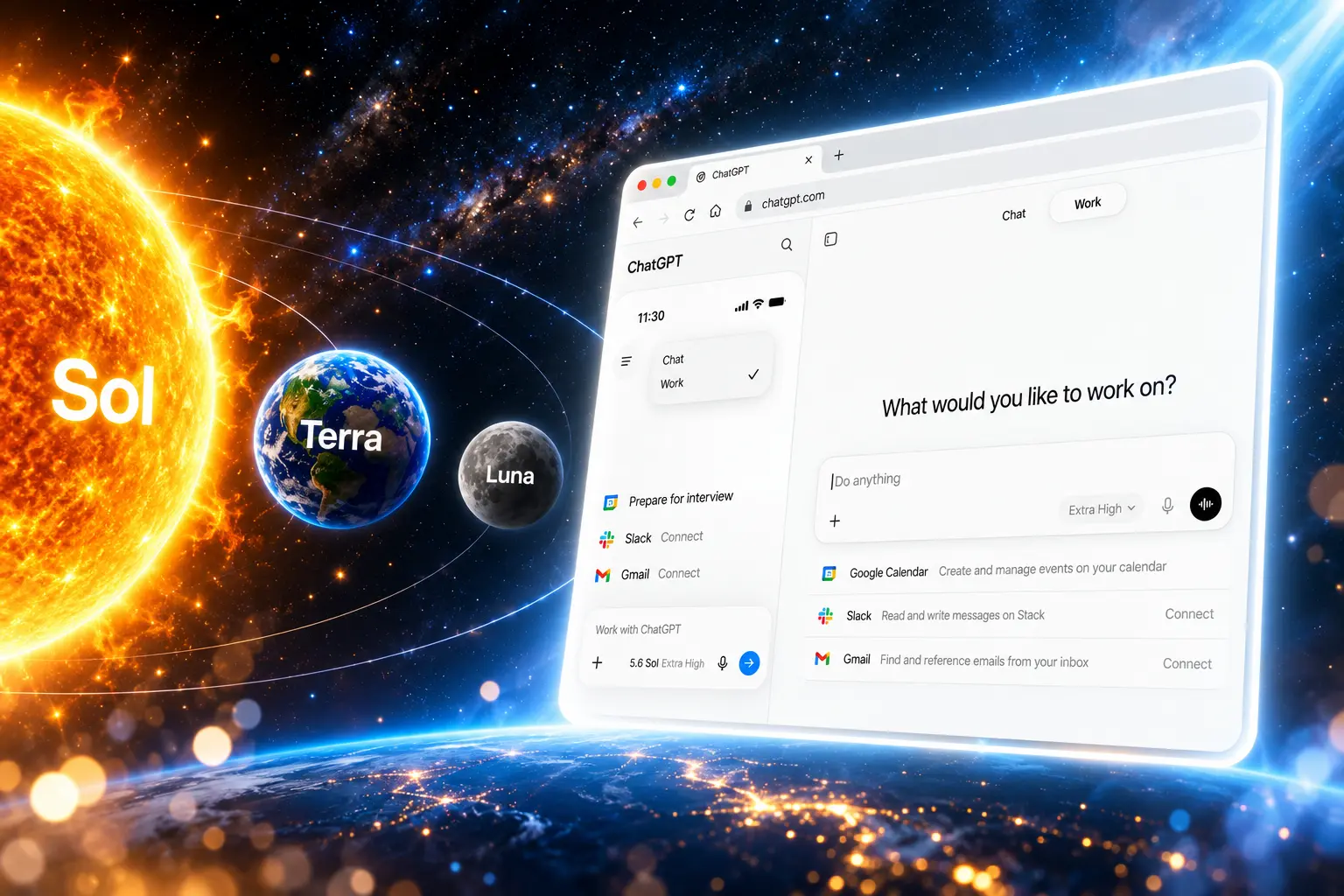
ChatGPT Work Treats Mail and Slack as Job Triggers
ChatGPT Work is the agent sitting next to ordinary Chat and, on the desktop app, next to Codex. OpenAI’s help pages describe Chat as fast conversation and Work as longer, multi-step jobs that are supposed to come back as a document, spreadsheet, presentation, report, or Site. Help pages also still describe Work as rolling out to eligible accounts.
The July 9 Work post said the desktop app on Mac and Windows bundles Chat, Work, and Codex. It also said plugins for Slack and Teams sit alongside Google Drive, SharePoint, email, calendars, CRMs, project trackers, and internal tools. Type @ and an app name, or let ChatGPT pick a plugin from the prompt.
WHAT CHATGPT WORK CAN PLUG INTO
- Chat apps: Slack and Microsoft Teams, including jobs that turn new messages into updated docs or slides.
- Files: Google Drive and SharePoint, plus local folders on the desktop app when you grant them.
- Mail and time: Email and calendars, with event-triggered tasks that can fire on new Gmail.
- Code hosts: GitHub pull request activity in an authorized repository can start a Work task.
- Business systems: CRMs, project trackers, and other internal tools through the plugins directory.
Eligible Plus, Pro, Business, Enterprise, Edu, and ChatGPT for Healthcare users can set those event-triggered tasks. OpenAI says they are off for Free and Go, and off in FedRAMP workspaces. Enterprise, Edu, and Healthcare admins have to switch the feature on. Slack tasks need @ChatGPT in every channel the job watches.
Event Triggers on Gmail and Slack
A scheduled Work job can run once, repeat, or watch for a change. OpenAI’s examples include refreshing a meeting agenda from Slack each week. That is a different product from a chatbot that waits for a paste. It is also a different risk, because the agent can keep moving while the user is in another meeting.
On September 10, 2026, OpenAI went further with ChatGPT for Financial Services, a tailored Work setup that pairs built-in financial data with GPT-6 Astra. Tibo, who works on Codex and ChatGPT at OpenAI, said the Agents API is the infrastructure under ChatGPT Work, wrapped so developers can start in under a minute.
Local Folders Still Sync Context to the Cloud
Work on web and mobile runs in the cloud. The desktop app can use local files and desktop apps with permission. OpenAI still warns that messages and task context may be stored in the cloud even when the job runs on the computer. That is the same file-retention problem that led Iowa counties to warn workers.
Healthcare gets a sharper line. OpenAI says event-triggered tasks in ChatGPT for Healthcare are not covered under a Business Associate Agreement, and should not transmit, store, or process protected health information. The agent can watch a mailbox. It does not inherit every compliance wrapper the mailbox had.
Sol, Terra, and Luna Are a Price Ladder
A workday agent that stays on Sol for every step would be a billing event, not a background helper. OpenAI’s own July 30 post made that plain. Twenty-one days after general availability, it cut Luna 80% and Terra 20%, and it said those cuts also change how usage counts against Codex and ChatGPT Work subscriptions.
THE GPT-5.6 API LADDER ON JULY 30
| Model | Job | Input / 1M tokens | Output / 1M tokens | July 30 change |
|---|---|---|---|---|
| GPT-5.6 Sol | Flagship reasoning | $5.00 | $30.00 | None that day |
| GPT-5.6 Terra | Everyday work | $2.00 | $12.00 | 20% less |
| GPT-5.6 Luna | Fast, high-volume | $0.20 | $1.20 | 80% less |
Luna’s new input rate is $0.20 per million tokens. Subscription prices and quota budgets did not move. Cheaper tiers simply burn fewer credits, which is how OpenAI makes long Work sessions fit a plan. Fast mode for Sol, which replaced Priority Processing in the API, runs up to 2.5 times faster at twice the price with no claimed change in intelligence.
Michele Catasta, president and head of AI at Replit, said GPT-5.6 Luna is the closest the firm has come to intelligence too cheap to meter. OpenAI’s help pages say Plus, Pro, Business, and Enterprise users can pick Sol, Terra, and Luna inside Work, while Free and Go users get Terra there. Terra and Luna are not choices in ordinary Chat. On August 6, Luna became the default Chat model for Free and Go. On August 21, OpenAI dropped Sol API and credit pricing by over 20% for three months.
Inside Microsoft 365, the Files Never Leave
Microsoft made Copilot Cowork generally available in June 2026, before ChatGPT Work shipped. Cowork runs across Outlook, Teams, Excel, and Word, grounded in Microsoft Graph and Work IQ, and it bills extra usage on Copilot Credits. Charles Lamanna’s pitch at Microsoft has been to hand off the job and come back to finished office work, not another chat thread.
The tenancy split is the part buyers actually have to live with. Microsoft’s own architecture pages say Copilot data stays in the tenant, in Exchange, SharePoint, and OneDrive locations that Purview can retain and audit. ChatGPT Work reaches the same apps through plugins and then does the reasoning on OpenAI’s side. Admins can shut off Work Cloud or Work Local by role. They cannot turn OpenAI into a folder inside SharePoint.
By September 2026, Microsoft’s Cowork changelog listed Claude Fable 5.1 and GPT-6 Astra inside Copilot Cowork as model-picker options. OpenAI is now competing with a workplace agent that can call OpenAI’s own next model without giving OpenAI the tenant. Anthropic’s Claude Cowork is the other desk agent in that three-way, stronger when the job is controlling local desktop apps and polishing Word, Excel, PowerPoint, and PDF files.
Why Plus Accounts Got a Five-Hour Cap
Demand showed up faster than the workday slogan. On July 14, 2026, Tibo said Codex and ChatGPT Work had reached 8 million active users, and OpenAI reset usage limits again. Paid users spent the summer watching those resets, an August 31 outage on the Work surface, and a fight over how long a $20 Plus seat can actually run.
On August 25, Tibo said Plus accounts would get the five-hour limit back across ChatGPT Work and Codex. He said the window smooths compute load so weekly usage can stay generous, and that Plus users are relatively casual and new, and that they accidentally burn a whole week and then get confused. Pro $100 and Pro $200 seats would keep the five-hour cap off for the coming months.
Tomorrow we will bring back the 5h limit for Plus accounts across ChatGPT Work and Codex. I had mentioned this a while ago, but then postponed it.
This is necessary as (a) the 5h limit allows us to smoothen the load on our compute, allowing to keep the plan generous in terms of…
— Tibo (@thsottiaux) August 25, 2026
A $20 Plus seat is a full work tool in a lot of markets, and a five-hour window fights the pitch that this agent can cover longer jobs. People who moved over for fewer gates than Claude now meet a timer, then watch Sol chew the weekly pile on medium settings. The routing advice writes itself: keep Sol for the unclear step, dump the rest on Luna, and treat every long Work run like a metered meeting.
Daybreak Wants Passkeys for Cyber Work
OpenAI did not pretend GPT-5.6 was a mild chat upgrade. On Agents’ Last Exam, a long-horizon test across 55 professional fields, it said Sol hit 53.6. On knowledge work, it said the model pulls messy context from Slack, Notion, Microsoft 365, and Google Drive and turns it into shareable artifacts. The same launch post is where the cyber numbers sit.
GPT-5.6 CYBER FIGURES OPENAI POSTED
- ExploitBench: 73.5% for GPT-5.6 against 47.9% for GPT-5.5 at a comparable output-token budget.
- Red team: About 700,000 NVIDIA A100 Tensor Core GPU-equivalent hours of black-box automated testing before general availability.
- Blocks: GPT-5.6 Sol cyber safeguards block roughly 10 times more potentially harmful activity than previous models, OpenAI said.
- Threshold: Sol did not cross the Cyber Critical line under OpenAI’s Preparedness Framework in the tests it described.
OpenAI said the model found bugs and exploit building blocks in Chromium and Firefox tests, and did not autonomously produce a full-chain exploit under those conditions. Qualified people can apply for Daybreak Trusted Access for Cyber, with tighter safeguards for authorized defensive work. Individual members had to turn on hardware-backed passkeys by September 1, 2026, to keep the most cyber-capable frontier models. OpenAI also shipped a GPT-6 Astra critical cyber model with computer use, the next step on that same track.
The inbox product does not ask for a Yubikey. OpenAI’s help pages say event-triggered Work tasks in ChatGPT for Healthcare are not covered under a Business Associate Agreement, and that local desktop jobs can still store messages and task context in the cloud. The model left a government preview. The agent now has a path into Gmail, Slack, Drive, and CRM, on a price ladder built so most of the day never touches Sol.

Instagram Plus Tests a Read-Only Mode That Cuts Stories

Altman Asks the Public to Accept Some AI Harm

Google Freezes OSS VRP Product Reports After AI Flood

AI Agents Make Payment Rails the Scarce Prize

Turkey’s Crypto Boom Now Runs Through Three Banks

Fable 5 Came Back Under a Commerce On-Off Switch

Google’s SpaceX GPU Lease Has a Sept. 30 Deadline

Plasma One’s XPL Locks Face a 1.81 Billion Cliff

DGO’s Rs 549 World Cup Pass Cost Fans Sleep and Data

Moonshot AI’s $30 Billion Ask Became a $35 Billion Close
-
 AI4 months ago
Fable 5 Came Back Under a Commerce On-Off Switch
-
 AI5 months ago
Google’s SpaceX GPU Lease Has a Sept. 30 Deadline
-
 CRYPTO4 months ago
Plasma One’s XPL Locks Face a 1.81 Billion Cliff
-
 APPS5 months ago
DGO’s Rs 549 World Cup Pass Cost Fans Sleep and Data
-
 AI5 months ago
Moonshot AI’s $30 Billion Ask Became a $35 Billion Close
-

 NEWS5 months ago
ColorOS 17 Device List Spans Oppo, OnePlus and Realme
-

 GAMING4 months ago
The RTX 4050 Under Rs 70,000 Hides a Wattage Gap
-

 AI4 months ago
Boris Cherny’s Loops Still Demand a Higher Production Bar