
GADGETS
OpenAI’s First Hardware Sold Out as a $230 Codex Pad
OpenAI’s $230 Codex Micro keypad sold out in hours as merch, while Work Louder now sells the same Codex agent lights on a cheaper pad.

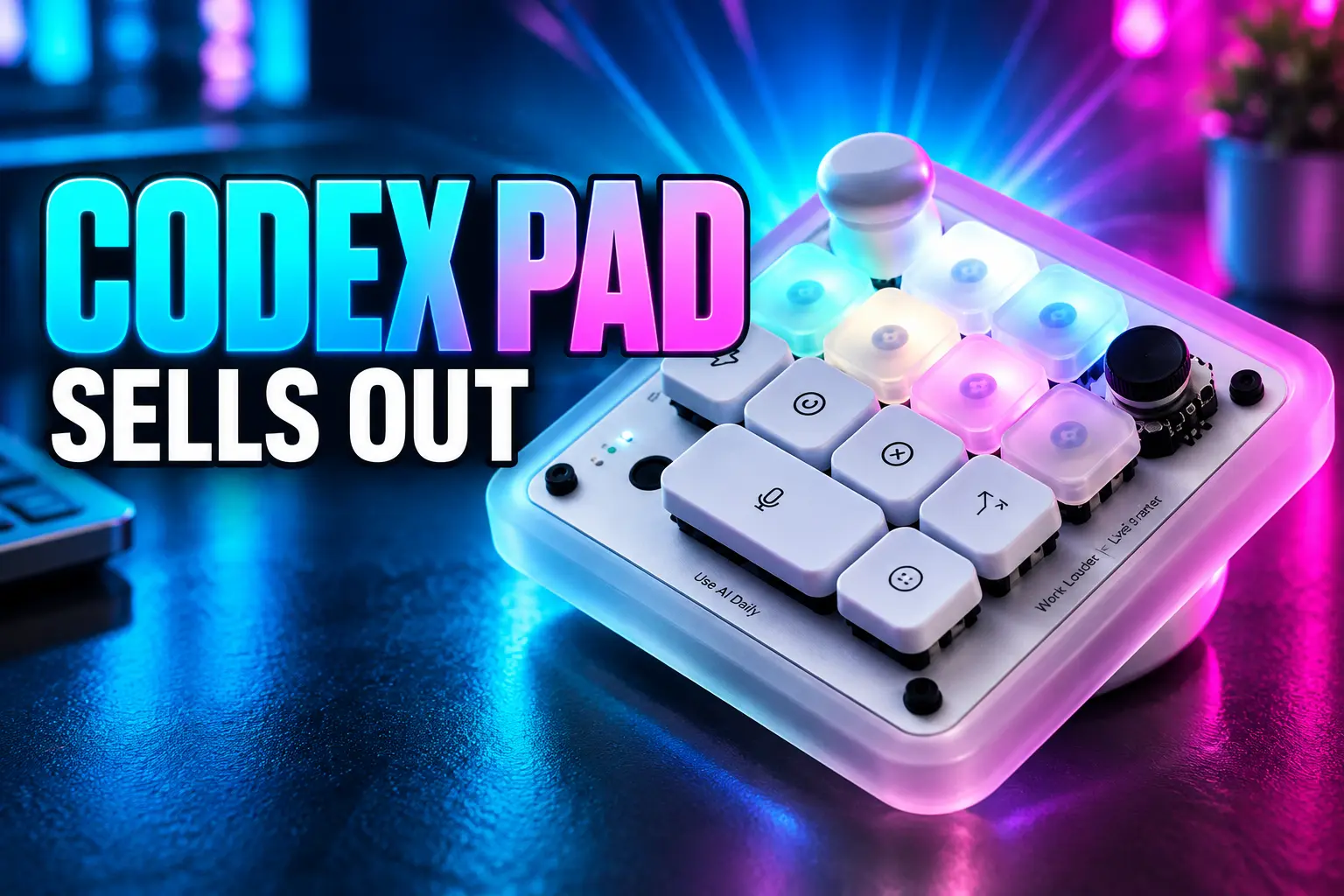
OpenAI’s Codex Micro, a $230 glowing keypad for coding agents, sold out the day it launched and remains listed as out of stock. The square pad, model kbd-1.0-codex-micro, is a limited Supply Co collaboration with Montreal keyboard maker Work Louder, built to steer Codex threads with lights, a dial, and a joystick. Work Louder now sells that same Codex hookup on its own Creator Micro 2 for $198, which is the part of this launch that actually stayed in production.
A Limited Run From the Merch Team
The idea did not come out of OpenAI’s hardware lab with Jony Ive. Mike Di Genova, co-founder of Work Louder, said OpenAI’s merchandise team called after Supply Co’s public shop drew mockery for hoodies and totes. “OpenX started to get a little bit of heat for their merch,” Di Genova said. That push, he said, was to “step up their merch game,” then build something developers would actually put on a desk.
Orders opened on July 15, 2026. OpenAI Developers posted the product film the same afternoon and closed with a joke aimed at anyone who waited: “Get yours before stock returns 410.”
Meet kbd-1.0-codex-micro, built with @work_louder.
Map the buttons and joystick to your workflow, and keep your pinned chats in view.
Get yours before stock returns 410. pic.twitter.com/MGQQ1ISW0l
— OpenAI Developers (@OpenAIDevs) July 15, 2026
The run sold through in about 12 hours. Di Genova had expected at least a month. “It was limited stock, but they purchased a lot,” he said. Neither company published a unit count. Sam Altman wrote that evening, “amazing to me that some people want the silent version,” after buyers split between clicky POM switches and silent POK switches.
Completed eBay sales peaked at $1,250 on July 16. Asking prices hit $1,850, then drifted toward $450 by July 27, still well above list. Thomas Ricouard, who works on Codex developer experience at OpenAI, had urged people not to sleep on the drop. The branded object behaved like a concert poster with RGB, which is what a merch SKU does when the logo is the scarce part.
THE CODEX MICRO CALENDAR
- June 29, 2026: OpenAI teases a Codex-branded Work Louder pad and shows it at the AI Engineer World’s Fair in San Francisco.
- July 10, 2026: Apple files a trade-secret complaint in San Jose against OpenAI’s separate consumer-hardware effort.
- July 15, 2026: Codex Micro goes on sale at $230 through Supply Co and sells out the same day.
- July 22, 2026: Work Louder says Creator Micro 2 will carry the Codex integration, with a free public update for existing Creator Micro 2 and Framer Micro units from August 1.
Five days before the keypad went live, Apple’s complaint called OpenAI’s hardware business “rotten to its core.” That filing targets the Ive-linked device program, not this accessory. The two projects share a company and almost nothing else on the bill of materials.
Work Louder Pushed the Same Brain to a Cheaper Pad
Work Louder had already reskinned this chassis for Figma and Framer. Codex Micro uses the same CNC polycarbonate and aluminum square, with 13 mechanical switches, a capacitive touch sensor, a rotary encoder, and a planar joystick. OpenAI’s own included-in-box line even still says “Creator Micro.”
On July 22, a week after the sellout, Work Louder moved the Codex mapping onto the regular Creator Micro 2 and offered the first 300 buyers a free MX Pure keyset with the code AGENT. OpenAI’s Codex documentation now tells people the ChatGPT desktop app supports Creator Micro 2 bought straight from Work Louder. The exclusive firmware lasted about as long as the exclusive stock.
I thought it was going to take at least a month to sell through the inventory. It was limited stock, but they purchased a lot.
Mike Di Genova, co-founder, Work Louder
Di Genova also argued the industry had reversed an old Steve Jobs line: if you want to make great software, make hardware, because the software moat is gone. That is a big claim to hang on a 13-key pad. What Work Louder actually got was simpler. OpenAI needed a physical Codex object in a hurry, and the Montreal shop already had the tooling, the six-layer Input software, and a habit of co-branded drops.
Creator Micro 2 Codex integration is the live product. It is listed at $198, with a Pro wireless model and a wired Base, a 2-year warranty, 14-day returns, and shipping in 1 to 3 business days. The MX Icon set that copies the Codex extra caps is $54 on its own. The OpenAI mark is the piece you cannot reorder.
Six Frosted Keys Show Idle, Thinking, and Error
The hardware pitch is not more shortcuts. Any macropad can fire accept, reject, or push-to-talk. The Codex-specific trick is six frosted Agent Keys that take live thread state from Codex and put it in peripheral vision, so you do not have to tab back to a sidebar to see which job died.
Di Genova walks through the map in Work Louder’s setup film. A single tap focuses that agent even if its window is buried. A double tap brings the thread forward. A blinking white key means that thread is selected. A dark key means nothing is assigned. In the config page you pick pinned threads, most recent threads, or custom assignments.
AGENT KEY COLORS
- White: The agent is idle.
- Blue: The agent is thinking.
- Green: The task is complete.
- Amber: Codex needs feedback from you.
- Red: The run hit an error.
- Off: No agent is assigned to that key.
The clear border also signals voice. Hands-on testers saw a sea-green glow when the mic was live, a white chase while Codex processed speech, then a solid white when the prompt had landed. The pad has no microphone of its own. The big key triggers whatever mic is already on the laptop or headset.
That glanceable row is why people paid for aluminum instead of another Stream Deck profile. A Stream Deck can show icons. It cannot, out of the box, receive Codex thread state unless you build the bridge. OpenAI built the bridge, then licensed the lamp.
YOLO Mode Bypasses Approvals From a Keycap
The box includes 32 extra icon keycaps plus 11 solid caps, so the legends can match the job rather than the factory print. Remapping lives in Codex itself, with Work Louder Input adding five more layers on top of the ChatGPT layer. Command keys default to accept, reject, push-to-talk, and a new chat. The joystick flicks into workflows such as reviewing a pull request, debugging, or refactoring. The dial sets reasoning level, which is a physical proxy for how much time and compute a task is allowed to burn.
Two of the extra legends tell you who this object thinks you are. YOLO fires full automation and maps to the CLI flag --dangerously-bypass-approvals-and-sandbox. YEET stages local changes, commits, pushes, and opens a GitHub pull request with an explanation already filled in. Those are not beginner toys. They are one-press versions of the same trust decisions Codex users already make in software, including in the head-to-head with Claude Code in 2026, where accept/reject speed is the whole fight.
DEFAULT PHYSICAL MOVES
- Joystick: Launch a saved Codex skill such as a PR review or a refactor.
- Dial: Raise or lower reasoning effort without opening model settings.
- Command row: Accept, reject, talk, or start a new thread without hunting the UI.
- YOLO cap: Skip the approval loop and the sandbox in one press.
- YEET cap: Commit, push, and open the pull request from the desk.
A hands-on unit weighed 2.6 pounds, dense enough that it does not skate when you mash the clicky switches. The slab sits on a slight slant, with the dial a bit higher than a typical board. Altman’s surprise at silent-switch demand makes more sense once you hear the clicky version in a shared room.
Why the Agent Lights Need the Desktop App
The Agent Keys do not talk to Codex in the cloud by themselves. The ChatGPT desktop app sits in the middle, reads thread-state events, and drives the LEDs over USB-C or Bluetooth. If you live in the Codex CLI, a browser tab, VS Code, or a JetBrains plugin, those six frosted keys stay dark. You still have a fancy shortcut pad. You do not have the status board you paid the OpenAI premium for.
Owners who did get the lights have a second problem that no launch film mentioned. New chats can shove the Agent Key order around, so the key your thumb learned as “the refactor thread” becomes a different session. You can pin assignments by hand, then you have to pin them again when a thread dies. A control surface that fights muscle memory is just another settings panel made of plastic.
OpenAI has been trying to keep those threads reachable away from the desk through Codex in the ChatGPT mobile app, which is the software answer to the same supervision job. The keypad is the desk version of that idea: approve, redirect, or ignore without waking a laptop window. It only works if the desktop app is already the hub. People asking OpenAI to restock at DevDay on September 29, 2026, are asking for the lamp, not another Bluetooth macro board.
A month-long desk test published on September 8 found the same ceiling. The pad could not debug a broken page or recover a bad run. It made waiting more visible. For anyone already staring at a Codex sidebar, that is a luxury. For anyone hoping hardware would make the agent smarter, it is a $230 notification LED.
The Branded Pad Costs $32 More Than Work Louder’s
The $230 Codex Micro listing still shows the OpenAI price and the word “Out of stock.” Work Louder’s matching chassis, now with Codex on board, is $198. The gap is $32 before you count the included icon set, which is the honest premium for a logo that no longer ships.
CODEX MICRO VERSUS CREATOR MICRO 2
| Spec | Codex Micro | Creator Micro 2 |
|---|---|---|
| Price | $230 | $198 |
| Seller | OpenAI Supply Co x Work Louder | Work Louder |
| Availability | Out of stock | Ships in 1 to 3 business days |
| Codex RGB status | Native | Native |
| Extra icon keycaps | 32 included | MX Icon sold separately, $54 |
| Connection | Bluetooth / USB-C | Pro: Bluetooth / USB-C; Base: USB-C only |
| Listed OS | Mac / Windows | Mac / Windows |
Both pads speak the same Input software and the same six layers. OpenAI’s copy still calls the device “your command center for agentic work,” which is a merch sentence that happened to describe a real workflow for people already running several Codex threads at once. Everyone else bought a heavy paperweight with a joystick.
OpenAI has been stretching Codex past a pure coding CLI with Codex plugins for knowledge workers, which is why a physical accept key is not only a programmer flex. If agents draft, file, and wait for a human, a lamp that turns amber is a product. If you run one chat at a time, it is jewelry.
Ive’s Device Is Still a Different Product
Codex Micro is separate from OpenAI’s consumer gadget with Jony Ive, the program tied to io Products, which OpenAI bought in 2025 in a deal valued at $6.5 billion. Apple’s July 10 complaint names that hardware push, OpenAI chief hardware officer Tang Tan, and more than 400 former Apple employees now at OpenAI. OpenAI has said it does not want other companies’ trade secrets. None of that litigation is about a 13-key Supply Co pad.
Altman had just posted a 2.5x jump in usage of Codex and ChatGPT Work in the week before the keypad shipped. The accessory is a souvenir of that spike: a way to touch a product that had moved from a window to a fleet of background jobs. Greg Brockman has called voice the interface that lets the computer move closer to you. The Micro’s talk key is a small, slightly comic version of that bet, bolted onto a keyboard company that already knew how to mill aluminum in small batches.
Supply Co still lists Codex Micro as out of stock, with no restock on the page. The control surface that made the lights worth discussing is on Work Louder’s site, shipping in a few days, without the OpenAI mark. That is the hardware OpenAI actually left in the market.

Instagram Plus Tests a Read-Only Mode That Cuts Stories

Altman Asks the Public to Accept Some AI Harm

Google Freezes OSS VRP Product Reports After AI Flood

AI Agents Make Payment Rails the Scarce Prize

Turkey’s Crypto Boom Now Runs Through Three Banks

Fable 5 Came Back Under a Commerce On-Off Switch

Google’s SpaceX GPU Lease Has a Sept. 30 Deadline

Plasma One’s XPL Locks Face a 1.81 Billion Cliff

DGO’s Rs 549 World Cup Pass Cost Fans Sleep and Data

Moonshot AI’s $30 Billion Ask Became a $35 Billion Close
-
 AI4 months ago
Fable 5 Came Back Under a Commerce On-Off Switch
-
 AI4 months ago
Google’s SpaceX GPU Lease Has a Sept. 30 Deadline
-
 CRYPTO4 months ago
Plasma One’s XPL Locks Face a 1.81 Billion Cliff
-
 APPS4 months ago
DGO’s Rs 549 World Cup Pass Cost Fans Sleep and Data
-
 AI4 months ago
Moonshot AI’s $30 Billion Ask Became a $35 Billion Close
-
 NEWS4 months ago
ColorOS 17 Device List Spans Oppo, OnePlus and Realme
-

 GAMING4 months ago
Xbox Cuts 3,200 Jobs After Five Years of Thin Returns
-
 GAMING4 months ago
The RTX 4050 Under Rs 70,000 Hides a Wattage Gap