
GADGETS
Eye Doctors Warn Childhood Myopia Is Rising Faster Than Ever
Eye doctors say children’s myopia is progressing faster since the pandemic, and research shows screen time is only part of a much bigger picture.

Eye doctors in Jakarta say children’s eyeballs are elongating faster than they did just a few years ago, and gadgets alone don’t explain why. Julie Dewi Barliana, chair of the Indonesian Ophthalmologists Association (PERDAMI, the country’s ophthalmology society) in Jakarta, says myopia cases are climbing and worsening faster than before the pandemic. Screens went up, outdoor hours went down, and kids’ distance vision followed.
Global research backs the trend but complicates the assumption that screens themselves are the direct cause. Several systematic reviews have found no consistent link between device use and myopia onset. What keeps showing up, study after study, is how little daylight kids get.
Is Screen Time to Blame for Rising Myopia?
Not entirely. Screen use correlates with the rise in childhood myopia, but multiple systematic reviews have failed to pin device time itself down as a direct cause. Doctors increasingly point to what heavy screen use replaces: hours of natural daylight. That distinction shapes which fixes work and which ones only sound like they should.
A pooled analysis of 276 studies covering more than 5.4 million children and teenagers, published in the British Journal of Ophthalmology, projects that global childhood myopia will affect 740 million kids by 2050, roughly 40% of that age group worldwide.
Formal guidance hasn’t caught up. Eye care societies have no specific rules for how much screen time is safe for developing eyes, clinicians note, only general child health guidance built around sleep and mood rather than vision.
Governments have moved faster on the device side of the problem than the eye health side. Sweden has recommended keeping smartphones away from children under 13, and European regulators are readying an age restriction recommendation for children’s social media use. Neither policy was written with vision in mind.
- Julius Oatts, a pediatric ophthalmologist, says clinicians see a dose dependent relationship between screen exposure and myopia, even without formal guidelines singling it out.
- A 2019 review by researchers Lanca and Saw examined 15 studies and found no definitive relationship between computer or video game use and myopia progression.
- Julie Dewi Barliana of PERDAMI Jakarta tells parents heredity plays a role, but stresses sunlight exposure as the factor she can actually change.
None of that settles the argument. It does explain why doctors keep circling back to outdoor time instead of just app timers.
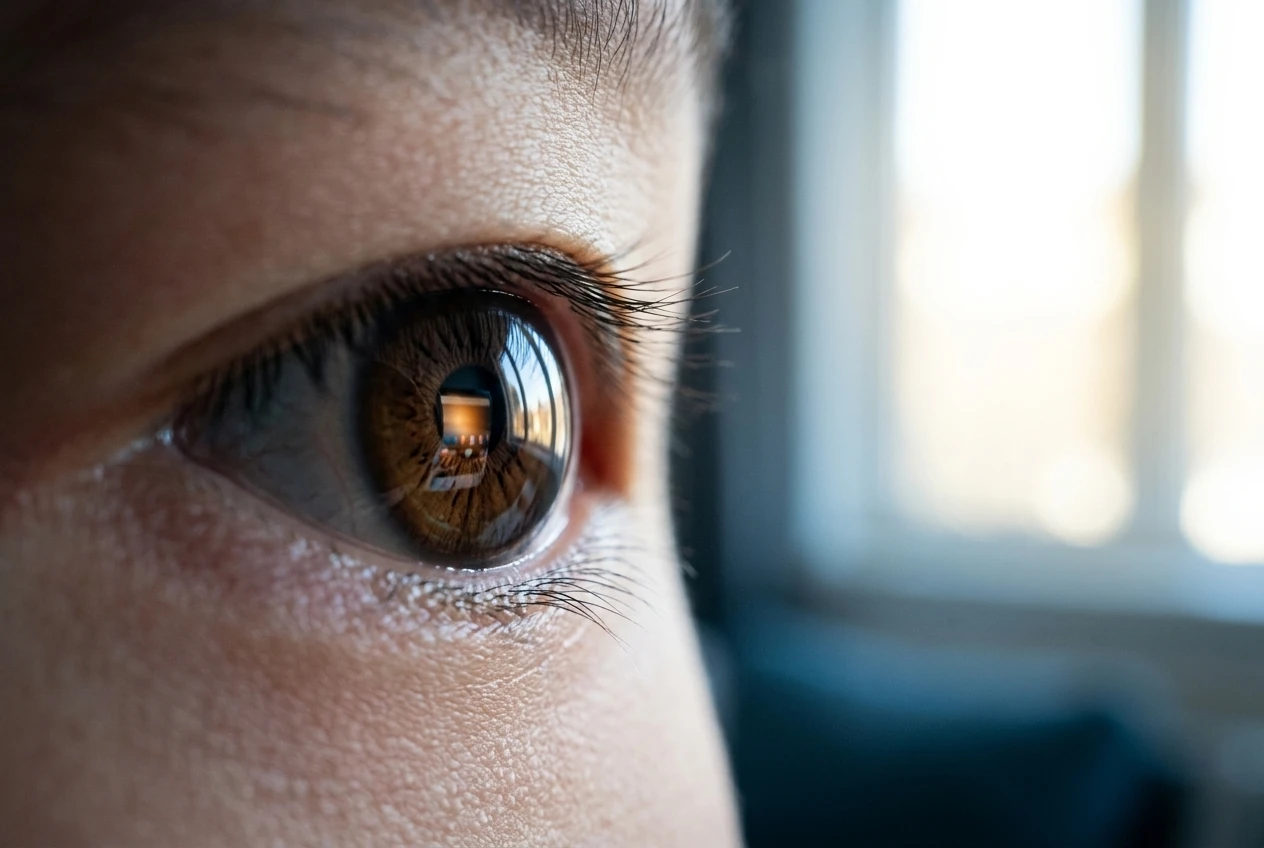
Inside a Growing Eyeball
Myopia is not a surface problem. It happens when the eyeball itself grows too long, front to back, so light focuses just short of the retina instead of directly on it.
Doctors describe a chain reaction. As the eyeball keeps stretching, tissue at the back, including the retina, gets pulled thin. Left unchecked, that thinning can progress into what is known as pathological myopia, linked to complications such as staphyloma and myopic macular disease, and a higher lifetime risk of vision loss.
Timing compounds the risk. A recent U.S. analysis of pediatric eye data found kids who develop myopia before age 10 are the most likely to progress to high myopia as adults, which widens the window for damage to build up.
The Warning Signs Most Parents Miss at Home
Most families don’t catch myopia early. Many parents only book an eye exam after a teacher flags that a child can’t read the blackboard, and by then the prescription is often already substantial.
- Squinting to bring distant objects into focus
- Tilting the head when looking at something across the room
- Sitting unusually close to the television or a tablet
- Complaining that writing on a whiteboard or sign looks blurry
So that’s what parents often don’t realize, so they only go to the doctor after entering school with a size that is already quite large.
Julie Dewi Barliana, chair of PERDAMI Jakarta, said at the Myopia Summit 2026 conference in Jakarta this month.
The burden isn’t spread evenly either. A global analysis from the International Agency for the Prevention of Blindness (IAPB, a global vision health organization) found that girls, urban children and East Asian adolescents face the highest rates of myopia.
Three Decades of Rising Numbers
The trend line curves upward everywhere researchers have measured it. A systematic review of 276 studies spanning 50 countries tracked the pace decade by decade.
| Period | Global Childhood Myopia Prevalence |
|---|---|
| 2001 to 2010 | 25.3% |
| 2011 to 2019 | 29.7% |
| 2020 to 2023 | 35.8% |
| 2050 (projected) | About 39.8%, or 740 million children and teenagers |
Medical Daily’s review of U.S. eye exam data found a similar arc closer to home. Myopia among 12 to 54 year olds there rose from about 25% in 1971 to more than 40% today, with an estimated 9.2 million American children ages 3 to 19 now affected.
Slowing the Progression Once Minus Sets In
Glasses correct blurry vision. They don’t slow the underlying stretching of the eyeball, which is why myopia management now looks well beyond the prescription pad.
Low-dose atropine drops are the most studied option. The American Academy of Ophthalmology reports that most children on the drops see progression slow by roughly half, with only about 1% reporting mild redness or irritation. “The sooner they start taking it, the less nearsighted they’ll be overall,” said David Epley, a pediatric ophthalmologist in Kirkland, Washington.
Lens technology has moved fastest. A review published in Investigative Ophthalmology and Visual Science found that dual-focus contact lenses remain the only FDA-cleared myopia treatment in the United States, even as newer spectacle and lens designs move through trials.
Dr. Barliana made a similar point about the specialized lenses she prescribes. They don’t stop the increase in minus altogether, but the yearly climb is expected to be smaller than it would be without them.
She sets a rough ceiling for parents to watch: annual increases beyond half a diopter are a signal to escalate treatment, with the goal of keeping progression well under that mark.
Alongside treatment, she repeats two habits to every family. The 20-20-20 rule means pausing every 20 minutes to look at something roughly 20 feet, or six meters, away for 20 seconds. The other is at least two hours of outdoor play a day for natural light exposure.
The Carrot Myth Doctors Keep Correcting
One myth won’t die. Dr. Barliana says parents still ask whether feeding kids more carrots can shrink a minus prescription. It can’t.
Carrots carry nutrients the retina uses to process light, but that has no bearing on a child’s refractive error. Diet alone was never going to fix an eyeball that’s grown too long.
The fixes that do move the number are less exciting. Cut indoor screen hours, add sunlight, and get a real eye exam before a teacher has to send a note home.
Frequently Asked Questions
At what age does childhood myopia usually begin?
A clinical study of myopic children in Spain found the average age of onset was 7.7 years, with the condition typically identified well before a child reaches secondary school.
Is myopia mostly inherited, or caused by lifestyle?
Genetics matter but don’t fully explain the surge. In that same Spanish cohort, 59.8% of myopic children had a family history of the condition, meaning roughly four in ten cases developed without one.
What is the elbow rule for screen distance?
Pediatric vision specialists suggest resting a fist against the eye and noting where the elbow lands. That distance is roughly the closest a book or screen should get to a child’s face during near work.
Why did myopia accelerate during the pandemic?
A 2024 meta-analysis found children’s average daily screen time jumped from about 2.1 hours to 5.6 hours during lockdown remote learning, and myopia progression sped up alongside it before easing once restrictions lifted.
What is orthokeratology?
Orthokeratology uses rigid contact lenses worn overnight to temporarily reshape the cornea. It’s one of several options, alongside atropine drops and multifocal lenses, that clinicians use to slow, not reverse, myopia progression.
Can myopia be reversed once it starts?
No current treatment reverses myopia after the eyeball has elongated. Glasses and contact lenses correct blurry vision but don’t touch the underlying growth, and researchers note that none of today’s interventions fully halt progression in every child.
Disclaimer: This article is for general informational purposes only and does not constitute medical advice. Myopia diagnosis and treatment, including atropine drops and specialized lenses, should only be pursued under the guidance of a qualified eye care professional. Figures cited are accurate as of publication and drawn from the sources linked above.


South Korea Retail Investors Face Reckoning After KOSPI AI Rally Collapses

Surrey AI Maps Three Heart Attack Paths and Their Molecular Roots

Germany Locks Neutral Apple ATT Prompts Across Most of Europe

Apple’s 5% EU Fee Quietly Rewrites Alternative App Store Math

Apple’s EU Fee Truce Cuts Complexity but Leaves Rivals Fuming

Pixel 11 Pro Fold Trades Thinness for Durability and Seven-Year Stay

Mayo AI Flags HCM Obstruction From Everyday Ultrasound Videos

Indian Brands Quietly Scale Landmark Screens and Home Tech

Navin Vatsa Turns Grief Into a Lifetime of Quiet Seeing

Google Bets Pixel 11 Agentic AI Will Redefine Phones

Oracle Cuts 21,000 Jobs in a Year, Cites AI in 10-K Filing

Fable 5 and Mythos 5 Return as US Lifts Anthropic Export Controls

SpaceX’s Google Deal Turns a Rocket Company Into a Cloud Landlord

CD Projekt Red Co-CEO: Redemption Arc Isn’t Done, Witcher 4 in 2027

XPL Rallies 30% Ahead of Plasma One Card Tier Launch

Google Search Profiles Build a Follow Graph Inside Discover

DGO App Brings Rs 549 Mobile Pass for FIFA World Cup 2026 in Nepal

Moonshot AI Targets $30 Billion in China’s Fastest AI Funding Sprint

Oppo’s ColorOS 17 Eligibility List Leaves A-Series Buyers Behind

Microsoft Xbox Layoffs Start in July as Sharma Slams 3% Margin
-
 AI2 months ago
Oracle Cuts 21,000 Jobs in a Year, Cites AI in 10-K Filing
-
 AI2 months ago
Fable 5 and Mythos 5 Return as US Lifts Anthropic Export Controls
-
 AI3 months ago
SpaceX’s Google Deal Turns a Rocket Company Into a Cloud Landlord
-
 GAMING2 months ago
CD Projekt Red Co-CEO: Redemption Arc Isn’t Done, Witcher 4 in 2027
-
 CRYPTO3 months ago
XPL Rallies 30% Ahead of Plasma One Card Tier Launch
-
 NEWS3 months ago
Google Search Profiles Build a Follow Graph Inside Discover
-
 APPS3 months ago
DGO App Brings Rs 549 Mobile Pass for FIFA World Cup 2026 in Nepal
-
 AI3 months ago
Moonshot AI Targets $30 Billion in China’s Fastest AI Funding Sprint