
NEWS
OnePlus Leaves the West and Doubles Down on India
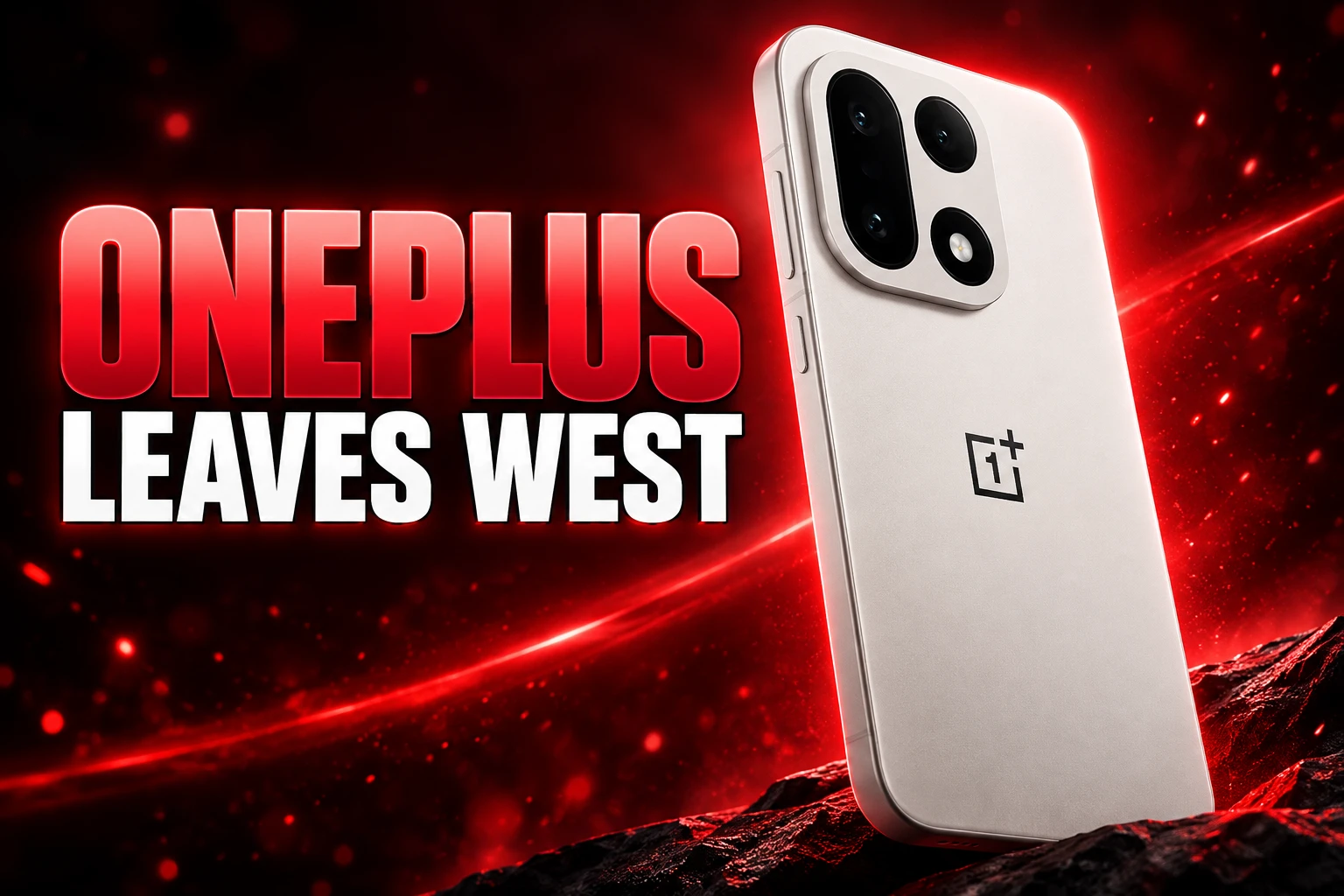
OnePlus halted Western phone launches on July 16, 2026, kept India open, and left the US with no OPPO replacement.

OnePlus confirmed on July 16, 2026 that it will stop launching new phones in North America and Europe, then denied the same-day claim that India is next. Remaining stock stays on sale in the West, software promises still apply, and India has kept getting new N-series phones through the same memory crunch that is wiping out cheap Android.
The leak that started the panic put India on a 2027 shutdown clock. The company called that unverified speculation before the day was over, and it has spent the weeks since launching and teasing more India hardware while ColorOS 17 beta began reaching the OnePlus 15.
New Phones Stopped in the West on July 16
The official line arrived in a community post, not a product keynote. OnePlus said it would conclude new product rollouts in Europe and North America as part of what it called a proactive global strategy adjustment, after months of denials that never quite promised another flagship for those regions.
Today, our hearts are undoubtedly heavy and mixed with emotion. As part of the proactive global strategy adjustment, OnePlus has decided to conclude new product rollouts in Europe and North America.
YRJ, Community Head, OnePlus Community, July 16, 2026
Shuang Chen, head of marketing at OnePlus, said the choice was not made in a rush and that the company had spent a long time with OPPO assessing what users needed in 2026. Executives at a briefing put it in slogan form: the right brand does the right thing in the right market. Current OnePlus 15 units and other leftover inventory can still be bought until they run out, and the company says those phones keep their software, security, and warranty terms.
That is a halt on new hardware, not an overnight brick of every device already sold. The harder split is geographic. OPPO said it will keep investing in Europe, including a broader UK online store, so a OnePlus shopper there at least has a parent brand on the same shelves. The United States has no such handoff.
India Called the 2027 Exit Unverified Speculation
The original leak said OnePlus would wind down in India in 2027 and live on only in China. OnePlus India answered in writing the same day: local business continues as usual, all local operations are on track, and the media should exercise restraint before amplifying unverified speculation.
Ford, vice president of OnePlus India Business, went further in a note to the India community, calling India one of the brand’s most important markets globally and saying actions speak louder than speculation. He pointed to recent launches, named the upcoming OnePlus N6x, and described an OPPO-backed after-sales network. The company did not publish a 2027 guarantee either way, so the leak is not disproven as a private plan. It is also not company policy.
Hardware already on the calendar backs the denial better than a press line. The OnePlus N6 launched on June 30 for India, with open sale from July 4, 2026, at ₹22,999 for 4 GB plus 128 GB and ₹24,999 for 6 GB plus 128 GB, built around an 8,000 mAh battery and a Dimensity 6360 Apex chip. By early September the company was teasing an N6 Lite for the same market. That is the behavior of a brand still stocking India, not one packing the warehouses.
Memory Prices Treble as Shipments Fall 13.9%
OPPO did not invent a crisis to justify a tidy org chart. Counterpoint Research’s May 2026 outlook said the memory shortage, driven by fabs steering capacity toward AI HBM and server DRAM, had become the main drag on phones, and that low-end makers now had to ask whether to stay in the market at all.
THE 2026 SMARTPHONE CRUNCH
- Full-year forecast: Counterpoint has global shipments set to fall 13.9% to 1.08 billion units, the lowest annual volume since 2013, after a February outlook of 12.4%.
- Second-quarter drop: The firm’s later monitor put Q2 2026 shipments down 11% year over year, the weakest second quarter since 2013.
- Memory shock: Mobile LPDDR4/5 prices were on track to treble in Q2 2026 versus Q4 2025, with the squeeze expected through the second half of 2027.
- Entry-level squeeze: LPDDR4 supply is tracking a decline of over 40% in 2026, and some sub-$150 tiers face an effective permanent removal.
Principal Analyst Yang Wang called the memory crisis the most disruptive supply-side event the smartphone industry has ever faced, because it will not respond to the usual price and channel tweaks. IDC, working from the same crunch, now cites a record average selling price of $550, up $100 from 2025, and research director Nabila Popal said the era of ultra cheap smartphones is over.
Xiaomi, OPPO, and Vivo each took double-digit shipment declines in that weak second quarter. India buyers already felt the same cost shock through memory-driven price hikes in India on OnePlus and OPPO phones. Pruning overlapping brands is what a volume house does when RAM is no longer cheap enough to prop up three nameplates in every region.
Realme Leaves China so OnePlus Can Keep India
The same July 16 cycle that ended OnePlus in the West also redrew sister brand Realme. Xu Qi, Realme’s vice president, wrote that a young brand sometimes needs more courage to focus than to coast, and that Realme would press the pause button on the Chinese market to concentrate on overseas work, including performance and gaming phones.
That swap had been staged for months. Realme moved back under OPPO as a sub-brand in January 2026, and from April 1 its China after-sales sat inside OPPO’s service network. OnePlus, by contrast, keeps its China and India product plans. OPPO takes the parent role in Europe, with a stated push into Central Europe. Realme is the overseas volume tool, including the Nordics of Finland, Denmark, Sweden, and Iceland, where it already sold better than it did in China.
WHERE EACH OPPO BRAND STILL SELLS
| Brand | China | India | United States | Europe |
|---|---|---|---|---|
| OnePlus | Still launching | Still launching, 2027 leak denied | No new phones from July 16, 2026 | No new phones from July 16, 2026 |
| OPPO | Core brand | Present, shared service | No official retail | Stays, wider UK store, Central Europe push |
| Realme | No new products | Present | Not a US stand-in | Nordics focus |
Liu Zuohu, who left OPPO in 2013 to found OnePlus with Carl Pei and later returned as a group product chief, is now the executive watching the overseas experiment he started get folded back into a shared platform. The multi-brand map that Chen Mingyong built for growth has been replaced by a simpler rule: each nameplate only keeps the markets where OPPO thinks it can still win.
What Happens to OxygenOS on Phones Already Sold?
Eligible OnePlus phones can move to ColorOS 17 with Android 17 on an optional update, and the company says owners who take that update can roll back to OxygenOS, with the exact rollback builds still to be listed. Phones outside the upgrade scope stay on their current software and keep version maintenance. Realme UI is on the same path onto ColorOS. Executives said ColorOS already serves more than 740 million users, and that one codebase is how they want faster, cleaner updates.
SOFTWARE CHOICES LEFT FOR OWNERS
- Optional jump: Eligible phones can take ColorOS 17 after the official release, and the company is not forcing that build on day one.
- Rollback window: OnePlus says a ColorOS updater can return to OxygenOS, though the specific rollback versions have not been posted.
- Older models: Devices outside the Android 17 list keep maintenance and security on the software they already run.
- India included: The ColorOS offer is global, so Indian OnePlus phones sit in the same software funnel as leftover Western stock.
The merge is not a 2026 idea. OnePlus and OPPO combined product and R&D teams in 2021 and put OxygenOS and ColorOS on one codebase while promising the names would stay separate. China OnePlus phones had already shipped ColorOS for years. Global OxygenOS kept the label long after reviewers started treating it as a skin.
The First ColorOS 17 Beta Landed in September
HOW THE BRAND WAS FOLDED BACK
- 2013: Liu Zuohu and Carl Pei found OnePlus as an invite-only flagship killer aimed at Europe and America.
- 2020: Carl Pei leaves; Liu later returns into OPPO’s product system.
- 2021: OnePlus and OPPO merge R&D, and OxygenOS shares ColorOS code.
- January 2026: Realme becomes an OPPO sub-brand again; China service folds in on April 1.
- July 16, 2026: OnePlus ends new Western phones; Realme pauses new China phones; India denial is issued.
- August 16, 2026: The North American community site and app shut at 11:59 PM ET.
- September 11, 2026: ColorOS 17 beta reaches a first wave that includes the OnePlus 15, with a fuller device list due September 17, 2026.
A ColorOS product manager said OPPO, OnePlus, and Realme would take the first ColorOS 17 wave together and that the adapted-model notice would come on September 17, 2026. For anyone who bought a OnePlus because OxygenOS felt closer to stock Android, the remaining distinction is now a toggle and a rollback promise, not a separate engineering team.
American Shops Have No OPPO Phone Waiting
Chen’s line that OnePlus will continue through OPPO is a European sentence. OPPO does not officially sell phones in the United States, and the company would not name a replacement brand when asked where North American customers should go next. It repeated software, after-sales, and warranty promises instead.
That vacuum is the part of the halt the European story hides. A Western OnePlus owner who liked large silicon-carbon batteries and high-watt charging now shops Samsung, Google, Motorola, or Apple, because the parent that absorbed OnePlus is not putting its own logo on US retail. Carrier history already pointed that way: after the T-Mobile years faded, OnePlus never rebuilt a mainstream US channel large enough to fund a local team through a memory crunch.
Geopolitics sat in the original leak as a supporting reason, and OPPO is a defendant in a live Northern District of California Apple trade-secret case against OPPO over alleged Apple Watch sensor material. The company’s public explanation for the West halt did not cite that docket. It cited focus. The practical result in America is the same: no new OnePlus, and no OPPO aisle behind it.
Support Continues After the US Forum Closed
OnePlus set August 16, 2026, 11:59 PM ET as the permanent close for communityus.oneplus.com and the US community app, and it told members to save posts, photos, and guides themselves because the archive would not be moved. A global Discord server was offered as a hangout, with an explicit warning that it is not an official support channel. Europe’s forum fate was described in conflicting ways in the days after the announcement, so the date that is firm is the North American shutdown.
The useful remainder is the support pledge, which is also the part already spelled out for owners tracking software updates and after-sales support after the US forum closed. Warranty work stays with authorized service centres. Security patches continue on the schedule already promised. ColorOS 17 is the upgrade path for phones that qualify, and OxygenOS remains an option for people who refuse the skin.
The next dated software marker is September 17, 2026, when OPPO said it would name ColorOS 17 devices across the three brands. In India, the N6 is already on sale and an N6 Lite has been teased, which is the clearest public evidence that the 2027 shutdown leak is not how the company is running the only large overseas market it still claims.

Instagram Plus Tests a Read-Only Mode That Cuts Stories

Altman Asks the Public to Accept Some AI Harm

Google Freezes OSS VRP Product Reports After AI Flood

AI Agents Make Payment Rails the Scarce Prize

Turkey’s Crypto Boom Now Runs Through Three Banks

Fable 5 Came Back Under a Commerce On-Off Switch

Google’s SpaceX GPU Lease Has a Sept. 30 Deadline

Plasma One’s XPL Locks Face a 1.81 Billion Cliff

DGO’s Rs 549 World Cup Pass Cost Fans Sleep and Data

Moonshot AI’s $30 Billion Ask Became a $35 Billion Close
-
 AI4 months ago
Fable 5 Came Back Under a Commerce On-Off Switch
-
 AI4 months ago
Google’s SpaceX GPU Lease Has a Sept. 30 Deadline
-
 CRYPTO4 months ago
Plasma One’s XPL Locks Face a 1.81 Billion Cliff
-
 APPS4 months ago
DGO’s Rs 549 World Cup Pass Cost Fans Sleep and Data
-
 AI4 months ago
Moonshot AI’s $30 Billion Ask Became a $35 Billion Close
-

 NEWS4 months ago
ColorOS 17 Device List Spans Oppo, OnePlus and Realme
-

 GAMING4 months ago
Xbox Cuts 3,200 Jobs After Five Years of Thin Returns
-
 GAMING4 months ago
The RTX 4050 Under Rs 70,000 Hides a Wattage Gap