
AI
Nvidia’s Banned AI Chips Now Cost $1 Million in China’s Black Market
Nvidia’s restricted AI chips have doubled in price on China’s black market, with the DGX B300 server now selling for $1.1 million, the FT says.

The Financial Times reported on Tuesday that Nvidia’s restricted AI chips have more than doubled in price on China’s black market, citing multiple Chinese chip traders. The DGX B300 server, the company’s flagship AI system, now sells for more than 8 million yuan ($1.1 million), up from 4 million yuan six months ago and well above its US retail value. The same hardware is still reaching China; the price tag is what has changed.
Demand has not softened, traders told the newspaper, because Chinese AI companies are still paying for the inference workloads the platform already runs. On top of the smuggling crackdown, the H20 chip’s April 2025 license requirement closed the last legal channel into the country. For the first time in years, the cost of advanced AI compute in China is comparable to, and in some cases higher than, US pricing.
The Price Tag Tuesday’s FT Report Put on a B300 Server
The Financial Times reported on Tuesday, citing multiple Chinese chip traders, that Nvidia’s restricted AI chips have more than doubled in price on China’s black market. The sharpest move was in the DGX B300, an eight-Blackwell-processor server system, which now sells for more than 8 million yuan ($1.1 million) in China. That is roughly double the price of six months ago, and well above the server’s US retail value.
The same report flagged sharp increases across other restricted lines. The ageing A100 accelerator, long retired from legal sale in China, has seen prices for A100-based servers triple since late last year, traders said. The H200 has been licensed in limited cases, but Chinese customs scrutiny is now slowing those shipments. Reuters, which republished the Tuesday report on Nvidia’s black-market price doubling, said it could not independently verify the prices quoted by the Chinese traders.
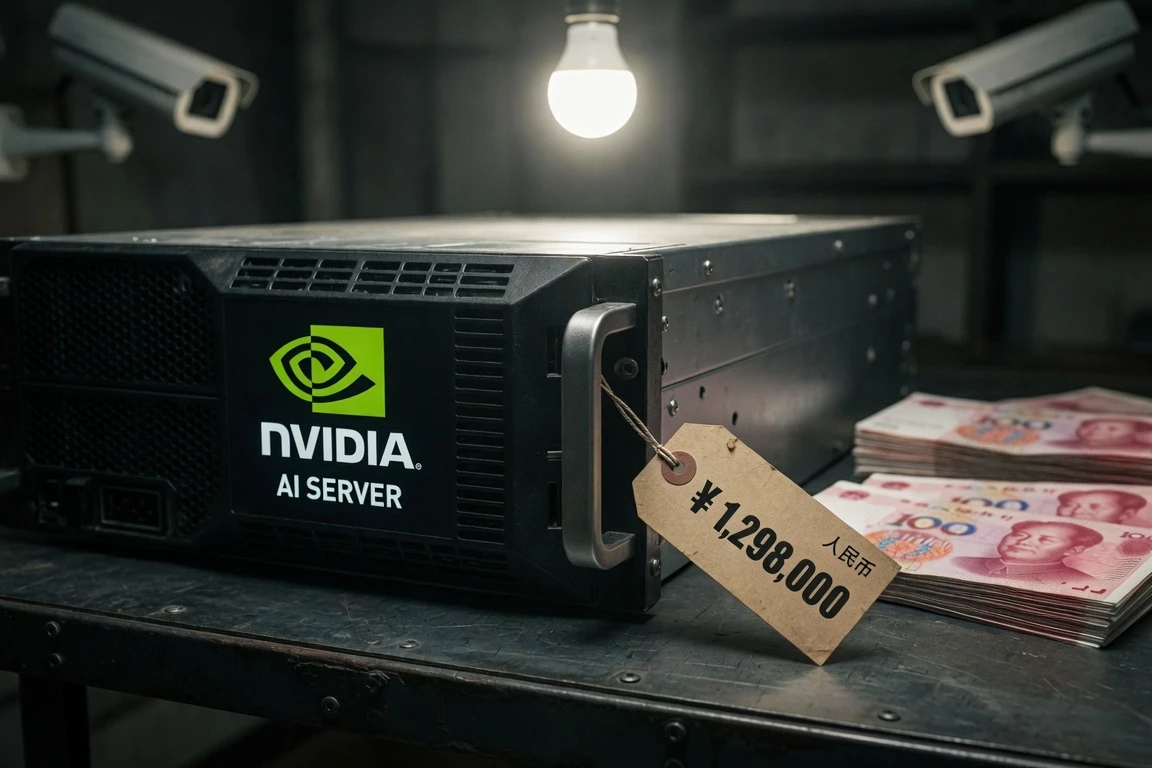
How a $550,000 US Server Doubled to $1 Million in China
The B300 server lists in the United States at around $550,000. It now sells in China for approximately 7 million yuan, roughly $1 million, according to four industry sources cited by Reuters and described in coverage of the B300 scarcity driving China’s $1 million servers.
Six months ago the same hardware changed hands in China for about 4 million yuan. The price move traces back to early 2026, when a crackdown on chip smuggling closed the grey-market supply channel Chinese companies had relied on to buy Nvidia hardware they could not purchase through official channels. Demand from Chinese AI companies has stayed strong throughout, and supply has tightened.
- DGX B300 server, China price: more than 8 million yuan ($1.1 million)
- DGX B300 server, US list price: around $550,000
- DGX B300 server, China six months ago: about 4 million yuan
- B300 server short-term rental, China: 190,000 yuan per month
- A100-based servers, China price move: tripled since late last year
Short-term rentals of the B300 in China have tracked the same trajectory, with contracts reportedly reaching 190,000 yuan per month. That is the kind of monthly bill that pushes Chinese AI labs to build clusters of older hardware while the new gear is unobtainable. For the first time in the export-control era, China’s GPU rental market is no longer the cheap option it was in 2023 and 2024.
The Supermicro Indictment That Choked the Grey Market
The grey market’s choke point dates to March 19, 2026, the day US federal prosecutors arrested Yih-Shyan “Wally” Liaw, co-founder of server maker Supermicro, and unsealed an indictment against him and two associates. The indictment alleged the three conspired to divert roughly $2.5 billion in Supermicro servers, containing Nvidia’s export-controlled Blackwell-class AI chips, to Chinese buyers through a Southeast Asian pass-through company, according to the federal indictment unsealed on March 19, 2026. Liaw and contractor Ting-Wei “Willy” Sun were arrested in California; Supermicro Taiwan general manager Ruei-Tsang “Steven” Chang remains a fugitive.
The scale of the alleged diversion ran into nine figures within weeks. Between late April 2025 and mid-May 2025 alone, at least approximately $510 million worth of Supermicro servers, assembled in the United States, were diverted to China in violation of US export control laws, the indictment said. To deceive the manufacturer’s compliance auditors, the defendants and their co-conspirators staged thousands of dummy servers, non-working physical replicas, at warehouses in Southeast Asia where the real hardware was supposed to be stored. Sun and a broker used a hair dryer to remove and affix labels and serial number stickers to the boxes and dummy servers, then re-packaged them for inspection.
Supermicro’s shares fell 33% on the day the indictment was unsealed, erasing more than $6 billion in market capitalisation, in a move that the insider-ownership screen flagging Super Micro after the indictment also captured. The company placed Liaw and Chang on administrative leave and terminated its relationship with Sun. Liaw and Sun have pleaded not guilty. Chang remains at large.
Why the H20 License Requirement Did Not Stop the Squeeze
The B300 squeeze sits on top of an earlier legal-channel closure. On April 9, 2025, the US government informed Nvidia that it required a license to export its H20 chip, the downgraded GPU Nvidia had designed to comply with earlier export control rules, to the Chinese market. The H20 had been Chinese companies’ primary access point for compliant Nvidia hardware.
Nvidia took a $4.5 billion charge in the first quarter of fiscal 2026 on excess H20 inventory and purchase obligations. The company was unable to ship an additional $2.5 billion of H20 revenue that quarter. That removed the only chip Nvidia was still officially selling into China.
- April 9, 2025: US government notifies Nvidia of H20 license requirement
- Q1 FY2026: Nvidia records a $4.5 billion charge on H20 inventory and purchase obligations
- Q1 FY2026: An additional $2.5 billion of H20 revenue could not be shipped
The legal channel for compliant Nvidia hardware in China effectively closed that quarter. Every B300 server now in China has either been smuggled in, re-exported through a third country, or assembled from chips routed around the licensing regime.
Where China’s AI Labs Are Still Paying Premium Prices
Demand is the side of the equation the US crackdown has not been able to reach. Chinese AI companies are still racing to deploy inference workloads, the part of AI compute that generates outputs after a model is trained. Per-token cost is the competitive metric that matters most to them right now.
Nvidia’s hardware still runs the developer ecosystem, the CUDA software stack, and the model implementations Chinese engineers already know. That is why traders say Chinese buyers are paying the doubling rather than walking away. Many are deliberately structuring their purchases to avoid holding Nvidia hardware directly on their balance sheets, fearing exposure to US sanctions. The hardware is moved through less exposed entities, sometimes in Hong Kong, sometimes through holding companies, and the user pays a premium for the legal distance from the chip.
The result is a market in which the same Nvidia server that lists in the US for around $550,000 costs more than 8 million yuan in China. Renting the same server for a month costs up to 190,000 yuan per month. Scarcity has not weakened Nvidia’s grip on the Chinese AI market; it has tightened it.
What Huawei Has Not Yet Replaced
China’s domestic chipmakers have been working on a substitute for years. Huawei’s latest Ascend processors are being tested by major Chinese data-centre operators, the FT report said. Beijing has been encouraging adoption of the local parts.
Software compatibility and ecosystem limitations continue to make Nvidia’s platform the preferred choice for many developers, industry executives told the newspaper. Most large Chinese AI models are still written to run on Nvidia’s CUDA software stack, a gap that HiSilicon’s price hike and the HBM ceiling on Chinese chips also reflects. Porting models to a domestic alternative costs engineering time, and per-token cost is what the inference market prices.
That is the demand side of the scarcity story, and it is what the export controls have not been able to break. Until Huawei’s Ascend line or another domestic option can match the developer experience of Nvidia’s stack, the doubling is likely to stick.
Frequently Asked Questions
Why is the Nvidia B300 server so expensive in China right now?
A March 2026 US indictment against Supermicro co-founder Wally Liaw and two associates disrupted the grey-market supply channel that had been a critical workaround for Chinese companies unable to buy Nvidia hardware through official channels, the FT reported. With demand still strong and the legal H20 channel already closed, prices doubled in six months.
What was the H20 export ban and when did it happen?
On April 9, 2025, the US government informed Nvidia that it required a license to export its H20 chip, a downgraded GPU Nvidia had designed to comply with earlier export control rules, to the Chinese market. Nvidia took a $4.5 billion charge in the first quarter of fiscal 2026 on excess H20 inventory and purchase obligations and was unable to ship an additional $2.5 billion of H20 revenue that quarter.
How much did the Supermicro smuggling case cost Supermicro’s shareholders?
Supermicro’s shares fell 33% on the day the indictment was unsealed, erasing more than $6 billion in market capitalisation. Liaw resigned from the Supermicro board the same day.
Are Chinese AI companies switching to Huawei chips instead?
Huawei’s latest Ascend processors are being tested by major Chinese data-centre operators, the FT report said, but software compatibility and ecosystem limitations continue to make Nvidia’s platform the preferred choice for many developers, industry executives told the newspaper.


OpenAI Ultrafast Puts GPT-5.6 Sol on Live Workloads

Apple’s 15% External Fee Bid Admits Its Own Zero Floor

JBL Beats Bose and Sony on Value for 2026 Soundbars

iPhone Users Pull 40 Percent More From Microdrama Apps

Nebius Q2 Turns AI Cloud Demand Into Prepaid Growth Machine

One UI 9.5 App Lock Ends Years of Samsung Delays

Shiprocket IPO Premium Hides ESOP Costs and Flat Merchant Base

Google Halves Gemini 3.7 Flash Price to Fuel Agent Swarms

Dawnwalker Time Clock Cracks Open-World RPG Habits

Gemini 3.7 Flash Cuts Agent Costs While Pro Stays Delayed

Fable 5 and Mythos 5 Return as US Lifts Anthropic Export Controls

Oracle Cuts 21,000 Jobs in a Year, Cites AI in 10-K Filing

SpaceX’s Google Deal Turns a Rocket Company Into a Cloud Landlord

CD Projekt Red Co-CEO: Redemption Arc Isn’t Done, Witcher 4 in 2027

XPL Rallies 30% Ahead of Plasma One Card Tier Launch

Google Search Profiles Build a Follow Graph Inside Discover

DGO App Brings Rs 549 Mobile Pass for FIFA World Cup 2026 in Nepal

Moonshot AI Targets $30 Billion in China’s Fastest AI Funding Sprint

Microsoft Xbox Layoffs Start in July as Sharma Slams 3% Margin

Oppo’s ColorOS 17 Eligibility List Leaves A-Series Buyers Behind
-
 AI2 months ago
Fable 5 and Mythos 5 Return as US Lifts Anthropic Export Controls
-
 AI2 months ago
Oracle Cuts 21,000 Jobs in a Year, Cites AI in 10-K Filing
-
 AI2 months ago
SpaceX’s Google Deal Turns a Rocket Company Into a Cloud Landlord
-
 GAMING2 months ago
CD Projekt Red Co-CEO: Redemption Arc Isn’t Done, Witcher 4 in 2027
-
 CRYPTO2 months ago
XPL Rallies 30% Ahead of Plasma One Card Tier Launch
-
 NEWS2 months ago
Google Search Profiles Build a Follow Graph Inside Discover
-
 APPS2 months ago
DGO App Brings Rs 549 Mobile Pass for FIFA World Cup 2026 in Nepal
-
 AI2 months ago
Moonshot AI Targets $30 Billion in China’s Fastest AI Funding Sprint