
AI
CaoCao Mobility Launches AI Innovation Center to Power RoboX
CaoCao Mobility launched an AI Innovation Center with Shanghai AI Research Institute to back the RoboX strategy targeting 100,000 Robotaxis by 2030.

CaoCao Mobility announced on June 25, 2026 that it has set up a dedicated AI Innovation Center with the Shanghai Artificial Intelligence Research Institute to advance AI integration into real-world mobility operations. The center is part of the RoboX strategy the Hong Kong-listed, Geely-backed company unveiled on June 18, 2026 at the Hong Kong auto expo. That strategy targets 100,000 Robotaxis and 100,000 Robovans in service by 2030. The new center is one strand in a wider commercialization push that includes a purpose-built Robotaxi designed without a driver’s seat, a launch into Hong Kong, and deals in Abu Dhabi and Europe.
The new center arrives as China’s robotaxi industry is operating under a regulatory cooling-off period that began after a March 31, 2026 operational disruption at Baidu’s Apollo Go service in Wuhan. Per a May 29 industry report, many newly added vehicles are currently held back from passenger operations. Industry leaders, including Pony.ai and WeRide executives, have called for differentiated oversight instead of blanket rules.
The AI Innovation Center, in Plain Terms
CaoCao Mobility said the new organization will operate as the dedicated platform for turning AI research into commercial mobility services. The center was set up under a strategic partnership with the Shanghai Artificial Intelligence Research Institute. The June 25 announcement was first reported by Gasgoo.
The center’s responsibilities will span fundamental research, technology development, algorithm innovation, and real-world deployment studies, per the June 25 statement. Its stated job is to shorten the path from laboratory breakthroughs to commercial mobility services. The new organization will support the RoboX strategy with end-to-end coverage, from research and development through industrial implementation and operational deployment. CaoCao said the center will also help move innovations out of controlled testing environments and into everyday urban transportation networks.
CaoCao has also built out a corporate structure around the push. Per Gasgoo, CaoCao Zhixing Technology (Shanghai) was recently established with 50 million yuan in registered capital, wholly owned by Hangzhou Youxing Technology, a CaoCao affiliate. The company has separately posted for a Chief AI Officer on recruitment platforms.
AI is moving from the digital world into the physical world. Transportation services such as passenger mobility and freight transport will evolve into essential infrastructure for the AI era, and CaoCao is accelerating its full-scale AI transformation to embrace this trend.
CaoCao CEO Shawn Gong (Gong Xin), per the company’s June 22 press release laying out the RoboX strategy.
The RoboX Framework It Has to Feed
RoboX is the strategy the AI center is being built to feed. CaoCao unveiled it on June 18, 2026 at the Hong Kong expo. Per the June 22 press release detailing the RoboX strategy, the goal is to build a globally leading physical AI mobility technology platform. As Geely Holding Group’s primary commercialization platform for RoboX, CaoCao will run the strategy across Robotaxi, Robovan, Robobus, Robotruck and other applications.
The framework rests on three pillars: intelligent driving technologies, intelligent purpose-built vehicles, and intelligent operations. CaoCao said it will focus on Level 4 autonomous driving and continue to improve safety, operational efficiency, and cost competitiveness across passenger and freight transportation scenarios.
The headline target sits inside a plan CaoCao calls the Dual-100,000 Plan: 100,000 Robotaxis and 100,000 Robovans deployed by 2030. The split gives CaoCao one of the largest stated autonomous mobility networks in China, covering both passenger transportation and autonomous logistics. To support it, CaoCao will develop infrastructure including an intelligent hybrid dispatching system, an AI Super Brain for Operations, and Green Intelligent Mobility Hubs. The first of those hubs, in Hangzhou, opened in December 2025.
Underpinning the whole effort is Robo OS, a core operations system that handles demand understanding, supply-demand matching, and service fulfillment. CaoCao said the OS will support AI agent integration and coordination, connecting AI agents to intelligent mobility resources. Per the press release, vehicles become “execution terminals for AI agents” in this model.
Where CaoCao Actually Stands Today
The current state of the operation sets the scale of the work. An initial fleet of 100 Robotaxis began operating in Hangzhou in late 2025, the South China Morning Post reported in April. On April 1, 2026, CaoCao became the first operator approved for unmanned road tests in the city. Per CEO Gong Xin, as cited by SCMP, many local governments in China are highly supportive of L4-related applications, and CaoCao believes the technology is approaching a critical inflection point. CaoCao is targeting fully driverless operations this year, according to the same SCMP interview.
That places CaoCao well behind the largest Chinese robotaxi fleets on reported scale. Baidu’s Apollo Go handled 3.2 million Robotaxi orders in Q1 2026, with weekly peak orders exceeding 350,000 in March 2026. Pony.ai reported its global Robotaxi fleet had surpassed 1,700 vehicles as of May 24, 2026, with a raised 2026 year-end target of 3,500 vehicles. WeRide’s domestic fleet reached approximately 1,000 vehicles by the end of April 2026.
| Operator | Reported Robotaxi Scale | Source Period |
|---|---|---|
| CaoCao Inc. | 100 Robotaxis operating in Hangzhou | Feb 2026 |
| Pony.ai | 1,700+ Robotaxis globally | May 24, 2026 |
| WeRide | ~1,000 Robotaxis in China | End of April 2026 |
| Baidu Apollo Go | 3.2 million Robotaxi orders in Q1 | Q1 2026 |
A Web of Partnerships Stacked Alongside
The AI center is one strand in a commercialization push CaoCao has been stacking partnership by partnership. On the same day RoboX was unveiled, CaoCao signed a strategic partnership with Farizon Auto, also part of the Geely group, covering the new energy commercial vehicle sector and Robovan models such as the Shentong T6. CaoCao also signed a framework cooperation agreement with Douyin Group for AI-powered mobility services integration and in-vehicle music content recommendations.
The international push is already moving. On June 24, 2026, CaoCao signed a partnership with May Mobility to bring robotaxis to Europe. Per CaoCao’s IR page, an earlier MoU with the Abu Dhabi Investment Office (ADIO), signed November 10, 2025 at the DRIFTx exhibition in Abu Dhabi, marked the start of overseas Robotaxi operations in the Middle East. Another Chinese automaker has made its own AI mobility push into the UAE this year.
Domestic-side partnerships round out the stack. In December 2025, CaoCao agreed to acquire 100% of Weixing Technology, operator of StarRides, and proposed to acquire 100% of Zhejiang Geely Business, both moves framed as building a one-stop tech-driven mobility platform. In September 2025, CaoCao launched the CaoCao Zhixing Satellite with Geespace, making it, per the company, the world’s first mobility platform to apply low-orbit satellite communication to Robotaxi operations at scale. Earlier in 2025, CaoCao also signed deals with Aerofugia on low-altitude mobility and with Dobot Robotics on operations and maintenance.
- Sept 2025: CaoCao Zhixing Satellite launched with Geespace
- Nov 10, 2025: ADIO MoU signed in Abu Dhabi
- Dec 30, 2025: Acquisitions of Weixing Technology and Geely Business agreed
- Late 2025: Initial fleet of 100 Robotaxis begins operating in Hangzhou
- April 1, 2026: First approval for unmanned road tests in Hangzhou
- June 18, 2026: RoboX strategy unveiled, Hong Kong Robotaxi service launched
- June 24, 2026: May Mobility partnership for European robotaxis
The Regulatory Headwind Above It All
China’s robotaxi industry is operating under a regulatory cooling-off period that began after a March 31, 2026 incident in which nearly 100 Baidu Apollo Go vehicles suddenly ceased operations in Wuhan. The Ministry of Industry and Information Technology, the Ministry of Public Security, and the Ministry of Transport held a joint meeting in mid-April to mandate safety rectifications.
Per the report on China’s robotaxi regulatory cooling-off, many newly added vehicles are currently held back from passenger operations, with market observers expecting this phase to persist through the end of June. Industry leaders have called for differentiated rather than blanket regulation. WeRide CEO Han Xu has urged authorities to avoid “one-size-fits-all” penalties, suggesting an aviation-style framework that rewards strong safety records and penalizes poor ones. “We expect that as time progresses, regulation will become more differentiated based on safety performance, operational records, and technical capabilities,” Han stated.
Pony.ai CFO Wang Haojun echoed the call, arguing that higher entry barriers and strengthened safety oversight are essential steps as the sector transitions from early pilot programs to large-scale commercialization. Companies with superior safety records are positioned to earn public and regulatory trust, Wang said. Per the report, the cooling-off has not stopped leading operators from continuing to expand their fleets and raise targets.
CaoCao’s expanded testing permissions in Hangzhou and its planned driverless operations fit inside this environment. Its 100,000-by-2030 target, alongside Pony.ai’s raised 3,500-vehicle 2026 target and WeRide’s growing domestic fleet, all depend on regulators eventually resuming approvals for new vehicle deployments.
The Math the Center Is Being Asked to Solve
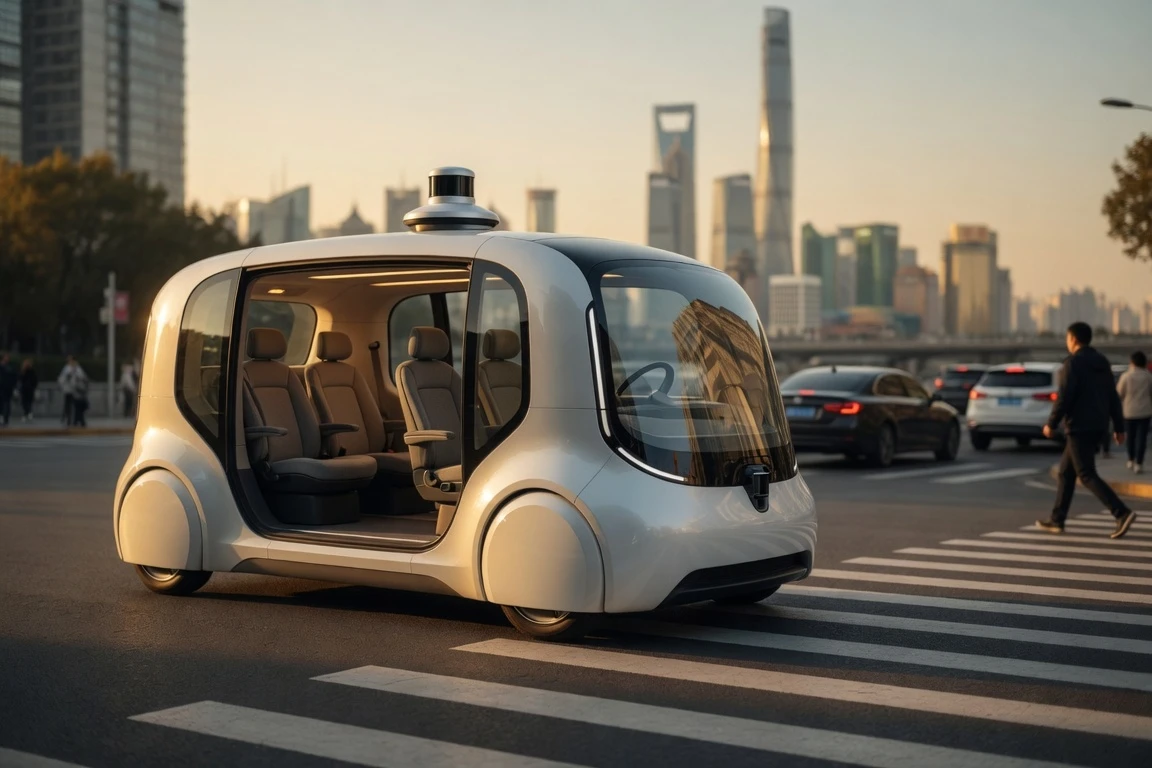
The concrete thing the new AI center is being asked to feed is a specific vehicle: the Eva Cab, a purpose-built Robotaxi Geely unveiled at Auto China in Beijing. Per the report on Geely’s Eva Cab robotaxi design, the Eva Cab has no driver’s seat, steering wheel, or pedals, with four passenger seats arranged vis-à-vis. Geely described it as the first dedicated Robotaxi fully developed in China.
Mass production of the Eva Cab is scheduled for the first half of 2027, per the same report. The Shanghai AI Research Institute partnership puts academic research inside the same organization that operates the fleet, and pairs the Dual-100,000 Plan with a research pipeline designed to keep scaling. CaoCao, China’s second-largest ride-hailing provider after Didi per the report, has said the new center will play a key role in the RoboX transformation.


OpenAI Ultrafast Puts GPT-5.6 Sol on Live Workloads

Apple’s 15% External Fee Bid Admits Its Own Zero Floor

JBL Beats Bose and Sony on Value for 2026 Soundbars

iPhone Users Pull 40 Percent More From Microdrama Apps

Nebius Q2 Turns AI Cloud Demand Into Prepaid Growth Machine

One UI 9.5 App Lock Ends Years of Samsung Delays

Shiprocket IPO Premium Hides ESOP Costs and Flat Merchant Base

Google Halves Gemini 3.7 Flash Price to Fuel Agent Swarms

Dawnwalker Time Clock Cracks Open-World RPG Habits

Gemini 3.7 Flash Cuts Agent Costs While Pro Stays Delayed

Fable 5 and Mythos 5 Return as US Lifts Anthropic Export Controls

Oracle Cuts 21,000 Jobs in a Year, Cites AI in 10-K Filing

SpaceX’s Google Deal Turns a Rocket Company Into a Cloud Landlord

CD Projekt Red Co-CEO: Redemption Arc Isn’t Done, Witcher 4 in 2027

XPL Rallies 30% Ahead of Plasma One Card Tier Launch

Google Search Profiles Build a Follow Graph Inside Discover

DGO App Brings Rs 549 Mobile Pass for FIFA World Cup 2026 in Nepal

Moonshot AI Targets $30 Billion in China’s Fastest AI Funding Sprint

Microsoft Xbox Layoffs Start in July as Sharma Slams 3% Margin

Oppo’s ColorOS 17 Eligibility List Leaves A-Series Buyers Behind
-
 AI2 months ago
Fable 5 and Mythos 5 Return as US Lifts Anthropic Export Controls
-
 AI2 months ago
Oracle Cuts 21,000 Jobs in a Year, Cites AI in 10-K Filing
-
 AI2 months ago
SpaceX’s Google Deal Turns a Rocket Company Into a Cloud Landlord
-
 GAMING2 months ago
CD Projekt Red Co-CEO: Redemption Arc Isn’t Done, Witcher 4 in 2027
-
 CRYPTO2 months ago
XPL Rallies 30% Ahead of Plasma One Card Tier Launch
-
 NEWS2 months ago
Google Search Profiles Build a Follow Graph Inside Discover
-
 APPS2 months ago
DGO App Brings Rs 549 Mobile Pass for FIFA World Cup 2026 in Nepal
-
 AI2 months ago
Moonshot AI Targets $30 Billion in China’s Fastest AI Funding Sprint