
AI
Video Rebirth Lands at No. 6 on the AI Video Benchmark With BACH
Singapore’s Video Rebirth, founded by ex-Tencent scientist Dr. Wei Liu, debuted BACH at No. 6 on the Artificial Analysis leaderboard in April 2026.

Bach-1.0 Preview landed at No. 6 on the Artificial Analysis Text to Video Leaderboard on April 5, 2026, in a tweet from the benchmark’s official account. A small Singapore startup had placed itself on a ranking built for the world’s largest AI labs.
A month later, on May 7, 2026, the company behind that model, Video Rebirth, launched it publicly as BACH, an industrial-grade AI video engine for professional film, advertising, and gaming production. The startup has raised $80 million and runs a lean operation out of Singapore, Forbes reported. Its founder, Dr. Wei Liu, IEEE/AAAS Fellow, walked away from a Tencent distinguished-scientist role and an eight-year career at the Chinese tech giant to build it. The benchmark debut puts a small team next to entries from ByteDance, Alibaba, Google, and xAI on the current leaderboard.
How a Small Singapore Startup Landed at No. 6 on a Benchmark Built for Giants
Artificial Analysis confirmed the ranking on April 5, 2026, via the Artificial Analysis announcement of Bach-1.0 Preview, noting that Bach-1.0 Preview is “the latest Text to Video model from @video_rebirth.” The benchmark ranks models using blind user votes translated into Elo scores, with no brand identity visible to the voter. Video Rebirth’s model entered the top 10 against incumbent models with vastly more compute.
The public launch followed on May 7, 2026, when BACH became available at bach.art. Liu framed the model around a specific gap in professional production. “The question we kept hearing from production teams was not whether AI could make impressive video; they had seen that,” he said in the launch announcement. “The question was whether AI could understand what they were actually trying to shoot.” That framing, control rather than novelty, is the company’s pitch to enterprise customers.
- Leaderboard debut: No. 6 on April 5, 2026
- Public launch: May 7, 2026 at bach.art
- Total raised: $80 million
- Funding structure: $50 million (November 2025) plus a $30 million extension
- Multi-shot cap: 30 seconds
- Native frame rate: 30 fps
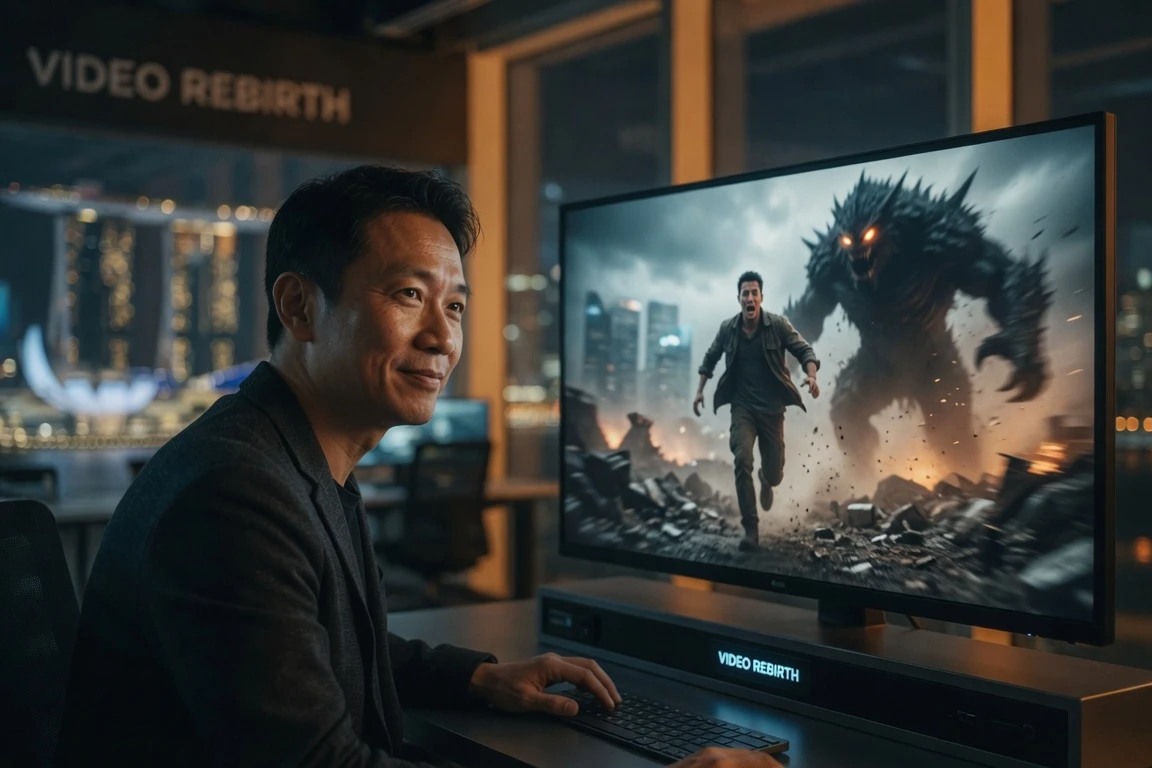
BACH in a Production Workflow
BACH generates 30-second multi-shot films from reference images and a text prompt, with consistent identity, coherent transitions, and narrative flow handled inside one workflow. The current leaderboard shows ByteDance Seedance 2.0 at the top with Elo 1218, followed by Alibaba-ATH, Kling 3.0, SkyReels V4, and Google Veo 3.1. Bach entered the same arena with a fraction of the compute stack of those entries.
The model’s character consistency runs on a proprietary mechanism called Physics Native Attention. Rather than matching visual similarity between shots, the mechanism constructs identity from bone structure, skin tone, proportional relationships, and the muscular dynamics that drive expression. That base lets the engine lock identity across shots, so a character in frame one reads as the same person in frame five. The launch statement called this “not approximate resemblance but locked identity.”
Directors can specify distinct emotional states per shot in a sequence: calm composure in the first, anger sparked by confrontation in the second, quiet tears in the third. The model executes each direction down to the micro-expression level. The intensity in an angry gaze, the tension of a furrowed brow, and the hollow look in the eyes as tears fall are all part of the specified performance. BACH is available now at bach.art and targets enterprise customers in advertising, entertainment, filmmaking, and gaming. The company’s positioning is industrial-grade, not consumer novelty.
Liu drew a sharp line between what demos usually show and what a production team needs. “A whip pan is not a slow push,” he said in the May 7 launch. “A character transitioning from anger to grief is not a random expression change.” Until an AI video engine understands those distinctions, in his framing, it is not a production tool.
| Company | Model | Multi-shot / interaction cap | Key differentiator |
|---|---|---|---|
| Video Rebirth | BACH 1.0 | 30-second multi-shot films | Physics Native Attention, Dual DiT, native 30 fps |
| Google DeepMind | Genie 3 | A few minutes of interactive navigation | 24 fps at 720p, promptable world events (research preview) |
| OpenAI (discontinued) | Sora 2 | Standalone app shut down March 24, 2026 | Hyperreal motion and sound; Disney $1B stake deal cancelled |
The Physics-First Architecture Behind BACH
BACH uses an architecture called Dual DiT that splits the work of prompt adherence and visual generation between two specialized components rather than asking one model to handle both. The company describes this division of labor as the source of its compute efficiency. Liu told the launch audience that the team trains on fewer, higher-quality videos, including licensed movies and music videos plus in-house footage, most at 720p resolution. That choice is part of the cost story the company tells.
Physics Native Attention sits on top of that split as the consistency mechanism. It builds identity from physics: bone structure, skin tone, proportional relationships, muscular dynamics. The result is a character whose performance reads as the same person across shots, not a resemblant stand-in.
The company’s own framing for BACH’s frame rate is “the World’s First Native 30 fps” for an industrial-grade video engine. That detail matters in advertising and film, where fluid motion is a basic expectation rather than a feature. Liu’s argument is that BACH gives control and motion quality at the same time, where most of the field has had to choose one. “BACH is built around that understanding,” he said, returning to the production-ready framing. The same dual-brain architecture that drives prompt fidelity also drives the visual fidelity, in the company’s own description.
The question was whether AI could understand what they were actually trying to shoot. A whip pan is not a slow push. A character transitioning from anger to grief is not a random expression change. Until an AI video engine understands these distinctions, it is not a production tool. BACH is built around that understanding.
Dr. Wei Liu, Co-founder and CEO of Video Rebirth, IEEE/AAAS Fellow, in the company’s May 7, 2026 launch announcement.
Why Generative Video Became the Front Door to World Models
The argument from Video Rebirth, Google DeepMind, and a handful of others is that generative video is the working path to world models, the AI systems that simulate physical environments and predict what happens next inside them. Video Rebirth’s founders go further: a model trained to produce physically consistent video is already most of the way to a world model.
Google DeepMind made a parallel bet with Genie 3. The team announced Genie 3 as a limited research preview on August 5, 2025, and public access via Project Genie began rolling out on January 29, 2026 to Google AI Ultra subscribers in the United States, per Google DeepMind’s Genie 3 research preview. Genie 3 generates dynamic worlds from text prompts that users can navigate in real time, retaining consistency for a few minutes at 24 frames per second and 720p resolution. The DeepMind framing is explicit: “world models are also a key stepping stone on the path to AGI.”
OpenAI’s Sora offered the counter-evidence. The company shut down its standalone Sora app on March 24, 2026, Variety reported, with Disney cancelling a $1 billion equity and licensing deal the same day in the Sora shutdown and Disney deal collapse. The Sora app had launched in September 2025. The capital intensity of consumer-grade video generation proved too steep.
The pattern across the field is consistent. Google opened up a research preview, then extended to a paid consumer channel. OpenAI pulled the consumer route and refocused its Sora team on world simulation research for robotics and physical tasks. ByteDance, Alibaba, and Kuaishou stayed in the market with their own models. Video Rebirth chose the industrial route, tools for professional creators over consumer novelty, and is now betting that the path to commercial world models runs through enterprise customers who already pay for production-grade tools. Workflow integration, not the model itself, is the moat the company is building.
The open question is who funds the path from research preview to commercial product. Google’s world model work is bankrolled by a trillion-dollar parent. OpenAI retreated from the consumer app. ByteDance and the Chinese giants have distribution. Video Rebirth has a $80 million runway and a production-tool pitch, the smallest economic envelope in the comparison.
Who’s Backing the $80 Million Round
Video Rebirth closed $80 million in funding in two stages: a $50 million round in November 2025, then a $30 million extension after BACH’s benchmark debut. The extension drew strategic demand from global investors, the company said in its announcement. The round is led by AMD Ventures, with Hyundai Motor Group’s ZER01NE, CJ Group-affiliated HIVEN, and Feedback Ventures all participating, per the $80 million funding round details.
AMD’s role is infrastructure. Sagi Paz, Head of AMD Ventures, framed the partnership as a long-term compute alliance. Hyundai’s ZER01NE sees Video Rebirth as a partner for autonomous-driving simulation and physical AI inside hyper-realistic digital worlds. CJ Group’s HIVEN expects collaboration across CJ ENM, the entertainment arm that produces Korean drama and film. Feedback Ventures, whose partner Peter Lim joined from Temasek, sees the company positioning for simulation-driven industries. Co-founders include Dan Kong, an ex-G42 AI investor now COO, and Difu Li, formerly leading AI strategy at Tencent, now CSO.
Video Rebirth’s pioneering approach to building world models natively through video exemplifies the type of technical innovation that aligns with AMD’s commitment to advancing the future of AI. We are proud to collaborate with Video Rebirth and for AMD to serve as their long-term infrastructure partner, delivering the high-performance compute foundation needed to scale their industrial-grade realities to the world.
Sagi Paz, Head of AMD Ventures, in Video Rebirth’s $80 million funding announcement.
Olympus, the World Model Video Rebirth Is Building
Video Rebirth’s stated next milestone is a world model called Olympus, targeted for the end of 2026. Liu Wei’s framing is that video generation is the path to a world model, not a destination of its own. “We do video generation in order to build a world model,” he has said in the company’s communications. The model would work similarly to Google’s Genie 3 but extend the interactive duration and add environmental sound.
Hyundai’s investment thesis is the natural first customer. ZER01NE explicitly framed Video Rebirth as a “key partner for the future of mobility,” with potential to train physical AI inside hyper-realistic digital worlds. Hyundai Motor owns Boston Dynamics and operates an autonomous-driving business that already runs large simulation workloads. The integration runway is concrete: Video Rebirth’s models could become the simulation layer Hyundai uses to test edge-case driving scenarios, from a malfunctioning truck blocking the road to weather events the fleet has not encountered. The economic logic of the partnership lines up cleanly with the product roadmap.
The technical hurdle is real-time simulation of physical scenarios with consistent physics. Difu Li, Video Rebirth’s CSO, has described the moment as “the precipice of a ‘De-engineering’ revolution in pan-entertainment.” Genie 3 currently supports “a few minutes” of consistent navigation before drift sets in. Olympus would need to extend that, add environmental sound, and ship at commercial grade.
Liu Wei left a Tencent distinguished-scientist role, where he had led the Hunyuan foundational-model team for more than eight years, to pursue this. His public forecast is that the next 12 months will focus on technical breakthroughs inside the laboratory. The implied standard is straightforward: Olympus has to ship by year-end to vindicate the thesis, and Hyundai’s mobility roadmap is the natural first customer for a working world model. If Olympus lands, the company will have shown that a 30-person operation can produce what trillion-dollar labs have only previewed.
Frequently Asked Questions
What is Video Rebirth?
Video Rebirth is a Singapore-headquartered AI video startup founded by Dr. Wei Liu, a former Tencent distinguished scientist and IEEE/AAAS Fellow, in late 2024. The company is publicly known through its $80 million funding round, which closed in March 2026, and the May 7, 2026 launch of its flagship model, BACH.
What is the BACH model?
BACH is Video Rebirth’s industrial-grade AI video engine, available at bach.art. It generates multi-shot films up to 30 seconds long from text prompts and reference images, with character consistency built on a proprietary mechanism called Physics Native Attention, and outputs at a native 30 frames per second.
How much has Video Rebirth raised?
Video Rebirth raised $80 million in total through a $50 million initial close in November 2025 and a $30 million extension that closed in March 2026. The capital is earmarked for commercializing the BACH model and developing a world model called Olympus.
Who are Video Rebirth’s investors?
The strategic investors include AMD Ventures as compute partner, Hyundai Motor Group’s ZER01NE for mobility and autonomous driving, HIVEN affiliated with CJ Group for entertainment and Korean content, and Feedback Ventures. The mix spans semiconductors, automotive, entertainment, and venture capital.
What is the Olympus world model?
Olympus is Video Rebirth’s planned world model, targeted for release by the end of 2026. It would let users generate interactive 3D environments from text prompts, similar in concept to Google’s Genie 3 but with environmental sound and a longer consistent-interaction window. Liu has described it as the company’s next major technical milestone.


Google Opens Gmail to Voice and Gates Docs Live

Lenovo Prices the IdeaPad Vibe Against Apple’s $699 Neo

Xbox Caps Game Pass Cloud Gaming at 15 Hours

GTA 6 DualSense Controllers Follow Sony’s Usual $84.99 Script

South Korea Retail Investors Face Reckoning After KOSPI AI Rally Collapses

Surrey AI Maps Three Heart Attack Paths and Their Molecular Roots

Germany Locks Neutral Apple ATT Prompts Across Most of Europe

Apple’s 5% EU Fee Quietly Rewrites Alternative App Store Math

Apple’s EU Fee Truce Cuts Complexity but Leaves Rivals Fuming

Pixel 11 Pro Fold Trades Thinness for Durability and Seven-Year Stay

Oracle Cuts 21,000 Jobs in a Year, Cites AI in 10-K Filing

Fable 5 and Mythos 5 Return as US Lifts Anthropic Export Controls

SpaceX’s Google Deal Turns a Rocket Company Into a Cloud Landlord

CD Projekt Red Co-CEO: Redemption Arc Isn’t Done, Witcher 4 in 2027

XPL Rallies 30% Ahead of Plasma One Card Tier Launch

Google Search Profiles Build a Follow Graph Inside Discover

DGO App Brings Rs 549 Mobile Pass for FIFA World Cup 2026 in Nepal

Moonshot AI Targets $30 Billion in China’s Fastest AI Funding Sprint

Oppo’s ColorOS 17 Eligibility List Leaves A-Series Buyers Behind

Microsoft Xbox Layoffs Start in July as Sharma Slams 3% Margin
-
 AI2 months ago
Oracle Cuts 21,000 Jobs in a Year, Cites AI in 10-K Filing
-
 AI2 months ago
Fable 5 and Mythos 5 Return as US Lifts Anthropic Export Controls
-
 AI3 months ago
SpaceX’s Google Deal Turns a Rocket Company Into a Cloud Landlord
-
 GAMING2 months ago
CD Projekt Red Co-CEO: Redemption Arc Isn’t Done, Witcher 4 in 2027
-
 CRYPTO3 months ago
XPL Rallies 30% Ahead of Plasma One Card Tier Launch
-
 NEWS3 months ago
Google Search Profiles Build a Follow Graph Inside Discover
-
 APPS3 months ago
DGO App Brings Rs 549 Mobile Pass for FIFA World Cup 2026 in Nepal
-
 AI3 months ago
Moonshot AI Targets $30 Billion in China’s Fastest AI Funding Sprint