
COMPUTERS
Apple’s Price Increases Hit Every Mac, iPad, and Apple TV
Apple raised prices on 14 Mac, iPad, and Apple TV models on June 25, 2026, with the M3 Ultra Mac Studio gaining $1,300 as AI-driven memory costs surge.

Apple raised prices across most of its Mac, iPad, and Apple TV lineup on June 25, 2026, with the M3 Ultra Mac Studio gaining $1,300 overnight and the entry-level Apple TV climbing $70. The company blamed a global memory chip shortage driven by AI data center demand, a problem CEO Tim Cook called a “hundred-year flood.”
The increases hit 14 products in Apple’s online store. The iPhone, Apple Watch, AirPods, and Studio Display held their old prices, at least for now. Cook had signaled the move was coming the week before in an interview with The Wall Street Journal.
Apple Raised Prices on 14 Products
Apple’s online store went down briefly on Thursday morning, then came back up with new price tags across the catalog. The complete list of new and old prices across 14 products was published within hours. Most of the affected products saw increases between $100 and $500, but two outliers stood out: the M3 Ultra Mac Studio at $1,300 and the M4 Max Mac Studio at $500.
| Product | Old Price | New Price | Increase |
|---|---|---|---|
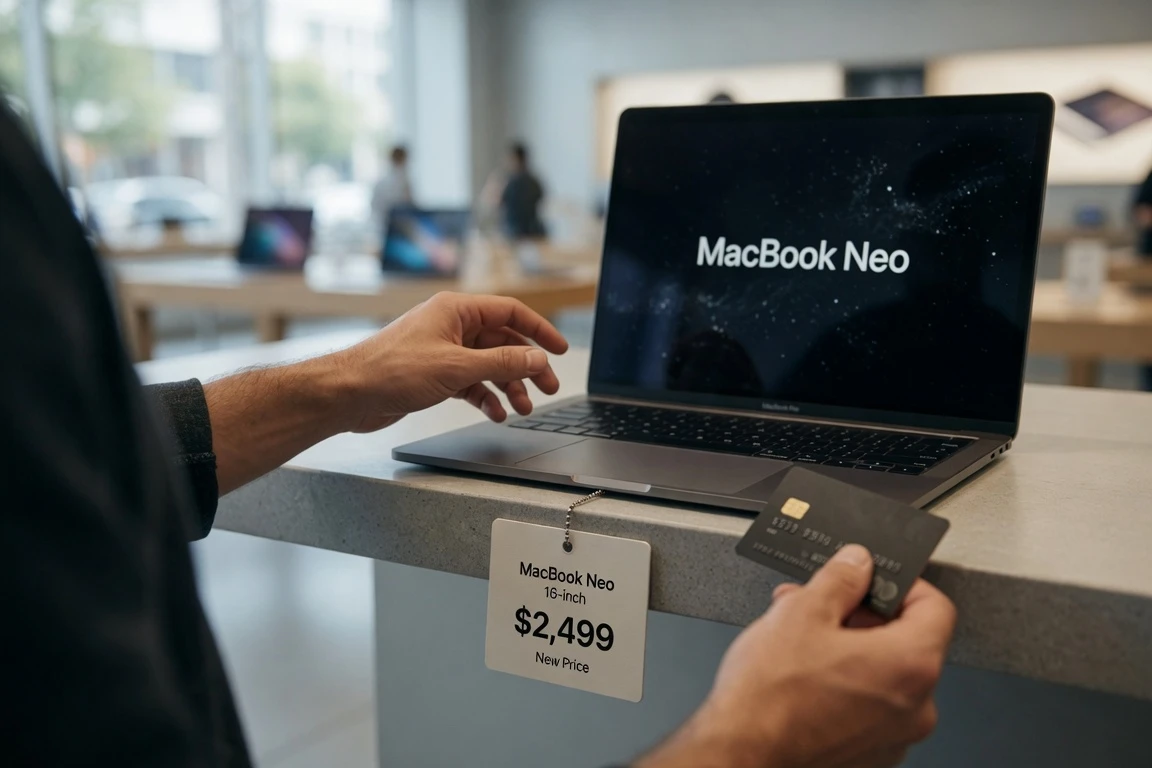
| MacBook Neo | $599 | $699 | $100 |
| 13-inch MacBook Air | $1,099 | $1,299 | $200 |
| M5 MacBook Pro | $1,699 | $1,999 | $300 |
| iMac | $1,299 | $1,499 | $200 |
| Mac mini (M4 Pro) | $1,399 | $1,599 | $200 |
| Mac Studio (M4 Max) | $1,999 | $2,499 | $500 |
| Mac Studio (M3 Ultra) | $3,999 | $5,299 | $1,300 |
| iPad | $349 | $449 | $100 |
| 11-inch iPad Air | $599 | $749 | $150 |
| 13-inch iPad Pro | $1,299 | $1,499 | $200 |
| iPad mini | $499 | $599 | $100 |
| Apple TV 4K (Wi-Fi) | $129 | $199 | $70 |
| Apple TV 4K (Wi-Fi + Ethernet) | $149 | $249 | $100 |
| HomePod mini | $99 | $129 | $30 |
| HomePod | $299 | $349 | $50 |
| Vision Pro | $3,499 | $3,699 | $200 |
The full Mac lineup shifted. The MacBook Neo, Apple’s cheapest laptop introduced earlier this year, moved from $599 to $699. The 13-inch MacBook Air moved from $1,099 to $1,299. The MacBook Pro started at $1,999 instead of $1,699. The iMac rose from $1,299 to $1,499, and the Mac mini with M4 Pro climbed from $1,399 to $1,599.
The iPad line moved in lockstep. The base iPad went from $349 to $449, the iPad Air went from $599 to $749 for the 11-inch and from $749 to $949 for the 13-inch, the iPad Pro started at $1,199, and the iPad mini went from $499 to $599.
Outside the Mac and iPad families, three device families took price hikes of their own. The Apple TV 4K Wi-Fi model moved from $129 to $199, and the Apple TV 4K Wi-Fi + Ethernet model moved from $149 to $249. The full-size HomePod moved from $299 to $349, the HomePod mini moved from $99 to $129, and the Vision Pro moved from $3,499 to $3,699.
The catalog now reflects the first broad price reset Apple’s Mac and iPad lineup has seen in years.
The Biggest Hits Were at the High End
Per the percentage increases calculated across every affected product, the Apple TV 4K took the steepest percentage jump in the catalog, rising 54.3% on the Wi-Fi model. The base iPad climbed 28.7%, the M3 Ultra Mac Studio rose 32.5%, and the M4 Max Mac Studio rose 25%.
The MacBook Neo, by contrast, rose a comparatively modest 16.7%. Higher configurations across the Mac and iPad lines saw their prices stretch even further, with top-spec models climbing well past the entry-level increase. The average increase across the affected products came to $246.67.
Apple’s Explanation: A ‘Hundred-Year Flood’ of Memory Costs
Apple had warned the increases were coming. CEO Tim Cook told The Wall Street Journal in an interview published the week before that price hikes were unavoidable because of memory and storage chip costs. Cook described the scale of the shortage as a “hundred-year flood” and added: “I’ve never seen anything like it in any area in over 40 years.”
In a statement after the new prices went live, Apple said the company had been absorbing rising component costs but could not keep doing so. The company said it had “never seen a component price increase this much, this quickly” and that it had reached “a point where we need to begin raising prices on a number of products.” Apple has historically absorbed component cost swings rather than passing them on, so the move marks a shift in approach. The statement did not say when prices might return to their old levels.
Cook framed the shortage as a side effect of the AI buildout. “There’s less supply at a time when consumers want devices and the memory guys are passing along huge price increases,” he told the Journal. According to research firm TechInsights, the prices of DRAM and NAND chips have both quadrupled over the past 12 months and are projected to keep rising into 2027.
Even Refurbished Macs and iPads Went Up
Apple’s Certified Refurbished store, the company’s official channel for discounted returned and repaired units, also raised prices the same day. According to the full breakdown of refurbished price changes, prices across the refurbished inventory rose by an average of $160 to $180. Mac increases averaged $204 at the low end and $330 at the high end. The iPad increases were more uniform, mostly in the $120 to $150 range.
Some specific examples from the catalog:
- Refurbished 14-inch MacBook Pro with M4 Pro chip: $1,699 to $1,779
- Refurbished 14-inch MacBook Pro with M5 chip: $1,359 to $1,439
- Refurbished 14-inch MacBook Pro with M5 chip (highest configuration): $2,629 to $3,309
- Refurbished 14-inch MacBook Pro with M2 Max: $4,249 to $4,839
- Refurbished 10th-gen iPad Wi-Fi 256GB: $339 to $409
- Refurbished iPad mini 6: $379 to $459 or $449 to $529
The logic is harder to explain for refurb. MacRumors noted that many refurbished units contain original memory, storage, and logic boards, or service parts purchased before the latest component cost spike. The price increases appear to follow Apple’s new pricing structure rather than the actual cost of each individual device. Apple’s Certified Refurbished prices are calibrated to stay a fixed percentage below the equivalent new unit, so when the new price moves, the refurb price moves with it.
The Squeeze Is Hitting the Whole Consumer Electronics Industry
Apple is not the only one passing the cost on. Hours after Apple’s announcement, Microsoft’s Xbox price hike starting August 1 brought a $100 increase to the 512 GB model and a $150 increase to the 1 TB model. Console storage and memory prices have more than doubled, Microsoft said, and the company expects them to double again by fall 2027.
Analysts expect the pressure to reach the iPhone eventually. “Apple hasn’t announced what the iPhone price increases will be, but they are surely coming,” Nabila Popal, senior director of data and analytics at International Data Corporation, said in an email to CBS News. “The storm isn’t over yet; this is just the beginning.” Apple’s own statement on June 25 did not address the iPhone, and Apple’s shares were down $16.49, or 5.6%, to $276.68 in afternoon trading the day of the announcement.
What’s Left for Buyers Looking for a Way Around It
For now, third-party retailers still have inventory at the old prices. On the day of the increase, Amazon still listed pre-hike prices for many Apple products, several of them discounted further for Amazon Prime Day. A 13-inch M5 MacBook Air was listed at $949 against a new Apple price of $1,299, and an M4 iPad Air was listed at $519 against a new Apple price of $749.
The window is narrow. Amazon’s listing for the MacBook Neo was already marked as a Prime Day deal at $590 against the new $699 list, with the Prime Day window open just as Apple’s online store updated.
Apple has not signaled a timeline for when prices might come back down. Tim Cook framed the memory shortage as structural rather than temporary, and the statement pointed to “the rapid expansion of AI data centers” as the cause. The next decision will be whether the iPhone joins the list, and Apple’s next Apple TV and HomePod mini are reportedly ready and waiting on a launch window, but Cook told the Journal last week that Apple has not yet decided on iPhone pricing.
Frequently Asked Questions
What Apple products got price increases on June 25, 2026?
Apple raised prices on the MacBook Neo, MacBook Air, MacBook Pro, iMac, Mac mini, Mac Studio, every iPad model, both Apple TV 4K variants, both HomePod speakers, and the Vision Pro. The iPhone, Apple Watch, AirPods, and Studio Display were not affected at this point.
Why is Apple raising prices now?
Apple cites a global memory and storage chip shortage driven by the rapid buildout of AI data centers. CEO Tim Cook told The Wall Street Journal the situation has become “unsustainable” and described the scale of the shortage as “a hundred-year flood,” his most dramatic language on component costs in years.
Did refurbished Macs and iPads go up too?
Yes, the same day. Apple’s Certified Refurbished store raised prices, with Mac increases averaging $204 at the low end and $330 at the high end, and iPad increases in the $120 to $150 range. Many refurbished units contain components acquired before the chip shortage, so the move tracks Apple’s new pricing structure rather than actual component cost on each device.
Will the iPhone get a price hike next?
Apple has not announced iPhone price changes. Analysts at International Data Corporation expect iPhone increases to come eventually. Nabila Popal of IDC told CBS News the company is likely “saving that announcement for later,” with iPhones as Apple’s biggest revenue driver.
Are competitors also raising prices for the same reason?
Yes, the same memory shortage is forcing price hikes across consumer electronics. Hours after Apple’s announcement, Microsoft said it would raise Xbox console prices starting August 1, citing more than doubled storage and memory costs. IDC’s Nabila Popal told CBS News the storm is “just the beginning,” with research firm TechInsights projecting DRAM and NAND prices to keep rising into 2027.


OpenAI Ultrafast Puts GPT-5.6 Sol on Live Workloads

Apple’s 15% External Fee Bid Admits Its Own Zero Floor

JBL Beats Bose and Sony on Value for 2026 Soundbars

iPhone Users Pull 40 Percent More From Microdrama Apps

Nebius Q2 Turns AI Cloud Demand Into Prepaid Growth Machine

One UI 9.5 App Lock Ends Years of Samsung Delays

Shiprocket IPO Premium Hides ESOP Costs and Flat Merchant Base

Google Halves Gemini 3.7 Flash Price to Fuel Agent Swarms

Dawnwalker Time Clock Cracks Open-World RPG Habits

Gemini 3.7 Flash Cuts Agent Costs While Pro Stays Delayed

Fable 5 and Mythos 5 Return as US Lifts Anthropic Export Controls

Oracle Cuts 21,000 Jobs in a Year, Cites AI in 10-K Filing

SpaceX’s Google Deal Turns a Rocket Company Into a Cloud Landlord

CD Projekt Red Co-CEO: Redemption Arc Isn’t Done, Witcher 4 in 2027

XPL Rallies 30% Ahead of Plasma One Card Tier Launch

Google Search Profiles Build a Follow Graph Inside Discover

DGO App Brings Rs 549 Mobile Pass for FIFA World Cup 2026 in Nepal

Moonshot AI Targets $30 Billion in China’s Fastest AI Funding Sprint

Microsoft Xbox Layoffs Start in July as Sharma Slams 3% Margin

Oppo’s ColorOS 17 Eligibility List Leaves A-Series Buyers Behind
-
 AI1 month ago
Fable 5 and Mythos 5 Return as US Lifts Anthropic Export Controls
-
 AI2 months ago
Oracle Cuts 21,000 Jobs in a Year, Cites AI in 10-K Filing
-
 AI2 months ago
SpaceX’s Google Deal Turns a Rocket Company Into a Cloud Landlord
-
 GAMING2 months ago
CD Projekt Red Co-CEO: Redemption Arc Isn’t Done, Witcher 4 in 2027
-
 CRYPTO2 months ago
XPL Rallies 30% Ahead of Plasma One Card Tier Launch
-
 NEWS2 months ago
Google Search Profiles Build a Follow Graph Inside Discover
-
 APPS2 months ago
DGO App Brings Rs 549 Mobile Pass for FIFA World Cup 2026 in Nepal
-
 AI2 months ago
Moonshot AI Targets $30 Billion in China’s Fastest AI Funding Sprint