
AI
Takaichi Carries an AI Cooperation Track Into New Delhi
India Japan AI cooperation is on Takaichi’s summit agenda following the inaugural AI Strategic Dialogue held on April 21-22 in Mumbai and Bengaluru.

Japanese Prime Minister Sanae Takaichi arrived in New Delhi on Wednesday night for a three-day visit opening the 16th India-Japan Annual Summit. The agenda runs across economic security, semiconductors, energy, and resilient supply chains. India-Japan AI cooperation has its own seat at the table: it took formal shape at the inaugural AI Strategic Dialogue on April 21 and 22 in Mumbai and Bengaluru, with a separate joint statement expected this week.
The April dialogue was the first operational running of the India-Japan AI Cooperation Initiative, also known as JAI, that Prime Minister Narendra Modi and then-Japanese Prime Minister Shigeru Ishiba concurred to launch during Modi’s August 2025 Tokyo visit. Both sides engaged on substantive cooperation across the entire AI stack, from co-creation of industrial AI solutions to talent mobility and joint governance, according to India’s April dialogue readout from New Delhi. On the sidelines in Bengaluru, ONESTRUCTION, a Japanese construction-tech and AI startup, signed a Memorandum of Understanding with DataKaveri Systems, which operates the India Urban Data Exchange. More than 150 business leaders from Japan are traveling with Takaichi for the summit.
The First AI Strategic Dialogue Already Happened
The dialogue opened on April 21, 2026 in Mumbai with Amit A. Shukla, India’s Joint Secretary for Cyber Diplomacy at the Ministry of External Affairs, and Takahiro Hanada, Japan’s Deputy Assistant Minister for Cyber Security at the Foreign Ministry, co-chairing the floor. Both sides engaged on the entire AI stack, with policy convergence and industrial AI solutions among the joint aims, the MEA’s April 22 readout said. The second session moved to Bengaluru at 1:30 p.m. local time on April 22. Both governments agreed to convene the next round of the dialogue in Japan at dates yet to be set.
The two foreign ministries framed the work in sharper language than the MEA readout did. Deputy Assistant Minister Hanada told the Mumbai floor that intensifying international competition in advanced technologies was making cooperation with India, a key Global South partner, more important. The two sides concurred that Japan-India relations in AI were gaining importance “even more in the current strategic environment,” per the Tokyo readout on the Mumbai and Bengaluru sessions.
The Indian delegation was steered through MEA’s Cyber Diplomacy division, the desk that also handles India’s engagement on AI cooperation at the United Nations and at AI Summits. The April track runs directly off the India-Japan AI Cooperation Initiative, or JAI, that Modi and Ishiba concurred to launch during Modi’s August 2025 visit to Tokyo. Both governments have since described cooperation in AI as a central pillar of the India-Japan Joint Vision for the Next Decade. That Joint Vision was the headline outcome of the 15th Annual Summit in Tokyo on August 29-30, 2025, and runs across eight pillars: economy, economic security, mobility, environment, technology and innovation, health, people-to-people ties, and state-prefecture engagement.
The diplomatic path that brought the dialogue to Mumbai started nine months earlier. The 18th Japan-India Foreign Ministers’ Strategic Dialogue, during Foreign Minister Motegi’s January 2026 visit to India, agreed to set up the AI Strategic Dialogue. Modi’s August 2025 trip to Tokyo committed Japan to a JPY 10 trillion private investment target for India-bound flows over the next decade. That target, announced in Tokyo, more than doubled an earlier JPY 5 trillion commitment that was achieved in three years.
What Tokyo 2025 Set in Motion
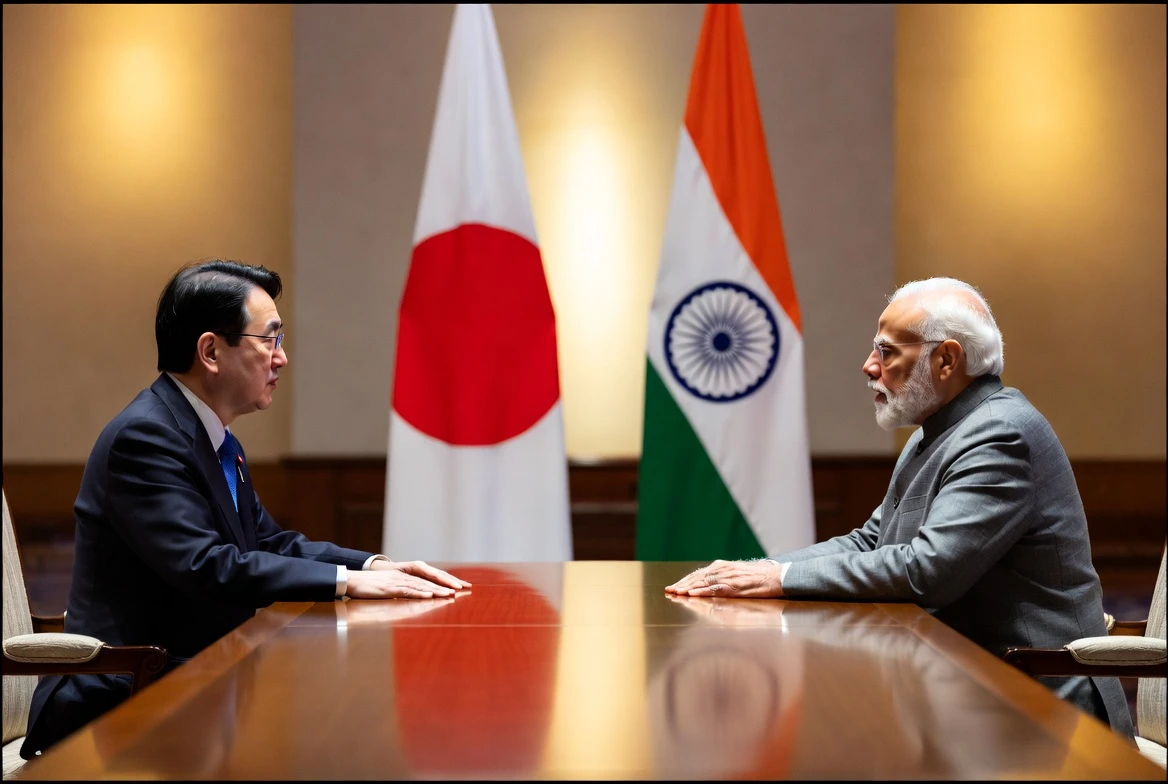
The 15th Annual Summit in Tokyo on August 29-30, 2025 was the larger container. Modi and Ishiba adopted the Joint Vision for the Next Decade, the framework through which the AI track was launched, alongside the JPY 10 trillion Japan-to-India private investment target that more than doubled the prior JPY 5 trillion commitment. Defense industrial cooperation, semiconductors, clean energy, and people-to-people ties were also on the table.
AI was given a launch vehicle of its own: the Japan-India AI Cooperation Initiative, or JAI. The mechanism to deliver JAI in concrete form was agreed three months later, in January 2026, when Foreign Minister Motegi traveled to New Delhi for the 18th Japan-India Foreign Ministers’ Strategic Dialogue. The Mumbai dialogue on April 21 was the first operational run, co-chaired on the Japanese side by Deputy Assistant Minister Takahiro Hanada of MOFA Japan and on the Indian side by Joint Secretary Amit A. Shukla of MEA’s Cyber Diplomacy desk. The Bengaluru session the next day moved the work into startup-level matchmaking. India’s August 2025 trip to Tokyo also produced an action plan to exchange 500,000 personnel between the two countries over five years, with 50,000 highly-skilled Indian personnel earmarked for Japan.
JAI runs across five operational lanes, listed in the MEA and MOFA readouts: co-creation of AI solutions in the industrial domain, joint research and academic exchanges, AI talent mobility, AI governance and policy coordination, and engagement in multilateral AI forums. The April dialogue ran all five. The next round in Japan will run under the same five-lane framework.
Companies on Both Sides of the Table
The Mumbai dialogue was closed-door, but the Bengaluru track on April 22 put faces to the framework. Japan’s MOFA listed the participating Japanese companies in alphabetical order: Aeterlink, EdgeCortix, Fujitsu Research of India Pvt. Ltd., HIGHRESO, I’mbesideyou, ONESTRUCTION, and Tier IV. India’s side fielded BharatGen and Sarvam, both developing domestic large language models, plus other unnamed participants. The MOFA readout described the closed-door work as constructive talks on concrete and practical collaboration possibilities. ONESTRUCTION’s MOU with DataKaveri Systems was the only signed output named in either ministry’s readout.
The matchups were deliberate and gave the dialogue a startup-to-startup output alongside the intergovernmental text. ONESTRUCTION, the Japanese construction-tech and AI startup, paired with DataKaveri Systems, the operator of the India Urban Data Exchange, per the MOFA readout. India put forward two LLM developers, with BharatGen and Sarvam each working on a domestic large language model. The remaining participants on each side were listed in each readout only as “and others.”
- Japan (per MOFA, alphabetical): Aeterlink, EdgeCortix, Fujitsu Research of India Pvt. Ltd., HIGHRESO, I’mbesideyou, ONESTRUCTION, Tier IV, and others.
- India (per MOFA, alphabetical): BharatGen, Sarvam (developing domestic large language models), and others.
- Signed MoU on sidelines: ONESTRUCTION, a Japanese construction-data and AI startup, with DataKaveri Systems Private Limited, the operator of the India Urban Data Exchange.
Semiconductors Sit Underneath the AI Push
The AI track sits on top of a deeper semiconductor partnership that has been running since 2023. India and Japan formalized their semiconductor supply chain cooperation through a Memorandum of Cooperation that year, since renewed with the India-Japan Digital Partnership 2.0 in 2025. Specific deals inside the framework now include Renesas Electronics’ Outsourced Semiconductor Assembly and Test facility in Gujarat, Tokyo Electron’s partnership with TATA Electronics, and collaborative design centers run under India’s Chips to Startup program.
Japan is separately investing more than JPY 10 trillion into domestic semiconductors and AI over seven years, per the Avasant report on the bilateral framework. Renesas’s Gujarat OSAT facility is the most visible cross-border deal, putting packaging and testing capacity on Indian soil. Tokyo Electron’s tie-up with TATA Electronics covers front-end process tooling. The Chips to Startup program, run by India’s Ministry of Electronics and Information Technology, sustains collaborative design centers around both flows.
- Renesas Electronics OSAT facility in Gujarat, putting packaging and testing capacity on Indian soil.
- Tokyo Electron partnership with TATA Electronics, covering front-end process tooling.
- Collaborative design centers under India’s Chips to Startup program, run by the Ministry of Electronics and Information Technology.
- 2023 Memorandum of Cooperation on semiconductor supply chain, since renewed with the India-Japan Digital Partnership 2.0 in 2025.
The combined flows give India packaging, design, and tooling capacity alongside Japanese process leadership. Renesas’s Gujarat facility, Tokyo Electron’s TATA partnership, and the design centers under Chips to Startup each address a separate layer of the value chain. India’s own AI data center buildout is the consumer that pulls all of it into production, per a recent assessment of the power math behind India’s AI infrastructure build.
The Yen-Rupee Settlement and a $27 Billion Trade
The trade base beneath the AI track is significant. India’s Ministry of Commerce data, posted by the Embassy of India in Tokyo, put bilateral trade at $27.47 billion for FY 2025-26: US$ 21.43 billion of Japanese exports to India and US$ 6.04 billion of Indian exports to Japan. India ranks 14th in Japan’s total trade with a 1.75% share and 8th in Japan’s total exports with a 2.61% share. Japan ranks 10th in India’s total trade and 21st in India’s total exports, per the FY 2025-26 trade figures and Japanese FDI data.
The yen-rupee settlement plan at this week’s summit is meant to lower friction in those flows. A proposed framework would allow direct yen-rupee settlement for bilateral trade and reduce reliance on dollar-routed payments. The summit agenda covers the local-currency mechanism alongside the AI track and the broader economic security declaration.
Key India-Japan figures
- US$ 27.47 billion: bilateral trade in FY 2025-26, per India’s Ministry of Commerce data posted by the Embassy of India in Tokyo.
- JPY 10 trillion: Japanese private investment target to India over the next decade, agreed at the 15th Annual Summit in August 2025.
- More than 150: business leaders traveling with Prime Minister Takaichi.
- Around 10: agreements expected to be finalised at this week’s summit.
- 81.5%: share of Japanese companies in India planning to expand local operations over the next 1-2 years, per a 2025 JETRO survey.
Tariffs and Hormuz Form the Backdrop
In the midst of increasing uncertainty in the international situation, the importance of collaboration with India, which shares fundamental values and strategic interests, is growing ever greater.
Takaichi said that at an informal press conference in Tokyo before flying to New Delhi. “With the participation of more than 150 individuals from Japan’s business community,” she added, “we aim to broaden the scope of Japan-India cooperation through public-private partnership and realize a strong economy.” The framing echoes Japan’s push to 2 percent of GDP on defence, formalized under her cabinet. The bilateral agenda has been crowded by external shocks, including a recent Strait of Hormuz crisis that pushed both economies toward alternative energy suppliers and accelerated food, fuel, and fertilizer inflation in India.
External pressure is also on the semiconductor and supply chain tracks. The Trump administration’s tariffs on Japan and India have hit both economies, with the ORF analysis describing the situation as one where “arbitrary tariffs imposed by the Trump administration” compound existing supply chain stress. Beijing’s grip on rare earths and other critical inputs has given Tokyo and New Delhi a shared reason to diversify. The Quadrilateral Security Dialogue framework, including a recent Quad Foreign Ministers’ Meeting in New Delhi, sets the regional backdrop.
Within that backdrop, the AI cooperation track serves a strategic purpose that the April dialogue text made clear. MOFA Japan’s readout said the AI track was needed amid “intensifying international competition in the field of advanced technologies.” The January 2026 agreement to set up the dialogue included specific mentions of AI cooperation in third countries. The next round of the dialogue is scheduled in Japan, which both sides have signaled is the binding track of the JAI framework.
What This Week’s Summit Is Set to Produce
The deliverables for this week run broader than the AI track alone. India and Japan are expected to unveil a joint declaration on economic security cooperation and a separate joint statement on collaboration in artificial intelligence, per people familiar with the discussions. Around 10 agreements are also expected to be finalised across defence, semiconductors, critical minerals, pharmaceuticals, and skill mobility.
Takaichi’s itinerary runs from a ceremonial reception at Rashtrapati Bhavan to summit talks with Modi and a joint economic forum with business leaders from both countries. The next round of the AI Strategic Dialogue will be held in Japan at dates to be set, the MEA readout confirmed. Beyond this summit, the JAI architecture sits as the binding thread: a JPY 10 trillion investment target, a 500,000-personnel exchange plan, semiconductor MoC flows, and an industrial-AI dialogue that has now produced its first startup-level MoU.
Frequently Asked Questions
What is the India-Japan AI Strategic Dialogue?
It is the bilateral mechanism set up under the Japan-India AI Cooperation Initiative (JAI) to coordinate AI policy, industrial AI co-creation, talent mobility, joint research, and governance between New Delhi and Tokyo. The dialogue is co-chaired on the Indian side by the Ministry of External Affairs’ Cyber Diplomacy division and on the Japanese side by the Ministry of Foreign Affairs’ deputy assistant minister for cyber security, with the first session held on April 21, 2026.
When did the first India-Japan AI Strategic Dialogue take place?
It was held on April 21 in Mumbai, with a Bengaluru startup-level networking session on April 22. Both governments agreed at the close to convene the next round of the dialogue in Japan at dates yet to be set.
What is the Japan-India AI Cooperation Initiative (JAI)?
JAI is the umbrella framework that the two prime ministers agreed to launch during Prime Minister Modi’s visit to Tokyo in August 2025. It runs across five cooperation lanes: industrial AI solutions, joint research, AI talent mobility, AI governance, and engagement in multilateral AI forums.
Which companies attended the Bengaluru AI session?
Japan’s MOFA readout named seven Japanese companies in alphabetical order: Aeterlink, EdgeCortix, Fujitsu Research of India Pvt. Ltd., HIGHRESO, I’mbesideyou, ONESTRUCTION, and Tier IV. India’s side listed BharatGen and Sarvam, both developing domestic large language models. The session also produced an MOU between ONESTRUCTION and DataKaveri Systems, the operator of the India Urban Data Exchange.
What is the JPY 10 trillion investment target?
It is the Japan-to-India private investment commitment the two prime ministers agreed to at the 15th Annual Summit in Tokyo on August 29-30, 2025. The target covers the next decade and more than doubles an earlier JPY 5 trillion commitment that was achieved in three years.


Samsung’s Galaxy A27 Price Jump Traces Back to a Chip Shortage

ZOTAC RTX 5090 SOLID Catches Fire Near the PCIe Slot, Not the Cable

StepFun’s STEPX Neo Debuts as an AI Phone With Doubao’s Old Problem

Halo Studios Cancels Project Ekur Amid Leadership Abuse Claims

Sandisk Stock Sinks 8% as Wall Street Keeps Raising Price Targets

VCT Pacific Bans Crypto Sponsors, but Riot Keeps One Exception

A New 133-Study Review Finds Video Games Boost the Brain, Barely

XRP Tests $1 Support a Year After Ripple’s SEC Victory

Sierra’s Pay-Per-Result AI Bet Comes With a Rising Token Bill

Audiera’s BEAT Nears $3 Again as Its Supply Echoes LAB and RAVE

Microsoft Xbox Layoffs Start in July as Sharma Slams 3% Margin

Google Search Profiles Build a Follow Graph Inside Discover

Oracle Cuts 21,000 Jobs in a Year, Cites AI in 10-K Filing

Oppo’s ColorOS 17 Eligibility List Leaves A-Series Buyers Behind

Google DeepMind and A24 Sign $75 Million AI Partnership Deal

OCC Issues AML Consent Order Against Wise and Crypto.com Sponsor Bank

Meta’s Iris AI Chip Enters Production in September, Tests Clean

DGO App Brings Rs 549 Mobile Pass for FIFA World Cup 2026 in Nepal

Anthropic Tells Senators Alibaba Ran the Largest Claude Distillation Attack

Apple Strikes Preliminary Deal For Intel To Make iPhone And Mac Chips
-
 GAMING1 month ago
Microsoft Xbox Layoffs Start in July as Sharma Slams 3% Margin
-
 NEWS1 month ago
Google Search Profiles Build a Follow Graph Inside Discover
-
 AI3 weeks ago
Oracle Cuts 21,000 Jobs in a Year, Cites AI in 10-K Filing
-
 NEWS1 month ago
Oppo’s ColorOS 17 Eligibility List Leaves A-Series Buyers Behind
-
 AI3 weeks ago
Google DeepMind and A24 Sign $75 Million AI Partnership Deal
-
 CRYPTO2 months ago
OCC Issues AML Consent Order Against Wise and Crypto.com Sponsor Bank
-
 AI4 days ago
Meta’s Iris AI Chip Enters Production in September, Tests Clean
-
 APPS1 month ago
DGO App Brings Rs 549 Mobile Pass for FIFA World Cup 2026 in Nepal